
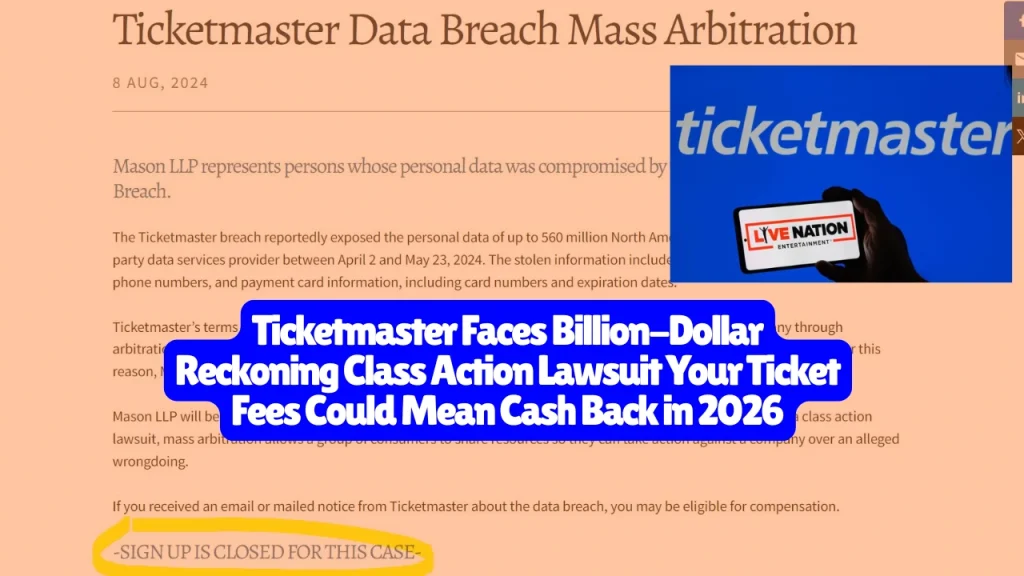
Ticketmaster Faces Billion-Dollar Reckoning Class Action Lawsuit Your Ticket Fees Could Mean Cash Back in 2026
If you bought concert tickets through Ticketmaster since 2010, you’re likely part of a massive class action that could deliver actual money—not just discount codes—after a federal judge certified nationwide claims in December 2025. Here’s the bottom line: Multiple lawsuits claim Ticketmaster illegally hid fees that inflated your ticket prices by 24% to 44%, and trials begin in March 2026. No settlement exists yet, but if plaintiffs win, damages could reach billions with potential treble damages under antitrust law.
Sarah Martinez thought she was paying $85 for Taylor Swift tickets in 2022. By checkout, the price hit $122. “I felt trapped,” she told reporters. “The clock was ticking down, and I’d already invested 20 minutes selecting seats.”
Sarah isn’t alone. She’s one of tens of millions of Americans potentially covered by class action lawsuits now steamrolling toward Ticketmaster—and this time, the legal ammunition is different.
What Makes the 2026 Lawsuits Different From Past Ticketmaster Settlements
Remember Ticketmaster’s $400 million settlement from 2016? Class members got discount codes worth $2.25 per ticket—basically forcing you to buy more tickets to get your “refund.”
The 2026 cases operate on entirely different legal grounds. On December 12, 2025, Judge George H. Wu certified a nationwide antitrust class action covering anyone who bought primary tickets through Ticketmaster at major U.S. venues since 2010. That’s roughly 400 million ticket purchases spanning 15 years.
Antitrust claims carry treble damages—meaning if a jury finds Ticketmaster caused $1 billion in overcharges, damages automatically triple to $3 billion. Real money. Not vouchers.
Attorney Mark Ankcorn, representing the plaintiffs, stated the certification ruling positions the case to proceed with classwide evidence and classwide recovery.
A separate lawsuit filed by Michelle Madrigal in March 2025 attacks the hidden fee practices under state consumer protection laws in California, Florida, Illinois, and New York. That case goes to jury trial on June 30, 2026.
And then there’s the government assault: The Department of Justice, backed by 40 state attorneys general, filed a civil antitrust lawsuit seeking to break up Live Nation and Ticketmaster entirely. Trial begins March 2, 2026.
The “Drip Pricing” Scheme Courts Are Targeting
Pull up Ticketmaster’s website. Search for a concert. You see an attractive price—let’s say $100.
You select seats. You enter payment info. Only at the final checkout screen does the real price appear: $144.
The extra $44 comes from:
- Service fee: $15.50
- Facility charge: $12.50
- Order processing fee: $8
- Convenience fee: $8
Meanwhile, an eight-minute countdown clock ticks in the corner. Pop-ups warn “other fans are viewing these seats.” You’ve already invested time. The pressure mounts.
Plaintiffs call this “drip pricing”—advertising a low price, then dripping in mandatory fees at the point when consumers are psychologically committed.
Internal Ticketmaster documents expose the strategy. A 2015 executive study concluded: “The less transparent the higher the conversion. This means we’re headed towards less transparency.”
Translation: Hiding fees makes Ticketmaster more money.
How Much Money Are We Talking About?
No settlement exists, so there’s no definitive answer yet. But the numbers tell a story.
Live Nation collected fees on 329 million tickets in 2023 alone. Court documents allege Ticketmaster charged fees on approximately 1 billion tickets during the proposed class period.
If average fees were $20 per ticket (a conservative estimate given the 24%-44% markup range), total fees exceed $20 billion. Under treble damages, potential liability could theoretically reach $60 billion.
The reality will likely be smaller—courts consider what companies can actually pay without bankruptcy. But even a 10% settlement of the theoretical maximum would mean $6 billion distributed to class members.
Compare that to the Canadian settlement approved in January 2025: Ticketmaster agreed to pay CA$6 million for similar hidden fee allegations covering tickets purchased from 2015-2018. Eligible Canadian buyers received vouchers worth up to CA$45 each.
The U.S. cases cover a longer time period, involve more tickets, and include powerful antitrust claims the Canadian case lacked.
Related article: Subnautica 2 Lawsuit, The $250M Corporate Case You Can’t Join (Here’s the Truth)
Who’s Behind the Lawsuits—And What They’re Claiming
The Madrigal Hidden Fees Case (California Federal Court)
Michelle Madrigal, along with plaintiffs from Florida, New York, and Illinois, filed this lawsuit in March 2025. They claim Ticketmaster’s pricing tactics violate:
- California Consumer Legal Remedies Act
- Illinois Consumer Fraud and Deceptive Business Practices Act
- Florida Deceptive and Unfair Trade Practices Act
- New York General Business Law
- California Unfair Competition Law
Judge John F. Walter denied Ticketmaster’s motion to dismiss in August 2025, finding the allegations describe potentially actionable deceptive practices. Jury trial: June 30, 2026.
The Nationwide Antitrust Class Action
Lead plaintiff Skot Heckman filed this lawsuit in January 2022, alleging Live Nation and Ticketmaster unlawfully monopolized primary ticketing services and used that power to impose supracompetitive fees.
The breakthrough came December 12, 2025, when Judge Wu certified a nationwide class covering U.S. consumers who bought primary tickets and paid fees at major venues through Ticketmaster since 2010.
Ticketmaster argued that individualized issues involving tickets at 1,000 venues made class certification impossible. The judge rejected this argument.
The DOJ Antitrust Lawsuit
Filed May 23, 2024, this government action seeks structural relief—potentially forcing Live Nation to divest Ticketmaster and end the merger that created the entertainment giant in 2010.
Assistant Attorney General Jonathan Kanter stated: “The live music industry in America is broken because Live Nation-Ticketmaster has an illegal monopoly.”
Judge Arun Subramanian denied Live Nation’s motion to dismiss on March 14, 2025. Trial: March 2, 2026.
The FTC Consumer Protection Case
On September 17, 2025, the Federal Trade Commission and seven states sued for violations of the FTC Act and the Better Online Ticket Sales (BOTS) Act.
The FTC alleges Ticketmaster deceived consumers about prices, enabled ticket brokers to violate purchase limits, and “triple dipped” by profiting from the primary sale, the resale, and the final purchase of resold tickets.
What Internal Documents Reveal
Discovery has unearthed damaging evidence.
On price transparency: A senior Ticketmaster executive admitted in 2015 internal review: “The less transparent the higher the conversion. This means we’re headed towards less transparency.”
On ticket brokers: Internal emails show executives admitting the company “turn a blind eye as a matter of policy” to brokers’ violations of ticket limits.
An internal review found just five brokers controlled 6,345 Ticketmaster accounts and possessed 246,407 tickets to 2,594 events.
On the countdown clock: Plaintiffs allege Ticketmaster’s website employs “digital dark patterns” including countdown timers designed to pressure buyers into hasty decisions.
On verification systems: In 2021, Ticketmaster opted against using third-party identity verification because it was “too effective” and could hurt revenue.
Ticketmaster’s Defense Strategy—And Why It’s Failing
Live Nation and Ticketmaster deny all wrongdoing.
Their primary defense: Venues, not Ticketmaster, set the fees. They claim they simply pass through charges determined by facility owners on a show-by-show basis.
But internal documents undercut this argument. The FTC alleges Ticketmaster offers brokers technological support through a software platform called TradeDesk, which helps brokers manage tickets purchased from multiple accounts.
Ticketmaster also tried forcing customers into private arbitration. The U.S. Supreme Court declined to hear their appeal in October 2025, clearing the way for court proceedings.
Judge Walter’s decision letting the Madrigal case proceed noted: “The allegations, if true, describe a potentially actionable deceptive practice.”
Judge Wu’s class certification ruling rejected Ticketmaster’s arguments about individualized issues, finding commonality across the nationwide class.
Am I Part of the Class Action? A Simple Test
You’re likely covered by the nationwide antitrust class if:
- You purchased primary tickets through Ticketmaster or a Live Nation affiliate
- The event was at a major concert venue in the United States
- You made purchases anytime from 2010 to present
- You paid service fees added to the base ticket price
You may have additional claims under the Madrigal case if:
- You reside in California, New York, Illinois, or Florida
- You purchased tickets during relevant time periods
One important exception: The class definition excludes anyone “judicially determined in this case” to have an enforceable arbitration agreement with Ticketmaster. Most consumers won’t fall into this category after the Supreme Court’s October 2025 decision.
What You Should Do Right Now
Step 1: Gather Your Documentation
- Search your email for Ticketmaster purchase confirmations since 2010
- Download receipts showing base prices vs. final prices paid
- Take screenshots of your Ticketmaster account purchase history
- Save any communications about price differences
Step 2: Monitor Case Developments
Bookmark these resources:
- Court docket: Madrigal v. Ticketmaster (Case No. 2:25-cv-02375)
- Heckman v. Live Nation antitrust case
- Settlement administrator websites (will be announced if settlements occur)
Step 3: Don’t File Your Own Claim Yet
Class actions haven’t reached settlement. No claims process exists. Anyone telling you to submit claims now is likely running a scam.
Step 4: Watch for Official Notice
If settlement occurs or judgment enters, courts will approve a claims administrator who will send official notice by email or mail. That notice will explain:
- Exact eligibility criteria
- How to submit claim forms
- Required documentation
- Claims deadline
- Estimated payout amounts
The Timeline: What Happens Next in 2026
February 17, 2026: Final pretrial conference in DOJ antitrust case
March 2, 2026: DOJ antitrust trial begins in New York federal court. This will be the most high-profile antitrust case since government actions against Microsoft and Google.
June 5, 2026: Pretrial conference in Madrigal hidden fees case
June 12, 2026: Hearings on motions in limine (what evidence can be presented) in Madrigal case
June 30, 2026: Jury trial begins in Madrigal v. Ticketmaster
Throughout 2026: Discovery continues in certified nationwide antitrust class action. Expect document releases revealing more internal Ticketmaster practices.
Settlement negotiations: Class certification dramatically increases pressure on Live Nation to settle. With multiple trials scheduled and potential billion-dollar verdicts looming, settlement discussions are likely happening behind the scenes.
What’s Different About These Cases—Legal Firepower
Previous Ticketmaster settlements involved limited claims about specific fee categories over narrow time periods.
The 2026 legal assault operates differently:
Federal antitrust claims: Sherman Act violations carry treble damages and can result in structural remedies like forced breakups.
Government backing: The DOJ and 40 state attorneys general provide resources individual plaintiffs can’t match.
Extended time period: The certified class covers 15 years of purchases, exponentially increasing potential damages.
Internal documents: Discovery has produced smoking-gun evidence of intentional fee concealment and broker facilitation.
Regulatory momentum: All-in pricing laws are spreading. California, Colorado, and Minnesota now require upfront fee disclosure. Federal legislation is pending.
Public pressure: The 2022 Taylor Swift ticketing disaster triggered congressional hearings and accelerated scrutiny.
The Precedent: How Similar Cases Ended
Stubhub (2015): After California sued for drip pricing, Stubhub agreed to display total prices upfront. No cash settlement—just changed practices.
Airbnb (2018): Following pressure about hidden cleaning fees, Airbnb began showing total prices earlier in the booking process.
Concert promotion antitrust cases (various): Most settled for structural changes rather than massive cash payouts—defendants agreed to stop exclusive dealing arrangements.
The Ticketmaster precedent (2016): The $400 million settlement sounds big, but class members received $2.25 discount codes per ticket. The settlement forced consumers to buy more tickets to realize any benefit.
What Makes 2026 Different: The Perfect Storm
Multiple factors converge to create unprecedented pressure:
- Class certification achieved: Judge Wu’s December 2025 ruling is a game-changer
- Government involvement: DOJ resources and enforcement power exceed private plaintiff capabilities
- Multiple lawsuits: Ticketmaster faces simultaneous assaults—federal antitrust, state consumer protection, FTC enforcement, and private class actions
- Internal evidence: Discovery has produced damaging documents executives wish stayed buried
- Public awareness: Social media amplifies consumer anger in ways that didn’t exist during prior settlements
- Regulatory change: States are enacting all-in pricing laws, showing political momentum for reform
- Financial exposure: Potential damages under treble damages provisions could reach tens of billions
The Questions Everyone’s Asking
Q: When will I receive money?
Realistically, not before late 2026 at the earliest, possibly years longer if cases go through trials and appeals. The Schlesinger case filed in 2003 didn’t pay out until 2016.
Q: How much will I get per ticket?
Unknown. It depends on settlement amounts or jury verdicts, number of class members filing claims, and administrative costs. Past settlements ranged from $2.25 discount codes to the Canadian vouchers worth up to CA$45.
Q: Is this only discount codes again?
Not necessarily. The certified antitrust class action seeks monetary damages—real money. State consumer protection claims also typically provide cash relief. But settlement terms are negotiated, not guaranteed.
Q: Can I opt out and sue individually?
Yes, when official class notice goes out, you’ll have a window to exclude yourself and pursue your own lawsuit. Most people don’t—individual lawsuits are expensive and time-consuming.
Q: Do I need to hire a lawyer?
No. Class counsel handles everything and gets paid from any settlement or judgment. You don’t pay attorney fees unless you opt out to file your own case.
Q: What if I bought tickets for out-of-state events?
You’re still covered by the nationwide class action as long as purchases were made through Ticketmaster for events at major U.S. venues.
Q: What about international events?
The certified U.S. class covers U.S. venues only. Canada had a separate lawsuit that settled in January 2025 for CA$6 million.
Q: Could Ticketmaster go bankrupt?
Extremely unlikely. Live Nation is a $38 billion company. Even massive damages wouldn’t trigger bankruptcy, though it could force divestiture of Ticketmaster.
Q: Will ticket prices go down if the government wins?
Possibly. Breaking up Live Nation and Ticketmaster would increase competition. But venues and artists also influence pricing, so effects may vary.
The Bigger Picture: What This Means for Live Entertainment
These lawsuits could fundamentally reshape how Americans buy tickets.
If the DOJ prevails: The government seeks to break up Live Nation and Ticketmaster. This would restore competition not seen since before the 2010 merger. Rival platforms like SeatGeek, Vivid Seats, and AXS could compete for venue contracts.
If consumers win: Billion-dollar damages would send a clear message: hidden fees carry real consequences. The industry would accelerate adoption of all-in pricing to avoid future liability.
If settlements occur: Live Nation might agree to structural changes—ending exclusive venue contracts, providing data transparency, enabling competition—in exchange for damage caps.
Tennessee Attorney General Jonathan Skrmetti made clear that state attorneys general will continue the fight even if federal priorities shift, stating they’ll proceed with the March 2026 trial regardless of DOJ participation.
The Human Cost Behind the Numbers
The lawsuits describe more than financial harm. They capture frustration millions of fans experience.
Emily Rodriguez, a nurse from Chicago, saved for months to take her daughter to see Olivia Rodrigo. “I budgeted $200 for two tickets based on the listed price,” she explained. “At checkout, it was $287. I almost didn’t buy them, but how do you tell your 12-year-old we can’t go?”
Marcus Chen, a college student, described the countdown pressure: “You’re watching the clock tick down, there’s a pop-up saying other people are viewing your seats, and suddenly you’re clicking ‘buy’ without even processing the final price.”
These experiences—repeated millions of times across years—form the foundation of the lawsuits.
What Legal Experts Are Saying
Kathleen Bradish, vice president and director of legal advocacy for the American Antitrust Institute, told reporters: “The likelihood that the consumer action will succeed has gone up significantly. Once you pass the motion to dismiss, that really makes it consequential for the company to keep doing the practice.”
Professor Rebecca Allensworth, who teaches antitrust law at Vanderbilt, noted: “Class certification substantially raises the stakes because it positions the case to proceed with classwide evidence and classwide potential recovery.”
Former FTC official William Kovacic observed that simultaneous government and private enforcement creates maximum pressure: “Companies facing multiple lawsuits with overlapping claims often seek global settlements to achieve finality.”
Your Action Plan: Month by Month
January 2026: Gather all documentation. Search emails, download receipts, take account screenshots.
February-March 2026: Watch news coverage of DOJ trial. Outcomes could influence settlement negotiations in other cases.
April-May 2026: Monitor for settlement announcements. If Live Nation settles the DOJ case, consumer settlements may follow quickly.
June 2026: Follow Madrigal trial. Jury verdicts often trigger settlement discussions.
July-December 2026: Watch for official class notice. Claims administration processes typically launch 60-180 days after settlement approval or judgment entry.
2027 and beyond: Be patient. Complex class actions take time. The Schlesinger case took 13 years from filing to payout.
The Bottom Line: Is This Time Different?
Ticketmaster has weathered lawsuits before. The company settled the Schlesinger case with discount codes. Canadian consumers received vouchers. Past cases resulted in minor changes to website language.
But three factors make 2026 different:
Legal momentum: A federal judge certified a nationwide antitrust class action—a procedural victory that dramatically increases pressure.
Government power: The DOJ brings resources and remedies private plaintiffs can’t match, including the ability to break up companies.
Financial exposure: Previous settlements involved narrow claims over limited periods. The certified class covers 15 years and 400 million purchases. Under treble damages, potential liability reaches into the tens of billions.
Live Nation President Joe Berchtold hinted at settlement possibilities, suggesting solutions could involve ending venues’ exclusive right to auction ticketing services.
That’s the language of negotiation—not defiance.
What You Need to Remember
- You don’t need to do anything right now except preserve documentation
- No legitimate claims process exists yet—beware of scams
- Official notice will come via email or mail from court-approved administrators
- This involves real potential for cash damages, not just discount codes
- Trials begin in March 2026, with major developments expected throughout the year
- You don’t need a lawyer—class counsel handles everything
- The cases cover purchases since 2010 at major U.S. venues
- Patience is required—final resolution may take years
For now, the most important action is documentation. Your email receipts showing the price jump from search to checkout could be the evidence that strengthens the class claims.
The countdown clock Ticketmaster used to pressure millions of purchases is now ticking for the company itself. By year’s end, we’ll know whether this legal assault forces fundamental industry change—or whether, once again, consumers get discount codes and Ticketmaster continues business as usual.
One thing is certain: 2026 will be the most consequential year in Ticketmaster’s legal history.
About the Author

Sarah Klein, JD, is a licensed attorney and legal content strategist with over 12 years of experience across civil, criminal, family, and regulatory law. At All About Lawyer, she covers a wide range of legal topics — from high-profile lawsuits and courtroom stories to state traffic laws and everyday legal questions — all with a focus on accuracy, clarity, and public understanding.
Her writing blends real legal insight with plain-English explanations, helping readers stay informed and legally aware.
Read more about Sarah