
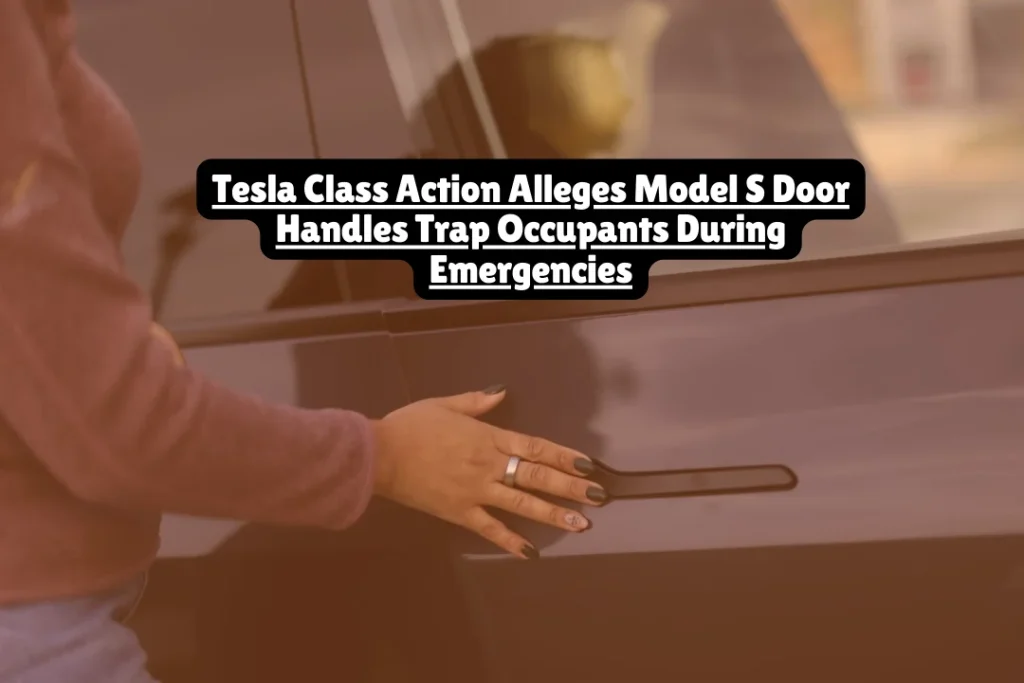
Tesla Class Action Alleges Model S Door Handles Trap Occupants During Emergencies
A proposed class action lawsuit filed February 13, 2026, against Tesla, Inc. alleges that 2023–2026 Model S vehicles contain a material safety defect: electronically actuated door handles that can trap occupants inside the vehicle during a crash, power loss, or fire. The 36-page filing charges that the electric vehicle’s electronically activated door handle design renders the Model S “not reasonably escapable and not reasonably rescuable” in the event of a collision that causes a loss of low-voltage power, or an emergency system shutdown, particularly for drivers and passengers attempting to exit the rear of the vehicle.
The case is Hyde v. Tesla Inc., No. 3:26-cv-00942-BJC-MMP, filed in the U.S. District Court for the Central District of California. No settlement has been reached. The lawsuit is in its early litigation phase.
Quick Facts
| Detail | Information |
| Lawsuit Type | Proposed Class Action — Product Defect / Consumer Protection |
| Defendant | Tesla, Inc. |
| Case Name | Hyde v. Tesla Inc., No. 3:26-cv-00942-BJC-MMP |
| Court | U.S. District Court, Central District of California |
| Date Filed | February 13, 2026 |
| Plaintiff’s Counsel | Kazerouni Law Group APC |
| Current Status | Proposed Class Action — Litigation Phase (No Settlement) |
| Who May Be Affected | California residents who purchased or leased a 2023–2026 Tesla Model S |
| Settlement Amount | None — litigation is ongoing |
| Claim Deadline | TBD — no settlement or claim process exists yet |
| Official Settlement Website | None — case has not settled |
Current Status and What Happens Next
This lawsuit is in its earliest stage. Plaintiff Robert L. Hyde filed the complaint on February 13, 2026, and the court has not yet certified the case as a class action. No settlement has been proposed or approved.
Here is where the case stands:
- Filed: February 13, 2026, U.S. District Court, Central District of California
- Class certification: Not yet filed or granted
- Settlement: None — litigation-phase case only
- Claim filing: No claim process is available at this time
- NHTSA: A federal safety investigation into Tesla’s electronic door handle design is currently active and widening
- Next steps: Tesla will have the opportunity to respond to the complaint; the court will later consider whether to certify a class
Consumers cannot file a claim or receive compensation at this time. This article will be updated as the case develops.
What the Lawsuit Alleges
The Core Defect: Electronics Over Safety
According to the Tesla class action, both the interior and exterior door handles require electronic latch actuation to function. In the event of a crash or battery failure — foreseeable events for any vehicle — the flush-mounted exterior handles may fail to extend, preventing first responders from reaching those inside.
Should a Tesla Model S lose power, the exterior door handles will fail to extend and actuate, meaning the doors cannot be opened from the outside, and the interior door handle latches will also fail to actuate. This creates a scenario where a person inside the vehicle after a crash cannot get out, and a first responder outside cannot get in — without breaking a window.
Rear Passengers Are the Most Vulnerable
The lawsuit draws a sharp distinction between the front and rear door designs. The Model S interior rear door handles do not have the same readily accessible manual emergency release mechanism as the interior front door handles. Should a Tesla Model S lose power, the rear interior door handles can only be opened manually by folding back the carpet below the rear seats to expose the mechanical release cable, which the filing argues is “not reasonably discoverable or usable by an average occupant under emergency conditions.”
The class action contends that this design is inherently flawed and potentially dangerous, given that the cables are “not reasonably discoverable” by an average passenger, especially during the panic and stress of an emergency. A passenger would need to be “intimately familiar” with the Model S design to find the emergency release for the rear interior door handles.
The filing puts the risk in stark terms: “Even though there is a hidden cable underneath the rear seat carpet, if the passenger is unaware of it, [is] unable or does not know how to pull that emergency manual release, there is no way to quickly enter the vehicle from the outside in the instance of a battery failure other than breaking the windows.”
Related article: $60.5M Tinder Plus and Gold Age Discrimination Settlement, Who Is Eligible and How to Get Paid
Vulnerable Populations at Heightened Risk
The allegedly defective Tesla door handles pose a significantly higher safety risk for pets, children, the elderly, and individuals with disabilities who may not be able to locate or use the cable.
Hyde further argues that the current manual release process is “tedious” and nearly impossible for children, the elderly or the disabled to perform during a life-threatening emergency.
Tesla Allegedly Knew and Did Nothing
Hyde alleges that Tesla has long been aware of these defects through customer complaints and public reports but has failed to rectify the issue or warn consumers.
Tesla has “distorted” the value of its vehicles by misrepresenting them as suitable for everyday use, despite the significant safety risks posed by the defective door handles. Every individual who purchased a Tesla Model S from 2023 onward received a vehicle at a higher price and with a markedly lower value than what they were led to believe.
Financial Harm to Consumers
The lawsuit does not only address physical safety. The suit also contends that 2023-present Tesla Model S vehicles are worth less than consumers paid due to the door handle problems. The complaint argues that had Tesla disclosed the design’s limitations, reasonable consumers would have reconsidered their purchase decision.
Who Could Be Included
The Tesla Model S class action lawsuit seeks to represent all California residents who purchased and still own, or lease/leased, at least one 2023–2026 model year Tesla Model S vehicle.
In plain terms, the proposed class covers:
- Who: California residents only (at this stage)
- Vehicle: 2023, 2024, 2025, or 2026 model year Tesla Model S
- Purchase or lease: Both owners and lessees are included
- Current ownership: Individuals who still own the vehicle and those who previously leased one
- Exclusion: Purchases on secondary markets may be subject to additional review during litigation
The class has not been certified by a court. Class certification is a separate legal step that comes later in litigation, and the precise boundaries of who qualifies will be defined at that stage.
Prior Cases and Industry Context
The Hyde lawsuit is the latest in a growing body of legal challenges targeting Tesla’s electronic door handle design across multiple vehicle models.
Fatal Incidents Driving Legal Pressure
By Bloomberg’s count, 15 people have died due to Tesla’s door handle design. Multiple lawsuits allege accidents where people were trapped in Teslas, though not all fatal. Similar lawsuits have been filed over a crash where three teenagers died in a Cybertruck and another where five occupants died in a Model S, all involving a collision with a tree, a fire, and inoperable interior door handles.
A 2024 crash in Wisconsin claimed the lives of five people inside a 2016 Model S after the vehicle struck a tree and caught fire. A nearby resident heard screams for several minutes after the crash but was unable to assist due to the rapidly spreading fire.
The complaint cites a fatal incident involving a Model Y with similar design features, alleging the driver died in a vehicle fire after being unable to manually open the doors.
NHTSA Investigation
Just weeks before the lawsuit’s filing, the National Highway Traffic Safety Administration (NHTSA) launched an investigation into Tesla’s emergency door release mechanisms. The probe, initiated after a defect petition, focuses on whether the mechanical overrides in Tesla models are sufficiently accessible and labeled.
Tesla itself admitted that the system should be changed and recently announced that it’s working on an improved door release system. In September 2026, Tesla design chief Franz von Holzhausen stated that Tesla is looking to combine its electronic and manual door-release mechanisms into one button to make the handles more intuitive for occupants “in a panic situation.”
China Bans the Design
Chinese regulators finalized a ban on Tesla-style electronic door handles in early 2026. The Chinese regulation requires that all vehicles with electronic actuators have mechanical fallbacks in the event of electrical failure.
Proposed U.S. Legislation
U.S. lawmakers are pushing back against electronic door handles altogether. A bill introduced to Congress, dubbed the SAFE Exit Act, aims to mandate easily identifiable manual door releases on all new vehicles, directly targeting designs popularized by Tesla.
Prior Tesla Door Handle Lawsuit
A prior lawsuit involving Model S door handles for earlier model years similarly alleged that the defective design created a “significant safety risk” and that Tesla “knew or should have known” about the problem. That case noted that Model S door handles after the 2016 model year were redesigned, which the complainant argued demonstrated Tesla’s awareness of the original design’s flaws.
Frequently Asked Questions
Is this a class action lawsuit?
It is a proposed class action. Plaintiff Robert L. Hyde filed the complaint on February 13, 2026, in the U.S. District Court for the Central District of California. A judge has not yet certified it as a class action — that is a separate legal step that comes later in the litigation process.
Has a settlement been announced?
No. As of March 2026, no settlement has been proposed or approved. This is a litigation-phase case and no claim filing process currently exists.
Who may be eligible if a settlement is reached?
The Tesla Model S class action lawsuit seeks to represent all California residents who purchased and still own, or lease/leased, at least one 2023–2026 model year Tesla Model S vehicle. Eligibility will be formally defined if and when the court certifies a class or a settlement is reached.
What exactly is the alleged defect?
Both the interior and exterior door handles on the 2023–2026 Model S require electronic latch actuation to function. In a crash or power-loss scenario, the exterior handles fail to extend and the interior latches fail to actuate. Rear passengers face additional risk because their manual emergency release is a hidden cable beneath the rear seat carpet, which the lawsuit argues is not reasonably discoverable during an emergency.
Is there a claim form I can file right now?
No. Because no settlement exists, there is no claim form or official settlement website. Consumers do not need to take any action at this stage to be included in the case if it eventually settles.
What does Tesla say?
Tesla has not publicly commented on the Hyde class action specifically. However, Tesla has admitted that the system should be changed and has announced it is working on an improved door release system. Tesla has not admitted any wrongdoing in this or related cases.
Is my Tesla Model S safe to drive?
No recall has been issued by NHTSA for the 2023–2026 Model S door handle design as of the date of this article. However, the NHTSA investigation is ongoing. Consumers with concerns about their vehicle’s emergency door release mechanism should consult their owner’s manual and contact Tesla directly or visit the NHTSA website at nhtsa.gov to review any active safety notices.
What happens next in this case?
Tesla will be served with the complaint and will have the opportunity to respond. If the case survives any motions to dismiss, the plaintiff will seek class certification. A settlement could be reached at any point during this process. This article will be updated as developments occur.
Additional Context
The design controversy surrounding Tesla’s electronic door handles extends well beyond this single lawsuit. Tesla engineers went in the direction of automation and overlooked what happens to the human body after a crash, according to Charles Mauro, founder of Mauro Usability Science, a New York consulting firm specializing in human factors engineering. “Musk’s idea is a computer on wheels, but the design of the door locks was overlooked.”
Tesla has confirmed that it is finally redesigning its handles, but has not disclosed when that fix will be available to existing owners. Meanwhile, the Hyde lawsuit represents both a safety claim and a financial one — arguing that consumers paid a premium for a vehicle whose design limitations Tesla never disclosed at the point of sale.
This article will be updated if a settlement is reached, a class is certified, or further developments occur in Hyde v. Tesla Inc.
Last Updated: March 4, 2026
Disclaimer: This article is for informational purposes only and does not constitute legal advice. Legal claims and outcomes depend on specific facts and applicable law. For advice regarding a particular situation, consult a qualified attorney.
About the Author

Sarah Klein, JD, is a licensed attorney and legal content strategist with over 12 years of experience across civil, criminal, family, and regulatory law. At All About Lawyer, she covers a wide range of legal topics — from high-profile lawsuits and courtroom stories to state traffic laws and everyday legal questions — all with a focus on accuracy, clarity, and public understanding.
Her writing blends real legal insight with plain-English explanations, helping readers stay informed and legally aware.
Read more about Sarah