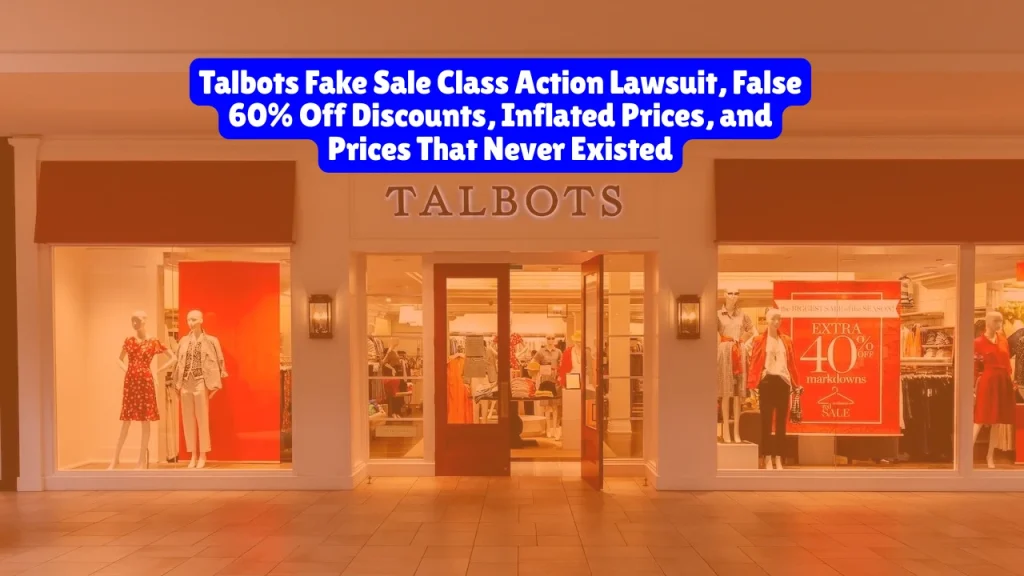
Talbots Fake Sale Class Action Lawsuit, False 60% Off Discounts, Inflated Prices, and Prices That Never Existed
Talbots faces multiple class action lawsuits alleging the company uses artificially inflated “original” prices to create fake discounts on clothing and accessories. The most recent lawsuit (December 2024) claims Talbots’ online store displays strikethrough “regular” prices that products were never actually sold at, making discounts appear larger than they are.
An earlier 2017 lawsuit targeting California outlet stores alleges products marked with purported 60% discounts were never sold at their “original” prices—and that outlet merchandise is lower-quality goods manufactured specifically for outlets, not regular-store items on sale. The lawsuits assert claims for false advertising, consumer fraud, unjust enrichment, and violations of California consumer protection laws. California consumers who purchased Talbots products advertised with discounts may be eligible to join class actions seeking refunds and damages.
Two-thirds of consumers admit that a promotion or coupon “often closes the deal” when they’re wavering on a purchase. Retailers know this—and some allegedly exploit it by inventing fake “original” prices to make sales look irresistible.
The December 2024 Online Store Lawsuit
The newest Talbots lawsuit targets the company’s website pricing practices.
Filed: December 16, 2024
Court: Federal court (specific court not yet disclosed)
Pages: 61-page complaint
How the Alleged Scam Works
According to the lawsuit, Talbots’ website displays products with:
- A strikethrough “original” price
- A lower “sale” price
- Prominent discount percentages
But those “original” prices are allegedly artificially inflated—the products were never actually sold at those prices.
The lawsuit contends that items listed on Talbots.com are consistently available for less than the purported “original” price, meaning the discounts are fake.
The FTC Rule Talbots Allegedly Violated
The Federal Trade Commission’s Guides Against Deceptive Pricing are clear:
When you advertise a product at a discount from a “former price,” that reference price must be genuine.
If the former price is inflated and the item was never (or only briefly) offered at that price, the bargain “is a false one,” according to the FTC.
“In such a case, the ‘reduced’ price is, in reality, probably just the seller’s regular price.”
Why It Matters
Research shows consumers are far more likely to purchase an item at a given price if they believe it’s a significant discount from the actual market value.
Marking items with artificially inflated reference prices falsely creates this impression and deceives shoppers into:
- Buying items they wouldn’t otherwise purchase
- Paying higher prices than they would under fair market competition
- Making impulse purchases based on fake “limited time” urgency
The lawsuit alleges that about two-thirds of consumers admit promotions and coupons “close the deal” when they’re undecided about a purchase.
Talbots allegedly exploits this psychology by creating fake discount urgency.
Who’s Covered
Class Definition: All individuals who, while in California and within the applicable statute of limitations period, purchased one or more Talbots products advertised at a discount or markdown
Related article: New Smoking Law 2026, FDA Just Changed Age Verification Rules – Here’s What Retailers Must Do Now
The 2017 California Outlet Store Lawsuit
Years before the online lawsuit, Talbots faced similar allegations about its outlet stores.
Plaintiff: Lynette Fliegelman
Court: California state court
Filed: 2017
Attorney: Zev Zysman, Law Offices of Zev B. Zysman APC
What Happened to Fliegelman
In December 2016, Fliegelman visited a Talbots Outlet store in Camarillo, California, during an advertised sale: “Up to 60% off every item in the store.”
She spent $54.39 on:
- Two T-shirts marked with an “original price” of $26 each
- One long-sleeve denim shirt marked with an “original price” of $74.50
Her receipt showed all three items subject to the advertised 60% discount.
But according to the lawsuit, those “original prices” were not the prevailing market price for those items during the 90 days before her purchase.
Fliegelman alleges Talbots made up those original prices to create a false impression of a discount.
The Outlet Store Deception
The lawsuit makes a disturbing allegation about how outlet stores operate:
Common assumption: Outlet stores sell the same goods as regular stores, just at lower prices.
Reality per the lawsuit: Talbots outlet stores sell entirely different merchandise—lower-quality clothing manufactured specifically for outlets—while encouraging customers to believe they’re getting regular-store merchandise at deep discounts.
According to the complaint, Talbots never actually offered these outlet products at the “original” prices marked on the tags.
Throughout outlet stores, signage touts merchandise as “60% off” with tags bearing purported original and discounted prices for comparison—but the original prices are allegedly fictitious.
Legal Claims
The Fliegelman lawsuit asserts:
Violation of California consumer protection laws: California has specific statutes governing how sale merchandise must be advertised, requiring that reference prices be genuine
Violation of federal law: FTC Act provisions prohibiting “unfair or deceptive acts or practices in or affecting commerce” and false advertisements
False reference pricing: When stores claim to discount items from a “regular” price they never actually sold them at, it’s deceptive
What Fliegelman Seeks
- Corrective advertising campaign: Court order requiring Talbots to inform consumers about its pricing practices
- Restitution: Refunds for all affected customers
- Disgorgement of profits: Talbots forced to give back all profits gained through deceptive pricing
- Attorney fees and costs
- Pre-judgment interest
Class Definition: All persons who, within four years preceding the filing, purchased an item marked with a purported discount off the stated regular price from any Talbots Outlet store in California and who have not received a refund or credit
Class Period: June 21, 2013 through final judgment
Similar Retail False Discount Lawsuits
Talbots is far from alone in facing these allegations.
La-Z-Boy/Joybird (December 2025): $7.015 million settlement for consumers who purchased items with allegedly inflated discounts
Arhaus (October 2025): $6 million settlement for consumers who bought purportedly discounted items with inflated original prices
Lenovo: Class action alleged the tech retailer advertised strikethrough “regular” prices products were never actually sold at for a reasonably substantial period
Kohls, JC Penney, Sears: All have faced similar allegations of false reference pricing over the years
The pattern is consistent: retailers allegedly inflate “original” prices to make discounts look dramatic when customers are really paying regular market price.
The Psychology Behind False Discounts
Research cited in the lawsuits reveals why this tactic works so well:
Consumers are significantly more likely to buy an item at a given price if they’re under the impression it’s a substantial discount from actual market value.
The mere presence of a strikethrough price creates:
- Perceived value: “This must be worth more than I’m paying”
- Urgency: “I need to buy now before the sale ends”
- Fear of missing out: “If I don’t buy now, I’ll lose this deal”
- Justification: “It’s okay to spend because I’m saving so much”
When the “original” price is fake, all of these psychological triggers are manipulated through deception.
Real Customer Experiences
Better Business Bureau complaints reveal ongoing frustration with Talbots’ pricing practices:
“I placed phone order with Talbots 9/08/25… I never received a clear accounting of what my order actually cost per their 30% discount… I believe their billing is incorrect and I requested… a full and accurate accounting of the discounted price… Talbots has never even acknowledged my email nor have they provided an accurate billing invoice.”
Another customer complained about cancelled orders after using coupons:
“The [representative] told me the reason my order got cancelled is they don’t honor multiple coupons despite the fact i used only one coupon code and the %off and free shipping were both automatically applied! So basically they are lying in the email about ‘sold out’!”
These complaints suggest pricing and discount issues extend beyond the formal lawsuits.
What the Law Requires
Under FTC guidelines and California consumer protection law, retailers must:
Establish genuine former prices: The “regular” or “original” price must be the actual price at which the item was openly and actively offered to the public for a reasonably substantial period of time
Avoid perpetual sales: If an item is “always on sale,” it’s not really on sale—that’s just the regular price
Don’t inflate to discount: Creating an artificially high reference price just to show a discount is deceptive
Limited time means limited: If you advertise “limited time only” but always have a sale running, that’s misleading
California Civil Code §1770 specifically prohibits representing that goods have characteristics, benefits, or quantities they do not have, and misrepresenting the source, quality, or price of goods.
Current Status of the Lawsuits
December 2024 Online Lawsuit: Just filed, in very early stages. No response from Talbots yet.
2017 Outlet Store Lawsuit: Status unclear as of January 2026. This case may have settled confidentially, been dismissed, or could still be in litigation. No public settlement website exists.
Typical class action timeline:
- Months 1-12: Class certification, initial motions
- Months 12-24: Discovery, motion practice
- Months 24-36: Settlement negotiations or trial
Most consumer class actions settle rather than go to trial, often resulting in refund programs for affected customers.
Who Can Join
December 2024 Online Lawsuit:
- California residents (potentially expanding to other states)
- Purchased Talbots products online advertised with strikethrough “original” prices and discounts
- Purchased within applicable statute of limitations (likely 4 years)
2017 Outlet Store Lawsuit (if still active):
- Anyone who purchased from Talbots Outlet stores in California
- Products marked with purported discounts from “regular” or “original” prices
- Purchased between June 21, 2013 and date of final judgment
- Have not already received refund or credit
What You Need:
- Receipts or order confirmations
- Credit card statements showing Talbots purchases
- Documentation of advertised discount percentages
- Tags or photos showing “original” vs. “sale” prices
How to Check If You Were Affected
Step 1: Review your Talbots purchase history
- Check email for order confirmations
- Review credit card statements
- Log into Talbots account if you have one
Step 2: Look for discount purchases
- Items advertised with strikethrough prices
- Products marked “X% off”
- Outlet store purchases with discount claims
Step 3: Check if items were actually sold at “original” prices
- Search online price tracking sites (CamelCamelCamel for Amazon competitors, price history tools)
- Check if Talbots items are “perpetually on sale” at the same “discounted” price
- Look for patterns of constant “limited time” sales
Step 4: Document everything
- Save receipts
- Screenshot product pages showing pricing
- Keep tags if you still have them
- Note dates and amounts
What to Do If You Were Affected
1. Keep Your Documentation
Don’t throw away receipts, tags, or order confirmations. You’ll need proof of purchase if a settlement is reached.
2. Monitor Class Action Websites
Check:
- ClassAction.org – Talbots
- Settlement websites (if created)
3. File a Complaint
Report deceptive pricing to:
- FTC: ftc.gov/complaint
- California Attorney General: Consumer protection division
- Better Business Bureau: bbb.org/file-a-complaint
4. Request Price Adjustments
Talbots has a 14-day price adjustment policy. If an item goes on sale within 14 days of your purchase:
- Contact Talbots customer service
- Provide your receipt
- Request the price difference as a refund
5. Consider Individual Legal Action
If you’ve suffered significant damages from false discount claims, consult a consumer protection attorney about individual legal options.
Potential Compensation
Based on similar false discount settlements:
La-Z-Boy/Joybird: $7.015 million settlement
Arhaus: $6 million settlement
Various retail settlements: Typically $10-$100 per person depending on purchases and number of claimants
If Talbots settles, compensation could include:
- Partial or full refunds of the price difference between advertised discount and actual discount
- Store credit
- Cash payments
- Changes to pricing practices
Frequently Asked Questions
Q: What if I only bought one or two items from Talbots?
You may still be eligible. Class actions aggregate many small individual claims into one large case.
Q: Do I need receipts?
Yes, ideally. But credit card statements, order confirmations, or Talbots account purchase history may also work as proof.
Q: What if I bought from regular Talbots stores, not outlets?
The 2017 lawsuit specifically targets outlets. The 2024 lawsuit targets the website. Regular retail store purchases may not be covered unless additional lawsuits are filed.
Q: How long do I have to join?
California’s statute of limitations for consumer fraud is typically 4 years. If you purchased within that window, you may be eligible.
Q: Can I get a refund now?
Not from the lawsuit—settlements can take 2-3 years. However, you can try Talbots’ 14-day price adjustment policy or their 60-day return policy.
Q: What if Talbots is my favorite store?
You can still shop there. The lawsuit is about seeking accountability for past deceptive practices, not putting them out of business.
Q: How much could I receive?
Depends on settlement size, number of claimants, and how much you spent. Most false advertising settlements result in $10-$100 per person.
Q: What evidence do I need?
Original receipts, tags showing original vs. sale prices, order confirmations, credit card statements, or screenshots of advertised prices.
Q: Are all Talbots sales fake?
Not necessarily. The lawsuits allege systematic use of false reference pricing on certain items, not that every single discount is fake.
Q: Has Talbots commented?
Talbots has not issued public statements about the December 2024 lawsuit. The company’s response to the 2017 lawsuit is not publicly available.
That “$74.50 shirt for 60% off” sounds like an amazing deal—until you realize the shirt was never actually sold for $74.50 in the first place. It was always $29.80. You didn’t save 60%. You paid full price with a side of deception.
As these lawsuits move forward, Talbots customers may finally get answers about whether those “incredible savings” were real—or just incredibly misleading marketing.
About the Author

Sarah Klein, JD, is a licensed attorney and legal content strategist with over 12 years of experience across civil, criminal, family, and regulatory law. At All About Lawyer, she covers a wide range of legal topics — from high-profile lawsuits and courtroom stories to state traffic laws and everyday legal questions — all with a focus on accuracy, clarity, and public understanding.
Her writing blends real legal insight with plain-English explanations, helping readers stay informed and legally aware.
Read more about Sarah