
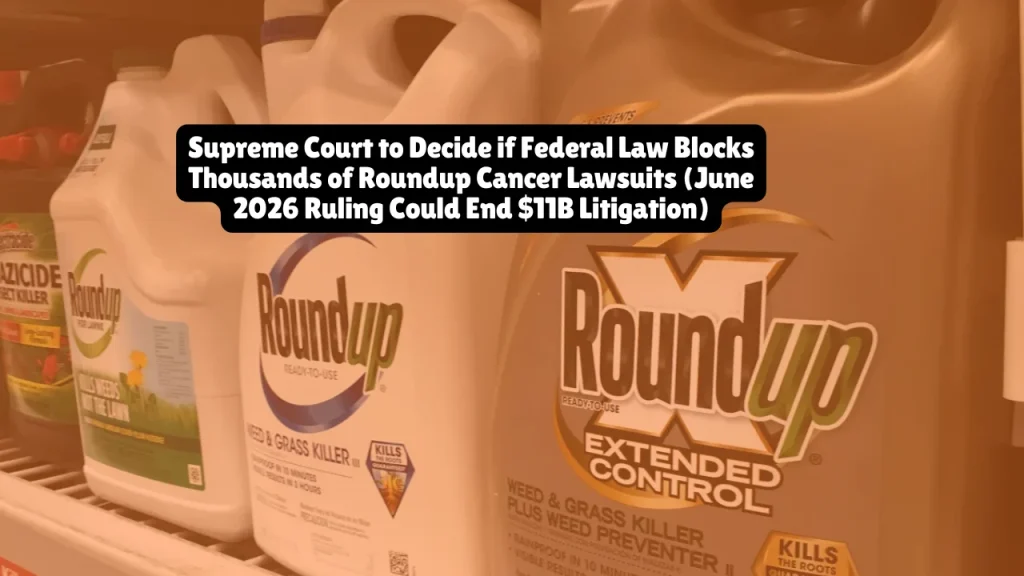
Supreme Court to Decide if Federal Law Blocks Thousands of Roundup Cancer Lawsuits (June 2026 Ruling Could End $11B Litigation)
The U.S. Supreme Court will decide whether federal pesticide law blocks state lawsuits by thousands of cancer victims who claim Monsanto’s Roundup weed killer caused their non-Hodgkin lymphoma. On January 17, 2026, the Court agreed to hear Monsanto v. Durnell, which could end or massively expand litigation that’s already cost Bayer over $11 billion—with 61,000 active cases still pending and potential exposure reaching tens of billions more.
Why the Supreme Court May Block Roundup Lawsuits
The Supreme Court granted review on a single legal question: “Whether the Federal Insecticide, Fungicide, and Rodenticide Act [FIFRA] preempts a label-based failure-to-warn claim where EPA has not required the warning.”
Federal preemption is a legal doctrine under the Supremacy Clause of the Constitution that prevents state laws or lawsuits from conflicting with federal regulatory schemes. Monsanto argues that because the Environmental Protection Agency approved Roundup’s product labels without cancer warnings after reviewing glyphosate’s safety, state juries cannot second-guess that federal determination by finding Monsanto should have warned about cancer risks.
This isn’t a question about whether Roundup causes cancer—it’s about whether state courts have the power to decide that question at all when a federal agency has already ruled on it.
What Monsanto Is Arguing to the Supreme Court
Monsanto’s core argument is straightforward: “State law effectively tells the manufacturer ‘add this warning,’ while federal law tells it ‘do not.'” The company contends this creates an impossible conflict that FIFRA’s preemption provision resolves in favor of federal law.
Monsanto points to the Third Circuit’s 2024 decision in Schaffner v. Monsanto, which held that FIFRA expressly preempts failure-to-warn claims when EPA has determined a warning is not required and regulations forbid adding such warnings without EPA approval. The company argues every leading regulator worldwide—EPA, European Food Safety Authority, European Chemical Agency, and regulators in Canada, New Zealand, Japan, and Australia—has concluded glyphosate-based herbicides can be used safely.
Bayer CEO Bill Anderson called the Supreme Court’s decision to hear the case “good news for U.S. farmers, who need regulatory clarity” and “an important step in our multi-pronged strategy to significantly contain this litigation.”
Related article: Minnesota Ice Lawsuit, Federal Agents Sued Over Racial Profiling and Constitutional Violations During Immigration Surge
What Plaintiffs Are Arguing
John Durnell, the Missouri plaintiff whose case the Supreme Court will review, argues that Monsanto seeks “immunity by judicial fiat” through a flawed preemption argument. His attorneys contend that “Monsanto never has proposed a cancer warning for formulated Roundup, and the U.S. Environmental Protection Agency never has rejected one.”
Plaintiffs argue FIFRA allows state tort claims when companies fraudulently withhold safety information from EPA during the approval process. They claim internal “Monsanto Papers” revealed the company ghostwrote scientific articles claiming Roundup was safe and manipulated studies to hide glyphosate’s cancer risks—evidence that was never disclosed to EPA when it approved the labels.
The Missouri Court of Appeals and several other courts, including the Ninth and Eleventh Circuits, ruled that state failure-to-warn claims don’t conflict with federal law because they address information Monsanto allegedly concealed from regulators rather than challenging EPA’s scientific findings.
How Many Lawsuits Could Be Affected
Approximately 170,000 Roundup lawsuits have been filed alleging glyphosate causes non-Hodgkin lymphoma and other cancers. Bayer has settled nearly 100,000 cases for approximately $11 billion, but roughly 61,000 active lawsuits remain pending—including over 4,500 consolidated in federal multidistrict litigation in California.
If the Supreme Court rules in Monsanto’s favor, tens of thousands of pending cases could be dismissed, and future claims blocked entirely. This would represent one of the largest mass tort litigation collapses in U.S. history. However, if the Court rejects Monsanto’s preemption argument or rules narrowly, the litigation will continue with potentially tens of thousands of additional claims.
The Circuit Split and Lower Court Rulings
The Supreme Court typically grants review when federal appeals courts disagree on important legal questions. Here, the Third Circuit ruled FIFRA preempts state failure-to-warn claims in Schaffner, while the Ninth and Eleventh Circuits reached the opposite conclusion in similar cases. Missouri’s Court of Appeals and state appellate courts in California and Oregon have also allowed Roundup lawsuits to proceed.
The conflict centers on whether EPA’s determination that glyphosate doesn’t require cancer warnings “locks in” the labeling requirements, making it legally impossible for state courts to impose different standards through tort verdicts.
When Will the Supreme Court Decide?
The Court announced it will hear the case on January 17, 2026. No oral argument date has been set yet, but arguments typically occur 2-4 months after the Court grants review. The Court’s 2025-2026 term ends in June 2026, meaning a decision is expected by late June 2026 at the latest.
Bayer stated it expects a decision during the Court’s 2026 session ending in June. This timeline creates uncertainty for thousands of plaintiffs whose cases may be dismissed or allowed to proceed based on how nine justices interpret federal pesticide law.
What Trump Administration Support Means
In December 2025, Solicitor General D. John Sauer—appointed by the Trump administration—filed a brief supporting Monsanto’s position and urging the Supreme Court to grant review. The Justice Department argued: “Where, as here, EPA has specified the health warnings that should appear on a particular pesticide’s label, a manufacturer should not be left subject to ’50 different labeling regimes prescribing’ different requirements.”
This marks a return to the federal government’s position during the first Trump administration. The Biden administration’s Solicitor General previously asked the Court in 2022 not to hear Bayer’s appeal, saying “FIFRA does not preempt” such claims. The shift in the government’s position likely influenced the Court’s decision to grant review.
What Happens If the Supreme Court Rules for Monsanto
If the Court holds that FIFRA preempts state failure-to-warn claims, pending Roundup lawsuits would face dismissal, and cancer victims would lose their primary legal remedy. Trial courts would be required to grant summary judgment for Monsanto in thousands of cases based on federal preemption.
However, plaintiffs’ attorneys argue certain claims might survive even a broad preemption ruling—such as claims based on fraudulent concealment of evidence from EPA, design defect claims arguing Roundup is unreasonably dangerous regardless of warnings, or claims under state laws with Monsantos different legal theories than failure to warn.
What Roundup Victims Should Do Now
If you used Roundup extensively and developed non-Hodgkin lymphoma, consult a mass tort attorney experienced in product liability immediately. The Supreme Court decision will dramatically affect whether you can pursue compensation.
Preserve all evidence of Roundup exposure: purchase receipts, photographs showing Roundup use, witness statements from family members who saw you using it, and complete medical records documenting your cancer diagnosis and treatment. If you already have an active lawsuit, contact your attorney to understand how the Supreme Court ruling may affect your specific case and whether settlement negotiations should be prioritized.
Monitor the Supreme Court’s decision through SCOTUSblog.com or the Court’s official website at supremecourt.gov. The case docket number is 24-1068 (Monsanto Company v. Durnell)
Related article: $2.4M Capital One FCRA Settlement, Automatic Payments for “Deceased” Reporting Victims (Final Approval March 2026)
Last Updated: January 17, 2026
Disclaimer: This article provides general information only and does not constitute legal advice. Consult a qualified attorney for advice about your specific situation.
Call to Action: If you used Roundup and developed non-Hodgkin lymphoma, consult a qualified mass tort attorney immediately to understand how the Supreme Court’s June 2026 decision may affect your legal rights and whether you should prioritize settlement discussions.
Stay informed, stay protected. — AllAboutLawyer.com
Source
About the Author

Sarah Klein, JD, is a licensed attorney and legal content strategist with over 12 years of experience across civil, criminal, family, and regulatory law. At All About Lawyer, she covers a wide range of legal topics — from high-profile lawsuits and courtroom stories to state traffic laws and everyday legal questions — all with a focus on accuracy, clarity, and public understanding.
Her writing blends real legal insight with plain-English explanations, helping readers stay informed and legally aware.
Read more about Sarah