
Supreme Court Tariff Ruling 2026, Trump’s Tariffs Struck Down What It Means for You, Prices, and $175 Billion in Refunds
Last Updated: February 20, 2026 — Breaking Decision Issued Today
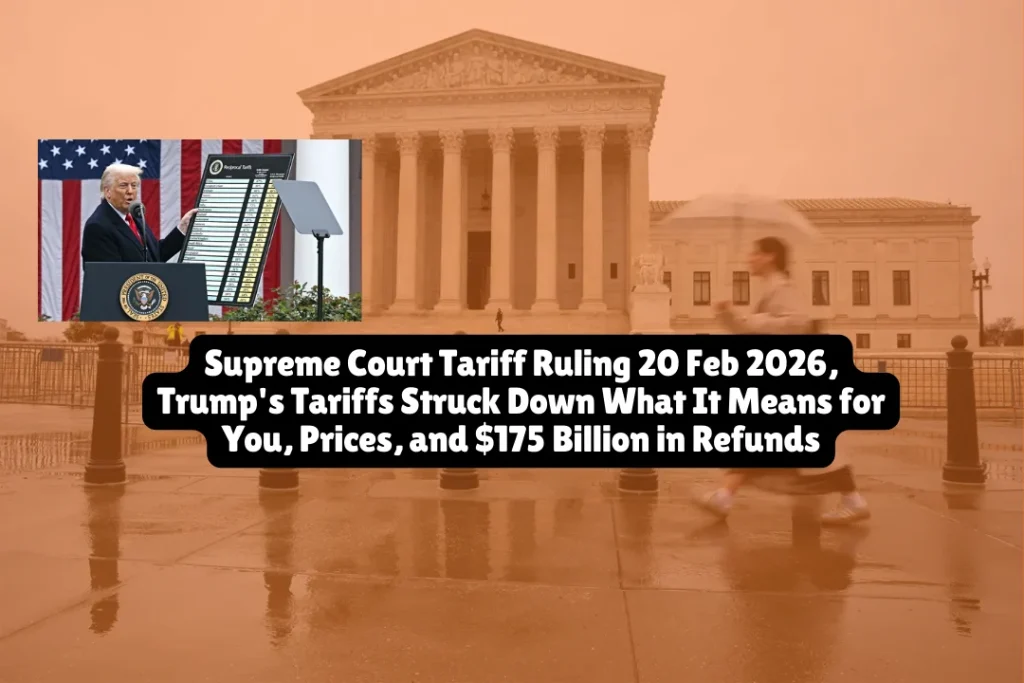
The U.S. Supreme Court ruled today, February 20, 2026, that President Donald Trump did not have the legal authority to impose the sweeping tariffs he placed on imports from nearly every country in the world. The vote was 6 to 3. The ruling strikes down what economists called the largest U.S. tax increase in more than 30 years — and opens the door to up to $175 billion in refunds to businesses that paid those tariffs. Here is everything you need to know, explained simply.
TL;DR — The Most Important Facts Right Now
| Details | |
| Decision | Supreme Court strikes down Trump’s IEEPA tariffs — 6 to 3 |
| Date | February 20, 2026 |
| Case name | Learning Resources, Inc. v. Trump (consolidated with Trump v. V.O.S. Selections) |
| Who wrote the opinion | Chief Justice John Roberts |
| Who voted with majority | Roberts, Sotomayor, Kagan, Gorsuch, Barrett, Jackson |
| Who dissented | Thomas, Alito, Kavanaugh |
| What tariffs are struck down | All tariffs imposed under IEEPA — roughly half of all U.S. tariff revenue |
| What tariffs remain | Section 232 tariffs (steel, aluminum, autos) — these are unaffected |
| Potential refunds | Up to $175 billion — but refund process is unclear and could take years |
| What it means for consumers | Average household cost burden may drop by ~$600–$800 in 2026 |
What Just Happened — In Plain English
President Trump came back to office in January 2025 and immediately started imposing tariffs — taxes on goods imported into the U.S. — on dozens of countries. He used a 1977 law called the International Emergency Economic Powers Act (IEEPA) as his legal authority, claiming trade deficits and fentanyl trafficking constituted national emergencies.
The Constitution says the power to set tariffs is assigned to Congress. But Trump used IEEPA, which does not specifically mention tariffs but allows the president to “regulate” imports and exports when he deems there to be an emergency due to an “unusual and extraordinary threat” to the nation. Before Trump, no president had ever used that law to tariff imports.
Small businesses sued. States sued. The cases worked their way up through federal courts, all of which ruled against Trump. The Supreme Court took the case on an expedited basis — and today, they ruled against Trump too.
“Based on two words separated by 16 others in IEEPA — ‘regulate’ and ‘importation’ — the President asserts the independent power to impose tariffs on imports from any country, of any product, at any rate, for any amount of time,” Chief Justice John Roberts wrote. “Those words cannot bear such weight.” “IEEPA contains no reference to tariffs or duties.” Moreover, “until now no President has read IEEPA to confer such power.”
In plain English: the word “regulate” in a 1977 emergency law does not give any president the unlimited power to tax every import from every country at whatever rate he chooses. Trump needed specific permission from Congress to do that — and he didn’t have it.
The Cases That Started It All
Two separate lawsuits brought this case to the Supreme Court. Both were filed by small businesses pushed to the brink by the tariffs.
Case 1: Learning Resources, Inc. v. Trump
The plaintiffs in this case were small businesses, including Learning Resources, an educational toy business in Illinois. Learning Resources makes educational toys for children — most manufactured in China. When tariffs on Chinese goods hit 145%, the company said it faced potential bankruptcy and filed suit directly challenging the president’s authority.
Case 2: Trump v. V.O.S. Selections, Inc.
The plaintiffs in V.O.S. Selections consisted of five small businesses which were facing potential bankruptcy due to the tariffs. They filed suit against the government on April 14, 2025, in the United States Court of International Trade.
Both cases were consolidated and decided together today. The Supreme Court sided with the small businesses in both.
The Full Legal Timeline — How We Got Here
| Date | Event |
| January 20, 2025 | Trump takes office — begins signing tariff executive orders |
| February 2025 | IEEPA tariffs imposed on Canada, Mexico, China |
| April 2, 2025 | “Liberation Day” — Trump announces sweeping global tariffs |
| April 14, 2025 | V.O.S. Selections files suit in Court of International Trade |
| May 28, 2025 | Court of International Trade unanimously rules IEEPA tariffs illegal |
| June 2025 | Learning Resources files directly with Supreme Court seeking expedited review — rejected |
| August 29, 2025 | Federal Circuit Court of Appeals upholds ruling against Trump tariffs |
| September 2025 | Supreme Court agrees to hear both cases on expedited basis |
| November 5, 2025 | Oral arguments heard — justices express skepticism toward government |
| February 20, 2026 | Supreme Court rules 6-3 — IEEPA tariffs are illegal |
The 6-3 Vote — Who Voted How and Why It Matters
Chief Justice John Roberts was joined by Justices Sonia Sotomayor, Elena Kagan, Neil Gorsuch, Amy Coney Barrett, and Ketanji Brown Jackson in the majority. Justices Clarence Thomas, Samuel Alito, and Brett Kavanaugh dissented.
This is a remarkable coalition. The majority includes three liberals (Sotomayor, Kagan, Jackson) and three conservatives (Roberts, Gorsuch, Barrett). It is not a partisan ruling — it is a ruling about the limits of presidential power that crossed ideological lines.
In a part of the opinion joined by Gorsuch and Barrett, Roberts said that Trump’s reliance on IEEPA to impose the tariffs violated the “major questions” doctrine — the idea that if Congress wants to delegate the power to make decisions of vast economic and political significance, it must say so clearly.
The three dissenting justices — Thomas, Alito, and Kavanaugh — did not disagree simply because they support Trump. Their dissent focused on the messy practical consequences of the ruling, particularly around refunds.
Justice Kavanaugh warned about the potential logistical difficulty of having to refund tariffs already collected. “In the meantime, however, the interim effects of the Court’s decision could be substantial,” Kavanaugh wrote in his dissent. “The United States may be required to refund billions of dollars to importers who paid the IEEPA tariffs, even though some importers may have already passed on costs to consumers or others.”
Which Tariffs Are Struck Down — And Which Ones Stay
This is the most important thing to understand: not all of Trump’s tariffs are gone.
The tariffs at stake in the court case are those issued under the authority of the International Emergency Economic Powers Act (IEEPA). IEEPA tariffs represent about half of all the import taxes the government is collecting each month. Other tariffs were issued under different statutes which are not being challenged.
What is struck down:
- The 10% baseline tariff on goods from most countries (“Liberation Day” tariffs)
- “Reciprocal” tariffs targeting specific countries to narrow trade deficits
- IEEPA tariffs on Canada, China, and Mexico imposed citing fentanyl trafficking
What stays in place:
- Section 232 tariffs on steel, aluminum, autos, and heavy trucks — these are unaffected by the ruling and will remain in place
- Section 301 tariffs (some China-specific tariffs from the first Trump term)
- Any tariffs reimposed under other legal authorities going forward
The administration has promised that any tariffs found to be illegal by the Supreme Court will be replaced with alternative import taxes, using other laws where the president’s authority is more clear.
In other words — Trump can try to get to the same place using different legal roads. The ruling stops this specific approach, not tariffs altogether.
What This Means for Your Wallet Right Now
This is what most people want to know. Here’s the honest answer.
For consumers:
The Tax Foundation found that Trump’s tariffs cost each U.S. household $1,000 in 2025, and will cost each household $1,300 in 2026. If the IEEPA tariffs are struck down, the Yale Budget Lab estimates the average consumer cost burden would fall by about half in 2026 — to about $600 to $800 — compared to what they would have paid pre-2025.
The Tax Policy Center estimates that if the Supreme Court rules against IEEPA tariffs and they aren’t replaced, taxes on households would fall by $1.4 trillion over 10 years, saving families an average of $1,200 in 2026.
However — and this is critical — consumers are unlikely to receive direct refunds for higher prices they already paid. While businesses may be able to receive refunds for their tariff payments, it’s unlikely consumers would get such refunds.
Prices on imported goods may begin to fall gradually — but don’t expect overnight changes at the register. Businesses need time to renegotiate contracts, adjust supply chains, and pass savings forward.
For businesses:
Business owners said that the Supreme Court ruling could spell relief by lowering their costs and potentially leading to refunds. Businesses could be owed nearly $150 billion in refunds after the Supreme Court struck down the IEEPA tariffs.
We Pay the Tariffs, a group of small businesses that oppose Trump’s tariffs, immediately called for a “full, fast and automatic” refund process. “Small businesses cannot afford to wait months or years while bureaucratic delays play out, nor can they afford expensive litigation just to recover money that was unlawfully collected from them in the first place,” Dan Anthony, the group’s executive director, said in a statement.
The $175 Billion Refund Question — Will Businesses Get Their Money Back?
This is the most complicated and unresolved part of the ruling.
Penn Wharton Budget Model projects that reversing the IEEPA tariffs will generate up to $175 billion in refunds. The decision does not explicitly order immediate refunds. However, the decision that the tariffs were collected illegally has opened the door to refund claims. Importers generally have 180 days after goods are “liquidated” to protest and request refunds from U.S. Customs and Border Protection.
The court did not weigh in on whether or how the federal government should provide refunds to the importers who have paid the tariffs, estimated in 2025 at more than $200 billion.
So what happens now? Here is what trade attorneys are saying:
Joyce Adetutu, international trade lawyer at Vinson & Elkins, said her firm is telling clients it is going to be difficult to issue a broad-scale refund with the “push of a button.” “I think what’s more likely is that the CIT and the government, Customs, are going to work together to try to allow those who have preserved their claim for a refund to seek that refund… and those who don’t protest will forfeit any refund,” she said.
“We believe it may take months, if not years, to be decided by the CIT,” said Greg Tompsett, vice president of customs brokerage USA at logistics company Kuehne + Nagel. “The extended period of time may also result in additional subsequent lawsuits, which may drive that back to the Supreme Court.”
The key issue for businesses: Companies will not only be seeking billions in tariff refunds, but billions that are tied up in customs bonds and collateral. With some tariffs increasing from 10–25% or more for certain products, importers are facing customs bond amounts ranging from a minimum of $50,000 to as high as $450 million.
The key issue for consumers: Alex Jacquez, chief of policy and advocacy at Groundwork Collective, said: “There is little reason to believe companies will pass those savings on to consumers.”
Bottom line: the refund process is going to be slow, complicated, and heavily litigated. Do not expect a check in the mail.
What Trump Said — And What He Can Do Next
Trump wrote on social media in January: “If the Supreme Court rules against the United States of America on this National Security bonanza, WE’RE SCREWED!”
The White House had no immediate comment after the ruling. Trump announced a press conference for 12:45 p.m. ET today.
What can Trump do next? Several options remain available:
Option 1 — Section 232: Use national security authority already used for steel and aluminum to impose new tariffs on additional products. This authority is well-established and harder to challenge.
Option 2 — Section 301: Use trade law authority to target specific countries for unfair trade practices, as was done with China tariffs during Trump’s first term.
Option 3 — Ask Congress: Push Congress to pass legislation explicitly authorizing the tariffs. This faces an uncertain legislative path.
The Trump administration has said it will use those pathways to impose new tariffs — and get to the “same place” — should the Supreme Court strike down IEEPA tariffs. “Even if we assume IEEPA is ruled to be used unconstitutionally, it won’t change a lot,” said Gary Hufbauer, a nonresident senior fellow at the Peterson Institute for International Economics and a former Treasury Department official.
What the Economy Lost Under These Tariffs
Trump promised that imposing the highest tariffs since the Great Depression would spark a renaissance in U.S. manufacturing. But factories have been in a slump for most of the last year, shedding 108,000 jobs in 2025. The vast majority of factory managers, many of whom rely on foreign components, say tariffs have been a drag on their business.
Altogether, Trump tariffs were the largest U.S. tax increase as a percent of GDP in more than 30 years and amounted to an average tax increase per U.S. household of $1,000 in 2025 and $1,300 in 2026, primarily driven by the now-illegal IEEPA tariffs. If the IEEPA tariffs had been left in place, the Tax Foundation estimates U.S. GDP would have shrunk by 0.3 percent.
California’s beverage exports of brewery, winery, and distillery products fell more than 32% compared to the same period in 2024, from over $1.3 billion to $880 million through October. Soybean exports to China from the Port of Los Angeles fell 80% last year.
Reactions From Across the Spectrum
Business groups: Footwear Distributors and Retailers of America said Friday’s ruling “marks an important step toward creating a more predictable and competitive environment for American businesses and consumers.” The Distilled Spirits Council urged the Trump administration to “secure a permanent return to zero-for-zero tariffs” with top trade partners.
Small business advocates: Beth Benike, co-founder of Busy Baby, which makes mealtime accessories for babies, said: “I am expecting a full refund, but if for some reason we don’t get them, I would have to raise my prices, which will be tough for consumers.”
Progressive critics: “Any consumer looking for relief from tariff-driven price hikes did not find it at the Supreme Court today,” said Alex Jacquez of Groundwork Collective, adding that refunds for businesses could take years to process.
California Governor Gavin Newsom: Newsom called for immediate tariff refund checks following the ruling, noting that California was the first state to challenge Trump’s tariffs when it filed suit in April 2025.
FAQs — Everything People Are Searching Right Now
Did the Supreme Court strike down all of Trump’s tariffs? No. The ruling strikes down tariffs imposed under IEEPA — roughly half of all tariff revenue. Section 232 tariffs on steel, aluminum, and autos remain in place. Trump can also try to reimpose tariffs using different legal authorities.
What does the Supreme Court tariff ruling mean for me? If you are a consumer, prices on imported goods may gradually fall — but not immediately. Economists estimate the average household cost burden from tariffs could drop by about $600–$800 in 2026 compared to what it would have been under the full tariff regime.
Will I get a refund from the tariffs? Individual consumers are unlikely to receive direct refunds. Businesses that directly paid the tariffs as importers are the ones who may be eligible. That process will take months or years and is not yet decided.
Which companies are eligible for tariff refunds? U.S. importers — businesses that directly paid IEEPA tariffs to U.S. Customs and Border Protection — are the primary candidates for refunds. Importers generally have 180 days after goods are liquidated to file a protest and request a refund from CBP.
How much could the government owe in tariff refunds? Penn Wharton Budget Model projects up to $175 billion in potential refunds. As of December 14, 2025, CBP had collected approximately $133.5 billion in IEEPA tariff payments from U.S. importers.
Who sued Trump over the tariffs? Small businesses including Learning Resources (educational toys) and V.O.S. Selections (wine importers), along with a coalition of states led by Oregon.
What is IEEPA — and why did Trump use it? The International Emergency Economic Powers Act of 1977 gives presidents broad power to regulate commerce during national emergencies caused by foreign threats. Trump used it to justify tariffs on the grounds that trade deficits and fentanyl trafficking constituted national emergencies. The Supreme Court ruled today this interpretation goes too far.
Can Trump just impose new tariffs under a different law? Yes. The Trump administration has said it will use other legal authorities — including Section 232, Section 301, and Section 122 — to reimpose tariffs. These paths have stronger legal foundations and are harder to challenge.
What was the vote and who wrote the decision? The vote was 6 to 3. Chief Justice John Roberts wrote the majority opinion, joined by Justices Sotomayor, Kagan, Gorsuch, Barrett, and Jackson. Justices Thomas, Alito, and Kavanaugh dissented.
Did any conservative justices vote against Trump’s tariffs? Yes — three of them: Chief Justice Roberts, Justice Gorsuch, and Justice Barrett all joined the majority ruling against the tariffs.
When will prices actually go down? This is unclear. The ruling removes the legal basis for the tariffs, but businesses need time to renegotiate supply contracts, adjust pricing, and pass savings to consumers. Some price relief may come in weeks; broader changes could take months. And if Trump reimposed tariffs under other legal authority, prices could stay elevated.
What did Trump say about the ruling? Trump announced a press conference for 12:45 p.m. ET today. Before the ruling, he wrote on social media: “If the Supreme Court rules against the United States of America on this National Security bonanza, WE’RE SCREWED!”
Last Updated: February 20, 2026 — Breaking. This article will be updated as Trump responds and the refund process develops.
Disclaimer: This article is for informational purposes only and does not constitute legal or financial advice. All information is based on publicly available court records, official Supreme Court opinions, and verified reporting from authoritative news sources. For legal advice regarding tariff refund claims, consult a licensed international trade attorney.
About the Author

Sarah Klein, JD, is a licensed attorney and legal content strategist with over 12 years of experience across civil, criminal, family, and regulatory law. At All About Lawyer, she covers a wide range of legal topics — from high-profile lawsuits and courtroom stories to state traffic laws and everyday legal questions — all with a focus on accuracy, clarity, and public understanding.
Her writing blends real legal insight with plain-English explanations, helping readers stay informed and legally aware.
Read more about Sarah