
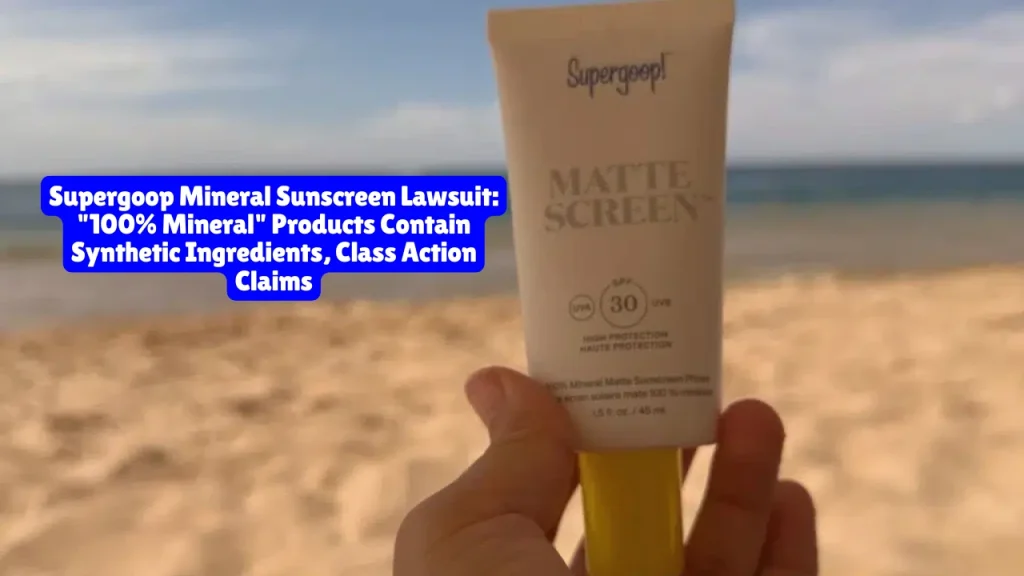
Supergoop Mineral Sunscreen Lawsuit, “100% Mineral” Products Contain Synthetic Ingredients, Class Action Claims
A new class action lawsuit alleges Supergoop falsely markets its “mineral” sunscreen products as containing only mineral or natural ingredients when they actually contain synthetic, chemically processed ingredients. The lawsuit targets products marketed with claims like “100% non-nano-minerals” and “mineral SPF protection,” including (Re)setting 100% Mineral SPF 25, Bright-Eyed 100% Mineral Eye Cream SPF 40, Zinc Screen 100% Mineral Lotion, and Mineral Unseen Sunscreen. California residents who purchased these products within the four years before filing may be eligible to join the class action seeking damages for false advertising and consumer fraud.
The mineral sunscreen market is worth billions—consumers willingly pay premium prices for products they believe are natural and chemical-free. When those “100% mineral” claims turn out to be false, it’s not just misleading marketing. It’s a betrayal of trust.
What the Lawsuit Alleges
The 22-page complaint accuses Supergoop of fraudulently mislabeling its mineral sunscreen products by claiming every ingredient is mineral-based or from a natural source.
Supergoop’s marketing materials prominently feature:
- “100% non-nano-minerals”
- “Mineral SPF protection”
- “Mineral broad-spectrum sunscreen”
But according to the lawsuit, these products contain “a plethora of synthetic, processed, and chemically altered ingredients.”
Why This Matters
Mineral sunscreens use zinc oxide or titanium dioxide as active ingredients. These sit on top of your skin and physically block UV rays—they don’t absorb into your bloodstream like chemical sunscreens.
Chemical sunscreens contain synthetic organic compounds like avobenzone, oxybenzone, and octinoxate that absorb UV radiation after penetrating the skin.
The distinction matters to health-conscious consumers, parents buying sunscreen for children, and people following dermatologist advice to use mineral formulations.
Which Products Are Affected
The lawsuit specifically names these Supergoop products:
✗ Supergoop (Re)setting 100% Mineral SPF 25
✗ Bright-Eyed 100% Mineral Eye Cream SPF 40
✗ Zinc Screen 100% Mineral Lotion
✗ Mineral Unseen Sunscreen
The list is not exhaustive—other Supergoop products marketed as “mineral” or “100% mineral” may also be affected.
Related article: Nike Data Tracking Lawsuit, Company Ignores Privacy Settings, Shares Customer Data Without Consent
The Legal Claims
The lawsuit asserts multiple causes of action under California law:
False Advertising: Supergoop allegedly made untrue statements about ingredients being entirely mineral-based.
Breach of Express Warranty: The “100% mineral” claims created a warranty that the products contained only mineral ingredients.
Consumer Fraud: Supergoop allegedly deceived consumers to charge premium prices “at the expense of unwitting consumers and lawfully acting competitors.”
Unjust Enrichment: Supergoop profited unfairly from misrepresentations about product ingredients.
The complaint argues that reasonable consumers would interpret “mineral” and “100% non-nano-minerals” to mean every ingredient in the product is entirely mineral-based and natural—not just the active sunscreen ingredients.
Why Consumers Were Misled
Mineral sunscreen has exploded in popularity as consumers increasingly seek natural, eco-friendly ingredients in skincare products.
The lawsuit alleges Supergoop knew it could profit from this trend and deliberately misrepresented its products to capitalize on consumer demand for clean beauty.
Many consumers specifically avoid chemical sunscreen ingredients due to:
- Health concerns about absorption into bloodstream
- Potential endocrine disruption
- Environmental impact on coral reefs
- Skin sensitivity issues
- Medical advice to use mineral formulations
When Supergoop marketed products as “100% mineral,” consumers reasonably believed they were avoiding synthetic chemicals entirely.
Supergoop’s History with Lawsuits
This isn’t Supergoop’s first rodeo with false advertising claims.
2021: Reef-Safe Lawsuit
Supergoop was sued in 2021 for falsely advertising chemical sunscreens as “reef-safe” when they contained ingredients harmful to coral reefs.
June 2025: $350,000 Settlement
The Santa Clara County District Attorney’s Office settled a civil lawsuit against Supergoop for $350,000 over misleading “reef friendly” and “reef safe” claims.
The settlement, filed June 3, 2025 in Santa Clara County Superior Court, barred Supergoop from:
- Advertising chemical sunscreens as “reef friendly” or “reef safe”
- Using drawings, symbols, or photos of coral reefs in marketing
- Displaying reef-related imagery on packaging
This was the second “reef friendly” settlement the DA’s office obtained—Sun Bum paid $300,000 in May 2025 for similar false advertising.
District Attorney Jeff Rosen stated: “We are keeping a close watch on the industry to protect consumers from getting burned by false and misleading advertising.”
2023: SPF 40 Lawsuit
In December 2023, MarceAnn Dunning filed a class action in U.S. District Court for the Southern District of New York (Case No. 1:23-cv-11242) alleging Supergoop’s Unseen Sunscreen SPF 40 products don’t actually contain SPF 40.
The lawsuit claimed:
- Supergoop Unseen Face Sunscreen SPF 40 actually has SPF 23
- Supergoop Unseen Body Sunscreen SPF 40 actually has SPF 20
Supergoop moved to dismiss the case in May 2024. In January 2025, U.S. District Judge John P. Cronan granted Supergoop’s motion to dismiss, ruling that plaintiffs failed to adequately plead facts necessary to establish Article III standing because the complaint lacked sufficient allegations to support an injury-in-fact.
The pattern is clear: Supergoop faces repeated challenges over whether its marketing claims match reality.
Current Status of the Mineral Sunscreen Lawsuit
The mineral sunscreen synthetic ingredients lawsuit was filed in California court in December 2024.
The case seeks to represent all California residents who purchased the listed Supergoop mineral products during the four years before and until the filing date.
No Settlement Yet
As of January 2026, no settlement has been reached. The lawsuit is in early stages.
Typically, class action litigation follows this timeline:
- Filing and class certification (6-12 months)
- Discovery and motion practice (12-24 months)
- Settlement negotiations or trial (18-36 months)
Many consumer class actions settle before trial—but it can take 2-3 years from filing to settlement approval.
Who Can Join the Class Action
If you purchased any of these Supergoop products in California within the four-year period before December 2024, you may be eligible:
- (Re)setting 100% Mineral SPF 25
- Bright-Eyed 100% Mineral Eye Cream SPF 40
- Zinc Screen 100% Mineral Lotion
- Mineral Unseen Sunscreen
- Other products marketed as “100% mineral” or “mineral-only”
What You Need:
- Proof of purchase (receipt, credit card statement, online order confirmation)
- California residency during purchase period
How Class Actions Work
You typically don’t need to “sign up” when a class action is first filed. If the court certifies the class, you’ll receive notice with instructions on how to file a claim when a settlement is reached.
However, you can contact the plaintiff’s attorneys to:
- Provide information about your purchase
- Express interest in participating
- Ensure you’re notified of developments
What Compensation Might Be Available
If a settlement is reached, typical remedies in false advertising sunscreen cases include:
Refunds: Partial or full purchase price refunds for affected products
Damages: Compensation for paying premium prices based on false “mineral” claims
Injunctive Relief: Court orders requiring Supergoop to stop making misleading mineral claims
Based on similar sunscreen settlements:
- Johnson & Johnson aerosol sunscreen: $1.75 million settlement (2023)
- Coppertone benzene lawsuit: $2.3 million settlement (2023)
- Sun Bum reef-safe claims: $300,000 settlement (2025)
- Supergoop reef-safe claims: $350,000 settlement (2025)
Individual payouts depend on settlement size, number of claimants, and purchase amounts.
Similar False Advertising Cases
Supergoop is far from alone in facing mineral sunscreen lawsuits.
Target (November 2023): Class action alleged “reef conscious” sunscreen contains ingredients harmful to coral reefs.
Walmart Equate Sunscreen: Lawsuit claims “reef-friendly” products contain avobenzone, homosalate, octisalate, and octocrylene—all harmful to reefs.
Big Lots Sound Body Sunscreen: False advertising over “reef-conscious” claims despite containing reef-damaging chemicals.
MISSHA and A’pieu Sunscreens: Class action over false “waterproof” and “sweatproof” claims—FDA states no sunscreen is truly waterproof.
The clean beauty industry faces increasing scrutiny over whether marketing claims match ingredient reality.
What the FDA and FTC Say
FDA Sunscreen Regulation
The FDA regulates sunscreens as over-the-counter drugs, not cosmetics. This means strict labeling requirements and safety testing.
However, the FDA doesn’t specifically define “mineral sunscreen” in its regulations. The term has become marketing shorthand for sunscreens using only zinc oxide and/or titanium dioxide as active ingredients.
FTC False Advertising Standards
The Federal Trade Commission prohibits deceptive advertising under FTC Act Section 5.
Marketing claims must be:
- Truthful
- Not misleading
- Substantiated by evidence
When Supergoop markets products as “100% mineral” or containing “100% non-nano-minerals,” reasonable consumers interpret this to mean all ingredients—not just active ingredients—are mineral-based.
Real Consumer Impact
Online reviews reveal the frustration consumers feel when they discover the truth:
“I have developed hyperpigmentation all over my face since I started relying on this product for daily sunscreen 1.5 years ago.” – Consumer comment on TopClassActions.com
“I recently purchased the Unseen Face Stick, used it on myself, my husband and 2 kids at the beach… Very disappointed.” – Parent’s review
“I began second guessing the efficacy of this sunscreen and felt that Supergoop’s Unseen Sunscreen was not giving me the protection I need.” – Consumer with melasma
These aren’t just disappointed customers—they’re people who relied on marketing claims to protect their health and their children’s health.
How to Protect Yourself
1. Read Ingredient Lists Carefully
Don’t rely solely on front-of-package claims. Check the full ingredient list for:
- Active ingredients (should only be zinc oxide and/or titanium dioxide for true mineral sunscreens)
- Inactive ingredients (look for synthetic chemicals like polymers, silicones, synthetic preservatives)
2. Look for Third-Party Testing
Independent lab testing adds confidence beyond brand claims. Organizations like EWG (Environmental Working Group) rate sunscreens based on ingredient safety.
3. Understand Marketing Language
- “Mineral SPF” ≠ “100% mineral ingredients”
- “Reef-safe” has no legal definition
- “Clean beauty” is unregulated marketing speak
- “Natural” doesn’t mean ingredient-free of synthetics
4. Check for Lawsuits
Before purchasing, search “[brand name] lawsuit” to see if the company has faced false advertising claims.
5. Save Your Receipts
Keep proof of purchase for any products marketed with health or ingredient claims. If a lawsuit emerges, you’ll need documentation to file a claim.
What Happens Next
The Supergoop mineral sunscreen lawsuit will likely proceed through:
Class Certification: The court decides whether to certify the case as a class action representing all affected California consumers.
Discovery: Both sides exchange evidence, including internal Supergoop documents about product formulation and marketing decisions.
Settlement Negotiations: Most consumer class actions settle. Supergoop may offer a settlement to avoid costly litigation and negative publicity.
Trial: If no settlement is reached, the case goes to trial where a jury decides whether Supergoop’s marketing was false and misleading.
Frequently Asked Questions
Q: Does this lawsuit affect all Supergoop products?
No. Only products specifically marketed as “mineral,” “100% mineral,” or “100% non-nano-minerals” are at issue. Chemical sunscreens marketed as such are not affected by this particular lawsuit.
Q: Can I still use my Supergoop mineral sunscreen?
The lawsuit is about false advertising and ingredient mislabeling—not product safety. The sunscreens likely still provide sun protection. However, if you purchased them specifically to avoid synthetic ingredients, they may not meet your expectations.
Q: What if I bought these products outside California?
This lawsuit currently only covers California residents. However, additional class actions may be filed in other states, or the class definition may expand.
Q: How do I join the lawsuit?
You typically don’t need to take action now. If the court certifies the class and a settlement is reached, you’ll receive notice with instructions on filing a claim. Monitor ClassAction.org for updates.
Q: What’s the difference between mineral and chemical sunscreen?
Mineral sunscreens use zinc oxide and/or titanium dioxide to physically block UV rays by sitting on top of skin. Chemical sunscreens use synthetic organic compounds that absorb into skin and convert UV radiation to heat.
Q: Are Supergoop’s mineral products actually mineral?
The active ingredients (zinc oxide and/or titanium dioxide) are mineral. The lawsuit alleges the inactive ingredients contain synthetic, chemically processed substances despite “100% mineral” marketing claims.
Q: Can I get a refund now?
Not through the lawsuit—settlements can take years. You could try contacting Supergoop directly for a refund based on false advertising concerns, though success isn’t guaranteed.
Q: What should I look for in truly mineral sunscreen?
Check that ONLY zinc oxide and/or titanium dioxide are listed as active ingredients. Then review inactive ingredients for synthetic chemicals, polymers, silicones, and chemical preservatives.
Q: Has Supergoop responded to the lawsuit?
Supergoop has not issued a public statement about the mineral sunscreen lawsuit as of January 2026. In past lawsuits, the company has moved to dismiss claims or settled without admitting wrongdoing.
Q: What are synthetic ingredients?
Synthetic ingredients are chemically manufactured in laboratories rather than derived directly from natural sources. Examples include polymers, silicones, synthetic preservatives, and chemical emulsifiers.
The clean beauty movement promised transparency, but lawsuits like this reveal how easily “natural” and “mineral” claims can mislead consumers willing to pay premium prices for products they believe are healthier.
Whether you purchased Supergoop mineral sunscreen or just want to make better-informed choices, this case reminds us: read the fine print, question marketing claims, and don’t assume “100% mineral” means what you think it means.
As more consumers demand accountability, we’re likely to see additional lawsuits challenging whether sunscreen companies deliver on their clean beauty promises—or just deliver good marketing.
About the Author

Sarah Klein, JD, is a licensed attorney and legal content strategist with over 12 years of experience across civil, criminal, family, and regulatory law. At All About Lawyer, she covers a wide range of legal topics — from high-profile lawsuits and courtroom stories to state traffic laws and everyday legal questions — all with a focus on accuracy, clarity, and public understanding.
Her writing blends real legal insight with plain-English explanations, helping readers stay informed and legally aware.
Read more about Sarah