
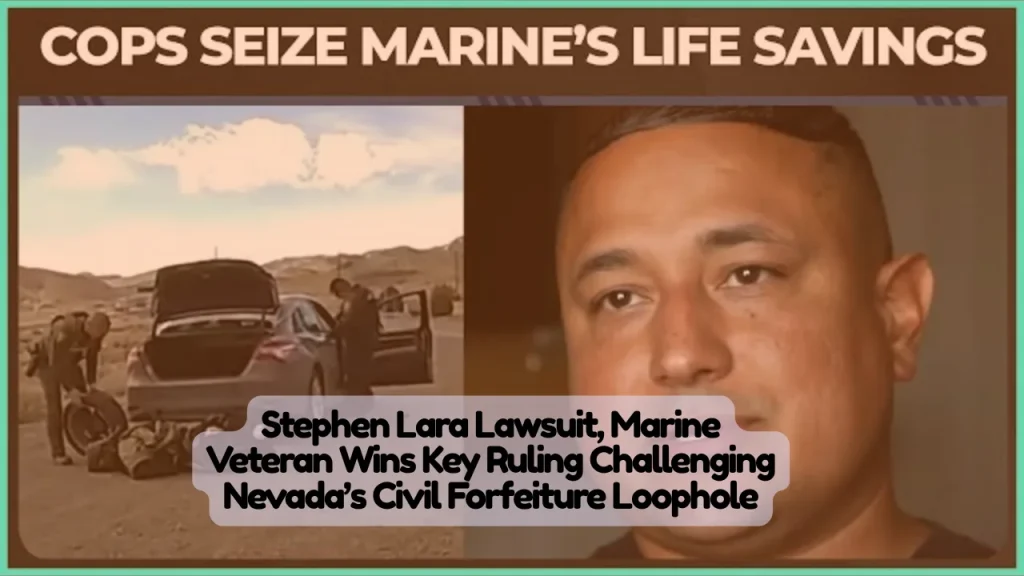
Stephen Lara Lawsuit, Marine Veteran Wins Key Ruling Challenging Nevada’s Civil Forfeiture Loophole
On January 10, 2025, Washoe County Judge Connie Steinheimer ruled Nevada Highway Patrol’s participation in federal civil asset forfeiture programs is unlawful, banning the practice statewide. The decision follows Marine veteran Stephen Lara’s four-year legal battle after Nevada State Troopers seized his $87,000 life savings in February 2021 without charging him with any crime. Lara’s lawsuit challenges Nevada law enforcement’s use of federal “equitable sharing” to bypass stricter state forfeiture protections, creating a landmark precedent restricting civil asset forfeiture nationwide.
What Is the Stephen Lara Lawsuit About?
Lara filed suit in Nevada’s Second Judicial District Court (Case CV21-01595) on February 1, 2022 against the State of Nevada, Department of Public Safety, Nevada Highway Patrol Colonel, and the sergeant who ordered the seizure.
The lawsuit challenges Nevada law enforcement’s participation in the Department of Justice’s federal equitable sharing program, which allows state police to hand seized property to federal agencies (typically the DEA), who forfeit it under more government-friendly federal law, then return 80% of proceeds to state police—effectively circumventing Nevada’s stricter forfeiture protections.
Lara argues this practice violates Nevada Constitution’s due process clause and state forfeiture statutes that require higher proof standards and faster court hearings for property owners.
The February 19, 2021 Traffic Stop
Lara, then 42, was driving from Lubbock, Texas to California to visit his two teenage daughters when Nevada Highway Patrol Trooper Rodney Brown stopped him on Interstate 80 near Reno for allegedly following a truck too closely.
Body camera footage shows the stop:
Brown initially praised Lara’s driving: “First, I applaud you on your driving. You drive great.” He later admitted: “The reason I stopped you is we have a special enforcement campaign going on. We’re trying to educate drivers about violations they may not realize they’re committing.”
Officers questioned Lara for over an hour about unrelated matters—drugs, bodies in the vehicle, where he was going, and why he was traveling with cash.
Lara cooperated fully and disclosed he was carrying $87,000 in cash—his life savings accumulated from 16 years of Marine Corps service, veteran benefits, and recent paychecks. He provided ATM receipts and documentation proving legitimate income sources.
Officers brought a drug-sniffing dog that allegedly “alerted” to the cash. Studies show most U.S. currency contains trace cocaine residue, making K-9 alerts unreliable indicators of drug involvement.
Officers admitted nothing was illegal. They acknowledged Lara committed no crime but seized the money anyway, leaving him stranded and penniless on the highway.
Nevada Highway Patrol immediately transferred the cash to the DEA through the equitable sharing program, anticipating federal forfeiture under lenient federal standards would allow them to keep 80% of proceeds.
What Legal Claims Were Filed?
Lara’s lawsuit seeks multiple forms of relief:
Declaratory Judgment: Nevada law does not authorize Nevada Highway Patrol’s participation in the federal equitable sharing program.
Constitutional Violations: Participation in the program violates Nevada Constitution’s due process protections by creating financial incentives for police to seize property without probable cause.
Violation of State Forfeiture Statutes: Nevada’s forfeiture laws provide stronger protections than federal law—requiring clear and convincing evidence, judicial oversight, and 60-day challenge periods. The equitable sharing program allows NHP to bypass these protections.
Damages: Compensation for emotional distress, loss of use of funds, and constitutional rights violations during the seven months Lara went without his life savings.
Injunctive Relief: Court order barring Nevada Highway Patrol from future participation in federal equitable sharing programs.
Related article: Are Schedule 3 Drugs Legal? What You Need to Know and How Are They Regulated?
January 10, 2025 Landmark Ruling
Judge Connie Steinheimer granted partial summary judgment for Lara, ruling that Nevada Highway Patrol cannot legally participate in the federal equitable sharing program.
Court’s Key Holdings:
“While federal law clearly provides Nevada the option to participate in the federal equitable sharing program, Nevada’s Legislature has yet to accept this offer. Without such an acceptance, NHP is unable to participate in this program—as doing so effectively requires NHP to eschew Nevada’s delineated forfeiture scheme.”
The court determined “there is no statutory authority for NHP to participate in the federal equitable sharing program.” Allowing NHP to use equitable sharing would require “liberally construing Nevada’s forfeiture statutes” in ways the legislature never intended.
Nevada’s forfeiture laws provide stricter requirements than federal standards—requiring judicial approval, clear and convincing evidence, and faster timelines for property owners to challenge seizures. Federal equitable sharing allows law enforcement to avoid these protections entirely.
Practical Effect: Nevada law enforcement can no longer hand seized property to federal agencies to circumvent state law. All forfeitures must comply with Nevada’s stricter protections, including higher proof standards and faster court access.
This ruling applies statewide, affecting all Nevada law enforcement agencies—not just Nevada Highway Patrol.
The Long Road to Justice
February 19, 2021: Nevada Highway Patrol seizes Lara’s $87,000. DEA takes possession through equitable sharing.
September 2021: After seven months without his money and DEA missing legal deadlines to charge him or return funds, Lara teams with Institute for Justice and files federal lawsuit to recover his money.
September 2, 2021: The Washington Post publishes exposé on the seizure, generating national media attention.
Day after lawsuit filed: DEA agrees to return Lara’s money—seven months after seizure, proving they never had legal basis to keep it.
February 1, 2022: Lara files state court lawsuit against Nevada Highway Patrol challenging the constitutionality of the seizure and equitable sharing program participation.
September 28, 2023: Court hears arguments on Nevada’s motion to dismiss.
December 29, 2022: Nevada Supreme Court rules Lara has standing to sue for damages under state constitution, rejecting qualified immunity defense. This earlier separate ruling allowed the case to proceed.
January 2024: Second Judicial District Court denies Nevada’s motion to dismiss, allowing Lara’s claims to move forward to discovery phase.
January 10, 2025: Judge Steinheimer issues landmark ruling that Nevada Highway Patrol participation in federal equitable sharing is unlawful, granting partial summary judgment for Lara.
Current Status (December 2025): Case ongoing. Lara continues pursuing damage claims and additional constitutional violations. Nevada may appeal the January 2025 ruling.
What Is the Federal Equitable Sharing Program?
Created by Congress in 1984, equitable sharing allows state and local law enforcement to partner with federal agencies on asset seizures, bypassing state forfeiture laws.
How It Works:
State police seize property under state law. Instead of pursuing forfeiture under state procedures, they transfer property to a federal agency (typically DEA, FBI, or ATF).
Federal agency handles forfeiture using federal law, which requires lower proof standards, provides fewer property owner protections, and often proceeds through administrative forfeiture with zero judicial oversight.
In over 85% of federal seizures, forfeiture occurs through administrative process—agencies simply keep property if owners miss deadlines or can’t afford lawyers. No court ever reviews the case.
Federal agency keeps 20% of proceeds and returns 80% to state police through “equitable sharing” payments.
Financial Incentives: From 2000-2019, state and local governments received $8.8 billion through equitable sharing. This creates direct financial incentives for police to prioritize seizures over arrests and prosecutions.
One former police chief called equitable sharing proceeds “pennies from heaven.” Lara calls it “highway robbery.”
Nevada’s Stricter Forfeiture Protections
Nevada reformed its civil forfeiture laws to provide stronger protections than federal standards:
Judicial Oversight Required: All forfeitures must be approved by a judge. Nevada prohibits administrative forfeiture.
Higher Burden of Proof: State must prove by “clear and convincing evidence” that property is connected to crime—higher than federal “preponderance of evidence” standard.
60-Day Challenge Period: Property owners have 60 days to contest seizures in court. Federal law allows agencies to delay hearings for months or years.
Reporting Requirements: Nevada law enforcement must report all seizures and forfeitures, improving transparency.
Reduced Financial Incentives: Nevada limits how much forfeiture proceeds law enforcement can keep, reducing profit motives.
The equitable sharing loophole allowed Nevada Highway Patrol to completely bypass these protections by handing property to federal agencies.
Plaintiff’s Arguments
Statutory Violation: Nevada’s legislature never authorized participation in federal equitable sharing. Absent explicit authorization, NHP cannot circumvent state forfeiture statutes.
Due Process Violations: Financial incentives created by equitable sharing—where police keep 80% of proceeds—violate due process by encouraging seizures without probable cause.
Profit Motive Evidence: NHP’s pattern of quickly transferring cash seizures to DEA demonstrates seizures are financially motivated rather than evidence-driven.
Lara’s Innocence: Seven months without charges or evidence proves the seizure was baseless. Returning money only after lawsuit and media attention confirms government had no legitimate basis.
Legislative Intent: When Nevada strengthened forfeiture protections in 2015, the legislature intended to restrict government power—not provide a federal bypass mechanism.
Defense Arguments
Federal Law Supremacy: U.S. Department of Justice authorizes all state and local agencies to participate in equitable sharing. Nevada doesn’t need separate state authorization.
Legitimate Law Enforcement Tool: Equitable sharing disrupts interstate drug trafficking and organized crime networks that cross state lines.
No Standing: Lara lacks standing to challenge the program because NHP acted as federal agent executing federal law—making this federal action immune from state lawsuits.
Voluntary Program: State agencies choose whether to use equitable sharing. NHP’s participation is discretionary, not mandatory.
No Explicit Prohibition: Nevada law doesn’t explicitly prohibit equitable sharing participation, so NHP has authority to accept federal offers.
The court rejected all defense arguments, finding Nevada law enforcement must follow Nevada law absent explicit legislative authorization to do otherwise.
Nevada Supreme Court’s Earlier 2022 Ruling
In December 2022, the Nevada Supreme Court unanimously ruled Lara can sue for monetary damages under the state constitution, rejecting qualified immunity defenses.
Court’s Holding: “We simply recognize the long-standing legal principle, that a right does not, as a practical matter, exist without a remedy for its enforcement.”
This earlier decision allowed Lara’s lawsuit to proceed and set precedent that Nevada officials cannot hide behind qualified immunity when violating constitutional rights.
The ruling was celebrated as striking a blow against both civil forfeiture and qualified immunity—the doctrine that shields government officials from accountability even when they violate citizens’ rights.
How This Compares to Similar Cases
State-Level Equitable Sharing Restrictions: Eight states plus Washington D.C. have passed anti-circumvention laws restricting equitable sharing: Arizona, California, Colorado, Nebraska, New Mexico, Maine, Maryland, and Ohio.
Nevada’s court ruling achieves similar results through judicial interpretation rather than legislation—finding state police must follow existing state law without explicit authorization to bypass it.
Federal Class Action: Institute for Justice is litigating a nationwide federal class action against TSA and DEA on behalf of travelers who had cash seized without probable cause at airports. That case challenges federal forfeiture practices directly.
North Carolina Sex Crime Victim (2023): Local police seized $69,000 from a sex offender that a court ordered paid to his victim as settlement. Police transferred the money to federal agencies through equitable sharing, denying the victim compensation. North Carolina effectively abolished civil forfeiture but equitable sharing allowed police to bypass the law.
Lara’s case is unique because it successfully challenged equitable sharing at the state court level based on state constitutional and statutory grounds—not federal law.
Applicable Legal Framework
Fifth Amendment (U.S. Constitution): “No person shall be deprived of property without due process of law.”
Nevada Constitution Article 1, Section 8: Provides due process protections courts have interpreted as stronger than federal Fifth Amendment protections.
Nevada Revised Statutes Chapter 179: Nevada’s forfeiture laws require judicial oversight, clear and convincing evidence standard, and 60-day challenge periods.
21 U.S.C. § 881 (Federal Law): Authorizes federal civil forfeiture for property connected to drug crimes, using lower “preponderance of evidence” standard.
DOJ Equitable Sharing Program: 28 U.S.C. § 524(c) authorizes federal agencies to share forfeiture proceeds with state and local agencies that participate in forfeitures.
Evidence Presented
Body Camera Footage: Shows Trooper Brown praising Lara’s driving, admitting the stop was a “special enforcement campaign,” and questioning him about unrelated matters for over an hour.
ATM Receipts and Pay Stubs: Lara provided documentation proving his $87,000 came from legitimate sources—military paychecks, veteran benefits, and savings.
K-9 Alert: Drug-sniffing dog allegedly detected drug residue on cash. Most U.S. currency contains trace cocaine, making K-9 alerts unreliable.
DEA Timeline: Federal agency held money for seven months, never filed charges, missed statutory deadlines, and only returned money the day after Lara filed lawsuit—proving no legitimate basis for seizure.
Nevada Highway Patrol Internal Communications: Discovery may reveal NHP’s motivations for targeting cash seizures and participating in equitable sharing. These documents remain subject to ongoing litigation.
Equitable Sharing Data: From 2000-2019, Nevada received millions through the program, demonstrating financial incentives driving seizure practices.
What This Means for Civil Forfeiture Nationwide
State Court Strategy: Lara’s victory demonstrates state courts can restrict equitable sharing based on state constitutional and statutory grounds without challenging federal law directly.
Closing the Loophole: Even in states with forfeiture reform, equitable sharing allows police to bypass protections. Lara’s case provides a roadmap for other states to close this loophole judicially.
Burden on Federal Legislation: The Fifth Amendment Integrity Restoration Act, reintroduced in Senate in January 2025, would end equitable sharing nationwide. Lara’s case strengthens the case for federal reform.
Discovery Phase Impact: As Lara’s case proceeds to discovery, internal law enforcement documents about equitable sharing motivations and financial incentives may expose nationwide patterns of profit-driven policing.
Monetary Damages: If Lara wins damages, it creates financial consequences for agencies that violate constitutional rights through civil forfeiture—encouraging policy changes to avoid liability.
Current Status and Next Steps
January 10, 2025 Ruling: Judge Steinheimer’s decision grants partial summary judgment, resolving the statutory question but leaving other claims pending.
Remaining Claims: Lara continues pursuing constitutional damages for due process violations, emotional distress, and loss of use of his money during the seven-month seizure.
State Appeals: Nevada may appeal the equitable sharing ruling to Nevada Court of Appeals or Supreme Court. Institute for Justice will defend the victory.
Discovery Ongoing: Lara’s attorneys can now obtain internal Nevada Highway Patrol documents revealing seizure practices, training materials, and financial data showing equitable sharing proceeds.
Settlement Unlikely: Institute for Justice attorneys stated Nevada “can’t settle this lawsuit without agreeing to heavily modify its forfeiture practices.” The constitutional principles at stake exceed monetary compensation.
Timeline: Full case resolution may take 1-2 additional years if Nevada appeals or fights remaining claims through trial.
Broader Implications for Law Enforcement Accountability
Qualified Immunity Rejection: Nevada Supreme Court’s 2022 ruling that Lara can sue for damages despite qualified immunity sets precedent for holding government officials accountable for constitutional violations.
Financial Accountability: Monetary damages create real consequences for agencies that profit from unconstitutional seizures, incentivizing policy reforms.
Transparency Requirements: Discovery in Lara’s case may force disclosure of law enforcement financial relationships with federal agencies and internal communications about seizure targeting.
National Model: Other states with forfeiture reforms can follow Nevada’s model—using state courts and state constitutional protections to restrict federal equitable sharing.
Congressional Pressure: Landmark state court victories strengthen arguments for federal legislation ending equitable sharing nationwide.
Frequently Asked Questions
Did Stephen Lara get his money back?
Yes. The DEA returned his $87,000 in September 2021—the day after Lara filed his federal lawsuit, seven months after the seizure. The immediate return proved the government never had legitimate grounds to keep it.
Was Stephen Lara charged with any crime?
No. Nevada Highway Patrol and the DEA never charged Lara with any crime. He was never arrested. The seizure was purely civil asset forfeiture based on suspicion, not criminal evidence.
What is the current status of the lawsuit?
The case remains ongoing as of December 2025. Judge Steinheimer’s January 10, 2025 ruling resolved the equitable sharing question in Lara’s favor. Lara continues pursuing constitutional damage claims. Nevada may appeal.
Can other Nevada residents benefit from this ruling?
Yes. The ruling applies statewide, banning all Nevada law enforcement agencies from participating in federal equitable sharing. Any Nevadan whose property was seized through this program may have grounds to challenge the seizure.
How much money is involved in equitable sharing nationwide?
From 2000-2019, state and local governments received $8.8 billion through federal equitable sharing. This creates massive financial incentives for police to seize property without due process.
What is the Fifth Amendment Integrity Restoration Act?
Bipartisan federal legislation that would end equitable sharing nationwide, requiring all forfeitures to proceed under state law. The bill has been pending since 2015 and was reintroduced in Senate in January 2025.
Can I be arrested for carrying cash?
No. Carrying cash is not a crime. However, under civil asset forfeiture, police can seize cash based on suspicion it’s connected to criminal activity without ever charging you with a crime. Lara’s case demonstrates the abuse of this practice.
What should I do if police seize my property?
Document everything, including officer names, badge numbers, and seizure receipts. Request written explanation of seizure basis. Do not consent to searches. Contact an attorney immediately—deadlines to challenge seizures are often short (30-90 days). Organizations like Institute for Justice provide free legal representation in civil forfeiture cases.
What Travelers Should Know
Your Rights During Traffic Stops:
You must provide license, registration, and insurance. You have the right to remain silent beyond providing required documents. You can refuse vehicle searches—do not consent.
Police may bring K-9 units, but dogs cannot justify extended detention without reasonable suspicion of criminal activity.
Carrying Cash Is Legal: No law prohibits traveling with cash. However, large amounts may attract law enforcement attention in jurisdictions that practice civil forfeiture.
Document Legitimate Sources: Keep receipts, bank statements, and documentation proving cash came from lawful sources—though even this may not prevent seizure.
Know State Laws: Research civil forfeiture laws in states where you’re traveling. Some states provide strong protections; others allow easy seizures.
Record Interactions: If legal in your state, record police interactions. Many states allow recording of police in public duties.
The Institute for Justice’s Role
Institute for Justice (IJ) is a libertarian public interest law firm that provides free legal representation in civil forfeiture cases nationwide. IJ represented Lara throughout his four-year battle.
IJ’s Civil Forfeiture Advocacy:
Currently litigating nationwide federal class action against TSA and DEA for airport cash seizures without probable cause.
Represented dozens of property owners in civil forfeiture cases, securing millions in returned property and damages.
Published extensive research documenting civil forfeiture abuses, including “Policing for Profit” reports grading states’ forfeiture laws.
Advocates for legislation ending or restricting civil forfeiture at state and federal levels.
IJ attorneys Wesley Hottot, Ben Field, and Brian Morris represent Lara. Local Nevada counsel are Jordan T. Smith and John A. Fortin of Pisanelli Bice PLLC.
Conclusion: A Landmark Victory With National Impact
Judge Steinheimer’s January 10, 2025 ruling closes a major civil forfeiture loophole exploited by law enforcement nationwide. By holding that state police must follow state law absent explicit legislative authorization to bypass protections, the decision provides a template for other states to judicially restrict equitable sharing.
Lara’s four-year fight demonstrates that one person challenging government overreach can create systemic change. His courage in continuing litigation after recovering his money—pursuing constitutional principles rather than just personal compensation—may ultimately protect millions from similar abuses.
The case’s broader significance extends beyond Nevada. As discovery proceeds and if Lara wins damages, internal law enforcement documents may expose the profit-driven motivations behind civil forfeiture nationwide, strengthening the case for federal reform through the Fifth Amendment Integrity Restoration Act.
For Marine veteran Stephen Lara, justice remains incomplete until he receives damages compensating for seven months without his life savings. But his landmark legal victory has already achieved something more important—shutting down a system that allowed police to profit from seizing innocent people’s property without due process.
Case: Lara v. State of Nevada, et al., Case No. CV21-01595 (Nev. 2d Jud. Dist. Ct.) | Judge Connie Steinheimer’s January 10, 2025 Ruling | Nevada Supreme Court December 29, 2022 Standing Decision | Sources: Institute for Justice, The Washington Post, Fox News, This Is Reno, Reason, The Hill, Nevada Revised Statutes Chapter 179, Nevada Constitution Article 1, Section 8
About the Author

Sarah Klein, JD, is a licensed attorney and legal content strategist with over 12 years of experience across civil, criminal, family, and regulatory law. At All About Lawyer, she covers a wide range of legal topics — from high-profile lawsuits and courtroom stories to state traffic laws and everyday legal questions — all with a focus on accuracy, clarity, and public understanding.
Her writing blends real legal insight with plain-English explanations, helping readers stay informed and legally aware.
Read more about Sarah