Stanley Zhong Lawsuit, Google Teen Rejected By 16 Colleges Sues UC System For Racial Discrimination (2025)
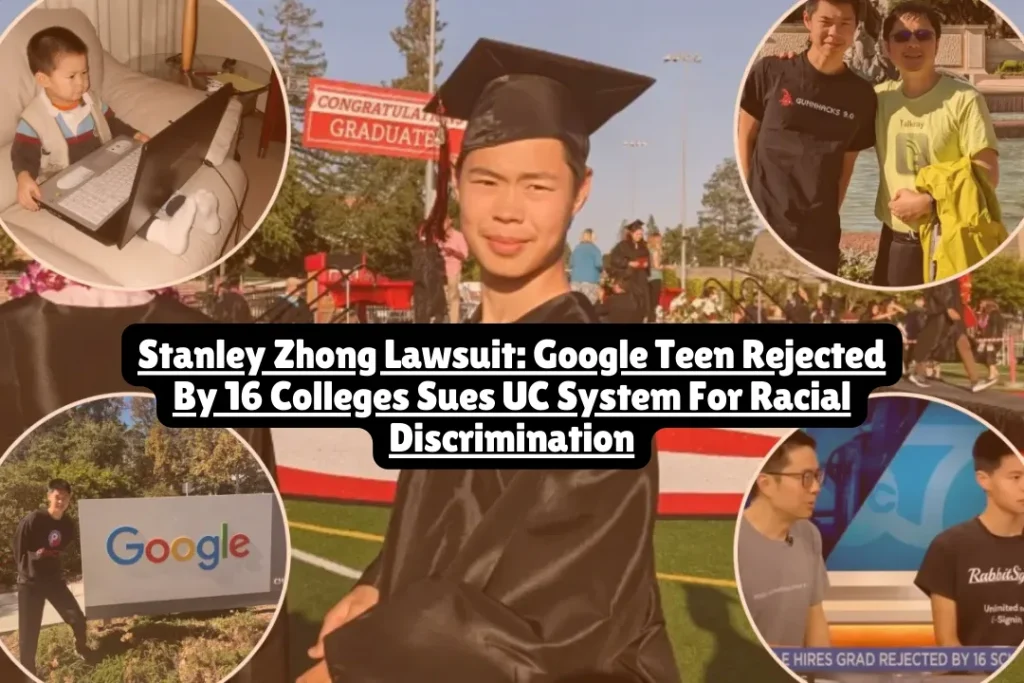
Stanley Zhong’s lawsuit alleges that multiple elite universities, including the entire University of California system, engaged in racial discrimination by rejecting his applications based on his Asian-American identity rather than his exceptional qualifications. In 2023, the Palo Alto teen was rejected by 16 out of 18 colleges despite having a 1590 SAT score, a 4.42 weighted GPA, and coding skills so advanced that Google hired him for a PhD-level position immediately after high school.
In February 2025, Stanley and his father Nan Zhong filed federal lawsuits in the U.S. District Court for the Eastern District of California, alleging the University of California illegally uses race in admissions despite California’s Proposition 209 ban on racial preferences passed in 1996.
What Is The Stanley Zhong Lawsuit About?
The Stanley Zhong lawsuit centers on allegations that America’s most selective universities systematically discriminate against highly qualified Asian-American applicants through holistic admissions processes that consider race as a factor.
Stanley Zhong filed lawsuits on March 22, 2025, in federal court against Cornell University, the University of California system (including Berkeley, UCLA, San Diego, Santa Barbara, and Davis campuses), the University of Washington, and the University of Michigan. The lawsuits also name the U.S. Department of Education as a defendant.
The legal claims cite violations of the Fourteenth Amendment’s Equal Protection Clause, Title VI of the Civil Rights Act of 1964, and California’s Proposition 209 constitutional amendment that prohibits state institutions from discriminating based on race in public education.
Who Is Stanley Zhong?
Stanley Zhong graduated from Gunn High School in Palo Alto with a 3.97 unweighted GPA and a 1590 SAT score—placing him among only 2,000 students nationwide to score at that level. His achievements extended far beyond test scores.
At age 13, Google mistakenly invited Stanley to interview for a full-time software engineering position after reviewing his resume, which detailed his advanced coding skills including advancing to semifinals in Google Code Jam and winning second place globally in MIT Battlecode’s high school division.
During the COVID-19 pandemic, Stanley founded RabbitSign, an unlimited free e-signing service that Amazon Web Services recognized as one of the most efficient and secure accounts they had reviewed.
Before turning 18, Google engineers evaluated Stanley and offered him an L4 position—a level that typically requires a doctoral degree or equivalent experience.
The College Rejection Pattern That Sparked Legal Action
Despite his qualifications, Stanley’s 2023 college application process ended in widespread rejection.
He was rejected or waitlisted by all five University of California campuses he applied to: Berkeley, Los Angeles, Santa Barbara, San Diego, and Davis. The rejections extended beyond the UC system.
Out of 18 total applications, Stanley was rejected by 16 schools including MIT, Carnegie Mellon, Stanford, Cornell, Caltech, University of Illinois, University of Michigan, University of Washington, University of Wisconsin, Georgia Tech, and Cal Poly San Luis Obispo. He was accepted only to the University of Maryland and the University of Texas.
Shortly after these rejections, Google offered Stanley a full-time software engineering position at a level typically requiring a PhD, following rigorous technical assessments and teamwork evaluations.
What Are The Specific Legal Claims In The Stanley Zhong Lawsuit?
The lawsuits make three primary allegations against the defendant universities.
Violation Of California’s Proposition 209
California voters banned the use of race in public university admissions through Proposition 209 in 1996. The Zhong lawsuit alleges the University of California system has circumvented this law through holistic review processes that effectively consider race.
According to Nan Zhong, evidence includes UC’s use of race in faculty hiring while knowing it’s illegal and hiding evidence of such practices, plus clear suppression of Asian enrollment despite strong growth of California’s Asian community.
Violations Of The Fourteenth Amendment Equal Protection Clause
The lawsuits claim that treating Asian-American applicants differently based on race violates the Equal Protection Clause of the Fourteenth Amendment. The complaints state that Stanley was denied equal opportunity to compete for admission on the same footing as other applicants solely because of his race or ethnicity.
Pattern And Practice Of Racial Discrimination
The lawsuits argue Stanley’s rejection reflects systemic discrimination against Asian-American applicants, supported by Students Who Oppose Racial Discrimination (SWORD), an organization founded in October 2024 by Stanley’s father to challenge allegedly discriminatory admissions policies.
Nan Zhong reported receiving emails from numerous Asian-American parents and students sharing similar stories of highly qualified applicants being rejected by all colleges they applied to.
How Are The Universities Responding To The Stanley Zhong Lawsuit?
The defendant universities have strongly denied the allegations.
A University of California spokesperson stated they believe the lawsuit to be meritless and will vigorously defend their admission practices, noting that California banned considering race in admissions in 1996 and UC has followed that law accordingly.
The spokesperson acknowledged that UC asks applicants about race and ethnicity in applications but maintains this information is collected only for statistical purposes, not to influence admissions decisions.
A University of Washington spokesman stated the university stands behind its admissions process while acknowledging they cannot admit all talented and capable applicants due to limited capacity.
What Is The Current Status Of The Stanley Zhong Lawsuit?
As of January 2026, the lawsuits remain in early procedural stages with no trial dates set.
Stanley and Nan Zhong are representing themselves pro se after multiple law firms they contacted declined to take the case or did not respond. According to Nan Zhong, lawyers on the political left didn’t want the case while lawyers on the right believed courts in California would be too biased.
Nan Zhong acknowledged that the legal complaints were largely written using ChatGPT and Gemini AI tools, and stated plans to file lawsuits against additional universities.
The lawsuits were filed following the U.S. Supreme Court’s June 2023 decision in Students for Fair Admissions v. Harvard, which declared race-conscious admissions unconstitutional at colleges and universities nationwide.
What You Must Know About College Admissions Discrimination Lawsuits
How This Case Fits Into Broader Affirmative Action Litigation
The June 2023 Supreme Court ruling in Students for Fair Admissions v. President and Fellows of Harvard College struck down race-based admissions in a 6-3 decision, ruling that Harvard’s admission program violated the 14th Amendment.
Stanley Zhong’s case applies post-2023 Supreme Court precedent to universities in states that already banned race-conscious admissions. California prohibited racial preferences through Proposition 209 in 1996, meaning the UC system operated under different legal constraints than Harvard or other private institutions.
Evidence Challenges In Admissions Discrimination Cases
Proving intentional discrimination in holistic admissions processes presents significant evidentiary challenges. Universities maintain wide discretion in evaluating subjective factors like essays, leadership, and personal character.
A 2020 California state auditor’s report found UC campuses did not adequately train or supervise application readers, creating risk of unfair or inconsistent evaluations, and provided readers with demographic information including names, native languages, and birthplaces that could bias evaluations.
Why Self-Representation Makes These Cases Harder
Legal experts note that civil rights lawsuits against well-funded institutions typically require extensive discovery, expert witnesses, and statistical analysis—resources difficult for self-represented litigants to access.
The Zhong family’s inability to retain counsel, combined with their use of AI tools to draft complaints, may affect the lawsuits’ procedural progression and ultimate outcomes.
What Similar Cases Have Established
This lawsuit follows similar patterns seen in other H1B visa discrimination lawsuits where plaintiffs alleged systematic bias in hiring and employment practices. Just as those cases challenged whether organizations could maintain fair practices when systematic preferences disadvantaged certain groups, the Zhong lawsuit questions whether holistic review processes mask impermissible racial considerations.
What To Do Next If You Believe You Faced College Admissions Discrimination
How To Document Potential Discrimination
If you believe you experienced discrimination in college admissions based on race or ethnicity, document everything. Save all application materials, correspondence with universities, rejection letters, and any information about admitted students’ profiles.
Gather objective evidence of your qualifications including test scores, grades, awards, achievements, and recommendation letters. Compare your credentials to published statistics about admitted student profiles for the universities that rejected you.
When Legal Consultation Is Appropriate
Consult with civil rights attorneys who specialize in education discrimination if you have strong evidence that race factored into an admissions decision. Many civil rights firms offer initial consultations to evaluate whether your case has legal merit.
Be prepared to discuss whether you can prove that similarly situated applicants of different races received different treatment, as this comparison forms the foundation of discrimination claims.
Understanding Your Rights Under Current Law
Following the 2023 Supreme Court decision, universities cannot use race as a factor in admissions decisions. However, Chief Justice John Roberts noted that applicants may discuss how race affected their lives through discrimination, inspiration, or other experiences.
The legal line between permissible discussion of race in personal statements and impermissible use of race in admissions decisions remains subject to ongoing litigation and interpretation.
Frequently Asked Questions About The Stanley Zhong Lawsuit
What is the Stanley Zhong lawsuit about?
The Stanley Zhong lawsuit alleges that multiple universities including the University of California system, Cornell, University of Washington, and University of Michigan engaged in racial discrimination by rejecting Stanley’s applications based on his Asian-American ethnicity rather than his qualifications. The lawsuits claim violations of the Fourteenth Amendment, Civil Rights Act, and California’s Proposition 209.
Why was Stanley Zhong rejected by 16 colleges despite his qualifications?
The lawsuits allege Stanley was rejected due to systematic discrimination against Asian-American applicants through holistic admissions processes that effectively consider race as a negative factor. Universities deny these allegations and maintain their admissions processes are race-neutral and comply with all applicable laws.
Is the Stanley Zhong lawsuit still ongoing?
Yes, as of January 2026, the lawsuits remain active in federal court. No trial dates have been set as the cases are in early procedural stages. Stanley and his father are representing themselves without legal counsel.
What happened to Stanley Zhong after college rejections?
Stanley Zhong accepted a full-time software engineering position at Google at an L4 level that typically requires a PhD or equivalent experience. He later enrolled at the University of Texas, one of two schools that accepted him, and continues working at Google while pursuing his education.
Can universities still use race in admissions after the 2023 Supreme Court decision?
No, the June 2023 Supreme Court decision in Students for Fair Admissions v. Harvard prohibited universities from using race as a factor in admissions decisions. However, applicants may discuss how race affected their personal experiences in essays, and universities retain discretion in holistic review of other factors.
What is Students Who Oppose Racial Discrimination (SWORD)?
SWORD is an organization founded in October 2024 by Nan Zhong, Stanley’s father, to help families challenge allegedly discriminatory admissions policies at colleges and universities. The organization supports the Zhong family’s lawsuits and collects evidence of similar cases affecting Asian-American applicants.
How common are Asian-American discrimination claims in college admissions?
Claims of discrimination against Asian-American applicants have been central to major litigation including the Students for Fair Admissions cases against Harvard and UNC. Statistical analyses in those cases showed Asian-American applicants needed higher test scores and grades than applicants of other races to gain admission to selective universities before the Supreme Court’s 2023 ruling.
Last Updated: January 26, 2026
Disclaimer: This article provides general information about the Stanley Zhong lawsuit and is not legal advice—individuals who believe they experienced admissions discrimination should consult qualified civil rights attorneys for case-specific guidance.
Stay informed about major legal developments affecting education, employment, and civil rights. Understanding your rights under current law empowers you to recognize discrimination and take appropriate action when necessary.
Stay informed, stay protected. — AllAboutLawyer.com
Meta Description: S
About the Author

Sarah Klein, JD, is a licensed attorney and legal content strategist with over 12 years of experience across civil, criminal, family, and regulatory law. At All About Lawyer, she covers a wide range of legal topics — from high-profile lawsuits and courtroom stories to state traffic laws and everyday legal questions — all with a focus on accuracy, clarity, and public understanding.
Her writing blends real legal insight with plain-English explanations, helping readers stay informed and legally aware.
Read more about Sarah