
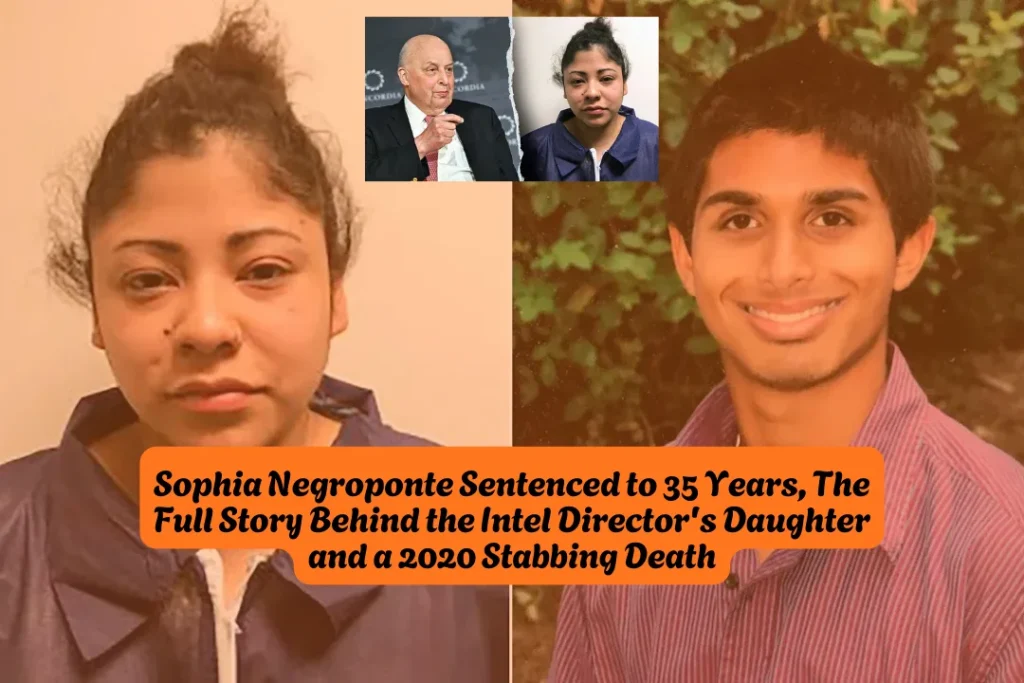
Sophia Negroponte Sentenced to 35 Years, The Full Story Behind the Intel Director’s Daughter and a 2020 Stabbing Death
Sophia Negroponte — the 33-year-old adopted daughter of John Negroponte, the first Director of National Intelligence in US history — was sentenced to 35 years in prison on March 7, 2026 for the second-degree murder of 24-year-old Yousuf Rasmussen. The sentence came after a retrial — Negroponte was originally convicted of the same charge in March 2023 and received the same 35-year sentence, but a Maryland appeals court overturned that conviction in January 2024 and ordered a new trial. Two separate juries, two separate trials, the same verdict, the same sentence. The case is now closed.
Quick Facts
- Defendant: Sophia Negroponte, 33 — Washington DC resident
- Victim: Yousuf Rasmussen, 24
- Date of crime: February 13, 2020
- Location: Airbnb apartment, 400 block of West Montgomery Ave., Rockville, Maryland
- Charge: Second-degree murder
- Sentence: 35 years in prison — imposed March 7, 2026
- Court: Montgomery County Circuit Court, Maryland
- Judge: Judge Terrence McGann
- Prosecution: Montgomery County State’s Attorney John McCarthy
- First conviction: March 2023 — overturned January 2024
- Retrial verdict: Guilty — November 2025
- Resentencing: March 7, 2026
What Happened on the Night of February 13, 2020
It all started on February 13, 2020 around 11:15 p.m. when officers with the Montgomery County and Rockville City Police Departments were called to reports of a fight with someone being cut inside an apartment in the 400 block of West Montgomery Avenue. The caller advised officers that a man had been stabbed in the neck and a woman named Sophia was still at the scene.
Sophia Negroponte and Rasmussen had attended the same Washington high school. The two friends had been drinking together that night, along with another person. They argued twice — Rasmussen left the apartment the first time, but returned. The second argument turned fatal.
The stabbing involved multiple knife wounds, including a fatal blow that severed Rasmussen’s jugular vein. Rasmussen was pronounced dead at the scene.
After being taken into custody, Negroponte allegedly told investigators she did not remember attacking Rasmussen but recalled arguing over a “silly issue” and later removing a knife from his neck.
Who Is John Negroponte — And Why Does It Matter?
President George W. Bush appointed John Negroponte as the nation’s first Director of National Intelligence in 2005 in the aftermath of the September 11 terrorist attacks — a newly created position designed to oversee and coordinate all US intelligence agencies. He later served as Deputy Secretary of State and previously held ambassador roles in Honduras, Mexico, the Philippines, the United Nations, and Iraq.
Sophia is one of five Honduran children who were abandoned or orphaned and adopted by John Negroponte and his wife Diana after he was appointed US Ambassador to Honduras in the 1980s.
The family connection brought intense public attention to what would otherwise have been a local Maryland criminal case. The contrast between John Negroponte’s decades at the highest levels of US national security and his daughter’s conviction for a drunken stabbing at an Airbnb became the central narrative surrounding the case from the moment of Sophia’s arrest.
The First Trial — Conviction, Then Overturn
Sophia Negroponte was convicted of second-degree murder in March 2023 and sentenced to 35 years in prison. The conviction was overturned in January 2024 by the Appellate Court of Maryland.
The reason for the overturn is critical to understanding why a second trial was necessary — and why it matters legally.
An opinion from three judges of the Appellate Court of Maryland sent the case back to Montgomery County for a new trial because the jury was allowed to hear portions of interrogation video showing police questioning Sophia Negroponte’s credibility — as well as testimony from a prosecution expert witness who also questioned her credibility.
The appeals court stated the reason was: “The detectives commented that they found Negroponte’s version of events ‘hard to believe’ and that it looked like she was not being honest. Under our long-established precedent, these kinds of assertions are not relevant and bear a high risk of prejudice.”
In plain terms: the detective’s personal opinion about whether Negroponte was lying was not proper evidence for a jury to hear. A detective saying a defendant seems dishonest can powerfully sway jurors — but it is not the detective’s job to render that opinion. That is the jury’s role. The appeals court ruled the error was serious enough to require a completely fresh trial.
The Retrial — Same Verdict, Same Sentence
During the retrial, prosecutors again laid out their argument that the stabbing occurred during a drunken dispute that turned deadly. The jury ultimately returned another conviction for second-degree murder in November 2025, leading to Friday’s sentencing.
Montgomery County State’s Attorney John McCarthy was direct about the outcome. “The 35-year sentence mirrors the sentence imposed following the first trial in 2023. This is an appropriate and just outcome in light of the seriousness of this crime and the consistent findings of two separate juries who carefully evaluated the evidence.”
Two completely separate juries — drawn from different jury pools, hearing evidence under different conditions — reached identical conclusions. That consistency is legally significant and likely to make any future appeal considerably more difficult.
Why Second-Degree Murder — Not First?
Many readers seeing this headline ask the same question: if someone stabbed a person and severed their jugular vein, why was this charged as second-degree murder rather than first-degree?
The answer comes down to one word: premeditation.
First-degree murder requires proof that the killing was planned and deliberate — that the defendant thought about it in advance and carried out an intentional plan to kill.
Second-degree murder covers intentional killings that were not premeditated — situations where someone intended to cause serious harm or death in the moment, without prior planning. It also covers killings that result from conduct showing extreme recklessness or disregard for human life.
Based on the evidence presented at both trials — a drunken argument between longtime friends that escalated suddenly — prosecutors charged and proved second-degree murder. There was no evidence Negroponte planned the killing in advance. The prosecution successfully argued she acted with intent to harm in the heat of the moment, which satisfies the legal standard for second-degree murder under Maryland law.
Under Maryland sentencing law, second-degree murder carries a maximum sentence of 40 years. The 35-year sentence imposed both times sits near the top of that range — reflecting the severity of the killing and the court’s assessment of the evidence.
Can She Appeal Again?
Technically yes — Negroponte has the right to appeal her retrial conviction. But doing so faces a very steep uphill challenge for two reasons.
First, the specific error that overturned the first conviction — the detective’s credibility opinion testimony — was not repeated in the retrial. Prosecutors and the court were acutely aware of that issue the second time around. Without that error to point to, the grounds for appeal narrow significantly.
Second, two juries reviewing the evidence reached the same guilty verdict at the same sentence. Courts give significant weight to consistent jury findings when evaluating appeal claims. Arguing that both juries were wrong faces a much higher legal bar than challenging a single verdict.
No appeal has been announced as of the time of this article’s publication.
What the Case Reveals About the Criminal Appeals Process
The Negroponte case is a clear illustration of how the appellate system is supposed to work — and why it matters.
A conviction being overturned does not mean the defendant was innocent. It means the process used to reach that conviction had a legal error serious enough to require a do-over. The appeals court identified a specific, well-established legal rule that was violated — detectives improperly telling a jury a defendant seemed dishonest — and ordered a clean trial.
That clean trial produced the same result. Which is itself significant: it tells us the evidence against Negroponte was strong enough to convince two completely separate juries beyond a reasonable doubt, even without the improper detective commentary that tainted the first trial.
The case also highlights how long the criminal justice process can run. The killing occurred in February 2020. The first trial concluded in 2023. The conviction was overturned in 2024. The retrial concluded in November 2025. Sentencing came in March 2026 — more than six years after the night Yousuf Rasmussen was killed.
For Rasmussen’s family, that timeline represents six years of waiting for finality. For Negroponte, it meant living with the uncertainty of a potential retrial for over two years after her first conviction was thrown out.
Key Legal Terms Explained
Second-Degree Murder: An intentional killing that was not premeditated — carried out in the heat of the moment with intent to cause serious harm or death, but without prior planning. In Maryland, carries a maximum sentence of 40 years.
Appellate Court: A higher court that reviews decisions made by lower trial courts — not to retry the case but to determine whether legal errors occurred that affected the fairness of the trial.
Conviction Overturn: When an appeals court finds a legal error serious enough to invalidate a conviction and order a new trial. It is not a finding of innocence — it is a procedural ruling that the original trial was flawed.
Retrial: A completely new trial following an overturned conviction. New jury, new proceedings, same charges. Both sides must present their full cases again from the beginning.
Premeditation: The element that distinguishes first-degree from second-degree murder — evidence that the defendant planned the killing in advance rather than acting impulsively.
Credibility Testimony: Testimony or evidence that comments on whether a defendant or witness is telling the truth. Courts restrict this because it is the jury’s exclusive role to assess credibility — not police officers or expert witnesses.
This article is for informational purposes only and does not constitute legal advice. All information is based on publicly available court records and verified news reports.
Sources: State of Maryland v. Sophia Negroponte, Montgomery County Circuit Court | AP Wire, March 7, 2026 | NBC Washington, March 7, 2026 | Fox News, March 7, 2026 | DC News Now, March 7, 2026 | Washington Post, January 23, 2024 | Appellate Court of Maryland opinion, January 2024
About the Author

Sarah Klein, JD, is a licensed attorney and legal content strategist with over 12 years of experience across civil, criminal, family, and regulatory law. At All About Lawyer, she covers a wide range of legal topics — from high-profile lawsuits and courtroom stories to state traffic laws and everyday legal questions — all with a focus on accuracy, clarity, and public understanding.
Her writing blends real legal insight with plain-English explanations, helping readers stay informed and legally aware.
Read more about Sarah