
Similac Heavy Metals Lawsuit, 98% of Samples Contaminated—What Parents Must Know
Abbott Laboratories faces a class action lawsuit claiming its Similac infant formulas contain dangerous levels of arsenic, cadmium, lead, and mercury—toxic heavy metals never disclosed to parents. Testing from 2022-2023 showed at least one heavy metal in 119 out of 121 Similac samples tested, with arsenic levels as high as 59.3 parts per billion (six times the FDA’s limit for bottled water). The lawsuit, filed March 2025 in Illinois federal court, is separate from the ongoing NEC litigation and focuses specifically on consumer fraud and failure to warn about toxic contamination. No settlement exists yet. This case is in early stages, with no court decisions on merit.
What Is the Similac Heavy Metals Class Action About?
On March 7, 2025, two parents—Tiffany Huggins of Washington and Lauren Nunez of California—filed an 85-page class action complaint against Abbott Laboratories in the U.S. District Court for the Northern District of Illinois.
The core allegation: Abbott knew its Similac powdered infant formulas contained or risked containing toxic heavy metals but deliberately hid this information from parents while marketing the products as “healthy,” “nutritious,” and safe for babies.
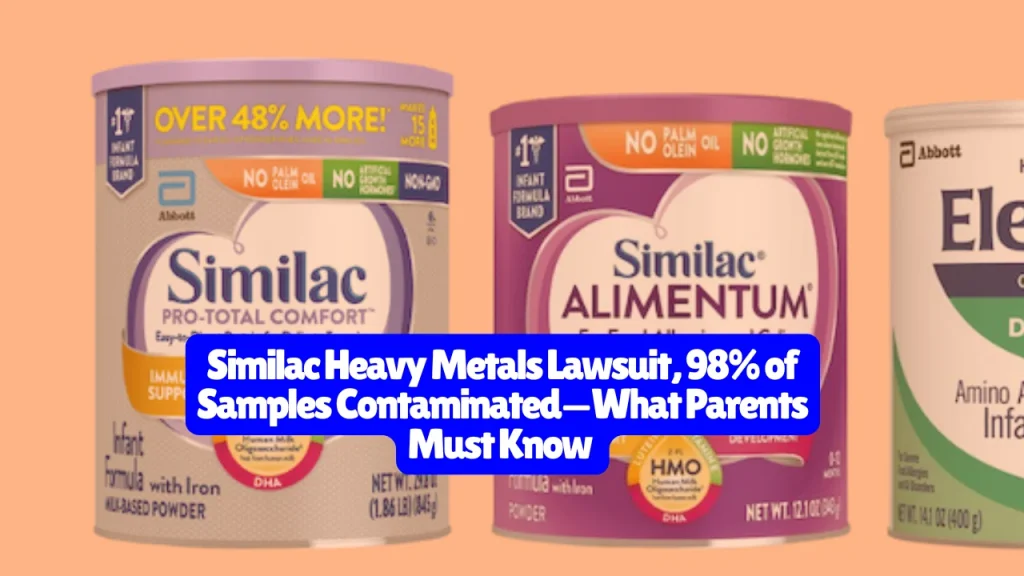
The affected products include:
- Similac Pro Advance
- Similac Advance OptiGRO
- Similac 360 Total Care
- Similac Soy Isomil
- Similac NeoSure
- Similac Total Comfort
The lawsuit claims Abbott violated state and federal consumer protection laws by selling premium-priced formulas with hidden contamination that parents could never have anticipated based on the packaging and marketing.
Heavy Metals in Similac: The Reality Behind the Allegations
This isn’t speculation—it’s backed by laboratory testing.
The testing results are alarming:
Arsenic: Up to 59.3 parts per billion (ppb) detected. The FDA sets the maximum contaminant level for arsenic in bottled water at 10 ppb. Similac formulas contained nearly six times that limit.
Cadmium: Up to 11.4 ppb detected. The FDA limit for cadmium in bottled water is 5 ppb. Similac formulas had more than twice that level.
Lead: Up to 3.6 ppb detected. Lead is “extremely toxic” and causes irreversible brain damage. The CDC states there is no safe level of lead exposure for children.
Mercury: Up to 10.1 ppb detected. The EPA’s maximum allowable level for mercury in drinking water is 2 ppb. Similac formulas had five times that amount.
The scale of contamination: Testing from 2022 and 2023—including Abbott’s own testing—showed that 119 out of 121 Similac samples (98.35%) contained detectable levels of at least one heavy metal. Only two samples tested clean.
Why this matters: The FDA has not established maximum allowable levels for heavy metals in infant formula. Abbott exploited this regulatory gap to sell contaminated products without disclosure.
Related article: NewJeans ADOR Lawsuit, Court Crushes Rebellion, Danielle Out—What Happened Today (December 29, 2025)

What Does the Lawsuit Allege About Heavy Metal Contamination?
The plaintiffs claim Abbott’s conduct was deliberate and deceptive.
Specific allegations include:
Abbott knew about the contamination. The lawsuit claims Abbott conducted its own testing showing heavy metal presence but never disclosed the results to consumers.
Abbott misled parents through packaging. Similac products feature messaging emphasizing “healthy,” “nutritious,” and “high-quality” ingredients with no mention of toxic metals.
Abbott charged premium prices. Parents paid extra for Similac believing it was safer and better quality than competitors, unaware it contained dangerous contaminants.
Abbott violated consumer protection laws. The lawsuit alleges violations of the Magnuson-Moss Warranty Act, state consumer fraud statutes, and breach of implied warranty.
Abbott failed to implement quality control. Despite knowing heavy metals pose serious risks—especially to infants—Abbott allegedly made no effort to reduce or eliminate contamination.
Abbott’s Response to the Lawsuit
Abbott has not filed a formal response yet, but in prior public statements, the company has acknowledged that trace levels of heavy metals can appear in foods due to environmental presence.
The defense Abbott will likely use:
“Heavy metals occur naturally in soil and water. Trace amounts in formula are unavoidable and don’t pose health risks at the levels detected.”
Why this defense is problematic:
The levels aren’t trace. When arsenic in formula is six times the FDA’s limit for bottled water, “trace” doesn’t cut it.
Infants are uniquely vulnerable. Adults can tolerate exposures that permanently damage developing infant brains.
Abbott didn’t warn parents. Even if contamination were unavoidable, failing to disclose it violates consumer protection laws.
Competitors have lower levels. If other manufacturers can reduce heavy metal contamination, Abbott had no excuse not to do the same.
Which Courts Are Handling This Lawsuit?
This heavy metals class action was filed in the U.S. District Court for the Northern District of Illinois, Eastern Division.
Why Illinois? Abbott Laboratories is headquartered in Illinois, making it the logical jurisdiction for consumer fraud claims.
Important note: This lawsuit is separate from the massive NEC (necrotizing enterocolitis) litigation also pending against Abbott. The NEC cases involve premature babies who developed a deadly intestinal condition after consuming Similac. Those lawsuits are consolidated in MDL-3026 in the same Illinois court, but they make different claims focused on failure to warn about NEC risks in preterm infants.
Current Status of the Similac Heavy Metals Class Action (December 2025)
Case status: Early stages. No court decisions on the merits yet.
What’s happened so far:
- March 7, 2025: Class action complaint filed
- March 24, 2025: News outlets report on the lawsuit
- April 2025: Additional parents express interest in joining the class
- December 2025: Case remains in pre-certification stage
What hasn’t happened yet:
- No class certification (the court hasn’t officially approved this as a class action)
- No settlement discussions publicly disclosed
- No trial date set
- No discovery phase begun
What to expect next:
- Abbott will likely file a motion to dismiss (challenging whether plaintiffs stated valid legal claims)
- Plaintiffs will file for class certification (asking the court to approve a nationwide class of all Similac buyers)
- If class certification is granted, discovery will begin (document exchanges, depositions, expert testimony)
- Settlement negotiations typically start after class certification
What Laws Apply to This Infant Formula Case?
Federal laws:
Magnuson-Moss Warranty Act: Protects consumers from deceptive warranties. The lawsuit claims Abbott’s implied warranties that Similac was safe and healthy were false.
Federal Food, Drug, and Cosmetic Act (FFDCA): Governs FDA regulation of infant formula. The lawsuit notes the FDA has not established maximum levels for heavy metals in formula—a regulatory gap Abbott allegedly exploited.
State laws:
Consumer Fraud Acts: Most states have laws prohibiting deceptive trade practices. The plaintiffs allege violations of Washington and California consumer protection statutes.
Breach of Implied Warranty: When a company sells a product, it implicitly promises the product is fit for its intended use. Infant formula containing brain-damaging heavy metals arguably isn’t “fit” for feeding babies.
Unjust Enrichment: Abbott allegedly profited by charging premium prices for contaminated formula without disclosure.
The legal standard plaintiffs must prove:
- Abbott made false or misleading representations (marketing Similac as safe/healthy without disclosing heavy metals)
- Consumers relied on those representations (parents bought Similac believing it was safe)
- Consumers suffered harm (paid premium prices for contaminated formula)
- Abbott knew or should have known its representations were false
Evidence of Heavy Metal Contamination
The plaintiffs have strong evidence backing their claims.
Independent laboratory testing (2022-2023):
- Tested 121 Similac samples across multiple product lines
- Found heavy metals in 119 samples (98.35%)
- Detected arsenic, cadmium, lead, and mercury at levels exceeding FDA limits for drinking water
Abbott’s own testing:
- The lawsuit claims Abbott conducted internal testing confirming heavy metal presence
- Abbott never disclosed these results to consumers
- Abbott continued marketing products as “healthy” and “nutritious”
Comparative analysis:
- Other infant formula brands have lower heavy metal levels
- This suggests Abbott’s contamination was preventable through better quality control
Medical research:
- Government agencies and medical experts agree there are “no known safe levels of heavy metals” for infants
- Even trace amounts accumulate in the body over time, causing cumulative brain damage
- Infants are uniquely vulnerable due to small size and developing nervous systems
What Legal Experts Say About the Claims
Product liability attorneys following this case note several strengths in the plaintiffs’ claims.
Strong points for plaintiffs:
Clear consumer protection violation. If Abbott knew about heavy metal contamination and didn’t disclose it, that’s textbook consumer fraud.
Measurable damages. Parents paid premium prices for Similac believing it was safer. If they’d known about contamination, they wouldn’t have bought it or would have paid less.
Compelling public interest. Courts take infant safety seriously. A case about brain-damaging toxins in baby formula will get judicial attention.
Regulatory gap exploitation. The FDA’s failure to set heavy metal limits for formula doesn’t give Abbott a pass to sell contaminated products without warning.
Challenges plaintiffs face:
Class certification hurdles. Abbott will argue parents in different states paid different prices and suffered different injuries, making a nationwide class unmanageable.
Causation issues. Plaintiffs must prove the heavy metals in Similac actually caused harm—difficult when most babies don’t show immediate symptoms.
Industry-wide problem. If all infant formulas contain some heavy metals (which they do), Abbott will argue Similac isn’t uniquely dangerous.
Trace levels defense. Abbott will claim the amounts detected are too small to cause harm, despite exceeding FDA limits for water.
Similar Product Liability Cases: How They Compare
This lawsuit fits a pattern of recent class actions targeting baby food manufacturers over heavy metal contamination.
Enfamil heavy metals class action (January 2024):
- Four plaintiffs sued Mead Johnson claiming Enfamil formulas contained arsenic, lead, cadmium, and mercury
- Allegations nearly identical to the Similac case
- Pending in U.S. District Court, Northern District of Illinois
- No settlement yet
Gerber baby food class action (2021):
- Parents sued over heavy metals in jarred baby foods
- Case resulted in Gerber reformulating products and improving testing
- Settled for undisclosed amount
Hain Celestial baby food lawsuit (2021):
- Earth’s Best Organic baby foods allegedly contained lead and arsenic
- Pending litigation
- No settlement yet
Key lesson from prior cases: Baby food manufacturers have repeatedly failed to disclose heavy metal contamination. Courts have allowed these lawsuits to proceed, finding that parents have valid consumer fraud claims even when products meet minimal FDA standards.
These patterns mirror broader product liability litigation, including the Abbott baby formula NEC lawsuits and high-stakes cases like the Johnson & Johnson baby powder talc litigation where manufacturers face massive liability for failing to warn about toxic contamination.
Timeline of Developments
March 7, 2025: Tiffany Huggins and Lauren Nunez file 85-page class action complaint in Illinois federal court
March 24, 2025: News outlets report on the lawsuit; parents nationwide begin expressing interest in joining
April 2025: Law firms investigating potential claims announce they’re accepting new clients
June 2025: Abbott likely files motion to dismiss (no public filings confirm this yet)
December 2025: Case remains in early litigation stages; no class certification decision yet
December 29, 2025 Status: As we close 2025, the heavy metals class action remains in pre-certification phase. Abbott has not yet filed its motion to dismiss publicly. Meanwhile, separate NEC bellwether trials against Abbott have faced setbacks—three Similac NEC cases were dismissed on summary judgment in October-November 2025 because plaintiffs couldn’t prove safer alternatives existed. However, one Enfamil NEC case is set for trial February 2, 2026, and a second wave of Similac NEC bellwethers is scheduled for August 2026.
2026 Expectations:
- January-February 2026: Abbott likely files motion to dismiss the heavy metals class action
- March-May 2026: Plaintiffs respond and file for class certification
- Mid-2026: Court ruling on motion to dismiss expected
- Late 2026: If case survives dismissal, discovery phase begins and potential settlement negotiations start
- Regulatory pressure: With FDA reviewing infant formula ingredients under new leadership, Abbott faces mounting pressure to disclose contamination levels even without court order
Estimated trial date: 2027-2028 at the earliest (if no settlement)
How to Determine Class Membership Eligibility
You may qualify if:
You purchased Similac powdered infant formula between March 7, 2019, and present (the class period)
You bought for household use (not for resale)
You purchased one of the affected products:
- Similac Pro Advance
- Similac Advance OptiGRO
- Similac 360 Total Care
- Similac Soy Isomil
- Similac NeoSure
- Similac Total Comfort
You would not have bought the product or would have paid less if Abbott had disclosed heavy metal contamination
What you need to join:
Proof of purchase: Receipts, credit card statements, or pharmacy records showing Similac purchases during the class period
Product identification: Know which specific Similac products you bought
Household use: You purchased for your own baby, not for a business
You do NOT need:
- Proof your baby was harmed by the formula
- Medical records showing heavy metal poisoning
- Evidence of developmental delays or neurological issues
This is a consumer fraud class action, not a personal injury lawsuit. You’re claiming economic harm (paying premium prices for contaminated formula), not physical injury to your child.
The Broader Implications for Infant Formula Safety Standards
This lawsuit could force changes across the industry.
Potential outcomes:
FDA regulation: Pressure on the FDA to establish maximum allowable levels for heavy metals in infant formula—something that should have existed decades ago.
Mandatory testing and disclosure: Courts could require manufacturers to test for heavy metals and disclose results on packaging, similar to warning labels on other consumer products.
Quality control standards: Abbott and competitors may implement stricter sourcing and manufacturing controls to reduce contamination.
Industry-wide settlements: If plaintiffs win or force a settlement, other formula manufacturers face similar lawsuits. This could lead to a comprehensive settlement restructuring infant formula safety standards.
Increased scrutiny: Parents, pediatricians, and regulators will demand transparency about what’s in infant formula—a long-overdue reckoning for an industry that’s operated with minimal oversight.
FAQ: Similac Heavy Metals Class Action
Q: Is this the same as the NEC baby formula lawsuit?
No. The NEC litigation involves premature babies who developed necrotizing enterocolitis (a deadly intestinal condition) after consuming cow’s milk-based Similac. Those are personal injury lawsuits seeking compensation for medical injuries and wrongful death. This heavy metals class action is a consumer fraud case about Abbott failing to disclose contamination. They’re separate lawsuits with different claims, though both target Abbott.
Q: Can I join this class action if I used Similac?
If you purchased any of the affected Similac products between March 7, 2019, and present, you may qualify. However, the court hasn’t certified this as a class action yet. If certification is granted, notice will be sent to potential class members with instructions on how to join or opt out.
Q: Do I need proof my baby was harmed by heavy metals?
No. This is a consumer fraud case, not a personal injury lawsuit. You’re claiming you paid premium prices for contaminated formula without knowing about the contamination. You don’t need to prove your child suffered physical harm.
Q: What if I don’t have receipts?
You may still qualify. Credit card statements, bank records, pharmacy purchase histories, or even testimony that you regularly bought Similac during the class period could suffice. An attorney can advise on acceptable forms of proof.
Q: How much money could I get from this lawsuit?
Too early to say. If the case settles, class members typically receive modest amounts (often $10-$100 per claim) unless they can prove significant out-of-pocket losses. If plaintiffs win at trial, damages could be higher. Settlement amounts depend on how many people join the class and what Abbott is willing to pay.
Q: Can I sue Abbott separately for my baby’s injuries?
Yes. If your child suffered developmental delays, neurological issues, or other health problems you believe were caused by heavy metal exposure from Similac, you can file a separate personal injury lawsuit. However, those cases face the difficult challenge of proving causation (that Similac specifically caused your child’s condition). Consult a product liability attorney.
Q: Is Similac still safe to use?
That’s a medical question, not a legal one. The lawsuit alleges Similac contains heavy metals at levels exceeding FDA limits for drinking water. If you’re concerned, consult your pediatrician about alternative formulas or breastfeeding options. Many pediatricians recommend breastfeeding over formula when possible.
Q: What about other infant formula brands?
The lawsuit focuses on Similac, but testing has found heavy metals in multiple brands, including Enfamil, Gerber, and others. A separate class action was filed against Enfamil in January 2024 making similar allegations. The problem appears industry-wide.
Q: Will Abbott recall Similac?
No recall has been announced. Abbott previously recalled Similac products in 2022 over bacterial contamination but not over heavy metals. The FDA has not ordered a recall, and Abbott maintains its products are safe.
Q: How long will this lawsuit take?
Class actions typically take 2-5 years to resolve. This case was filed in March 2025. If it follows typical timelines:
- 2025-2026: Motions to dismiss, class certification
- 2026-2027: Discovery, expert testimony
- 2027-2028: Trial or settlement But many class actions settle before trial.
Q: Should I stop using Similac?
Talk to your pediatrician. This is a medical decision. If you’re concerned about heavy metal exposure, ask your doctor about alternative formulas or breastfeeding options. Don’t abruptly switch formulas without medical guidance, as infants can be sensitive to formula changes.
Q: How do I join the lawsuit?
Wait for class certification. If the court certifies the class, notice will be mailed or emailed to potential class members with instructions. You can also contact one of the law firms handling the case to express interest. Most class actions don’t require you to hire your own attorney—the class counsel represents everyone.
Q: What if I fed my baby Similac years ago?
The class period starts March 7, 2019. If you purchased Similac on or after that date, you may qualify. If your purchases were before 2019, you likely don’t qualify for this particular class action, though you might have other legal options depending on your state’s statute of limitations.
What to Expect Next
2026 developments:
Motion to dismiss ruling: Abbott will argue the lawsuit should be thrown out because plaintiffs haven’t stated valid legal claims. The judge will decide whether the case can proceed. Expect this ruling in Q1-Q2 2026.
Class certification decision: If the case survives the motion to dismiss, plaintiffs will ask the court to certify a nationwide class. Abbott will oppose this, arguing the class is too broad. Decision expected mid-2026.
Discovery begins: If class certification is granted, both sides will exchange documents, take depositions, and gather evidence. Expect Abbott’s internal testing results to become public in late 2026.
Expert testimony: Both sides will hire toxicologists, pediatricians, and industry experts to testify about whether the heavy metal levels in Similac are dangerous.
NEC litigation impact: The separate NEC bellwether trials (February 2026 and August 2026) could influence settlement discussions in the heavy metals case. If Abbott faces massive verdicts in NEC trials, they may be more willing to settle the heavy metals class action to avoid further public relations damage.
Settlement talks: Most class actions settle. Expect confidential negotiations, possibly court-ordered mediation, beginning in mid-to-late 2026 if the case survives dismissal and class certification.
2027-2028:
Bellwether trials: If no settlement, courts often select a few representative cases to try first. These “test cases” help both sides gauge how juries will respond.
Industry-wide impact: Other formula manufacturers face similar lawsuits. A big settlement or verdict against Abbott will trigger settlements across the industry.
Regulatory action: Pressure mounts on the FDA to establish heavy metal limits for infant formula—something European regulators did years ago.
The Bottom Line
This isn’t a frivolous lawsuit. Laboratory testing shows 98.35% of Similac samples contained heavy metals at levels exceeding FDA limits for drinking water.
For parents who used Similac:
- You may qualify for the class action if you purchased affected products after March 2019
- You don’t need proof your baby was harmed—this is about economic damages, not personal injury
- Wait for class certification; you’ll receive notice if it’s approved
For the industry:
- This lawsuit exposes a massive regulatory failure—the FDA has no maximum limits for heavy metals in infant formula
- Abbott and competitors will face mounting pressure to reduce contamination and disclose testing results
- Expect industry-wide settlements and stricter safety standards
For infants:
- Heavy metals accumulate in the body over time, causing irreversible brain damage
- Even “trace” amounts are dangerous for developing babies
- There is no safe level of lead, arsenic, cadmium, or mercury exposure for children
This case is about holding Abbott accountable for selling contaminated formula at premium prices while hiding the truth from parents who trusted their products.
The question isn’t whether Similac contains heavy metals—testing proves it does. The question is whether Abbott will be forced to compensate the families who unknowingly fed toxins to their babies.
Last Updated: December 29, 2025
Court: U.S. District Court for the Northern District of Illinois, Eastern Division
Case Status: Pre-certification; early litigation stage; no motion to dismiss filed publicly yet
Affected Products: Similac Pro Advance, Similac Advance OptiGRO, Similac 360 Total Care, Similac Soy Isomil, Similac NeoSure, Similac Total Comfort
Class Period: March 7, 2019 – present
Next Expected Development: Abbott’s motion to dismiss (anticipated Q1 2026)
Disclaimer: This article is for informational purposes only and does not constitute legal or medical advice. Consult a qualified attorney about your legal rights and a pediatrician about infant feeding decisions. All information is based on publicly available court documents, testing results, and news reports as of December 2025.
About the Author

Sarah Klein, JD, is a licensed attorney and legal content strategist with over 12 years of experience across civil, criminal, family, and regulatory law. At All About Lawyer, she covers a wide range of legal topics — from high-profile lawsuits and courtroom stories to state traffic laws and everyday legal questions — all with a focus on accuracy, clarity, and public understanding.
Her writing blends real legal insight with plain-English explanations, helping readers stay informed and legally aware.
Read more about Sarah