
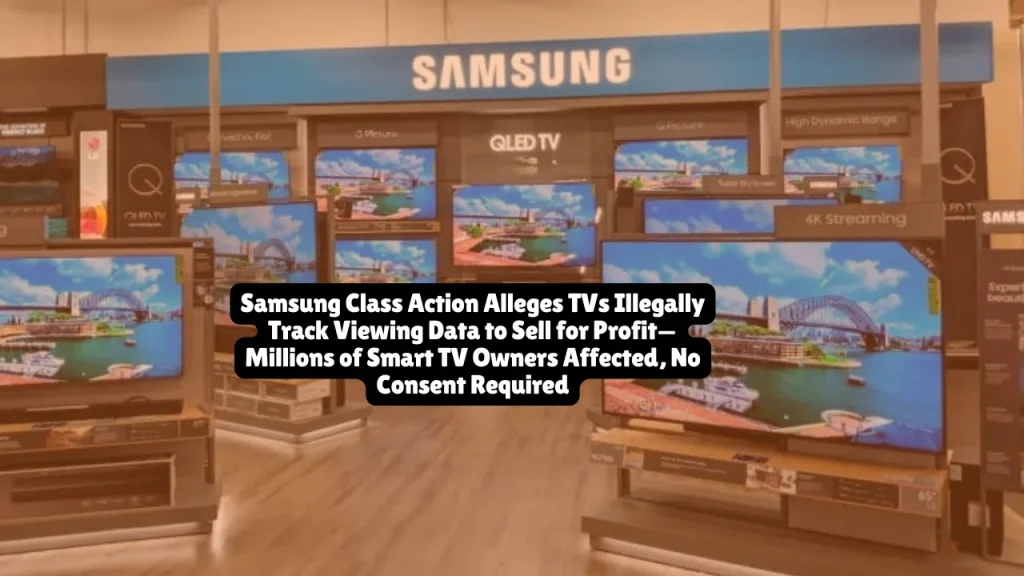
Samsung Class Action Alleges TVs Illegally Track Viewing Data to Sell for Profit—Millions of Smart TV Owners Affected, No Consent Required
Samsung faces a federal class action lawsuit alleging the company embeds automatic content recognition software in its smart TVs that secretly tracks what millions of Americans watch and sells this viewing data to advertisers like Google and X (formerly Twitter) for profit—all without obtaining proper consent from TV owners. Five plaintiffs filed the complaint on January 9, 2026, in New York federal court, claiming Samsung violated the Video Privacy Protection Act and state privacy laws by collecting personally identifiable viewing information that the company then monetizes through targeted advertising partnerships.
What Does the Lawsuit Allege About Samsung’s Unauthorized Data Collection?
The class action claims Samsung smart TVs contain automatic content recognition technology—ACR—that identifies what you’re watching by analyzing video content in real-time, capturing screenshots of your television display every 500 milliseconds (twice per second) to monitor viewing activity and build detailed profiles of your entertainment habits without explicit user permission. This surveillance technology operates invisibly in the background, tracking not just streaming content from apps like Netflix or Hulu, but also cable television, over-the-air broadcasts, connected gaming consoles, Blu-ray players, and any other device connected to your Samsung TV through HDMI inputs.
Here’s what makes this troubling: unlike Nielsen ratings programs that pay households to voluntarily track their viewing with specially installed equipment, Samsung’s ACR technology comes pre-installed and activated by default in millions of smart TVs. The complaint alleges Samsung then packages this granular viewing data—what shows you watch, when you watch them, how long you view each program, which channels you prefer, what content you search for—and sells it to third-party advertisers and data brokers who use the information to target you with personalized ads across multiple platforms.
The lawsuit specifically names Google and X as companies that purchased Samsung viewing data. According to the allegations, when you watch a particular show on your Samsung TV, advertisers can then serve you related ads on Facebook, Instagram, your smartphone, or other devices—creating a comprehensive surveillance ecosystem that follows your interests across your digital life, all without your knowledge or meaningful consent.
How Does Samsung Profit From Selling Your Viewing Data?
Samsung allegedly monetizes TV owner viewing habits through data sharing agreements with advertisers, analytics companies, and marketing platforms that pay for access to detailed consumer behavior profiles. Automatic content recognition technology—the software that identifies what you’re watching by analyzing video content frame-by-frame—is at the heart of Samsung’s alleged data collection scheme, allowing the company to build detailed profiles of viewing habits without explicit user permission.
The business model works like this: Samsung provides the hardware (your TV) as a gateway to continuous data harvesting. Every show you watch, every channel you flip to, every streaming service you use becomes a data point that Samsung captures, processes, and packages for sale. Advertisers pay premium prices for this information because viewing habits reveal intimate details about your interests, demographics, lifestyle, and purchasing intent far more accurately than generic consumer surveys.
Industry analysis suggests smart TV manufacturers increasingly rely on data monetization to subsidize hardware costs. Vizio, another smart TV maker, famously generated twice as much revenue selling customer viewing data and advertising as it did from actual television sales. According to a 2017 Federal Trade Commission settlement, Vizio collected viewing histories on 11 million smart televisions without users’ consent, ultimately paying $2.2 million to settle charges—a fraction of the profits generated from years of unauthorized data collection.
The Samsung complaint alleges similar practices: the company allegedly prioritizes data collection revenue over consumer privacy, embedding surveillance technology that continuously monitors household viewing to fuel a lucrative advertising ecosystem that treats your living room entertainment as a commodity to be harvested and sold.
Which Samsung TV Models Are Allegedly Tracking Viewing Data?
The class action targets Samsung smart TVs running the company’s Tizen operating system, which powers the vast majority of Samsung televisions sold in recent years. While the complaint doesn’t limit allegations to specific model numbers, the allegations encompass Samsung smart TVs capable of running ACR technology—essentially any internet-connected Samsung television manufactured and sold in the United States over the past several years.
This potentially affects millions of households. Samsung has consistently ranked as the world’s number one television brand, with the company reporting 88 million monthly active users on its Samsung TV Plus streaming platform as of October 2024. The widespread deployment of ACR technology across Samsung’s smart TV lineup means nearly every Samsung television owner who connected their TV to the internet likely had their viewing data collected and potentially sold.
Related article: Mario Badescu Sued Over Class Action Claims Facial Spray Does Not Contain Rosewater Despite Product Label
The technology operates through Samsung’s Smart Hub interface and related privacy settings that users encounter during initial TV setup. The complaint alleges that while Samsung technically allows users to disable ACR tracking, the company makes enabling data collection extremely easy—often requiring just one click during setup—while disabling tracking requires navigating through multiple menus and toggling several different settings buried deep in privacy configurations.
When and Where Was the Samsung TV Tracking Lawsuit Filed?
Plaintiffs filed DiGiacinto, et al. v. Samsung Electronics America, Inc., Case No. 1:26-cv-00196, on January 9, 2026, in the United States District Court for the Southern District of New York. The complaint names Samsung Electronics America, Inc., the company’s U.S. subsidiary headquartered in Ridgefield Park, New Jersey, as defendant.
The five named plaintiffs represent Samsung TV owners from multiple states who allegedly had their viewing data tracked and sold without proper consent. Like many consumer privacy class actions, these plaintiffs seek to represent a nationwide class of all U.S. residents who own Samsung smart TVs equipped with ACR technology and had their viewing information collected, stored, or disclosed to third parties.
The New York filing follows closely on the heels of separate but related legal action in Texas, where Attorney General Ken Paxton filed lawsuits on December 15, 2025, against five major TV manufacturers—Samsung, Sony, LG, Hisense, and TCL—alleging similar ACR surveillance practices. The Texas complaints describe ACR as “an uninvited, invisible digital invader” and claim these companies transformed “millions of American living rooms into mass surveillance systems.”
A Texas state court has already granted a temporary restraining order against Hisense prohibiting the company from collecting viewing data from Texas consumers, signaling judicial receptiveness to claims that smart TV data collection violates consumer protection laws.
What Privacy Laws Does the Lawsuit Claim Samsung Violated?
The complaint asserts violations of multiple federal and state privacy statutes, with the Video Privacy Protection Act forming the core of the legal challenge. The VPPA—enacted in 1988 after a newspaper published Supreme Court nominee Robert Bork’s video rental history—prohibits any “video tape service provider” from disclosing personally identifiable information about a consumer’s viewing habits without written consent.
While originally designed to protect video rental records from brick-and-mortar stores like Blockbuster, courts have increasingly recognized that the VPPA’s privacy protections remain robust in the streaming era. As the Second Circuit Court of Appeals declared in 2024, the VPPA is “no dinosaur statute”—its protections apply equally to modern video consumption through smart TVs, streaming platforms, and online services.
The lawsuit likely also asserts claims under state consumer protection laws, unfair business practices statutes, and potentially state wiretapping provisions that prohibit intercepting electronic communications without consent. California’s Invasion of Privacy Act, for example, has been successfully used in similar cases involving unauthorized data collection from apps and websites.
The VPPA provides particularly powerful remedies for plaintiffs: up to $2,500 in liquidated damages per violation, plus attorneys’ fees and litigation costs. When certified as a class action representing millions of Samsung TV owners, potential damages could reach billions of dollars—creating substantial settlement pressure even if Samsung maintains its practices were lawful.
What Evidence Supports the Illegal Tracking Allegations?
The allegations rest on multiple forms of documented evidence demonstrating Samsung’s data collection practices. Technical investigations by privacy researchers have analyzed Samsung smart TV software configurations, network traffic patterns, and data transmission practices to document exactly what information ACR technology collects and where it sends this data.
A September 2024 research paper titled “Watching TV with the Second-Party: A First Look at Automatic Content Recognition Tracking in Smart TVs” provided detailed technical analysis of how ACR operates across multiple TV brands. The study found that nearly three-fourths of U.S. households have a smart TV with ACR capability, with experts describing the technology as “like someone has installed a camera 24-7 in your living room.”
Texas Attorney General Ken Paxton’s December 2025 investigation included hands-on testing of Samsung smart TVs. According to the Texas complaint, state investigators purchased a Samsung Tizen TV from Best Buy in Austin, assembled it, and carefully documented the setup process and privacy settings. Their findings revealed that Samsung provides consumers with a one-click enrollment option during initial setup to enable ACR tracking, but opting out requires more than 15 clicks across multiple menus—creating asymmetric choice architecture that steers users toward surveillance.
Privacy policy analysis also supports the allegations. Researchers and attorneys have scrutinized Samsung’s privacy disclosures to determine whether the company adequately informed consumers that ACR technology would track all viewing activity and share this data with advertisers. The gap between Samsung’s dense legal language and average consumers’ understanding of what data collection actually occurs forms a key part of the deceptive practices claims.
What Is Samsung’s Response to the Data Tracking Allegations?
As of mid-January 2026, Samsung has not issued a public statement specifically addressing the New York federal class action allegations. When contacted about the Texas state lawsuits filed in December 2025, Samsung spokesperson Siobhan Lopez declined to comment, stating the company doesn’t have anything to say about ongoing litigation.
Samsung’s website privacy policies acknowledge that the company collects viewing information through ACR technology and may share this data with third parties for advertising purposes, but the question at the heart of both lawsuits is whether these disclosures constitute legally adequate informed consent under privacy statutes like the VPPA.
The company’s defense will likely argue that Samsung provides clear privacy disclosures during TV setup, that users can disable ACR tracking through settings menus, and that modern video streaming services commonly collect viewing data for legitimate business purposes like content recommendations and advertising. Samsung may also challenge whether it qualifies as a “video tape service provider” under the VPPA’s statutory definition, though courts have increasingly rejected narrow interpretations that would exempt streaming and smart TV companies from the law’s protections.
Following the Texas litigation, Samsung has not announced any changes to its ACR technology deployment, privacy settings interfaces, or data sharing practices. The temporary restraining order obtained against competitor Hisense in Texas demonstrates that courts may grant preliminary relief prohibiting data collection while lawsuits proceed, potentially pressuring Samsung to modify practices even before final judgments.
What You Must Know About This Lawsuit
How to Check If Your Samsung TV Is Collecting Viewing Data
Samsung smart TVs manufactured in recent years almost certainly contain ACR technology capable of tracking your viewing habits. To determine whether this tracking is currently active on your television, navigate to Settings > Support > Terms & Policy > Privacy Policy, then scroll to the section describing automatic content recognition or viewing information.
You can also access ACR settings more directly through Settings > Support > Terms & Policy > SyncPlus and Marketing. Look for options labeled “Viewing Information Services” or “Interest-Based Advertisement.” If these features are enabled, your Samsung TV is actively collecting viewing data and may be sharing it with third parties.
However, disabling these settings may not completely stop all data collection. Privacy researchers have found that some smart TVs continue transmitting usage information even after users disable advertised privacy controls, raising questions about whether Samsung’s opt-out mechanisms function as consumers reasonably expect.
Statute of Limitations Deadlines for Privacy Claims
The Video Privacy Protection Act imposes a two-year statute of limitations from the date a violation occurs or when you reasonably should have discovered the violation. For ongoing data collection, this means the limitations period may reset with each instance of unauthorized disclosure, but older violations beyond the two-year window may be time-barred.
State privacy laws impose varying deadlines. California’s Invasion of Privacy Act generally allows three years to file claims, while other states’ consumer protection statutes range from one to six years depending on specific provisions. Because class actions filed in 2026 will seek class certification covering millions of Samsung TV owners with viewing data collected over multiple years, determining which violations fall within applicable limitations periods will be critical.
How Class Action Privacy Settlements Typically Work
Based on precedent from similar technology privacy class actions, if the Samsung lawsuit proceeds to settlement, compensation will likely take several forms. Cash payments to class members who submit valid claims are standard, though individual amounts depend on the total settlement fund and number of claimants. Past VPPA settlements have resulted in payments ranging from $15 to $50 per person for consumer-facing video services.
Settlements commonly include injunctive relief—court orders requiring Samsung to change business practices going forward. This might mandate clearer privacy disclosures, easier opt-out mechanisms, default-off settings for ACR tracking, or complete elimination of certain data sharing partnerships. For many privacy-focused plaintiffs, these practice changes provide greater long-term value than monetary compensation.
However, class action settlements rarely provide full compensation for privacy violations. Attorney fees typically consume 25-33% of settlement funds. Administrative costs and cy pres awards (where unclaimed settlement money goes to privacy advocacy organizations rather than class members) further reduce individual recoveries. This reality makes individual VPPA lawsuits attractive for TV owners who can demonstrate they purchased Samsung TVs specifically because of privacy promises or suffered concrete damages from unauthorized data disclosure.
The VPPA’s $2,500 per violation statutory damages provision creates a powerful incentive for individual arbitration claims if Samsung’s terms of service include arbitration provisions. Multiple law firms have begun recruiting Samsung TV owners for individual arbitration filings seeking maximum statutory damages rather than joining the class action.
What to Do Next If You Own a Samsung Smart TV
Verify Your TV Model and Review Current Privacy Settings
Check your Samsung TV model by navigating to Settings > Support > About This TV. Note your model number, software version, and when you purchased the television. Document this information along with screenshots of your current privacy settings showing whether ACR tracking features are enabled or disabled.
Access Samsung’s privacy controls through Settings > Support > Terms & Policy. Review all options related to viewing information services, interest-based advertising, SyncPlus marketing, and automatic content recognition. Take screenshots showing the current status of each setting. If you choose to disable tracking, document the number of clicks and menu screens required to reach each privacy control.
This documentation serves two purposes: establishing your eligibility for the class action if you owned an affected Samsung TV during the relevant time period, and preserving evidence of how Samsung configured privacy defaults and opt-out complexity when you purchased your television.
File Complaints With FTC and State Consumer Protection Agencies
Beyond the class action lawsuit, Samsung TV owners can report privacy concerns to government regulators who have authority to investigate consumer protection violations. The Federal Trade Commission maintains an online complaint portal at reportfraud.ftc.gov where consumers can submit detailed information about privacy violations, deceptive business practices, and unauthorized data collection.
Include specific details in your FTC complaint: your Samsung TV model number, when you purchased it, what privacy settings you selected during setup, whether Samsung adequately disclosed ACR tracking and data sharing practices, and any evidence that your viewing information was used for targeted advertising across other platforms. The FTC uses complaint data to identify widespread consumer protection issues requiring investigation and potential enforcement action.
State attorneys general also investigate consumer privacy violations. Texas Attorney General Ken Paxton’s December 2025 lawsuits against Samsung and other TV makers demonstrate state-level enforcement can produce tangible results including court orders, practice changes, and consumer restitution. Contact your state attorney general’s consumer protection division to report Samsung’s alleged viewing data surveillance.
Contact Class Action Attorneys Investigating Samsung TV Tracking
Multiple law firms are investigating the Samsung smart TV privacy allegations and actively seeking affected TV owners to join litigation efforts. Contacting these attorneys does not obligate you to participate in the lawsuit or cost anything for initial consultations—consumer privacy class action lawyers work on contingency, collecting fees only from settlement funds or court-awarded attorney fees if the case succeeds.
Attorneys can evaluate whether your specific circumstances qualify for the class action, explain the differences between joining the class versus pursuing individual VPPA claims through arbitration (which may recover greater compensation but requires active participation), and advise on preserving evidence and documentation to support your claims.
For Samsung TV owners who suffered identity theft, financial fraud, or other concrete harms potentially linked to viewing data disclosure, individual privacy violation lawsuits may recover damages beyond what class action settlements typically provide. Consumer protection attorneys experienced in technology privacy cases like what happened in Flo App Lawsuit can assess whether your damages justify individual litigation.
Consider Disconnecting Your Smart TV From the Internet
The most certain way to stop Samsung from collecting your viewing data is disconnecting your smart TV from Wi-Fi and internet connections entirely. This prevents ACR technology from transmitting viewing information to Samsung’s servers regardless of privacy setting configurations.
The trade-off: you lose access to streaming apps, software updates, and smart features that require internet connectivity. Many consumers address this by using external streaming devices like Roku, Apple TV, or Amazon Fire Stick instead of their TV’s built-in smart platform. These separate devices provide access to streaming services while preventing the television itself from collecting comprehensive viewing data across all input sources.
This approach isn’t perfect—streaming device manufacturers conduct their own data collection—but it limits Samsung’s ability to monitor viewing from cable boxes, gaming consoles, Blu-ray players, and other HDMI-connected devices that the TV’s ACR technology can otherwise surveil.
Frequently Asked Questions
Which Samsung TV Models Are Illegally Tracking My Viewing Data?
The class action allegations target Samsung smart TVs running the company’s Tizen operating system and equipped with automatic content recognition technology. This encompasses essentially all internet-connected Samsung televisions manufactured and sold in the United States over the past several years. If your Samsung TV connects to Wi-Fi and includes features like Samsung TV Plus or Smart Hub, it almost certainly contains ACR tracking capability. Check your specific model by navigating to Settings > Support > About This TV.
What Viewing Information Does Samsung Collect and Sell?
Samsung’s ACR technology allegedly captures screenshots of your television display every 500 milliseconds (twice per second), identifying what shows, movies, sports, news programs, and other content you watch in real-time. This monitoring extends beyond streaming apps to include cable television, over-the-air broadcasts, connected gaming consoles, and any device connected via HDMI. The complaint alleges Samsung collects personally identifiable information including which programs you view, viewing duration, channel preferences, search queries, and watch times—then packages and sells this granular behavioral data to advertisers and data brokers.
How Does Samsung Profit From Selling My TV Viewing Data?
Samsung allegedly monetizes viewing habits through data sharing agreements with advertisers like Google and X (formerly Twitter) that pay for access to detailed consumer behavior profiles. Industry analysis suggests smart TV manufacturers increasingly rely on data sales to subsidize hardware costs—Vizio reportedly generated twice as much revenue selling customer viewing data as from actual television sales. Advertisers pay premium prices for Samsung’s viewing data because it reveals intimate details about interests, demographics, and purchasing intent more accurately than generic surveys, enabling highly targeted advertising across multiple platforms.
What Privacy Laws Did Samsung Allegedly Violate?
The lawsuit asserts violations of the federal Video Privacy Protection Act, which prohibits video service providers from disclosing personally identifiable viewing information without written consent. The VPPA provides up to $2,500 in statutory damages per violation plus attorneys’ fees. The complaint likely also includes claims under state consumer protection laws, unfair business practices statutes, and potentially state wiretapping provisions like California’s Invasion of Privacy Act that prohibit intercepting electronic communications without consent. These laws provide both monetary damages and injunctive relief requiring companies to change privacy-violating practices.
How Do I Know If My Samsung TV Is Tracking Me?
Navigate to Settings > Support > Terms & Policy > Privacy Policy and review sections describing automatic content recognition or viewing information. You can also check Settings > Support > Terms & Policy > SyncPlus and Marketing for options labeled “Viewing Information Services” or “Interest-Based Advertisement.” If these features are enabled, your Samsung TV is actively collecting viewing data. However, privacy researchers have found that some smart TVs continue transmitting usage information even after users disable advertised privacy controls, raising questions about whether opt-out mechanisms function as promised.
Can I Opt Out of Samsung’s Viewing Data Collection?
Samsung technically allows users to disable ACR tracking through privacy settings, but the complaint alleges the company makes enabling data collection extremely easy—often just one click during setup—while disabling requires navigating multiple menus and toggling several settings. Texas investigators found opting out required more than 15 clicks across different screens. Even after disabling advertised privacy controls, technical analysis suggests some data transmission may continue. The most certain opt-out is disconnecting your smart TV from the internet entirely, though this eliminates access to streaming apps and smart features.
What Compensation Can I Get From the Samsung TV Tracking Lawsuit?
Potential compensation depends on whether you join the class action or pursue individual VPPA claims. Class action settlements in similar privacy cases have resulted in payments ranging from $15 to $50 per person, plus practice changes requiring better privacy disclosures and easier opt-outs. Individual VPPA lawsuits can recover up to $2,500 in statutory damages per violation plus attorneys’ fees—potentially far more than class action settlements but requiring active participation in litigation or arbitration. Consult with consumer privacy attorneys to evaluate which approach provides greater recovery for your specific circumstances and damages.
Last Updated: January 16, 2026
Disclaimer: This article provides general information about the Samsung TV data tracking class action lawsuit and is not legal advice. For specific guidance about your situation, consult with qualified consumer privacy or technology law attorneys.
Take Action Now: If you own a Samsung smart TV, check your model and review privacy settings today. Document current configurations, consider filing FTC complaints about unauthorized data collection, and consult with class action attorneys to understand your legal options and potential compensation.
Stay informed, stay protected. — AllAboutLawyer.com
Meta Description: Samsung class action alleges TVs illegally track viewing data to sell for profit. Millions affected. Learn about ACR surveillance and how to join lawsuit.
About the Author

Sarah Klein, JD, is a licensed attorney and legal content strategist with over 12 years of experience across civil, criminal, family, and regulatory law. At All About Lawyer, she covers a wide range of legal topics — from high-profile lawsuits and courtroom stories to state traffic laws and everyday legal questions — all with a focus on accuracy, clarity, and public understanding.
Her writing blends real legal insight with plain-English explanations, helping readers stay informed and legally aware.
Read more about Sarah