
Rust-Oleum ‘2X Coverage’ Spray Paint Lawsuit, New $1B Claims Filed After Company Paid Only $3-$6 Per Person in 2017 Settlement
Rust-Oleum faces new false advertising lawsuits filed in November 2024 alleging its ‘2X Coverage’ spray paint doesn’t provide twice the coverage as claimed, despite a 2017 settlement where consumers received only $3-$6 each. The new lawsuit (Andreozzi v. Rust-Oleum, Case No. 1:24-cv-11710, N.D. Illinois) seeks damages after the company allegedly generated over $1 billion from the misleading claims since 2015. If you purchased Rust-Oleum ‘2X’ products recently, watch for settlement announcements—the 2017 case proves legal action works.
Americans spent $1.3 billion on spray paint in 2023—and Rust-Oleum dominates the market with its “2X Coverage” line promising “twice the coverage in a single pass” so projects are “done in half the time at half the cost.” But in 2017, the National Advertising Review Board found these claims false. Rust-Oleum settled for pennies, paid consumers as little as $3 each, then continued the same marketing. Now a new lawsuit alleges the company made over $1 billion from these deceptive practices while consumers wasted money buying extra cans.
What the 2017 Settlement Paid (And Why It Wasn’t Enough)
In 2017, Rust-Oleum settled a class action lawsuit (White v. Rust-Oleum Corp., Case No. 16AC-CC00533, Cole County Circuit Court, Missouri) over false “2X Coverage” claims.
Settlement terms:
- With proof of purchase: Up to $20 per household maximum
- Without receipts: $1 per product (max 3 products) or $1.50 per product with purchase details (max 4 products)
- Claim deadline: October 16, 2017
- Final approval: September 2017
- Checks mailed: December 2017
What consumers actually received: Most claimants got $3-$6 checks. One Missouri recipient reported $3, another in Ohio got the same amount.
The settlement also required Rust-Oleum to stop making certain false coverage claims. But according to the new 2024 lawsuit, the company never stopped—it just kept selling the same products with the same misleading labels.
Similar to other disappointing payouts covered in our analysis of Verizon’s $100M settlement where customers got $2.37 instead of the promised $15, corporate settlements often leave consumers with pennies while companies keep billions.
The New 2024 Lawsuit: $1 Billion in Alleged False Revenue
On November 18, 2024, consumers Jamiene Andreozzi and others filed a new class action lawsuit in federal court in Illinois against Rust-Oleum Corporation.
New allegations:
Continued false advertising. Despite the 2017 settlement, Rust-Oleum continues marketing ‘2X Coverage’ products as providing twice the coverage of competing brands—claims the company’s own technical documents allegedly contradict.
Over $1 billion in revenue. Since 2015, Rust-Oleum has reportedly generated more than $1 billion from its ‘2X Coverage’ line built on “unlawful and unfair business practices.”
National Advertising Review Board findings ignored. In 2017, the NARB (part of the Council of Better Business Bureaus) found Rust-Oleum’s “2X Coverage” labels misleading and recommended changes. The company settled the lawsuit but allegedly continued the same marketing.
Internal data contradicts claims. The lawsuit alleges Rust-Oleum’s own technical data sheets prove the products don’t deliver the promised coverage on wood, metal, and plastic surfaces.
The case: Jamiene Andreozzi et al. v. Rust-Oleum Corporation, Case No. 1:24-cv-11710, U.S. District Court for the Northern District of Illinois
Current status: The lawsuit was just filed in November 2024. Settlement negotiations haven’t begun, but if history repeats, consumers should prepare to file claims.
Related article: Pepsi and Walmart Caught in Massive Price-Fixing Scheme, Did You Overpay for Your Soda for the Last 10 Years?
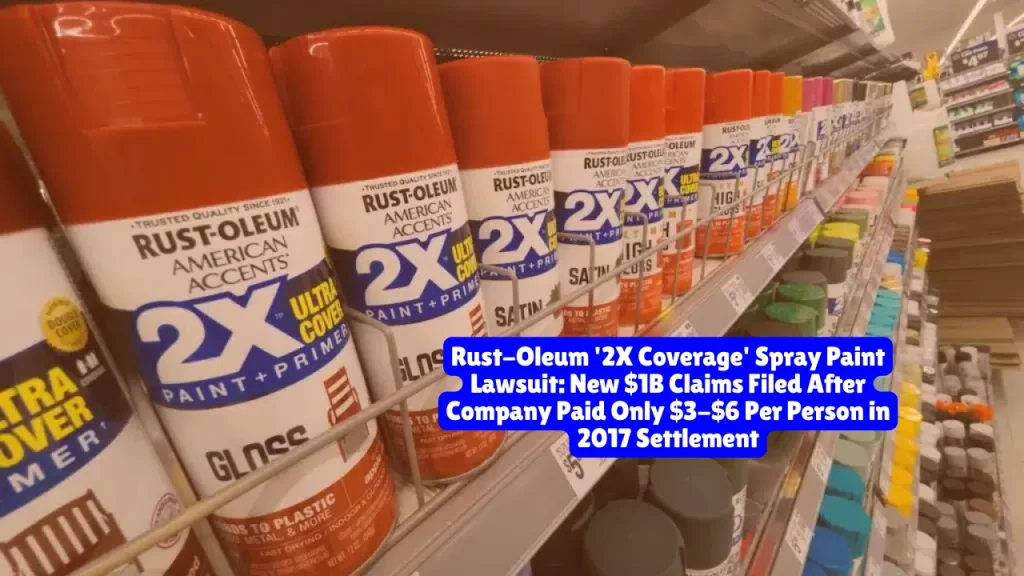
Which Rust-Oleum Products Are Covered
Both the 2017 settlement and 2024 lawsuit cover Rust-Oleum’s ‘2X Coverage’ spray paint line:
- Painter’s Touch Ultra Cover 2X spray paint
- Painter’s Touch 2X Ultra Cover spray paint
- PaintPlus Ultra Cover 2X spray paint
- American Accents Ultra Cover 2X spray paint
- American Accents 2X Ultra Cover spray paint
These products feature packaging with:
- “2X” or “DOUBLE COVER” labels
- Gold seal with “DOUBLE COVER” text
- Claims like “twice the coverage in a single pass”
- Representations that “one can = two cans”
- “Made with double cover technology” language
What the Lawsuits Allege
The promise: Rust-Oleum markets ‘2X Coverage’ products as providing double the coverage of competing general-purpose spray paints, meaning one can covers the same area as two cans of other brands.
The reality: According to lawsuits and National Advertising Review Board testing, the products don’t provide twice the coverage—consumers need to buy more cans than expected, spending extra money and time.
Why consumers paid more: DIY enthusiasts, homeowners, and professional painters purchased ‘2X Coverage’ products expecting superior value. When the products underperformed, they had to:
- Buy additional cans mid-project
- Pay premium prices for products no better than competitors
- Waste time making extra trips to stores
- Accept inferior project results
One plaintiff stated he wouldn’t have purchased the products—or paid premium prices—if he knew they didn’t actually provide double coverage.
What Consumer Protection Laws Say
False advertising violates multiple consumer protection statutes:
Federal Trade Commission Act: Prohibits deceptive advertising that misleads consumers about product performance. The FTC requires advertisers to have “competent and reliable scientific evidence” to support superiority claims.
State consumer protection laws: Most states have their own false advertising statutes. California’s False Advertising Law, Unfair Competition Law, and Consumers Legal Remedies Act provide remedies including:
- Actual damages
- Restitution of amounts paid
- Injunctive relief (stopping false ads)
- Civil penalties
- Attorney fees
Breach of express warranty: When companies make specific performance claims on packaging, those become binding warranties. If products don’t perform as promised, consumers can sue for breach of warranty.
What Happens Next in the 2024 Lawsuit
Early stages: The lawsuit was just filed in November 2024. Here’s the typical timeline:
Months 1-6: Rust-Oleum will likely file a motion to dismiss. Plaintiffs will respond. The court decides whether the case proceeds.
Months 6-18: If the case survives, plaintiffs will move for class certification, seeking to represent all consumers who purchased ‘2X Coverage’ products.
Months 18-36: Discovery phase where both sides exchange documents, including Rust-Oleum’s internal testing data, sales figures, and marketing materials.
Settlement or trial: Most class actions settle. Based on the $1 billion in alleged revenue, a settlement could be substantially larger than the 2017 case—but expect it to take 2-3 years.
Should You Keep Your Receipts?
If you purchased Rust-Oleum ‘2X Coverage’ products recently:
Save your receipts. Proof of purchase dramatically increases settlement payments. In the 2017 case, consumers with receipts could claim up to $20 per household versus $1-$1.50 without proof.
Document the purchase date and location. Even if you lost receipts, providing specific details increased payments from $1 to $1.50 per product in the last settlement.
Don’t throw away remaining products. Keep partially used cans as evidence of underperformance.
Take photos of results. If you experience coverage issues, photograph the project showing inadequate coverage or the number of extra cans needed.
Watch for settlement notices. Class members are typically notified by mail, email, or publication. Sign up for settlement tracking services or legal news alerts.
What If You Missed the 2017 Settlement?
The 2017 settlement is closed. The claim deadline was October 16, 2017, and checks were mailed in December 2017.
You cannot file claims for that settlement now. However:
The new 2024 lawsuit covers different time periods. If you purchased Rust-Oleum ‘2X Coverage’ products after May 30, 2017 (when the first settlement was approved), you may qualify for the new case.
No current settlement exists yet. The 2024 lawsuit is in early stages. Settlement negotiations haven’t begun. Keep monitoring legal news sites for updates.
Similar products may qualify for future settlements. Rust-Oleum has faced multiple lawsuits for other products, including Restore deck coatings and RockSolid deck products with similar performance claim issues.
Your Options If You Purchased ‘2X Coverage’ Products
Option 1: Wait for Settlement Announcement
If Rust-Oleum settles the 2024 lawsuit, the court will approve a settlement website where consumers can file claims. Based on the 2017 timeline, expect 2-3 years before payments are issued.
Option 2: Join the Current Lawsuit
Contact the plaintiffs’ attorneys handling the case. Class actions represent large groups, so you don’t need to hire your own lawyer or pay upfront fees.
Option 3: File Individual Small Claims
For recent purchases, you can sue Rust-Oleum in small claims court for breach of warranty or fraud. Most states allow claims up to $5,000-$10,000 without attorneys.
Option 4: Report to FTC
File a consumer complaint with the Federal Trade Commission atcReportFraud.ftc.gov. While the FTC won’t get you individual compensation, complaints help build regulatory enforcement cases.
Similar to other false advertising cases like HexClad’s $2.5M “non-toxic” settlement, consumer complaints drive both class actions and regulatory action.
FAQs
Can I still get money from the 2017 settlement?
No. That settlement is closed. Checks were mailed in December 2017 to consumers who filed claims by October 2017.
When will the 2024 lawsuit settle?
Unknown. The case was just filed in November 2024. Settlements typically take 2-3 years to negotiate, approve, and distribute payments.
Do I need receipts to claim?
For maximum compensation, yes. The 2017 settlement paid 10-20x more with proof of purchase. Save all receipts for future claims.
Does the new lawsuit cover products I bought in 2023-2024?
Likely yes, if the case achieves class certification. The complaint alleges ongoing false advertising continuing beyond the 2017 settlement.
Can I sue Rust-Oleum myself?
Yes, in small claims court for individual damages. However, joining a class action is typically easier and doesn’t require hiring an attorney.
What about other Rust-Oleum products like Restore deck coatings?
Those are subject to separate lawsuits. Rust-Oleum faces multiple class actions for various product lines with performance claim issues.
The Bottom Line
Rust-Oleum’s ‘2X Coverage’ spray paint has generated over $1 billion in sales since 2015—built on marketing claims that government reviewers found false. The 2017 settlement paid consumers as little as $3 each while the company continued the same practices.
Now a new lawsuit seeks to hold Rust-Oleum accountable for years of additional false advertising. If you’ve purchased ‘2X Coverage’ products, save your receipts and watch for settlement announcements.
Corporate settlements often shortchange consumers, as we’ve seen with Verizon and countless others. But class actions remain one of the few tools consumers have to fight back against false advertising by major corporations.
For updates on the 2024 lawsuit: Follow legal news sites covering class action settlements, or contact the attorneys handling the case for more information about eligibility and filing procedures when a settlement is reached.
Related: Celsius $7.8M False Advertising Settlement |HexClad $2.5M “Non-Toxic” Claims |Red Bull $13M “Gives You Wings“
Disclaimer: This article provides general information about the Rust-Oleum ‘2X Coverage’ lawsuits and settlements. It does not constitute legal advice. The 2017 settlement is closed. The 2024 lawsuit is pending. For specific legal questions, consult with a consumer protection attorney.
About the Author

Sarah Klein, JD, is a licensed attorney and legal content strategist with over 12 years of experience across civil, criminal, family, and regulatory law. At All About Lawyer, she covers a wide range of legal topics — from high-profile lawsuits and courtroom stories to state traffic laws and everyday legal questions — all with a focus on accuracy, clarity, and public understanding.
Her writing blends real legal insight with plain-English explanations, helping readers stay informed and legally aware.
Read more about Sarah