
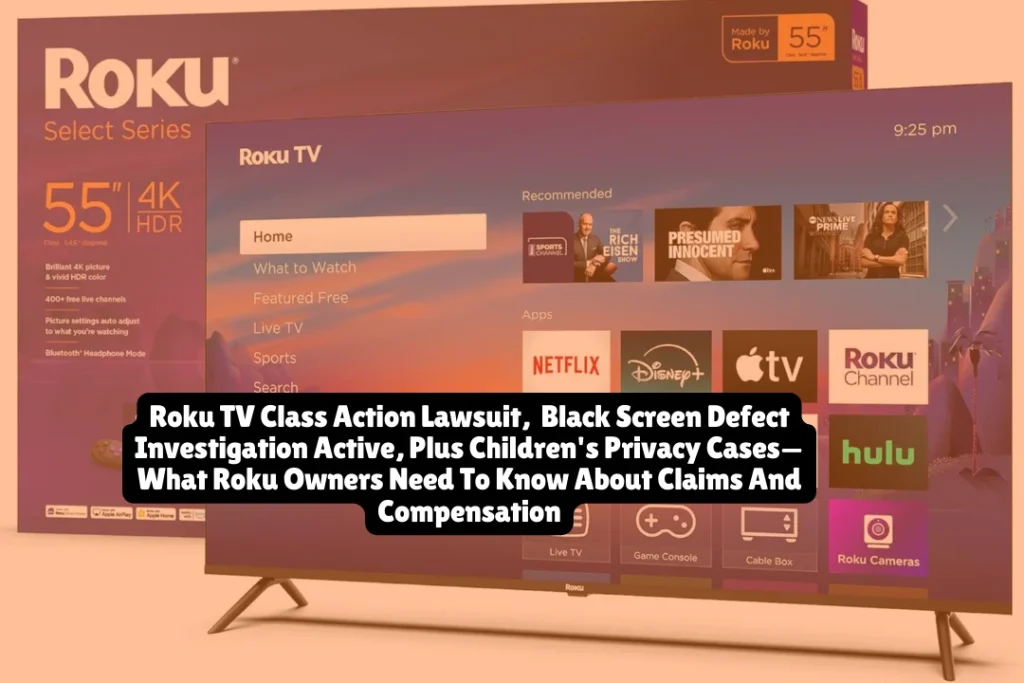
Roku TV Class Action Lawsuit, Black Screen Defect Investigation Active, Plus Children’s Privacy Cases—What Roku Owners Need To Know About Claims And Compensation
Roku Inc. faces multiple class action investigations and lawsuits in February 2026—and if you own a Roku TV that suddenly went black while audio continued, or if your child used Roku devices to watch content, you may qualify for compensation. A January 2026 investigation targets TCL and Roku for widespread black screen defects affecting consumers who purchased Roku TVs, while separate litigation filed in October 2025 alleges Roku illegally collected and sold children’s personal data to third-party advertisers without parental consent in violation of federal COPPA laws.
Florida’s Attorney General filed suit on October 14, 2025, claiming Roku violated the Florida Digital Bill of Rights, and a federal class action in California accuses Roku of embedding tracking pixels from Google, Facebook, and other companies to harvest sensitive viewing data from minors. If you experienced a black screen defect, own a Roku TV your child uses, or encountered Roku’s controversial forced arbitration agreement that disabled your device until you agreed to new terms, here’s everything you need to know about ongoing litigation, potential settlements, and how to protect your rights.
The Roku And TCL Black Screen Defect Investigation
A TCL and Roku class action lawsuit investigation is now underway as of January 2026, targeting a widespread manufacturing defect that causes Roku TV screens to suddenly go black while audio continues playing normally.
Many Roku and TCL Roku TV owners have reported similar problems across various models. In most cases, the television screen suddenly goes black while the audio continues to play. Others describe a flashing or completely white screen that makes the TV impossible to watch.
The investigation centers on whether Roku and TCL knew about the defect before selling these televisions and whether the companies provided adequate remedies. Consumer complaints indicate the problem typically occurs within the first two years of ownership—just outside the standard one-year warranty period, leaving customers with expensive paperweights and no manufacturer support.
Who Qualifies For The Black Screen Investigation
If you purchased a Roku TV or a TCL Roku TV and experienced a screen that stopped working, you may be eligible to join the TCL and Roku class action. The investigation covers consumers who experienced black screens, white screens, flickering displays, or other visual failures while audio continued functioning.
The law firm Schonbrun Seplow Harris Hoffman & Zeldes, LLP is leading the investigation. If you experienced this defect, you can submit information through legal investigation portals to determine if you qualify for potential compensation once a settlement is reached.
The Forced Arbitration Controversy
Adding fuel to consumer frustration, reports indicate the device becomes unusable until users agree to the new arbitration clause, which waives the right to sue Roku or join a class action lawsuit. In March 2024, Roku pushed a mandatory Terms of Service update that disabled devices until users agreed to binding arbitration, effectively blocking consumers from pursuing class action lawsuits.
The moment a Roku TV connects and updates, the HDMI inputs are locked out, and you are forced to sign up for a Roku account, give an email address, agree to terms, etc. This practice sparked outrage among consumers who purchased TVs only to find themselves unable to use basic HDMI inputs without agreeing to Roku’s legal terms.
Related Article: Alex Jones Sandy Hook Lawsuit, $1.4 Billion Verdict Upheld, February 2026 Bankruptcy Fight Blocks Payment
The Children’s Data Privacy Lawsuits
Roku faces two major children’s privacy cases in February 2026: a federal class action filed in October 2025 and a state enforcement action by Florida’s Attorney General.
Federal COPPA Class Action
According to the 24-page lawsuit, Roku, a popular streaming service host platform, employs third-party data tracking tools, including some made custom for its software, in order to collect sensitive and personally identifiable information from users, including children.
The lawsuit specifically names Google, Facebook, YouTube, LinkedIn, CJ Affiliate, Innovid, New Relic, and Display & Video 360 as the proprietors of tracking software embedded in Roku’s platform. The data that’s collected is primarily used in ad targeting, the suit says. However, the complaint states that not only is the collection of such information from children illegal under the Children’s Online Privacy Protection Act (COPPA), but that Roku is fully aware of its obligations under the law and continues to illicitly collect this data for the sake of its advertising.
The lawsuit alleges Roku deliberately chose not to implement child profile features—unlike Netflix, Disney+, and other streaming platforms that allow parents to disable data collection for children. While many streaming providers that offer child-directed content allow users to create a child profile—which, among other functions, either disables data collection or requires parental consent to activate it—Roku has deliberately elected not to implement any such features on its platform, allowing it to indiscriminately employ data collection practices, even for child-directed or child-viewed content, for the purpose of ad targeting.
Florida Attorney General Lawsuit
The lawsuit, filed by Florida’s Attorney General James Uthmeier, claims that Roku violated both the Florida Digital Bill of Rights and the Florida Deceptive and Unfair Trade Practices Act by failing to obtain parental consent before collecting and selling sensitive information.
The lawsuit was filed on Oct. 14 in Florida’s 20th Judicial Circuit in Collier County. It targets Roku and its Florida subsidiary, accusing them of selling children’s data collected from every county in Florida and nationwide.
The case is captioned Office of the Attorney General, State of Florida v. Roku, Inc., and Florida Roku Inc., Case No. 233525993. Florida seeks civil penalties, injunctive relief, and consumer restitution for violations of state privacy laws.
Who Qualifies For Children’s Privacy Claims
The Roku class action lawsuit seeks to represent anyone who, before reaching the age of majority, requested child-directed content or used any voice function on any Roku-enabled device during the applicable statute of limitations period.
If your child used Roku devices to watch content like cartoons, kids’ shows, or family programming, or if they used voice commands on Roku devices while under age 18, you may qualify for compensation once these cases reach settlement.
Previous Roku Settlement (Closed)
Roku previously settled a separate consumer lawsuit, though specific details remain limited. The deadline to submit claims has passed according to the official settlement website at roku.massarbsettlement.com.
The Roku class action settlement of 2025. I was informed that I would be receiving a check for 250.00 or direct deposit funds in February 2025. I never received anything, according to consumer complaints. This highlights the importance of tracking claim status and updating contact information with settlement administrators.
The previous settlement was administered by Postlethwaite & Netterville, though the specific legal claims and eligibility requirements are no longer publicly accessible since the claims deadline passed.
What You Must Know About Roku Litigation
Roku’s legal exposure extends far beyond current class actions. The company faces additional litigation from major corporate plaintiffs and regulatory scrutiny over data practices.
The Dolby Technology Dispute
“Roku is a sophisticated technology company that sells software and hardware for audio-visual streaming on televisions through an Internet connection and generates revenue primarily through selling advertising to consumers of streaming content,” the lawsuit says. “Roku recognizes the value of intellectual property, and has stated in its securities filings that it regards protection of its own IP as ‘critical to’ Roku’s success.”
In August 2024, Dolby Laboratories sued Roku for alleged unauthorized use of Dolby’s audio-visual technology. “As Roku’s business shifted towards Roku OS and rapidly expanded in recent years, Roku violated its license agreement with Dolby and distributed hundreds of millions of unauthorized and infringing copies of Dolby’s technologies without paying Dolby appropriate compensation.”
This corporate litigation doesn’t directly involve consumer compensation, but it demonstrates Roku’s pattern of legal disputes across multiple fronts.
Data Breach History
Roku disclosed two separate credential stuffing attacks in 2024 affecting approximately 591,000 user accounts total. The data breach, which Roku said affected approximately 576,000 user accounts, was revealed by the streaming TV service less than a month after it previously announced in March that about 15,000 user accounts had been accessed without authorization.
Roku attributed the data breach to a credential stuffing attack that locked certain users out of their accounts and led to a “limited number of cases” of efforts to purchase streaming subscriptions. While Roku claims sensitive information like Social Security numbers and full payment details weren’t accessed, the breaches raised serious questions about Roku’s security practices.
For context on how other tech companies handle similar data breach settlements, see AT&T Hit With $177 Million Class Action Lawsuit, Claim Your Share Of The Settlement Before December 18 The New Deadline.
Common Mistakes Consumers Make
Many Roku owners make these critical errors when dealing with defective devices or privacy concerns:
Agreeing to arbitration without opting out: Roku’s forced arbitration update in March 2024 included a 30-day opt-out period. Consumers who agreed without reading the terms waived their right to join class actions. Always read arbitration clauses and exercise opt-out rights when available.
Throwing away defective TVs without documentation: If you experienced the black screen defect, photograph the issue, save purchase receipts, document the date the problem occurred, and keep warranty information. This evidence is critical for future claims.
Assuming warranties cover software-related defects: Roku’s warranty typically applies only to its streaming hardware, not to the television’s display or other components. TCL offers a limited one-year warranty on its TVs, but that window often closes before the issue occurs.
Missing investigation deadlines: The TCL/Roku black screen investigation is active in February 2026. If you experienced this defect, submit your information to investigating law firms immediately. Once settlements are finalized, new claims typically aren’t accepted.
What Arbitration Means For Your Rights
Binding arbitration should be unconscionable, but the courts don’t agree with me, one consumer noted. Another big reason is that arbitration doesn’t allow class action lawsuits. If you cheat 10 million people out of $5 each, their only practical recourse is a class action lawsuit.
Companies favor mandatory arbitration because it prevents large class actions and keeps dispute resolution confidential. Individual arbitration claims rarely proceed because the cost and effort exceed the potential recovery for most consumers.
For more on how arbitration clauses impact tech company litigation, see Temu Lawsuit Update December 2025, No Settlement Yet—Cases In Arbitration, Here’s What You Need To Know.
What To Do Next
If you’re affected by Roku’s black screen defect, children’s privacy violations, or other issues, here’s your action plan for February 2026.
For Black Screen Defect Claims
Visit legal investigation portals tracking the TCL/Roku black screen class action. The law firm Schonbrun Seplow Harris Hoffman & Zeldes, LLP (sshhzlaw.com, 310-396-0731) is actively investigating these claims.
Document your experience thoroughly: photograph the black screen while audio plays, save your original purchase receipt showing the purchase date and retailer, note the exact date the defect first occurred, record the TV model number and serial number (usually found on the back of the TV or in settings), and save any correspondence with Roku or TCL customer service about the issue.
Contact the investigating law firm to submit your information. Even if you already threw away the defective TV, you may still qualify for compensation if you have documentation proving purchase and the defect.
For Children’s Privacy Claims
Monitor court developments in the federal COPPA class action and Florida state case. Both lawsuits are in early stages as of February 2026, meaning settlement websites and claim forms have not been established yet.
Save documentation showing your child’s Roku usage: note which Roku devices your child used and during what time periods, identify specific children’s content or channels they watched (Disney+, PBS Kids, YouTube Kids, Cartoon Network, etc.), save any parental control settings or account information, and document any voice commands your child used with Roku devices.
As these cases progress toward potential settlements, eligible class members will receive notice through mail or email if Roku has your contact information on file. For similar privacy settlements, see Kaiser Caught Sharing Your Medical Data With Google And Microsoft, Massive $47.5M Settlement Revealed On Kaiser Class Action Lawsuit, Here’s How Much You Could Get.
Tracking Case Developments
Check court dockets through PACER (pacer.gov) for federal cases. The federal COPPA class action and Florida AG case will have public filings available through the court systems.
Sign up for class action monitoring services like TopClassActions.com or ClassAction.org to receive email alerts when Roku settlements are announced. These free services notify consumers about new class actions and settlement claim periods.
For the black screen investigation, check the investigating law firm’s website periodically for updates about case status, settlement negotiations, and claim procedures.
Protecting Your Privacy Now
If you’re concerned about children’s data collection on Roku devices, take these immediate steps: disable voice features on Roku devices used by children, create separate streaming service profiles with parental controls (on Netflix, Disney+, etc.) rather than relying on Roku’s interface, review Roku’s privacy settings at Settings > Privacy > Advertising, and consider using Roku devices only for HDMI input from external devices rather than Roku’s native streaming apps.
Frequently Asked Questions
What Is The Roku TV Black Screen Defect Class Action About?
The investigation targets TCL and Roku for a manufacturing defect causing TV screens to suddenly go black while audio continues playing. The defect typically occurs within two years of purchase, just outside warranty coverage, affecting consumers across multiple Roku TV models who were left with unusable televisions and no manufacturer support.
Who Are The Defendants In Roku Lawsuits?
Roku Inc. is the primary defendant in multiple cases. TCL is named alongside Roku in the black screen defect investigation. Roku’s Florida subsidiary, Florida Roku Inc., is named in the Florida AG privacy lawsuit. These cases are separate from Dolby Laboratories’ corporate lawsuit against Roku over technology licensing.
What Are The Children’s Privacy Lawsuits About?
Two major cases allege Roku violated federal COPPA laws and Florida privacy laws by collecting children’s personal data through tracking pixels from Google, Facebook, and other companies without parental consent. The lawsuits claim Roku deliberately avoided implementing child profiles to maximize advertising revenue from data collected when children watched content on Roku devices.
How Much Money Can I Get From Roku Settlements?
No settlement amounts have been announced for the black screen defect investigation or children’s privacy cases as of February 2026. Previous consumer settlements in product defect cases range from $20 to $400 per claimant depending on the severity of harm and number of claims filed. Children’s privacy settlements under COPPA can reach $20 to $60 per affected child.
What Happened In February 2026 With Roku Lawsuits?
The TCL/Roku black screen defect investigation remains active in February 2026, with law firms accepting consumer information. The federal COPPA class action filed in October 2025 and Florida AG lawsuit filed October 14, 2025, continue through discovery and pretrial proceedings. No settlements have been announced for any active Roku litigation as of February 2, 2026.
Can I Still Join The Roku Settlement From 2025?
No. The deadline to submit claims has passed for the previous Roku settlement administered through roku.massarbsettlement.com. That settlement website is now closed to new claims. However, new investigations and lawsuits in 2025-2026 may lead to future settlement opportunities for different legal issues.
How Do I Know If Roku Settlement Emails Are Scams?
Legitimate settlement notices include specific case numbers, court information, and settlement administrator contact details. They never ask for payment to file claims or request sensitive financial information beyond what’s needed to send your payment. Verify all communications by checking official court dockets through PACER or contacting settlement administrators directly using phone numbers from court documents, not emails.
Last Updated: February 2, 2026
Legal Disclaimer: This article provides information about Roku class action lawsuits and investigations but does not constitute legal advice—consult with a qualified attorney for guidance about your specific situation and potential claims.
Take Action: If you experienced the Roku TV black screen defect or your child used Roku devices to watch content, document your experience now and contact investigating law firms before investigation windows close and settlement eligibility requirements are finalized.
Stay informed, stay protected. — AllAboutLawyer.com
About the Author

Sarah Klein, JD, is a licensed attorney and legal content strategist with over 12 years of experience across civil, criminal, family, and regulatory law. At All About Lawyer, she covers a wide range of legal topics — from high-profile lawsuits and courtroom stories to state traffic laws and everyday legal questions — all with a focus on accuracy, clarity, and public understanding.
Her writing blends real legal insight with plain-English explanations, helping readers stay informed and legally aware.
Read more about Sarah