
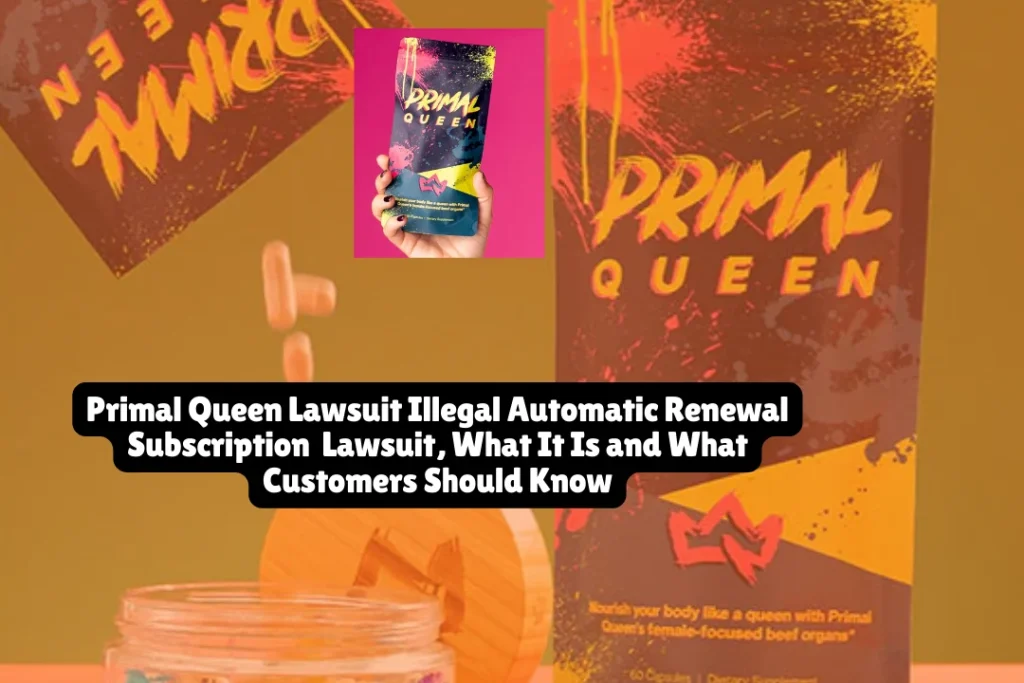
Primal Queen Lawsuit Illegal Automatic Renewal Subscription Lawsuit, What It Is and What Customers Should Know
If you were charged for a Primal Queen subscription you say you never signed up for, you are not alone — and a federal class action lawsuit is now making those same claims in court. Primal Queen, a women’s nutritional supplement company, was hit with a consumer class action on October 23, 2025, in the U.S. District Court for the Central District of California, accusing the company of operating an illegal automatic renewal subscription scheme. There is no settlement yet. No claim form exists. No payments are available. This article explains what the lawsuit alleges, who may be affected, and what to watch for as the case develops.
Key Case Facts
| Case Name | Blank et al. v. Primal Queen, LLC |
| Case Number | 5:25-cv-02810 (C.D. Cal.) |
| Also Docketed As | Natalie Erickson v. Primal Queen, LLC, 2:2025-cv-00005 (C.D. Cal.) |
| Court | U.S. District Court, Central District of California |
| Filed | October 23, 2025 |
| Plaintiff’s Attorneys | Hedin LLP and the Gucovschi Law Firm |
| Status | Pending — no settlement reached |
| Settlement Available? | No |
| Claim Form Available? | No |
| Defendant | Primal Queen, LLC — women’s nutritional supplement company |
What the Lawsuit Alleges
The lawsuit accuses Primal Queen of operating an illegal automatic renewal subscription scheme that enrolled customers without proper consent or clear disclosures, and made cancellation unnecessarily difficult through deceptive “dark pattern” practices, in violation of California’s Automatic Renewal Law.
In plain terms, the complaint claims that customers who thought they were placing a one-time order for Primal Queen supplements were actually enrolled in a recurring monthly subscription — without understanding or agreeing to that arrangement. The core allegation is that Primal Queen failed to adequately disclose the terms of its subscriptions.
The lawsuit also alleges that Primal Queen used “dark patterns” — deliberate design choices in the checkout process that made it confusing or difficult to avoid subscription enrollment or to cancel after the fact.
What Is California’s Automatic Renewal Law?
California’s Automatic Renewal Law (ARL), California Business and Professions Code §§ 17600–17606, requires businesses to:
- Clearly and conspicuously disclose all automatic renewal offer terms before a consumer agrees to purchase
- Obtain a consumer’s affirmative consent to the automatic renewal terms
- Provide a simple cancellation mechanism that consumers can use immediately
- Send a reminder notice before charging a recurring subscription if the initial period exceeds one month
If a company fails to meet these requirements, California law treats any charges collected as unauthorized — meaning customers may be entitled to a full refund of all amounts charged under the illegal subscription. Violations can also trigger civil penalties.
Who May Be Affected
Based on the allegations in the complaint, you may be affected by this lawsuit if you:
- Purchased any Primal Queen nutritional supplement product and were subsequently charged on a recurring basis
- Believed you were making a one-time purchase but were enrolled in a subscription
- Were charged without receiving clear disclosure of the automatic renewal terms before checkout
- Had difficulty canceling your Primal Queen subscription after discovering the recurring charges
- Are a resident of California or another U.S. state who purchased through Primal Queen’s website
BBB complaints against Primal Queen reflect exactly these allegations — customers reporting they placed what they believed to be a single order and were then billed again in subsequent months without their knowledge or consent.
What Is a “Dark Pattern” in Online Checkout?
Dark patterns are design techniques used in websites and apps that trick or manipulate users into doing things they did not intend — like signing up for a subscription. Common dark patterns in e-commerce include:
- Pre-checking a subscription box in the checkout form
- Hiding subscription terms in small print below the “Add to Cart” or “Buy Now” button
- Making a one-time purchase option harder to find than the subscription option
- Using confusing language like “Ship & Save” without clearly explaining it means recurring billing
- Creating cancellation processes with multiple steps, hidden menus, or mandatory phone calls
California’s ARL specifically targets these practices by requiring clear, conspicuous disclosure — not buried fine print.
What Primal Queen Has Said
As of February 2026, Primal Queen has not publicly issued a statement about the lawsuit. In responses to BBB complaints, Primal Queen has stated that customers signed up for a subscription at checkout and agreed to terms, pointing to renewal confirmations and arguing that refunds were issued in cases where customers requested them. The company’s legal response to the class action complaint in court has not been publicly summarized in available sources as of this writing.
What Happens Next
Because this lawsuit was filed in October 2025 and is still in its early stages, the typical litigation timeline looks like this:
Short term (months 1–6): The defendant files a response or motion to dismiss. The parties may begin early settlement discussions. The court may schedule a case management conference.
Medium term (months 6–18): The plaintiff’s attorneys file a motion for class certification, asking the court to formally recognize this as a class action on behalf of all similarly affected customers. Discovery begins — both sides exchange documents, records, and data.
Long term (18+ months): If the case is not dismissed and class certification is granted, the parties either negotiate a settlement or proceed to trial. If a settlement is reached, a claim form and settlement website will be created and publicized.
There is no timeline guarantee. Class action cases frequently take 2–4 years to fully resolve.
What You Should Do Right Now
Keep records. If you were charged by Primal Queen for a subscription you say you did not agree to, document everything now: screenshots of your order confirmation, bank or credit card statements showing the charges, any emails from Primal Queen, and any cancellation attempts you made.
Contact your bank or credit card company. If you were charged without authorization, you may be able to dispute the charges as unauthorized transactions through your financial institution, regardless of the lawsuit outcome.
Request a refund directly. Some customers who contacted Primal Queen directly reported receiving refunds. You do not need to wait for a lawsuit to resolve to attempt a direct refund request.
Do not pay anyone to join this lawsuit. Legitimate class action participation is free. If anyone contacts you offering to add you to the Primal Queen lawsuit in exchange for a fee, it is a scam.
Watch for official notices. If a settlement is eventually reached, class members typically receive notice by email or postcard. The only way to receive a payment is to file a timely, valid claim through the official court-authorized process — which does not exist yet.
Is This Related to Any Other Supplement Company Lawsuits?
The Primal Queen lawsuit is one of many similar cases filed against supplement and wellness companies in recent years alleging illegal auto-renewal subscription practices. Similar auto-renewal subscription lawsuits have been filed against dozens of companies, including cases that have resulted in multi-million dollar settlements for consumers who were enrolled in recurring billing without proper consent. The legal theory is well-established — California courts have consistently enforced the ARL against companies that fail to make subscription terms clear before checkout.
Frequently Asked Questions
Q: Is there a Primal Queen settlement I can file a claim for?
No. As of February 2026, the lawsuit is pending with no settlement reached. There is no claim form, no settlement fund, and no official settlement website. Any website claiming you can file a Primal Queen settlement claim right now is inaccurate.
Q: How do I know if I was enrolled in a Primal Queen subscription without my consent?
Check your bank or credit card statements for recurring charges from Primal Queen. Customers have reported being charged $44 or similar amounts monthly after believing they made a single purchase. If you see recurring charges you did not authorize, that is consistent with the lawsuit’s allegations.
Q: Can I get a refund from Primal Queen right now?
You can try. Contact Primal Queen customer service directly and request a refund, citing that you did not agree to a subscription. You can also dispute the charges with your credit card company. Neither action requires waiting for a lawsuit to resolve.
Q: What is California’s Automatic Renewal Law?
It is a California law that requires companies to clearly disclose subscription terms before enrollment, obtain affirmative consumer consent, and provide a simple cancellation method. Violations can result in all charges being deemed unauthorized and subject to refund.
Q: Who are the attorneys handling this case?
The lawsuit was filed by Hedin LLP and the Gucovschi Law Firm on behalf of the plaintiffs. You can find their contact information through the PACER federal court system under Case No. 5:25-cv-02810.
Q: Do I need to do anything to be part of this lawsuit?
Not yet. In a class action, you are automatically included as a class member if you meet the eligibility criteria — you do not need to sign up. When and if a settlement is reached, you will have the option to file a claim, opt out, or object. For now, the most useful thing you can do is preserve your records.
Q: When will this case be resolved?
There is no way to predict with certainty. Class action lawsuits typically take 2–4 years to fully resolve, including any appeals. Some settle sooner; some take longer. AllAboutLawyer.com will update this article when significant developments occur.
Q: What is Primal Queen’s product?
Primal Queen is a women’s nutritional supplement company. Its products include hormone support and wellness supplements marketed primarily to women.
Last Updated: February 17, 2026
Disclaimer: This article is for informational purposes only and does not constitute legal or tax advice. Settlement terms, eligibility, and payment amounts are subject to court approval and may change. For official information, always refer to the settlement administrator or the official settlement website.
About the Author

Sarah Klein, JD, is a licensed attorney and legal content strategist with over 12 years of experience across civil, criminal, family, and regulatory law. At All About Lawyer, she covers a wide range of legal topics — from high-profile lawsuits and courtroom stories to state traffic laws and everyday legal questions — all with a focus on accuracy, clarity, and public understanding.
Her writing blends real legal insight with plain-English explanations, helping readers stay informed and legally aware.
Read more about Sarah