
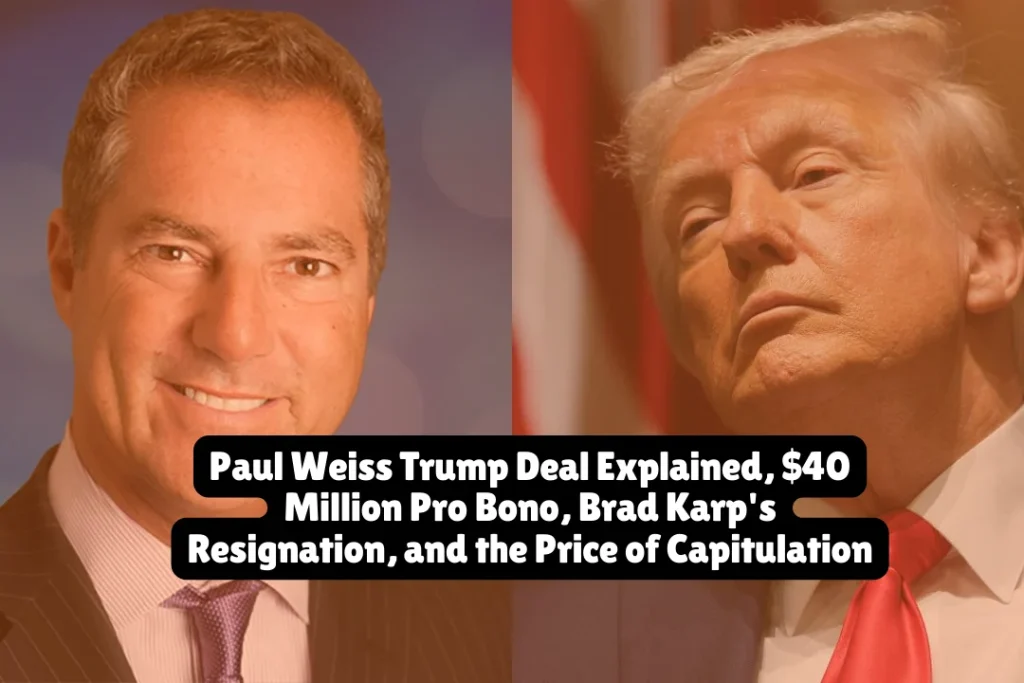
Paul Weiss and Trump Administration Agreement: Executive Order, $40 Million Pro Bono Commitment, and Leadership Changes Explained
Last Updated: March 4, 2026
This article summarizes publicly reported events involving Paul, Weiss, Rifkind, Wharton & Garrison LLP and actions taken by the Trump administration in March 2025. The discussion below is based on publicly available court filings, executive branch documents, congressional correspondence, and reporting from major national news organizations. It does not assert independent factual findings beyond those sources.
Background: The March 2025 Executive Order
On March 14, 2025, President Donald Trump issued an executive order identifying Paul Weiss and outlining measures affecting its attorneys.
According to the text of the order and subsequent reporting, the order stated that it would:
- Suspend security clearances for attorneys at the firm,
- Restrict their access to certain federal facilities, and
- Direct agency heads to review government contracts involving the firm.
The administration publicly cited several concerns, including the firm’s prior litigation work, its representation of clients in matters related to January 6 litigation, and its diversity, equity, and inclusion (DEI) policies.
Shortly after issuance of the order, Paul Weiss informed at least one federal court that a client relationship had ended following the order’s announcement, according to court filings reported by national outlets.
The March 20, 2025 Agreement
On March 20, 2025, the White House announced that the executive order would be rescinded following discussions with firm leadership.
According to White House statements issued that day, Paul Weiss agreed to:
- Affirm that it would not deny representation to clients based solely on political viewpoints,
- Commit to merit-based hiring, promotion, and retention policies,
- Dedicate the equivalent of $40 million in pro bono legal services over the administration’s term toward mutually identified initiatives, including veterans’ services, fairness in the justice system, and combating antisemitism.
Public descriptions of the agreement varied slightly between White House communications and internal firm communications. Some White House materials referenced alleged wrongdoing by a former partner; the firm’s internal statements did not adopt that characterization.
In communications to partners, then-chairman Brad Karp described the agreement as necessary to preserve the firm’s ability to continue serving clients and operating without disruption.
Legal Questions Raised
Following the announcement, members of Congress and legal commentators raised questions regarding the enforceability and broader implications of the agreement.
Issues discussed publicly included:
- Whether the circumstances surrounding the agreement could raise questions under traditional contract doctrines such as duress,
- Whether commitments related to pro bono allocations could implicate professional responsibility considerations, and
- Whether similar executive actions affecting law firms raised constitutional concerns.
No court has ruled directly on the enforceability of the Paul Weiss agreement. However, several other firms subject to comparable executive orders sought judicial relief and obtained federal court injunctions blocking enforcement of those orders. Certain aspects of those rulings remain subject to appellate review.
Professional and Institutional Impact
In the months following the agreement, several litigation partners departed Paul Weiss, according to reporting in legal industry publications. Commentators within the legal community publicly debated the implications of the agreement for law firm independence and executive authority.
The firm continues to operate as one of the largest and most profitable law firms in the United States, with substantial corporate, litigation, and mergers and acquisitions practices.
Context Regarding Publicly Released DOJ Materials
In February 2026, the U.S. Department of Justice publicly released a large volume of documents relating to Jeffrey Epstein. Media organizations subsequently reported that some of those materials included email communications involving Brad Karp.
The description below reflects reporting on those released materials and does not imply criminal or ethical wrongdoing unless expressly stated by authorities.
According to national media reports describing the released documents:
- Certain emails referenced social interactions between Karp and Epstein.
- Some communications were described as reflecting informal legal commentary provided in response to inquiries.
- One reported exchange referenced assistance related to a professional opportunity involving a family member.
At the time of publication, no criminal charges, disciplinary findings, or formal allegations of misconduct have been filed against Karp in connection with the released materials.
Leadership Transition
On February 5, 2026, Paul Weiss announced that Brad Karp had stepped down from his role as chairman. Reuters and other outlets reported that the leadership transition followed internal discussions among senior partners after publication of the materials.
Karp remains a partner at the firm and continues to focus on client service.
The firm appointed Scott Barshay as chairman effective immediately. Barshay previously led the firm’s corporate practice and has advised on major mergers and acquisitions.
Current Status (As of March 4, 2026)
- The March 2025 agreement remains in effect.
- No court has issued a ruling invalidating the agreement.
- Litigation concerning similar executive orders issued against other firms remains pending at the appellate level.
- Paul Weiss continues operations under new leadership.
Frequently Asked Questions
What did Paul Weiss agree to?
According to White House statements, the firm committed to merit-based employment policies, nonpartisan client representation, and $40 million in pro bono services toward specified initiatives over the administration’s term.
Has a court ruled on whether the agreement is enforceable?
No court has issued a ruling directly addressing the enforceability of the agreement.
Was Brad Karp accused of wrongdoing?
At the time of publication, no criminal charges or disciplinary findings have been filed against him in connection with the DOJ-released materials.
Who leads Paul Weiss now?
Scott Barshay currently serves as chairman of the firm.
Editorial and Legal Notice
This article is a journalistic summary of publicly available information, including official documents and reporting from established news organizations believed reliable at the time of publication. It does not constitute legal advice and does not assert independent allegations or conclusions beyond those publicly disclosed materials. Individuals and entities referenced are presumed not to have engaged in wrongdoing unless determined by a court or regulatory authority.
About the Author

Sarah Klein, JD, is a licensed attorney and legal content strategist with over 12 years of experience across civil, criminal, family, and regulatory law. At All About Lawyer, she covers a wide range of legal topics — from high-profile lawsuits and courtroom stories to state traffic laws and everyday legal questions — all with a focus on accuracy, clarity, and public understanding.
Her writing blends real legal insight with plain-English explanations, helping readers stay informed and legally aware.
Read more about Sarah