
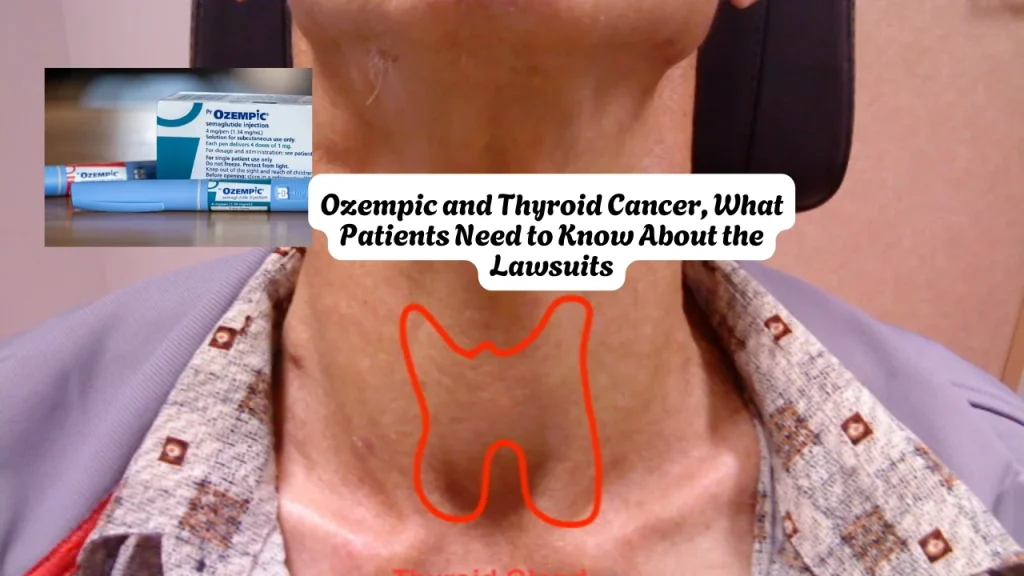
Ozempic and Thyroid Cancer, What Patients Need to Know About the Lawsuits
If you developed thyroid cancer after taking Ozempic and you are looking for a lawsuit to join, you deserve a straight answer — not a law firm intake form. The full picture here is more nuanced than most of what you will find in search results: the Ozempic MDL is real and growing, but the thyroid cancer claim specifically has hit serious scientific headwinds. The stronger active litigation focuses on stomach paralysis and vision loss. Here is what the evidence and the courts actually show as of March 2026.
| Field | Detail |
| Drug | Ozempic (semaglutide) / also Wegovy, Rybelsus, Mounjaro |
| Manufacturer | Novo Nordisk (Ozempic/Wegovy); Eli Lilly (Mounjaro) |
| MDL Name | In Re: GLP-1 Receptor Agonists Products Liability Litigation |
| MDL Numbers | MDL 3094 (GI injuries) / MDL 3163 (vision loss) |
| Court | Eastern District of Pennsylvania |
| Judge | U.S. District Judge Karen S. Marston |
| Pending Cases (March 2, 2026) | 3,363 (MDL 3094) + 54 (MDL 3163) |
| Thyroid Cancer — In Active MDL? | Not a primary injury track |
| Strongest Active Injury Claims | Gastroparesis, NAION vision loss |
| No Settlement Reached | No — active litigation only |
| Estimated Total Liability | $2 billion+ (projected, not confirmed) |
| Bellwether Trials | Scheduled late 2026 / early 2027 |
Where things stand in 2026:
- As of March 2, 2026, there are 3,363 pending claims in MDL 3094 and 54 in MDL 3163 — both in the Eastern District of Pennsylvania before Judge Karen Marston.
- A new study concludes that GLP-1 drugs such as Wegovy, Mounjaro, Ozempic, and Zepbound do not appear to increase the risk of thyroid cancer in humans — and when emerging data cuts against a thyroid cancer theory, plaintiffs’ attorneys focused on the stronger injury tracks say they need to move on.
- No confirmed settlements have been reached. Bellwether trials — the first test cases that signal how a jury might decide — are scheduled for late 2026 and early 2027, though those dates may shift.
- No claim form or settlement fund is currently open for any Ozempic injury.
What Ozempic Is and Why Millions Are Taking It
Ozempic is a weekly injectable drug made by Novo Nordisk and approved by the FDA in 2017 to treat type 2 diabetes. Its active ingredient is semaglutide, a GLP-1 receptor agonist — meaning it mimics a hormone that tells the body to produce insulin and slows down how quickly the stomach empties food.
About 12% of Americans have used Ozempic or another GLP-1 drug, many of whom have experienced severe side effects, according to a national survey conducted by RAND. The drug became a cultural phenomenon when doctors began prescribing it off-label for weight loss — a use later formalized through Wegovy, the higher-dose semaglutide product approved specifically for obesity.
The same mechanism that makes the drug effective — slowing gastric emptying — is also what plaintiffs allege causes the most serious injuries.
The FDA’s Thyroid Warning — and What It Actually Says
Every box of Ozempic carries a black box warning — the most serious warning the FDA issues — about thyroid cancer risk. That warning is real, and it is on the label. But understanding what it actually says matters enormously if you are trying to evaluate a potential claim.
The FDA’s black box warning states that in rodents, semaglutide causes thyroid C-cell tumors, and that it is unknown whether Ozempic causes thyroid C-cell tumors, including medullary thyroid carcinoma (MTC), in humans as the human relevance of semaglutide-induced rodent thyroid C-cell tumors has not been determined.
Two things are true at once: the warning is real, and the human evidence for thyroid cancer causation has not materialized the way it did in animal studies.
The SUSTAIN clinical trial program, involving 3,297 Ozempic patients, showed no confirmed thyroid cancer cases during study periods. Post-market surveillance systems have not identified increased thyroid cancer rates in populations using GLP-1 medications compared to control groups.
The FDA warning specifically addresses medullary thyroid carcinoma — only 3–4% of all thyroid cancers — and is based primarily on rodent studies, not human data. The Clayman Thyroid Center, which treats over 2,000 thyroid cancer patients per year, has not seen an MTC pattern linked to GLP-1 use.
Related article: $21.2M Perry’s Steakhouse Tip Pool Lawsuit, Did They Steal Your Tips?
What the Most Recent Science Says About the Thyroid Cancer Connection
The science on this has moved significantly in 2024 and 2025 — and readers searching for information deserve to know that, even if it is not what law firm intake pages are saying.
In one of the largest studies to date — the Scandinavian Cohort Study, published in 2024 — scientists tracked over 145,000 patients across Denmark, Norway, and Sweden. They compared people on GLP-1 drugs to those on other diabetes medications and found no statistically significant difference in thyroid cancer risk between the two groups after nearly four years of follow-up.
Researchers from the Mayo Clinic and Yale School of Medicine published a study in JAMA Otolaryngology Head & Neck Surgery finding that the increase in thyroid cancer diagnoses linked to GLP-1 receptor agonists disappeared after the first year of treatment when compared to other diabetes medications. Researchers believe this early-year spike is not caused by the drug — it reflects detection bias. Patients starting Ozempic are more closely monitored, doctors order more thyroid scans, and pre-existing nodules that would never have caused harm get discovered and diagnosed.
A 2025 JAMA analysis showed that patients on GLP-1 drugs were significantly more likely to receive a thyroid scan than those on other medications — which explains the apparent association without the drug actually causing cancer.
Plaintiffs’ attorneys in the MDL have noted that there is a real temptation in fast-moving pharmaceutical litigation to allege that a blockbuster drug causes every serious medical event reported after use — but that when emerging data cuts against the thyroid cancer theory, pursuing it does more harm than good to the overall litigation strategy.
Where the Real Litigation Strength Is: Gastroparesis and Vision Loss
More than 3,000 product liability lawsuits are pending in two MDLs, largely focused on gastroparesis and vision injuries such as non-arteritic anterior ischemic optic neuropathy (NAION), now centralized in the Eastern District of Pennsylvania before Judge Karen Marston.
Gastroparesis — also called stomach paralysis — is the injury at the center of MDL 3094. It occurs when the stomach stops moving food through properly, causing severe nausea, vomiting, bloating, and in serious cases, dangerous malnutrition. Plaintiffs allege that Ozempic’s label dramatically understated this risk, particularly for patients who did not have diabetes and were using the drug purely for weight loss.
NAION — non-arteritic anterior ischemic optic neuropathy — is a form of sudden vision loss caused by interrupted blood flow to the optic nerve. A new lawsuit filed in Travis County, Texas, alleges that a 52-year-old woman suffered sudden and irreversible blindness after using Ozempic for just six months, losing 90% of her vision in one eye in a single day. Her attorneys argue that Novo Nordisk ignored red flags in early clinical trials and failed to provide meaningful warnings.
The European Medicines Agency reported in June 2025 that semaglutide doubled the risk of NAION, prompting calls to update the drug’s labeling globally.
Who Actually Has a Viable Ozempic Lawsuit Right Now
There is no open class action claim form — Ozempic injury lawsuits are individual product liability cases consolidated into two MDLs. Each plaintiff has their own case. This matters because individual verdicts and settlements can be significantly larger than what a class action settlement might provide per person.
You may have a viable claim worth discussing with a pharmaceutical injury attorney if:
- You took Ozempic, Wegovy, Rybelsus, Mounjaro, or another GLP-1 drug
- You were diagnosed with gastroparesis (stomach paralysis) or suffered severe, ongoing gastrointestinal injury
- You experienced sudden vision loss or were diagnosed with NAION while taking one of these drugs
- You were prescribed the drug off-label for weight loss without diabetes
- You were not adequately warned by your prescriber or the drug’s label about these specific risks
- You developed medullary thyroid carcinoma (MTC) specifically — the rare type the FDA warning covers — and have a documented history of GLP-1 use
If you developed a more common form of thyroid cancer — papillary, follicular, or Hurthies cell — the current scientific consensus makes a causation argument significantly more difficult. An attorney can still evaluate your specific circumstances.
Important Dates in the Ozempic Litigation
| Milestone | Date |
| Ozempic FDA Approval | 2017 |
| GLP-1 MDL 3094 Established (GI injuries) | 2024 |
| GLP-1 MDL 3163 Established (Vision loss) | 2024 |
| Scandinavian Cohort Study — No thyroid cancer link | 2024 |
| Mayo Clinic / Yale JAMA Study — Detection bias finding | January 2025 |
| Cases in MDL 3094 pass 2,000 | July 2025 |
| EMA Reports Semaglutide Doubles NAION Risk | June 2025 |
| Cases in MDL 3094 pass 3,000 | Late 2025 |
| MDL Status Conference | February 10, 2026 |
| Pending MDL 3094 Cases | 3,363 as of March 2, 2026 |
| Bellwether Trials Scheduled | Late 2026 / Early 2027 |
| First Expected Settlement | TBD — not before 2026 at earliest |
| Open Claim Form | None — litigation phase only |
Frequently Asked Questions
Is there an Ozempic thyroid cancer settlement I can claim right now?
No. As of March 2026, no Ozempic settlement of any kind has been reached and no claim form exists. The litigation is in active pretrial proceedings with bellwether trials scheduled for late 2026 and early 2027. Any website asking you to “register” for a settlement or pay a fee to join is not legitimate.
Is Ozempic definitely linked to thyroid cancer?
The FDA carries a black box warning for medullary thyroid carcinoma based on rodent studies, but multiple large human studies published in 2024 and 2025 found no statistically significant increase in thyroid cancer risk among GLP-1 users compared to patients on other diabetes medications. The early spike in diagnoses researchers observed is now largely attributed to detection bias — not drug-caused cancer. The science is still developing, but the current weight of human evidence does not support a strong causal link.
What injuries are the strongest basis for an Ozempic lawsuit right now?
Gastroparesis — stomach paralysis causing chronic nausea, vomiting, and malnutrition — is the primary injury in MDL 3094, which has over 3,000 active cases. NAION vision loss is the focus of MDL 3163. Both injury categories have growing scientific support and are the ones plaintiffs’ attorneys consider most viable heading into bellwether trials.
Do I need a lawyer to file an Ozempic lawsuit?
Yes. These are individual product liability cases, not a class action with a simple claim form. An attorney evaluates your medical records, establishes the link between the drug and your injury, and files your case — typically on a contingency basis, meaning no upfront fees. Do not pay anyone to “register” your claim.
How much could an Ozempic lawsuit be worth?
Legal analysts project individual settlement amounts ranging from $50,000 to $200,000 for documented gastrointestinal injuries requiring hospitalization, $200,000 to $500,000 for severe gastroparesis, and potentially over $1 million for permanent vision loss cases. These are projections based on similar pharmaceutical litigation — no Ozempic settlements have been confirmed yet.
When will Ozempic lawsuits settle?
Plaintiffs’ attorneys have said directly that you should not expect any early settlements, much less a large-scale resolution, for years — and that mass tort litigation is unpredictable. The most realistic timeline for a broader resolution runs through at least 2027, depending on how bellwether trials go.
Should I stop taking Ozempic if I am worried?
Do not stop taking any prescription medication without speaking to your doctor first. Stopping Ozempic abruptly can cause blood sugar spikes in diabetic patients and other complications. If you have concerns about side effects, discuss them with your prescriber — that conversation is also medically and legally important to document.
Sources & References
- FDA Official Ozempic Prescribing Information (Black Box Warning): accessdata.fda.gov
- JAMA Otolaryngology — Mayo Clinic / Yale thyroid cancer detection bias study (January 2025): aboutlawsuits.com coverage
- Lawsuit Information Center — MDL March 2026 update: lawsuit-information-center.com
- Robert King Law Firm — MDL case count tracker: robertkinglawfirm.com
- Scandinavian Cohort Study: Pasternak et al., “GLP-1 receptor agonist use and risk of thyroid cancer,” The BMJ (2024)
Last Updated: March 29, 2026
Disclaimer: This article is for informational purposes only and does not constitute legal advice. The scientific findings described reflect published research as of March 2026 — this is an active area of study and conclusions may evolve. If you are currently taking Ozempic or a related GLP-1 drug, do not discontinue use without consulting your physician. For legal advice regarding a specific injury, consult a qualified pharmaceutical liability attorney.
About the Author

Sarah Klein, JD, is a licensed attorney and legal content strategist with over 12 years of experience across civil, criminal, family, and regulatory law. At All About Lawyer, she covers a wide range of legal topics — from high-profile lawsuits and courtroom stories to state traffic laws and everyday legal questions — all with a focus on accuracy, clarity, and public understanding.
Her writing blends real legal insight with plain-English explanations, helping readers stay informed and legally aware.
Read more about Sarah