
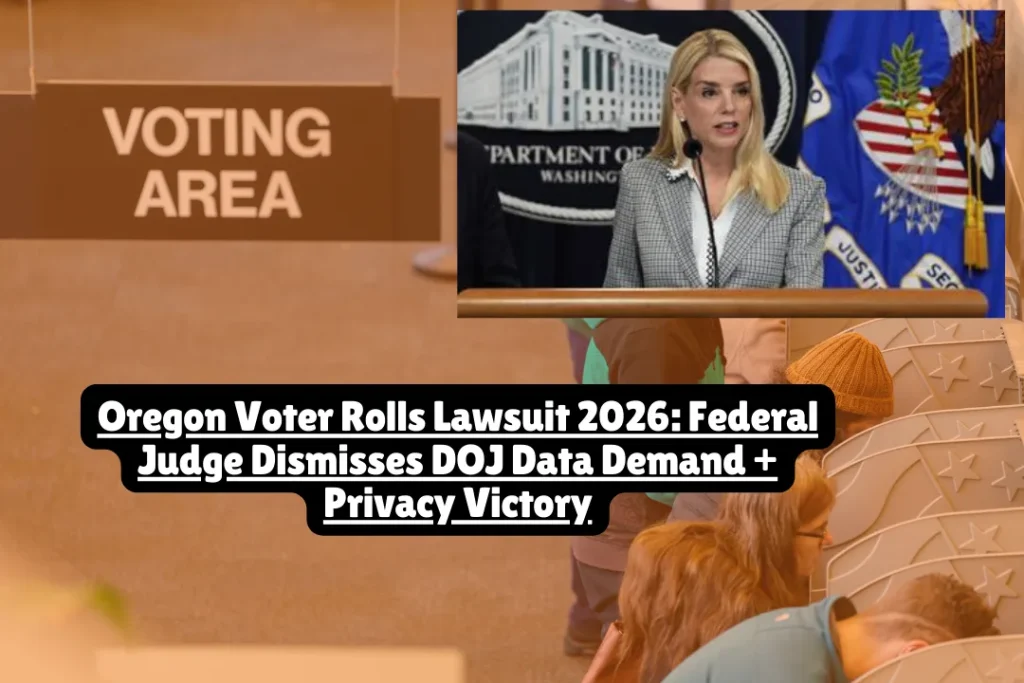
Oregon Voter Rolls Lawsuit 2026, Federal Judge Dismisses DOJ Data Demand + Privacy Victory
As of January 29, 2026, a major legal battle over Oregon’s voter registration data has reached a decisive turning point. On January 26, 2026, U.S. District Judge Mustafa Kasubhai officially dismissed the U.S. Department of Justice (DOJ) lawsuit that sought to force Oregon to hand over unredacted voter rolls containing private information.
This ruling is a significant development for the more than 3 million registered voters in Oregon, as it effectively blocks federal attempts to access sensitive data like partial Social Security numbers and driver’s license digits under the guise of list maintenance.
The Core of the Oregon Voter Rolls Lawsuit
The primary legal action, United States of America v. Oregon (Case No. 6:25-cv-01555), was filed in September 2025. The federal government alleged that Oregon’s refusal to provide complete, unredacted statewide voter registration lists violated several federal laws, including the National Voter Registration Act (NVRA) and the Help America Vote Act (HAVA).
Key details of the dispute include:
- The Federal Demand: The DOJ demanded unredacted electronic copies of the statewide voter list, including full names, dates of birth, residential addresses, and unique identification numbers.
- The State’s Refusal: Oregon Secretary of State Tobias Read refused the request, arguing that the federal government lacked the authority to demand such sensitive, personally identifiable information (PII) and that doing so would violate Oregonians’ privacy rights.
- The Allegations: Federal officials claimed the data was necessary to ensure the state was properly “cleaning” its rolls of ineligible voters, specifically focusing on non-citizen registrations.
January 2026 Update: Why the Lawsuit was Dismissed
In his ruling on January 26, 2026, Judge Kasubhai granted Oregon’s motion to dismiss, agreeing with the state that the federal government did not meet the legal threshold required to seize such records.
The court found that while federal law requires states to maintain accurate rolls, it does not grant the U.S. Attorney General a “backdoor” to bypass state privacy laws to obtain unredacted voter data. Oregon Attorney General Dan Rayfield hailed the decision as a victory for voter privacy, stating that voting laws cannot be used as a tool for unnecessary government intrusion.
Related Litigation: Judicial Watch and PILF
While the DOJ’s primary suit has been dismissed, Oregon has faced other legal challenges regarding its voter rolls:
- Judicial Watch v. Griffin-Valade: Filed in late 2024, this lawsuit alleged that Oregon failed to conduct a “reasonable program” to remove ineligible voters from its rolls. As of January 2026, this litigation remains active but has seen several counts dismissed due to procedural errors by the plaintiffs.
- Public Interest Legal Foundation (PILF): This group has also targeted Oregon, claiming the state fails to maintain and permit public inspection of records concerning “deceased retractions” and other list maintenance activities.
What You Must Know: 2026 Voter Roll Cleanup
Is My Registration Affected by the Lawsuit?
It is important to clarify that the DOJ lawsuit dismissal actually protects your data from being shared with federal agencies. However, the state is simultaneously conducting its own “housekeeping.”
On January 9, 2026, Secretary of State Tobias Read announced a major “restart” of the state’s routine voter roll maintenance. This is not a direct result of a settlement but rather a proactive step to address long-standing issues:
- 800,000 Inactive Records: The state has identified roughly 800,000 “inactive” voters.
- Immediate Cancellations: Approximately 160,000 registrations that have been inactive since 2017 are being canceled in late January 2026.
- Statutory Waiting Period: The remaining 640,000 inactive voters will be notified that their registrations will be canceled unless they take action (such as voting or returning a confirmation card) within the next two federal election cycles.
Common Misconceptions
A common mistake is confusing “inactive” status with being ineligible to vote. In Oregon, “inactive” voters are those whose mail-in ballots were returned as undeliverable. They stay on the rolls but do not receive a ballot automatically. The recent Directive 2026-01 issued on January 16, 2026, provides the official roadmap for how county clerks must now handle these records to ensure accuracy without disenfranchising eligible citizens.
What to Do Next
Action Steps for Oregon Voters
If you are concerned about your registration status following these 2026 updates, take the following steps:
- Check Your Status: Visit the official Oregon Secretary of State “My Vote” portal to ensure your registration is “Active” and your address is current.
- Respond to Mail: If you receive a Voter Confirmation Card in the mail, return it immediately. Failure to respond can eventually lead to your registration being moved to “inactive” or canceled.
- Update After Moving: Oregon’s “Motor Voter” system usually updates your address when you visit the DMV, but it is always safer to verify your registration manually after a move.
Official Resources
For the most accurate information on the status of Oregon’s voter rolls and ongoing litigation, consult:
- Oregon Secretary of State Elections Division: [sos.oregon.gov/elections]
- U.S. District Court for the District of Oregon: Search for Case No. 6:25-cv-01555.
- Directive 2026-01: This official document outlines the specific criteria for the 2026 voter roll purge.
FAQs
Did the federal government win the Oregon voter rolls lawsuit?
No. As of January 26, 2026, a federal judge dismissed the DOJ’s lawsuit, ruling that the government could not force Oregon to hand over unredacted voter data.
Why is Oregon purging 800,000 voters in 2026?
The state is not purging 800,000 voters at once. It is canceling 160,000 registrations that have been undeliverable and inactive since 2017. The other 640,000 inactive voters will remain on the list for now but face cancellation if they do not update their records by the next two federal elections.
Can the DOJ appeal the dismissal?
Yes. The DOJ has the right to appeal the January 26 dismissal to the 9th U.S. Circuit Court of Appeals. As of today, they have not publicly commented on whether they will do so.
What is the difference between an “Active” and “Inactive” voter?
Active voters receive a mail-in ballot for every election. Inactive voters are still registered but do not receive ballots because their previous mail was returned as undeliverable or they have not voted in several years.
Is the “Motor Voter” program being sued?
While the Motor Voter program has faced criticism for clerical errors (including roughly 1,800 non-citizens registered in error last year), the current DOJ lawsuit was about access to data, not the legality of the program itself.
Last Updated: January 29, 2026
Disclaimer: This article is for informational purposes only and does not constitute legal advice.
Stay informed about election law developments and protect your rights. For more on similar cases, check out our Oregon voter rolls lawsuit update page.
Stay informed, stay protected. — AllAboutLawyer.com
About the Author

Sarah Klein, JD, is a licensed attorney and legal content strategist with over 12 years of experience across civil, criminal, family, and regulatory law. At All About Lawyer, she covers a wide range of legal topics — from high-profile lawsuits and courtroom stories to state traffic laws and everyday legal questions — all with a focus on accuracy, clarity, and public understanding.
Her writing blends real legal insight with plain-English explanations, helping readers stay informed and legally aware.
Read more about Sarah