
Olympus Spa v. Armstrong Lawsuit, Federal Appeals Court Says Women-Only Spa Cannot Bar Transgender Customers
A Trump-appointed federal appellate judge invoked a crude anatomical phrase three times in a dissenting opinion on March 12, 2026 — drawing sharp rebukes from 29 of his colleagues on the 9th Circuit. The opinion instantly went viral. But beneath the headline is a landmark ruling on the collision between transgender anti-discrimination law, religious freedom, and women’s privacy rights that will reverberate across the country.
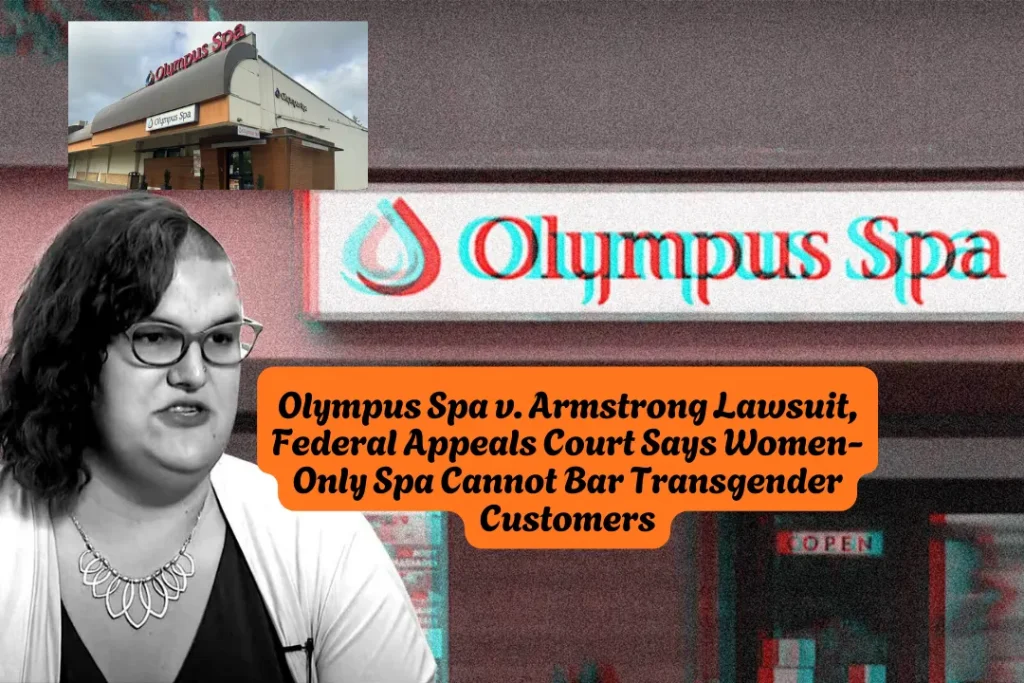
In Olympus Spa v. Armstrong, the 9th U.S. Circuit Court of Appeals held that Washington state can enforce an anti-discrimination law to allow a person who identifies as a woman — regardless of surgical status — to enter the spa. The facility in Lynnwood, Washington is a traditional Korean spa that limits admission to females only, because its services involve full nudity for Korean scrubs, communal bathing, saunas, and massages. The court dismissed the spa’s First Amendment claims. The case is now fully adjudicated at the appellate level, with Supreme Court review as the only remaining option.
Quick Case Snapshot
| Field | Detail |
| Plaintiff | Olympus Spa; Sun Lee (owner) |
| Defendant | Bobbie Armstrong (in her official capacity); Washington State Human Rights Commission (WSHRC) |
| Court | U.S. Court of Appeals for the Ninth Circuit |
| Case Number | 23-4031 |
| Filing Date | 2022 (original federal complaint) |
| Panel Judges | Margaret McKeown (majority); Ronald Gould (majority); Kenneth Lee (dissent, May 2025); Lawrence VanDyke (dissent, March 2026) |
| Claims Alleged | Violation of First Amendment — free exercise of religion, free speech, freedom of association |
| Damages Sought | Declaratory and injunctive relief — no monetary damages sought |
| Current Status | ✅ Affirmed — dismissal with prejudice upheld. Supreme Court petition possible. |
What Actually Happened?
In January 2020, a pre-operative transgender woman filed a complaint with the Washington State Human Rights Commission after claiming she was denied entry to Olympus Spa. Haven Wilvich, who identifies as a “nonbinary trans woman,” alleged the spa turned her away because she had not undergone gender-affirming surgery.
Olympus Spa, which has locations in Lynnwood and Tacoma, is a traditional Korean jjimjilbang that offers full-body scrubs, communal bathing, saunas, and massages — all performed in full nudity, consistent with Korean spa tradition. The spa’s entry policy required patrons to have female genitalia, but it did admit post-operative transgender women who had completed gender-affirming surgery.
After entering into a settlement with the WSHRC in October 2021, Olympus Spa sued, alleging the state’s enforcement against it violated its rights to free speech, freedom of religion, and freedom of association. A Seattle federal district court dismissed the case. The spa appealed to the 9th Circuit.
What the Lawsuit Alleged
Olympus Spa raised three constitutional arguments in federal court:
1. Free Exercise of Religion — The spa’s owners described themselves as traditional theologically conservative Korean Christians who consider modesty between males and females a central tenet of their faith. They argued that compelling the spa to admit pre-operative transgender women directly violated those sincere religious beliefs.
2. Freedom of Speech — The spa argued that its admission policy was expressive conduct — a statement about the nature of the space it operates — and that forcing it to abandon that policy compelled speech the owners do not endorse.
3. Freedom of Association — The spa argued it had a constitutional right to define the membership and clientele of its private space and to exclude those who do not share its values or meet its criteria.
The spa also argued that its female employees must, under the state’s enforcement position, provide full-body massages to naked pre-operative transgender women with intact male sexual organs — a requirement they contended violated their religious and personal rights.
What the Court Decided
The 9th Circuit panel affirmed the district court’s dismissal of the case with prejudice. The majority held that the spa’s admission policy discriminates based on gender identity and therefore, under Washington state law, discriminates based on sexual orientation — placing it squarely within the reach of the Washington Law Against Discrimination.
A three-judge panel dismissed the spa’s First Amendment arguments for free exercise of religion and freedom of association in a May 2025 ruling. The court then issued a further opinion on March 12, 2026, which triggered the viral judicial dissent. The panel held that the WSHRC’s action under WLAD did not impermissibly burden the spa’s First Amendment rights to free speech or free exercise of religion.
The Dissent That Went Viral
Judge Lawrence VanDyke, appointed by President Trump, opened his dissenting opinion with the phrase “This is a case about swinging dicks,” which he used three times. He wrote: “You may think that swinging dicks shouldn’t appear in a judicial opinion. You’re not wrong. But as much as you might understandably be shocked and displeased to merely encounter that phrase in this opinion, I hope we all can agree that it is far more jarring for the unsuspecting and exposed women at Olympus Spa — some as young as thirteen — to be visually assaulted by the real thing.”
VanDyke’s language drew sharp rebukes from 29 of his colleagues on the 9th Circuit. The dissent argued the majority had ignored the privacy and safety interests of the women and girls who use the spa and had elevated transgender access rights over them.
The earlier May 2025 dissent from Judge Kenneth Lee took a different tone. Lee argued the state of Washington was wrong to overzealously pursue the case against a family-owned immigrant business, writing: “Ultimately, this case is not just about the fate of a family-owned business. It is about power — which groups have it and which do not. And Asian Americans in Washington have historically lacked political clout.”
Washington State’s Position
The WSHRC maintained throughout the litigation that the spa’s policy violates the Washington Law Against Discrimination, which prohibits discrimination on the basis of sexual orientation — defined in Washington to include gender expression and identity — in places of public accommodation. The state argued its enforcement was a routine application of existing civil rights law, not a targeted action against religious exercise.
The ACLU of Washington supported the state’s position. The ACLU filed an amicus brief in the case, arguing that enforcement of WLAD was consistent with both state and federal anti-discrimination principles.
What Laws Are at the Center of This Case?
Washington Law Against Discrimination (WLAD), RCW 49.60 — Washington’s primary state civil rights statute. It prohibits public accommodations — including spas, restaurants, hotels, and other businesses open to the public — from discriminating on the basis of sexual orientation, which Washington law defines to include gender expression and gender identity.
First Amendment — Free Exercise of Religion — The First Amendment prohibits the government from substantially burdening sincere religious practice without a compelling interest. Olympus Spa argued the state had no compelling interest sufficient to override the owners’ faith-based objections to their admission policy.
First Amendment — Freedom of Expressive Association — The Supreme Court has recognized that certain organizations have a First Amendment right to exclude members who conflict with their expressive purpose (Boy Scouts of America v. Dale, 2000). Olympus Spa argued it qualified for similar protection.
Current Status & What Happens Next
- The 9th Circuit’s March 12, 2026 ruling affirms the dismissal with prejudice. Olympus Spa has exhausted its federal appellate options at the circuit court level.
- The spa’s legal team at the Pacific Justice Institute has not yet publicly announced whether it will petition the U.S. Supreme Court for certiorari — the formal request for the Supreme Court to review the case. Olympus Spa has 90 days from the ruling to file such a petition.
- Given the current composition of the Supreme Court and its recent decisions expanding religious freedom protections (303 Creative LLC v. Elenis, 2023), legal observers consider this a plausible candidate for Supreme Court review — though the Court grants certiorari in fewer than 2% of petitions it receives.
- If the spa does not petition the Supreme Court, or if the Court declines to hear the case, the 9th Circuit ruling stands and Olympus Spa must comply with the WSHRC’s enforcement position.
This page will be updated as the case develops.
Important Case Dates
| Milestone | Date |
| Incident (Wilvich Denied Entry) | January 2020 |
| WSHRC Complaint Filed | Late 2020 |
| WSHRC Settlement | October 2021 |
| Federal Lawsuit Filed | 2022 |
| District Court Dismissal | 2023 |
| First 9th Circuit Opinion (May 2025) | May 29, 2025 |
| Second 9th Circuit Opinion (March 2026) | March 12, 2026 |
| Supreme Court Petition Deadline | ~June 2026 (TBD) |
| Supreme Court Review | TBD |
Frequently Asked Questions
Is the Olympus Spa lawsuit real?
Yes. Olympus Spa v. Armstrong, Case No. 23-4031, is a matter of public record in the U.S. Court of Appeals for the Ninth Circuit. The full court opinions are publicly available through the ACLU of Washington and the 9th Circuit’s official document repository.
What did the 9th Circuit actually rule?
The panel affirmed the dismissal with prejudice of Olympus Spa’s lawsuit, holding that the spa’s policy discriminates based on gender identity — and therefore sexual orientation under Washington law — and that enforcing anti-discrimination law against the spa does not violate the First Amendment.
Can Olympus Spa still appeal?
The spa can petition the U.S. Supreme Court for certiorari. It can also request an en banc rehearing before the full 9th Circuit. Neither path guarantees review, and neither automatically stops the WSHRC enforcement action in the meantime.
Does this ruling apply outside Washington state?
The ruling directly binds courts within the 9th Circuit’s jurisdiction — which covers Washington, California, Oregon, Arizona, Nevada, Idaho, Montana, Alaska, and Hawaii. It is persuasive authority elsewhere but not binding on other federal circuits. States without similar anti-discrimination laws covering gender identity are not affected.
What was the dissent about?
Judge VanDyke argued he would have ruled in favor of Olympus Spa, contending the majority failed to weigh the privacy and safety interests of women and girls who use the spa against the access rights of pre-operative transgender women. His use of graphic language drew formal rebukes from 29 fellow judges on the 9th Circuit.
What does this mean for other faith-based businesses?
The ruling signals that Washington’s anti-discrimination protections for gender identity extend to nude service environments and that sincere religious objections alone do not exempt a public accommodation from compliance. Businesses with similar faith-based admission policies in 9th Circuit states should consult legal counsel to assess their exposure under applicable state laws.
Could the Supreme Court take this case?
Legal analysts note the case presents a direct tension between LGBTQ anti-discrimination protections and religious liberty claims — the same tension the Supreme Court has addressed in 303 Creative (2023) and Masterpiece Cakeshop (2018). The Court has not yet addressed a case involving nude service environments and gender identity. That novel factual context may increase the likelihood of Supreme Court interest.
Sources & References
Related Reading on AllAboutLawyer.com: For coverage of another active civil rights and discrimination lawsuit that made national headlines, see our report on the Micah Washington $20M federal civil rights case against Alabama officers — a case testing constitutional protections against government overreach. You can also explore our coverage of James Hodges lawsuit for more on how courts balance individual rights against institutional authority.
Last Updated: March 14, 2026
This article is for informational purposes only and does not constitute legal advice. Allegations in a complaint are not findings of fact. All parties are presumed innocent unless and until proven otherwise in court.
About the Author

Sarah Klein, JD, is a licensed attorney and legal content strategist with over 12 years of experience across civil, criminal, family, and regulatory law. At All About Lawyer, she covers a wide range of legal topics — from high-profile lawsuits and courtroom stories to state traffic laws and everyday legal questions — all with a focus on accuracy, clarity, and public understanding.
Her writing blends real legal insight with plain-English explanations, helping readers stay informed and legally aware.
Read more about Sarah