
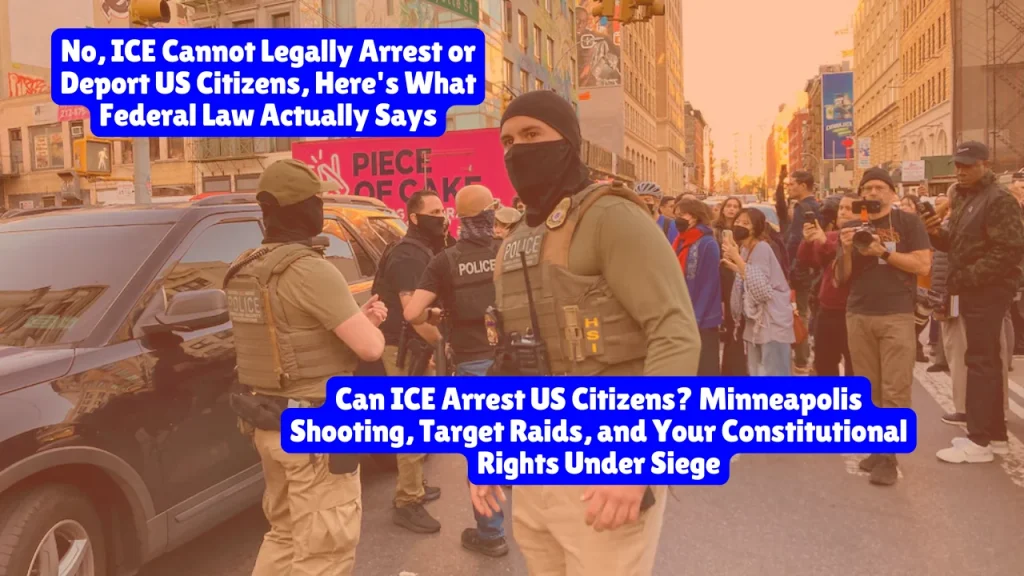
No, ICE Cannot Legally Arrest or Deport US Citizens, Here’s What Federal Law Actually Says
No, ICE cannot legally arrest or deport US citizens. However, ICE has detained over 170 US citizens since 2003, and recent January 2026 incidents show citizens are increasingly caught in enforcement operations—including fatal encounters. Can ICE detain US citizens during raids? What constitutional protections apply?
On January 9, 2026, ICE agents fatally shot Renee Nicole Good, a 37-year-old US citizen, in Minneapolis after ordering her to exit her vehicle during an immigration operation. Just days earlier, ICE arrested two US citizen Target employees at a Richfield, Minnesota store entrance. These incidents underscore a chilling reality: despite lacking legal authority over citizens, ICE increasingly detains Americans based on mistaken identity, outdated records, or allegations of interfering with immigration operations.
Understanding Your Rights Matters Because Anyone Can Be Caught in ICE Operations
This affects you if you’re a US citizen who might encounter ICE during workplace raids, traffic stops, or street operations, especially if you share characteristics ICE associates with undocumented immigrants. Understanding your constitutional protections could prevent wrongful detention, protect you during encounters, and help you document potential violations of your Fourth Amendment rights against unreasonable search and seizure.
ICE’s Legal Authority and Constitutional Limitations
Immigration and Customs Enforcement operates within a strict legal framework that distinguishes between its powers over non-citizens and the constitutional protections US citizens retain.
What ICE Is and What Laws Govern Its Powers
ICE was established in 2003 under the Homeland Security Act passed after the September 11 attacks. The agency absorbed duties from two defunct agencies: the Immigration and Naturalization Service and the United States Customs Service. ICE’s Enforcement and Removal Operations division carries out immigration raids, runs detention centers, and executes deportations.
Federal immigration law grants ICE authority to detain, arrest, and deport individuals believed to be in the United States illegally. The Immigration and Nationality Act authorizes ICE officers to question people, briefly detain them with reasonable suspicion of illegal presence, and arrest those they believe are immigration law violators. Unlike local police, ICE does not need judicial warrants to make immigration arrests—only administrative warrants issued by immigration officials.
The Critical Constitutional Limits on ICE’s Authority Over Citizens
The Fourth Amendment protects all persons in the United States—citizens and non-citizens alike—against unreasonable searches and seizures. For ICE to arrest anyone, officers must have probable cause to believe the person violated immigration law. This creates a fundamental limit: ICE cannot arrest US citizens for immigration violations because citizens cannot violate immigration law.
Professor Bill Hing from the University of San Francisco Law School states clearly: “Once they know you are a citizen, they have no authority over you.” However, ICE can temporarily detain citizens if officers reasonably believe they’re not citizens—placing the burden on citizens to prove their status. ICE can also arrest citizens for criminal offenses like obstructing immigration enforcement or assaulting officers.
When ICE Might Encounter US Citizens Despite Limited Authority
Several scenarios bring ICE into contact with citizens. First, workplace raids where citizens work alongside non-citizens—like the January 2026 Target incident where two US citizen employees were arrested. Second, traffic stops in areas with heavy immigration enforcement. Third, when citizens attempt to film, document, or protest ICE operations. Fourth, mistaken identity based on appearance, name confusion, or outdated records.
According to ProPublica’s investigation, ICE detained upward of 170 US citizens between 2003 and 2019. The list includes 130 people held for alleged infractions like interfering with operations, though these cases “often wilted under scrutiny” and few resulted in convictions. More recent data suggests wrongful detentions continue despite ICE’s lack of legal authority.
What “Arrest” Means in the ICE Context Versus Criminal Law
ICE arrests differ fundamentally from criminal arrests. Immigration detention is civil, not criminal—meaning different constitutional standards apply. ICE can detain someone based on reasonable suspicion they’re in the country illegally, a lower standard than probable cause required for criminal arrest. However, for US citizens, no level of suspicion justifies immigration detention because citizenship itself defeats any immigration violation claim.
Criminal arrests by ICE require the same probable cause as any law enforcement agency. If ICE arrests a citizen for obstruction, assault, or other crimes, normal criminal procedure applies—including Miranda rights, right to attorney, and criminal charges that must be prosecuted by district attorneys.
Can ICE Legally Arrest or Detain US Citizens?
The direct legal answer is nuanced: ICE cannot arrest citizens for immigration violations, but can temporarily detain them until citizenship is verified, and can arrest them for certain criminal offenses.
The Constitutional Framework Protecting US Citizens
The Fourth Amendment requires government agents to have probable cause before arresting anyone. For immigration arrests specifically, probable cause means suspicion the individual is in the US illegally and might try to escape before a warrant can be secured. US citizens cannot be in the country illegally by definition—their presence is constitutionally protected.
The Fourteenth Amendment guarantees due process, meaning the government cannot deprive citizens of liberty without fair legal procedures. Detaining a verified US citizen based solely on immigration concerns violates due process. However, if ICE reasonably suspects someone is not a citizen, brief detention for verification may be lawful if ICE acts in good faith.
When ICE Can Give Orders to or Temporarily Detain Citizens
ICE can give lawful orders to US citizens in limited circumstances directly tied to immigration enforcement authority. As MSNBC legal analyst explained in January 2026 analysis, ICE can order citizens—or even detain them temporarily—if they’re obstructing or interfering with immigration enforcement activity.
For example, if a citizen stands in front of an ICE vehicle preventing it from leaving an arrest scene, ICE can order them to move and potentially arrest them for obstruction. If a citizen physically interferes with an arrest, ICE can use the minimum necessary force to complete the arrest and charge the citizen with a crime. ICE agents reportedly directed Renee Good to exit her vehicle before fatally shooting her, though whether she was interfering with operations remains disputed.
What Recent Court Rulings and Legal Developments Say
The Supreme Court ruled December 23, 2025, that President Trump could not send National Guard troops to Chicago for immigration enforcement without local cooperation—demonstrating judicial limits on executive immigration enforcement power. Following this ruling, Trump halted federal force deployments to Los Angeles, Portland, and other cities.
Multiple federal courts have dismissed criminal charges against citizens accused of obstructing ICE operations after scrutiny revealed ICE agents lied about circumstances. In Los Angeles, Washington DC, and other cities, prosecutors accused protesters of assaulting or hindering officers, only to see cases crumble when evidence contradicted ICE reports. These dismissals suggest courts are skeptical of ICE’s characterization of citizen conduct as criminal obstruction.
What Happens When ICE Wrongfully Detains US Citizens
When ICE detains a citizen by mistake, the detention becomes unlawful once citizenship is verified. However, ICE often holds citizens until someone brings documentation proving citizenship—birth certificates, passports, or naturalization papers—or until an attorney intervenes. Some citizens have been held for days or even weeks before ICE released them.
Citizens wrongfully detained can sue the federal government under Bivens actions for constitutional violations, seek damages for false imprisonment, and file civil rights complaints. In November 2025, a US-born citizen sued after ICE agents arrested him, demonstrating that wrongful detentions trigger legal accountability. However, qualified immunity often protects individual officers from personal liability.
Your Rights as a US Citizen During ICE Encounters
Knowing your constitutional protections and how to assert them can prevent wrongful detention and protect your liberty.
What You Can and Cannot Be Required to Do
You can be required to provide identification if ICE has reasonable suspicion of immigration violations. If you’re a US citizen over 18, you should carry proof of citizenship—passport, birth certificate, naturalization certificate, or driver’s license. However, most Americans don’t carry passports daily, creating opportunities for wrongful detention.
You cannot be required to answer questions about where you were born, your immigration status, or how you entered the country—though remaining silent may prolong the encounter. According to ACLU guidance, you should ask, “Am I free to leave?” If ICE says yes, you can walk away. If they say no without probable cause that you committed a crime, the detention may be unlawful.
Your Right to Remain Silent and Refuse Searches
The Fifth Amendment protects your right against self-incrimination. You can tell ICE agents, “I am exercising my right to remain silent.” You don’t have to discuss your citizenship status, though doing so may be the fastest way to end the encounter if you can prove citizenship.
You have the right to refuse searches of your person, vehicle, or belongings unless ICE has a warrant. However, ICE claims authority to search vehicles without warrants under the automobile exception if they have probable cause of evidence or contraband. ICE cannot enter your home without a judicial warrant signed by a judge—not just an administrative warrant issued by ICE itself.
Your Right to Legal Representation and Documentation
You have the right to ask for an attorney and refuse to speak until legal counsel is provided. During any encounter, you should document the interaction by noting officers’ names, badge numbers, vehicle numbers, and circumstances. Tell ICE officers you want to speak with a lawyer immediately.
Citizens and non-citizens alike can record ICE performing law enforcement activities in public places, so long as recording doesn’t interfere with ICE activity like an arrest. Some states including Florida, Tennessee, and Louisiana require observers to move back 25 feet upon law enforcement request, though constitutional challenges to these laws are pending.
What You Must Know About ICE Authority and Recent Developments
Understanding the broader context helps you assess risk and respond appropriately to potential encounters.
How ICE’s Authority Has Evolved and Been Challenged
When ICE was created in 2003, it inherited immigration enforcement powers dating to the nation’s founding. However, ICE’s aggressive tactics under the Trump administration’s 2025 return have sparked unprecedented mass protests, legal challenges, and renewed calls for the agency’s abolition.
Courts have repeatedly limited ICE authority. Federal judges have ruled that ICE cannot rely solely on appearance to make immigration arrests, as millions of US citizens share characteristics ICE associates with undocumented immigrants. Courts require ICE to have specific, articulable facts supporting reasonable suspicion beyond physical appearance, accent, or location in Latino or immigrant neighborhoods.
Recent High-Profile Cases and Policy Changes
The January 9, 2026 fatal shooting of Renee Good triggered nationwide protests under the slogan “ICE Out for Good.” Video shows a masked ICE agent yelling expletives while attempting to open Good’s car door before another agent fired three shots at point-blank range as she attempted to drive away. ICE agents then prevented a doctor from checking her pulse and blocked paramedics for 15 minutes while she remained in the crashed vehicle.
Days earlier, ICE arrested two US citizens who were Target employees at the store entrance in Richfield, Minnesota, prompting massive protests demanding Target protect employees and customers from federal agents. In December 2025, ICE agents grabbed and tackled a Los Angeles man using his phone to film an immigration raid. He was released the next day and has sued the government.
TSA-ICE Data Sharing and Airport Arrests
As of January 2026, the Transportation Security Administration sends ICE passenger information multiple times weekly, including names, photos, and flight details. ICE checks these lists against its records and sends officers to arrest targeted individuals at airports. This program puts US citizens at risk if ICE’s records incorrectly identify them as non-citizens or if they match profiles ICE uses to select enforcement targets.
The National Immigrant Law Center reported in late 2025 that ICE is arresting people with pending immigration applications, including asylum seekers and green card applicants. This aggressive stance increases the likelihood of mistaken detentions affecting citizens whose records are confused with non-citizens sharing similar names or identifying information.
What to Do Next: Protecting Your Rights
Practical steps can help you prepare for potential ICE encounters and respond appropriately if they occur.
Step-by-Step Guidance If ICE Approaches You
First, stay calm and don’t run, argue, resist, or fight, even if you believe your rights are being violated. Physical resistance gives ICE grounds to arrest you for obstruction. Second, keep your hands visible and tell officers if you need to reach into a glove compartment or wallet for documents.
Third, ask if you’re free to leave. If yes, calmly walk away. If no, ask why you’re being detained and whether officers are from ICE or CBP. Fourth, clearly state, “I am a US citizen” and provide proof if you have it. Fifth, assert your right to remain silent regarding any questions beyond basic identification. Sixth, request an attorney immediately and do not sign anything until you speak with legal counsel.
Seventh, if officers attempt to enter your home, do not open the door unless they show a judicial warrant signed by a judge. Ask them to slide it under the door so you can verify it’s a judicial warrant, not just an administrative immigration warrant. Eighth, document everything—officer names, badge numbers, vehicle numbers, what they said, what happened, and any witnesses present.
Where to Find Official Resources and Report Violations
The American Civil Liberties Union provides “Know Your Rights” materials at aclu.org specifically for ICE encounters. The National Immigrant Justice Center offers guidance at immigrantjustice.org with information on what to do if detained. If you’re detained, loved ones can use ICE’s online detainee locator at locator.ice.gov to find you.
To report violations of your constitutional rights, file complaints with the DHS Office of Civil Rights and Civil Liberties at dhs.gov/crcl. Document everything before filing—dates, times, locations, officer names and badge numbers, witnesses, photos or videos if safely obtained, and any injuries or property damage. You can also contact your Congressional representative’s office for assistance with federal agency issues.
How to Find Legal Help and Protect Yourself
If ICE arrests or detains you, contact an immigration attorney immediately even though you’re a US citizen—immigration lawyers understand ICE procedures and detention facilities. Organizations like the American Immigration Lawyers Association at aila.org can provide referrals. Many attorneys offer free consultations and work on contingency for civil rights violations.
Consider carrying proof of citizenship when traveling in areas with heavy immigration enforcement. However, you’re not legally required to carry documents at all times unless you’re a legal permanent resident (green card holder). If you frequently encounter ICE in your community, document incidents even if you’re not personally detained—your evidence might help others challenge unlawful practices.
Frequently Asked Questions
Can ICE arrest US citizens?
No, ICE cannot legally arrest US citizens for immigration violations. However, ICE can temporarily detain citizens if officers reasonably believe they’re not citizens until status is verified. ICE has wrongfully detained over 170 US citizens since 2003 based on misidentification, outdated records, or appearance. ICE can also arrest citizens for criminal offenses like obstructing immigration enforcement or assaulting officers, though many such charges have been dismissed after scrutiny.
What rights do US citizens have during ICE encounters?
You have Fourth Amendment protection against unreasonable search and seizure, Fifth Amendment right to remain silent, and Sixth Amendment right to legal counsel. Ask “Am I free to leave?” and walk away if they say yes. State “I am a US citizen” and show proof if available. Request an attorney immediately and refuse to sign anything. You can record ICE in public places if you don’t interfere with their operations.
What should I do if ICE approaches me?
Stay calm, keep hands visible, and don’t run or resist. Ask if you’re free to leave. State “I am a US citizen” and provide proof if you have it. Assert your right to remain silent and request an attorney. Don’t answer questions about your birthplace, immigration status, or citizenship without a lawyer. Don’t sign any documents. Document officer names, badge numbers, and what happened.
Can ICE enter my home without a warrant?
No. ICE needs a judicial warrant signed by a judge to enter your home. Administrative immigration warrants issued by ICE itself don’t authorize home entry. Don’t open your door unless ICE shows a judicial warrant. Ask them to slide it under the door so you can verify it’s signed by a judge. If they enter without a warrant, state “I do not consent to this search” but don’t physically resist.
What is the difference between ICE and regular police?
ICE is a federal immigration enforcement agency within the Department of Homeland Security. Local police enforce state and local criminal laws. ICE officers often identify themselves as “police,” but they’re not local police. ICE focuses on immigration law violations, while police handle criminal matters. ICE can make immigration arrests without judicial warrants, while police generally need warrants for arrests unless they witness crimes or have exigent circumstances.
What happens if ICE wrongfully detains a US citizen?
ICE typically holds wrongfully detained citizens until someone provides citizenship documentation—birth certificate, passport, or naturalization certificate—or until an attorney intervenes. Some citizens have been detained for days or weeks. Once released, citizens can sue ICE under Bivens actions for constitutional violations, seek damages for false imprisonment, and file civil rights complaints with DHS. Several citizens have successfully sued after wrongful detentions.
Do I have to answer questions from ICE officers?
No. You have the Fifth Amendment right to remain silent. You don’t have to discuss where you were born, your immigration status, or how you entered the country. However, refusing to answer may prolong the encounter. Stating “I am a US citizen” and showing proof is usually the fastest way to end the encounter, but you’re not legally required to answer any questions beyond basic identification without an attorney present.
Pro Tip: Record every detail of ICE encounters immediately after they occur. Use your phone to create a voice memo or type notes while memory is fresh—officer descriptions, badge numbers, vehicle numbers, exact quotes, witnesses present, and timeline of events. Take photos of officers from a safe distance if legal in your state. Email these notes to yourself for timestamped backup. This documentation becomes critical evidence if you need to file complaints, sue for civil rights violations, or help others challenge ICE’s practices in your community.
Disclaimer: This article provides general information about ICE authority and US citizen rights during ICE encounters based on constitutional law, court rulings, and official government sources. It is not legal advice. ICE arrest and detention situations vary by individual circumstances, location, and specific facts. AllAboutLawyer.com does not provide legal services. For specific questions about your rights during an ICE encounter, wrongful detention, or potential civil rights violations, consult a qualified immigration attorney or civil rights lawyer immediately.
Related Resources:
Can ICE Agents Shoot Someone Trying to Run Them Over?
Do ICE Have the Same Rights as Police? Legal Authority
Can ICE Force You Out of Your Car? Your Rights
Yes, ICE Is Law Enforcement—But Their Authority Has Limits You Need to Know
Stay informed, stay protected. — AllAboutLawyer.com
Last Updated: January 12, 2026 — We keep this current with the latest legal developments
About the Author

Sarah Klein, JD, is a licensed attorney and legal content strategist with over 12 years of experience across civil, criminal, family, and regulatory law. At All About Lawyer, she covers a wide range of legal topics — from high-profile lawsuits and courtroom stories to state traffic laws and everyday legal questions — all with a focus on accuracy, clarity, and public understanding.
Her writing blends real legal insight with plain-English explanations, helping readers stay informed and legally aware.
Read more about Sarah