
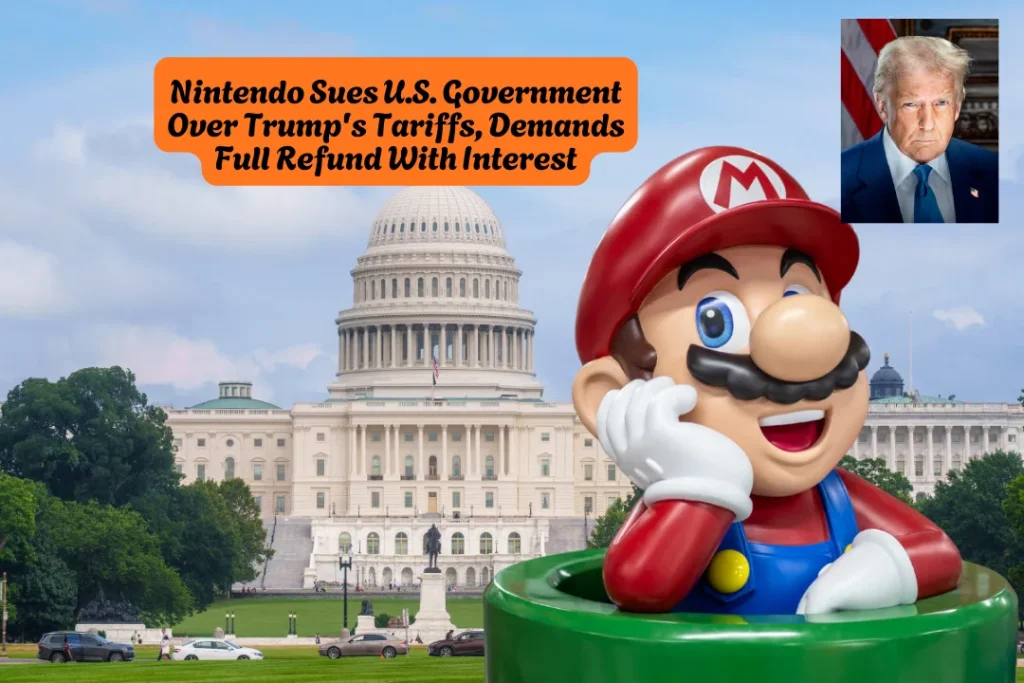
Nintendo Sues U.S. Government Over Trump’s Tariffs, Demands Full Refund With Interest
On March 6, 2026, Nintendo of America filed a lawsuit in the U.S. Court of International Trade, targeting the tariffs levied against it under President Donald Trump’s use of the International Emergency Economic Powers Act of 1977 (IEEPA). The company is demanding a full refund of all duties paid under those tariffs, with interest, as well as attorney fees.
The lawsuit follows a landmark February 2026 Supreme Court ruling that struck down IEEPA-based tariffs as unlawful — and joins a wave of over 1,000 similar corporate complaints filed against the U.S. government. This is not a consumer class action. It is a federal trade lawsuit brought by Nintendo of America as an importer seeking recovery of duties it paid directly to the U.S. government.
Quick Facts
- Case Name & Number: Nintendo of America Inc. v. United States, Case No. 1:26-cv-1540
- Court: U.S. Court of International Trade
- Date Filed: March 6, 2026
- Plaintiff: Nintendo of America Inc.
- Legal Representation: Venable LLP
- Defendants: U.S. Department of the Treasury; Department of Homeland Security; Office of the U.S. Trade Representative; U.S. Customs and Border Protection; U.S. Department of Commerce; Treasury Secretary Scott Bessent; former DHS Secretary Kristi Noem; and other named Trump administration officials
- Legal Basis: International Emergency Economic Powers Act of 1977 (IEEPA) — challenged as exceeding presidential authority
- Relief Sought: Full refund of all IEEPA duties paid since February 2025, with interest; attorney fees; reprocessing of import entries
- Supreme Court Ruling: February 20, 2026 — IEEPA tariffs struck down as unlawful
- Judge Overseeing Tariff Cases: Judge Richard Eaton
- Status: Active litigation — no settlement or refund issued yet
Current Status & What Happens Next
- On February 20, 2026, the U.S. Supreme Court ruled that Trump did not have the authority to impose tariffs via IEEPA, rendering those duties unlawful. Nintendo filed its lawsuit two weeks later, directly citing that ruling.
- Judge Richard Eaton, who has been designated to oversee the roughly 2,000 tariff refund lawsuits filed in the trade court, ruled on March 5 that companies are entitled to refunds.
- However, a critical obstacle has emerged immediately. On the same day Nintendo filed its lawsuit, Customs and Border Protection said in a filing it cannot currently comply with the order to refund tariffs. A system could be “operational” in 45 days, according to the Wall Street Journal.
- No refund timeline has been confirmed. Nintendo’s case will proceed alongside the broader consolidated litigation, and the government’s compliance with the refund order remains contested.
- This article will be updated as the court proceedings develop.
Background: What Were the IEEPA Tariffs?
Trump’s “Liberation Day” and the Tariff Escalation
Since February 1, 2025, President Trump implemented executive orders imposing tariffs on imports from a vast swath of countries under the International Emergency Economic Powers Act of 1977.
The complaint covers 10 executive orders in total, stretching from the initial February 1, 2025 tariffs on Canada, Mexico, and China through to a 40% tariff on Brazilian goods and a 25% tariff on India tied to its purchases of Russian oil, both issued in mid-2025. China-specific duties escalated rapidly over the period: starting at 10%, rising to 20%, then to 84%, peaking at 125%, and then reduced to 34% in May 2025.
Japan, where Nintendo is headquartered, was hit with a 24% reciprocal tariff, and Vietnam was hit with a 46% tariff.
How Nintendo Was Directly Harmed
Nintendo manufactures its consoles and accessories primarily in Vietnam and China, putting it squarely in the crossfire when sweeping tariffs were announced in April 2025.
The financial and operational consequences were immediate and public:
- Nintendo took the unprecedented step of delaying its U.S. pre-order window for the Nintendo Switch 2, directly blaming tariffs and evolving market conditions.
- The cost of a Switch OLED went up by $50, the standard model by $40, and the Switch Lite by $30. While Nintendo kept the Switch 2 console itself at its original price, accessories received price increases due to tariff costs.
- To keep the console price the same, Nintendo redirected most of its Vietnam-made units to the U.S. market, straining its global supply chain in the process.
What the Lawsuit Argues
The Core Legal Claim: IEEPA Does Not Authorize Tariffs
Nintendo’s lawyers argue the tariffs are in violation of the International Emergency Economic Powers Act of 1977 and therefore the company is entitled to a full refund of the tariffs paid since February 2025. “All tariffs collected under the IEEPA Duties must be refunded with interest,” lawyers write.
The legal argument is straightforward: IEEPA is an emergency powers statute — it was never intended by Congress to grant the president unilateral authority to impose sweeping tariffs on imports from nearly every country in the world. Courts agreed. The U.S. Supreme Court ruled on February 20, 2026 that Trump did not have the authority to impose tariffs via IEEPA, rendering those duties unlawful.
Using the Government’s Own Words Against It
Nintendo’s complaint deploys a particularly pointed legal strategy. A notable element of the complaint is its use of the government’s own prior concessions: in the earlier V.O.S. Selections v. Trump litigation, the government argued that “if tariffs imposed on plaintiffs during these appeals are ultimately held unlawful, then the government will issue refunds to plaintiffs, including any post-judgment interest that accrues.” Nintendo’s lawyers cite this directly, arguing that position already binds the government.
The Scale of Duties at Stake
According to Nintendo’s complaint, the tariffs resulted in the collection of more than $200 billion in duties on imports from nearly all countries since February 2025. Separately, U.S. Customs and Border Protection disclosed in a court filing that it collected approximately $166 billion in IEEPA tariffs specifically, spanning more than 330,000 importers and over 53 million entries.
Nintendo has not disclosed the specific dollar amount it paid in IEEPA tariffs, but given its product volume and manufacturing footprint in Vietnam and China, the figure is expected to be substantial.
The Broader Wave: Nintendo Is One of 1,000+ Companies Suing
Nintendo’s lawsuit is significant in name recognition — but it is far from alone.
As of early March 2026, more than 1,000 companies have filed similar lawsuits in the U.S. Court of International Trade. The roster includes Costco, FedEx, L’Oréal, Dyson, Revlon, Bausch & Lomb, and CVS — all filing complaints seeking refunds on tariffs they say were illegally collected.
According to research from the Tax Foundation, Trump’s tariffs amounted to an average tax increase of $1,000 per U.S. household in 2025, a figure projected to rise to $1,300 per household in 2026 if the IEEPA tariffs remained in place. The Yale Budget Lab reached similar conclusions, estimating that consumers faced $1,300 to $1,700 in additional costs compared with pre-2025 levels.
The question now facing courts, consumers, and businesses alike is whether refunds — if ordered — will flow back to the end consumers who ultimately absorbed these costs. Companies like FedEx have signaled they will issue tariff refunds to consumers, but say they will be unable to do so until courts and regulators clarify next steps. Nintendo has made no similar commitment.
Allaboutlawyer.com has previously covered the Costco tariff lawsuit against the Trump administration — one of the first major retailers to file a protective complaint in November 2025 ahead of a critical December 15 liquidation deadline. That filing, like Nintendo’s, challenged the IEEPA legal basis and demanded full tariff refunds. For deeper background on the legal arguments being used across all these cases, see the full breakdown of the Costco lawsuit against Trump and how the IEEPA authority question was litigated from the start.
What This Means for Consumers
Nintendo’s lawsuit is not a consumer class action. Consumers who paid higher prices for Switch 2 accessories or other Nintendo products as a result of tariff-driven price increases cannot file a claim in this case. Nintendo is suing as the importer of record — seeking recovery of duties it paid directly to the U.S. government.
However, the broader outcome of this litigation matters deeply to consumers:
- If Nintendo and other companies receive substantial tariff refunds, those savings may or may not be passed on to shoppers. Nintendo has not committed to any consumer price reductions tied to a potential refund.
- Nintendo’s peripheral price hikes during the Switch 2 launch were a direct illustration of how tariff costs reached consumers. Whether a reversal of those tariffs results in lower retail prices is a business decision entirely at Nintendo’s discretion.
- For the roughly 330,000 businesses that imported goods subject to IEEPA tariffs, the ultimate resolution of these cases will determine whether billions in trade costs are permanently absorbed or refunded into the economy.
FAQs
What is Nintendo suing the U.S. government for?
Nintendo of America filed a lawsuit in the U.S. Court of International Trade on March 6, 2026, seeking a full refund of all tariffs it paid under President Trump’s IEEPA executive orders since February 2025, plus interest and attorney fees.
Did the Supreme Court already rule on these tariffs?
Yes. On February 20, 2026, the U.S. Supreme Court ruled that Trump did not have the authority to impose tariffs via IEEPA, rendering those duties unlawful. Nintendo’s lawsuit directly relies on that ruling as its legal foundation.
Why can’t Nintendo get its refund immediately?
U.S. Customs and Border Protection said in a court filing that it cannot currently comply with the refund order. A refund system could be “operational” in approximately 45 days, according to the Wall Street Journal. The government’s capacity to process refunds across 330,000+ importers and 53 million entries is a significant logistical challenge.
How did the tariffs affect Nintendo’s products?
Nintendo raised the price of the Switch OLED by $50, the standard model by $40, and the Switch Lite by $30. It also increased prices on Switch 2 accessories while keeping the console itself at its original $449.99 price.
Can consumers join Nintendo’s lawsuit or file their own claim?
No. This is not a consumer class action. Nintendo filed as the importer of record seeking return of duties it paid directly to U.S. Customs. Individual consumers who paid higher retail prices as a result of tariffs have no current legal mechanism to recover those costs through this specific litigation.
How many other companies have filed similar lawsuits?
More than 1,000 companies have filed similar lawsuits in the U.S. Court of International Trade, including Costco, FedEx, L’Oréal, Dyson, Revlon, Bausch & Lomb, and CVS. Judge Richard Eaton has been designated to oversee roughly 2,000 such tariff refund cases.
What is IEEPA and why does it matter here?
The International Emergency Economic Powers Act of 1977 gives the president authority to regulate economic transactions during declared national emergencies. Nintendo’s lawyers — and the Supreme Court — have determined that the IEEPA does not extend to imposing broad tariffs on imports from nearly all countries, making the duties unlawfully collected and subject to full refund.
Will Nintendo pass tariff refunds on to consumers?
Nintendo has made no commitment to reduce consumer prices if it receives a tariff refund. While some companies like FedEx have signaled they will issue consumer refunds, they have stated they cannot do so until courts and regulators clarify next steps. Nintendo has confirmed it filed the complaint but said it has “nothing else to share.”
Last Updated: March 9, 2026
Disclaimer: This article is for informational purposes only and does not constitute legal advice. Legal claims and outcomes depend on specific facts and applicable law. For advice regarding a particular situation, consult a qualified attorney.
About the Author

Sarah Klein, JD, is a licensed attorney and legal content strategist with over 12 years of experience across civil, criminal, family, and regulatory law. At All About Lawyer, she covers a wide range of legal topics — from high-profile lawsuits and courtroom stories to state traffic laws and everyday legal questions — all with a focus on accuracy, clarity, and public understanding.
Her writing blends real legal insight with plain-English explanations, helping readers stay informed and legally aware.
Read more about Sarah