
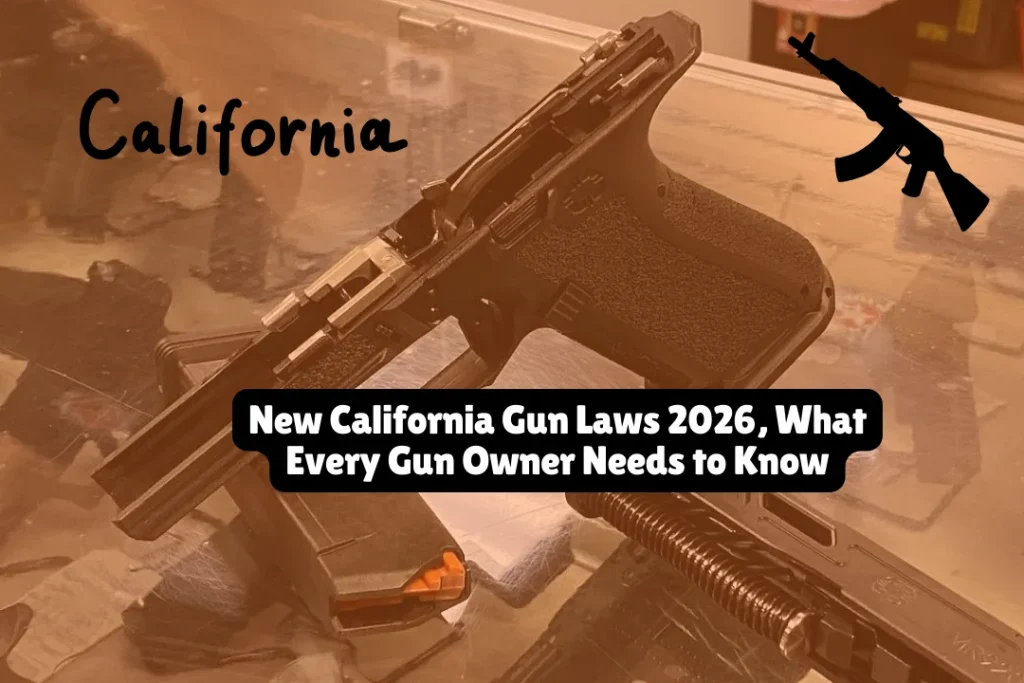
New California Gun Laws 2026, What Every Gun Owner Needs to Know
California entered 2026 with a significant wave of new firearm laws — some already in effect, others kicking in throughout the year. From how you store your guns at home to which handguns dealers can legally sell, the changes affect nearly every aspect of gun ownership in the state. This article explains each new law in plain English, when it takes effect, and what it means for California gun owners.
Quick Reference: Key Effective Dates
Before diving in, here is every major 2026 gun law and when it takes effect:
- January 1, 2026 — Mandatory safe storage (SB 53), ghost gun parts ban (AB 1263), firearm barrel sales through FFL (SB 704), insurance disclosure (AB 3067), CCW disqualification expansion (AB 1078 Phase 1)
- April 1, 2026 — Three-firearm-per-month purchase limit (AB 1078)
- July 1, 2026 — “Glock ban” fully operative for dealers (AB 1127)
- July 1, 2027 — Barrel background check requirement Phase 2 (SB 704)
1. Mandatory Safe Storage for All Gun Owners — SB 53
Starting January 1, 2026, California’s safe storage laws expanded significantly. Previously, safe storage was only required in homes with children. Under SB 53, the requirement now applies universally — meaning all California gun owners must store firearms safely, even if they live alone.
When you are not in direct control of your firearm, it must be stored in an approved locked container or secured with a trigger lock. Violations can result in criminal penalties, particularly if a firearm stored improperly is later used in a crime or accessed by an unauthorized person. California-approved storage options include gun safes, lockboxes, and trigger locks certified by the California DOJ.
2. Ghost Gun Parts and Online Sales Crackdown — AB 1263 and SB 704
Two separate laws targeting ghost guns and firearm parts took effect January 1, 2026. Together they close a loophole that previously allowed buyers to order unfinished receivers, frames, and barrels directly to their door without a background check.
AB 1263 demands transparency from sellers of products commonly used to manufacture ghost guns or other illegal weapons and adds new requirements around age verification and warnings. Online sellers of firearm precursor parts — including frames, receivers, and related components — must now verify the buyer’s age and eligibility before completing a sale.
SB 704 requires that all standalone firearm barrels — including partially finished barrels that can be readily completed — must be sold or transferred through a California-licensed FFL beginning January 1, 2026, with the purchaser appearing in person at the dealer. Direct-to-consumer barrel shipments into California are no longer permitted unless specific exemptions apply, such as law enforcement or military purchases.
Additional implementation milestones are scheduled for mid-2027, further tightening how certain parts may be sold and transferred. Starting July 1, 2027, buyers must complete a DOJ-prescribed background check at the dealer level when picking up a barrel, and dealers must electronically report the transaction to the California DOJ.
Related article: California’s Glock Ban Explained, What AB 1127 Does, What It Doesn’t, and What Comes Next
3. The “Glock Ban” — What AB 1127 Actually Does
AB 1127 is frequently called the “Glock ban” in gun community discussions, though its scope is broader than just one brand. The law targets handguns that are classified as readily convertible to fire automatically.
AB 1127 removes many popular handguns from California’s roster based on trigger design. The first phase began January 1, 2026, with a complete cutoff for the general public by July 1, 2026, dramatically shrinking handgun options statewide.
In practical terms: dealers had until July 1, 2026 to sell existing inventory of affected models. After that date, licensed dealers cannot sell any handgun classified under the law as readily convertible to a machine gun. This does not make existing legally owned pistols illegal to possess — it restricts future sales by licensed dealers, not current ownership.
AB 1127 imposes new restrictions and prohibits licensed dealers from selling affected models after the operative date, subject to limited statutory exceptions. The law is already facing legal challenges, with gun rights organizations arguing it unconstitutionally removes common firearms from the commercial market.
4. Three-Gun-Per-Month Purchase Limit — AB 1078
Beginning April 1, 2026, AB 1078 limits the number of firearms a person can apply to purchase within a 30-day period to three. This replaces the previous one-handgun-per-30-days limit and expands the restriction to cover all firearm types — not just handguns.
The law also introduces other significant changes. AB 1078 modifies licensing requirements for concealed carry permits, expanding disqualification criteria for applicants to include convictions under federal or out-of-state laws, being an unlawful user of controlled substances, and other potential risk factors. It also requires a more thorough background investigation for CCW license applicants, including reviewing publicly available information and character references.
Additionally, AB 1078 creates a pathway for non-residents to obtain a California CCW, though the process is described as expensive and burdensome. Non-resident applicants must meet all standard California CCW requirements plus additional conditions. The practical availability of non-resident permits will depend heavily on how individual county sheriffs implement the new rules.
5. Homeowner and Renter Insurance Disclosure — AB 3067
This is the new law most gun owners have not heard about. AB 3067 mandates that insurance companies update their applications for homeowners’ and renters’ insurance to ask specifically about firearms. When you apply for or renew a policy in 2026, you will be required to disclose if you have firearms in the home.
The law does not prohibit insurers from covering gun owners, nor does it require insurers to charge higher rates based on firearm ownership. However, it does create a formal disclosure requirement that did not previously exist. Gun owners should review their insurance policies carefully when renewing and be aware that this question is now a standard part of the application process in California.
6. DA Pilot Program for Gun Violence Restraining Orders — AB 1172
AB 1172 establishes a pilot program in four California counties — Alameda, El Dorado, Santa Clara, and Ventura — that expands the ability of district attorneys to file gun violence restraining orders (GVROs) until January 1, 2032.
Currently, GVROs can only be requested by law enforcement officers or family members. This pilot program allows district attorneys in those four counties to also file petitions — or to deny petitions submitted by others — to prohibit a person from purchasing or possessing firearms if they pose a significant danger to themselves or others. Gun owners in those counties should be aware of the expanded pool of people who can now initiate a GVRO against them.
7. Microstamping Update — What It Means for the Handgun Roster
No new microstamping requirement took effect in 2026, but a significant development occurred in 2025 that will shape the roster going forward. On July 18, 2025, the California DOJ released a report concluding that microstamping technology is technologically viable. Under the updated statutory framework, the DOJ must next evaluate commercial availability and implementation standards before any mandatory requirement takes effect.
In plain terms: California law requires that new handguns added to the roster include microstamping — technology that imprints a microscopic code on spent cartridge cases. For years, the state found the technology was not viable, effectively freezing the roster. Now that the DOJ has found it viable, the pathway to mandatory microstamping requirements is open. The timeline for implementation is not yet finalized, but gun owners and dealers should expect roster-related changes in 2027 as a result.
What Has Not Changed in 2026
A few things worth clarifying given widespread confusion:
The 10-day waiting period remains in effect. All firearm purchases in California still require a 10-day wait between purchase and delivery, with no exceptions for existing gun owners.
Ammunition background checks remain in effect. Each ammunition purchase requires a background check through the DOJ. The fee is $1 if you have a firearm record on file or $19 if you do not.
You still cannot buy a gun online and have it shipped directly to you. All firearm purchases must go through a licensed California dealer.
The open carry ban technically remains in effect. As covered separately, a Ninth Circuit ruling in January 2026 struck down the urban open carry ban, but that ruling has not yet taken legal effect due to a pending en banc petition.
2026 Compliance Checklist for California Gun Owners
Use this as a quick reference to make sure you are in compliance with current California law:
- Safe storage: All firearms not in your direct control must be in an approved locked container or secured with a trigger lock — even if you live alone
- Parts purchases: Buying a barrel or receiver online? It must ship to a licensed FFL now, not directly to your door
- Gun purchases: Maximum three firearms per 30-day period starting April 1, 2026
- Insurance: Expect a firearm disclosure question when you renew your homeowners or renters insurance
- CCW applicants: New background investigation standards and disqualification criteria apply — check with your county sheriff
- Dealers: Affected handguns under AB 1127 cannot be sold to the public after July 1, 2026
FAQs
What are the biggest new California gun laws in 2026?
The most impactful new laws are SB 53 (mandatory safe storage for all gun owners), AB 1263 and SB 704 (ghost gun parts and barrel sales restrictions), AB 1127 (the so-called Glock ban), and AB 1078 (three-gun-per-month purchase limit starting April 1, 2026).
Do I have to lock up my guns if I live alone in California?
Yes. Starting January 1, 2026, safe storage laws expanded significantly and now apply universally — not just in homes with children. When you are not in direct control of your firearm it must be secured in an approved locked container or with a trigger lock.
What is the Glock ban and does it make my existing gun illegal?
AB 1127 prohibits licensed dealers from selling handguns classified as readily convertible to fire automatically after July 1, 2026. It does not make existing legally owned firearms illegal to possess — it only restricts future dealer sales of affected models.
Can I still buy three guns a month in California?
Beginning April 1, 2026, the law limits the number of firearms a person can apply to purchase within a 30-day period to three. The previous limit applied only to handguns. The new limit covers all firearm types.
Can I order gun parts online and have them shipped to my house?
Not for barrels or precursor parts. All standalone firearm barrels must now be sold or transferred through a California-licensed FFL, with the purchaser appearing in person at the dealer. Direct-to-door shipment of these parts is no longer permitted.
Does the new insurance law affect gun owners?
AB 3067 requires insurance companies to ask about firearms when you apply for or renew homeowners or renters insurance. It does not prohibit coverage or mandate higher rates — it is a disclosure requirement only.
Is open carry legal in California now?
Not yet. While a Ninth Circuit panel struck down the urban open carry ban in January 2026, California’s Attorney General filed a petition for en banc rehearing, which pauses the ruling from taking effect. Existing open carry restrictions remain in force as of March 2026.
Last Updated: March 3, 2026
Disclaimer: This article is for informational purposes only and does not constitute legal advice. Laws and legal procedures vary by jurisdiction and may change over time. For advice regarding a specific situation, consult a qualified attorney or the appropriate authority.
About the Author

Sarah Klein, JD, is a licensed attorney and legal content strategist with over 12 years of experience across civil, criminal, family, and regulatory law. At All About Lawyer, she covers a wide range of legal topics — from high-profile lawsuits and courtroom stories to state traffic laws and everyday legal questions — all with a focus on accuracy, clarity, and public understanding.
Her writing blends real legal insight with plain-English explanations, helping readers stay informed and legally aware.
Read more about Sarah