
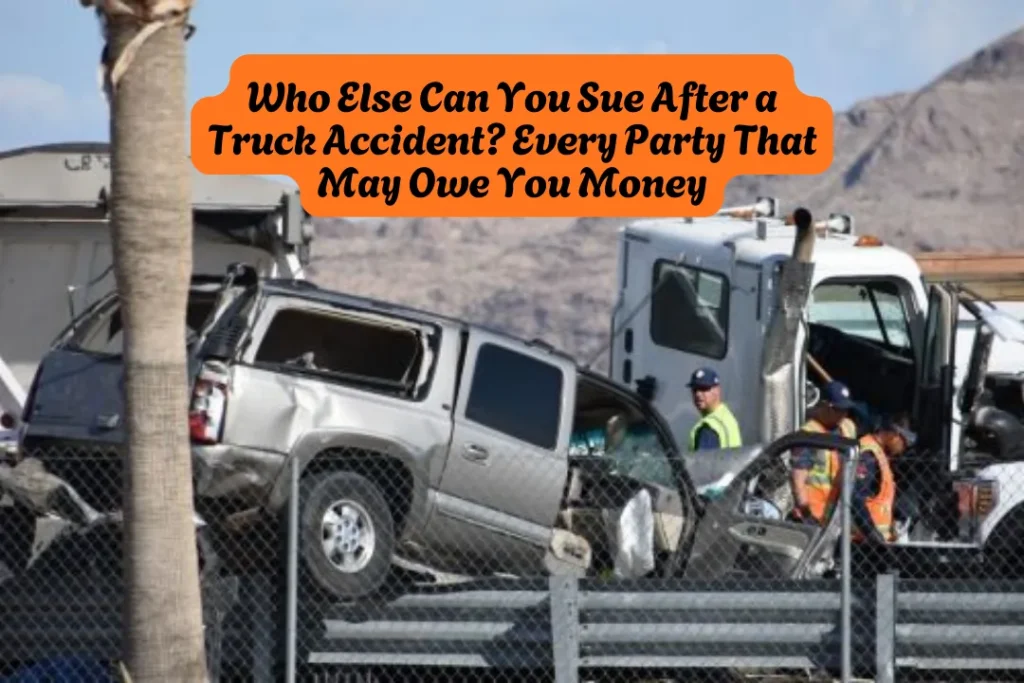
Who Else Can You Sue After a Truck Accident? Every Party That May Owe You Money
In a truck accident, multiple parties can be liable at the same time. You may be able to sue the truck driver, trucking company, cargo loader, maintenance provider, truck manufacturer, or other negligent drivers. Identifying and suing all liable defendants means accessing multiple insurance policies and significantly increasing your total compensation recovery.
Who can be sued in a truck accident case?
In a truck accident, multiple parties can be liable at the same time. You may be able to sue the truck driver, trucking company, cargo loader, maintenance provider, truck manufacturer, or other negligent drivers. Identifying and suing all liable defendants means accessing multiple insurance policies and significantly increasing your total compensation recovery.
Most people assume a truck accident is simple: the driver hit you, so you sue the driver. But that assumption can cost you hundreds of thousands of dollars.
The reality of truck accident cases is far more complex — and far more in your favor than you might realize. Commercial trucking involves a long chain of parties. The driver operates the truck. A company employs and dispatches them. A separate business may have loaded the cargo. A maintenance company may have serviced the brakes. A manufacturer may have built a defective part. Any one of those parties — or all of them — may have contributed to your crash.
Identifying every liable defendant in a truck accident case is one of the single most important things you can do for your recovery. Each additional defendant means an additional insurance policy. Each additional policy means more compensation available to you.
According to NHTSA, large truck crashes caused 5,837 deaths in 2022, with contributing factors frequently spanning driver error, company violations, cargo failures, and vehicle defects — often in the same crash.
This guide explains who the multiple defendants in truck accident cases can be, how joint liability works, and why finding every responsible party changes the outcome of your case. You can also review real semi-truck accident settlement examples to understand how multi-party cases compare to single-defendant claims.
Who Are the Potential Defendants in a Truck Accident Case?
The list of potentially liable parties in a truck accident is longer than most victims expect. Each party on this list carries their own legal responsibility — and their own insurance coverage.
Parties who can be named as defendants in a truck accident lawsuit include:
- The truck driver — personally liable for negligent driving, fatigue, impairment, or traffic violations
- The trucking company — liable through vicarious liability for the driver, or directly for negligent hiring and supervision
- The cargo loading company — liable when improperly secured or overloaded freight causes the crash
- The truck maintenance provider — liable when faulty repairs or missed inspections cause mechanical failure
- The truck or parts manufacturer — liable when a defective component such as brakes, tires, or steering causes loss of control
- A freight broker or shipper — liable when they pressured the driver to violate hours-of-service rules to meet deadlines
- Other drivers involved — liable when a third vehicle’s negligence contributed to the chain of events
Most truck accidents involve at least two or three of these parties. Catastrophic crashes frequently involve more. Each defendant you identify and successfully pursue adds a new source of compensation to your case.
Understanding which defendants apply to your specific situation requires a thorough investigation — which brings us to how courts handle multiple defendants legally.
How Joint and Several Liability Works in Truck Accidents
When multiple defendants share responsibility for your injuries, courts apply a legal doctrine called joint and several liability in many states. This doctrine is one of the most powerful tools available to truck accident victims.
Here is how it works in practice:
Under joint and several liability, each defendant can be held responsible for the full amount of your damages — not just their proportional share. If the trucking company is 60% at fault and the cargo loader is 40% at fault, you can recover 100% of your damages from the trucking company alone. The trucking company then has the right to pursue the cargo loader for their 40% share — but that is their problem, not yours.
This matters enormously when one defendant has more financial resources or insurance coverage than another. You are not forced to chase down a smaller party for their portion. You collect in full from whichever defendant can pay — and the law sorts out the rest.
Important note: Not all states apply joint and several liability equally. Some states use modified versions that limit full recovery depending on each party’s percentage of fault. A truck accident attorney can advise you on exactly how your state’s rules apply to your case.
Furthermore, under 49 CFR Part 390, motor carriers bear responsibility for ensuring their entire operation — including contractors and third-party loaders — complies with federal safety standards. This federal foundation strengthens multi-defendant claims significantly.
Third-Party Defendants: The Parties Most Victims Miss
The truck driver and trucking company are the obvious defendants. However, the third-party defendants are often the ones that dramatically increase a victim’s total recovery — and they are the ones most commonly overlooked.
Cargo Loaders and Shippers
Improperly loaded or unsecured cargo is a leading cause of truck accidents. When freight shifts, it can cause a truck to jackknife, tip over, or spill debris onto the roadway. Under FMCSA regulations, cargo must be properly secured and within weight limits at all times.
If a third-party loading company, warehouse, or shipper packed the truck’s cargo unsafely, they can be named as a defendant independent of the driver and trucking company. Their liability does not reduce your claim against the trucking company — it adds to the total recovery pool available to you.
Maintenance and Repair Companies
Many trucking companies outsource vehicle maintenance to third-party providers. Under 49 CFR Part 396, commercial trucks must be regularly inspected and maintained. When a contracted maintenance company misses a brake failure, tire defect, or steering problem — and that failure causes your accident — they become a direct defendant.
Truck and Parts Manufacturers
Occasionally a mechanical failure is not the result of poor maintenance but a defective product. If a tire blowout, brake failure, or steering defect traces back to a manufacturing flaw, the manufacturer faces product liability claims entirely separate from driver or company negligence.
Identifying these third-party defendants requires early, aggressive investigation. A commercial truck accident lawyer who understands all liable parties will begin preserving this evidence before it disappears.
How Comparative Negligence Applies When Multiple Defendants Share Fault
Most states use comparative negligence rules when multiple defendants share fault. Under these rules, each party’s liability is reduced by their percentage of fault — but the total damages you recover are calculated based on all defendants combined.
Here is how that plays out across different scenarios:
| Defendant | Fault % | Damages Owed (on $500,000 total) |
| Truck Driver | 40% | $200,000 |
| Trucking Company | 35% | $175,000 |
| Cargo Loader | 25% | $125,000 |
| Total | 100% | $500,000 |
In this example, you pursue all three defendants and recover your full $500,000. If you had only sued the driver, you would have recovered just $200,000 — leaving $300,000 on the table.
This is the core reason why identifying every liable defendant matters so much. Missing even one defendant can cost you a significant portion of your total compensation.
Furthermore, if you share partial fault for the accident, most states will reduce your total recovery by your fault percentage. However, identifying more defendants shifts the fault distribution away from you and toward the multiple responsible parties — which can significantly protect your net recovery.
Steps to Identify Every Liable Defendant in Your Truck Accident Case
Finding all responsible parties requires a structured investigation that must begin immediately after the crash. Here is how your attorney will approach it:
- Secure the black box (EDR) data — Records the truck’s speed, braking, and operational data in the seconds before impact
- Obtain the driver’s electronic logging device (ELD) records — Proves hours-of-service violations and fatigue
- Request the trucking company’s hiring and training files — Establishes negligent hiring or supervision claims
- Subpoena cargo loading records and weight tickets — Identifies improper loading as a contributing cause
- Pull the truck’s full maintenance and inspection history — Reveals whether a third-party mechanic missed a critical defect
- Investigate the truck’s component history — Determines whether a manufacturer defect contributed to mechanical failure
- Review FMCSA safety ratings and violation records — Shows systemic safety failures across the company’s entire operation
Time is critical in this process. Black box data gets overwritten. Maintenance records get lost. Cargo manifests disappear. Your attorney must send preservation letters to all potential defendants within days of the accident — not weeks.
An experienced 18-wheeler accident attorney knows exactly which records to demand from each potential defendant and how to use them to build a multi-party case.
Frequently Asked Questions
Can I really sue multiple defendants in the same truck accident lawsuit?
Yes. You can file a single lawsuit naming every liable party — the driver, trucking company, cargo loader, maintenance provider, manufacturer, and any other negligent party — all at once. Suing multiple defendants in one case is standard practice in truck accident litigation. It is more efficient than separate lawsuits and ensures you can recover from every available source of compensation.
How long do I have to sue multiple defendants in a truck accident?
The statute of limitations is the same whether you sue one defendant or ten. Most states give you 2–3 years from the accident date to file, though some states allow as little as one year. The deadline applies to all defendants, so you must identify and name every liable party within that window. Missing the deadline against even one defendant permanently bars that claim. Act quickly — evidence that identifies third-party defendants disappears faster than most victims realize.
Does suing multiple defendants mean I get more money?
Generally, yes — significantly more. Each additional defendant brings their own insurance policy and assets into the recovery pool. A truck driver may carry minimal personal coverage. The trucking company carries commercial policies of $1 million or more. A cargo loader or manufacturer may carry additional policies. Accessing all of these simultaneously is the primary financial reason to identify every liable party rather than settling for the most obvious one.
What if I was partially at fault — can I still sue multiple defendants?
In most states, yes. Comparative negligence rules allow you to recover damages even if you share partial fault, as long as your fault percentage does not exceed the state’s threshold (typically 50% or 51%). When multiple defendants share fault, each defendant’s percentage is calculated independently. Having more defendants often means fault is distributed more broadly — reducing your own percentage and protecting your net recovery.
How long does a multi-defendant truck accident case take to resolve?
Multi-defendant cases take longer than single-defendant claims — typically 18 months to 3 years, depending on complexity. Each defendant conducts their own discovery, may have separate attorneys, and may dispute liability differently. However, the increased timeline is almost always worth it. Cases with multiple defendants tend to result in significantly higher settlements or verdicts because the total available coverage is much larger.
Legal Terms Used in This Article
Joint and Several Liability: A legal doctrine that allows you to recover your full damages from any one defendant, even if multiple defendants share fault. The paying defendant can then seek reimbursement from the other liable parties.
Comparative Negligence: A legal rule that reduces your compensation by your percentage of fault. When multiple defendants share fault, each party’s percentage is calculated separately, which can reduce your own fault share.
Vicarious Liability: Legal responsibility an employer holds for the negligent acts of its employees during work. This allows you to sue the trucking company for the driver’s on-the-job negligence.
Third-Party Liability: Liability that falls on a party outside the primary driver-company relationship — such as a cargo loader, maintenance provider, or manufacturer — whose negligence contributed to the accident.
Negligent Maintenance: Liability that arises when a company fails to properly inspect or repair a commercial vehicle, and that failure contributes to an accident.
Defendants: The parties being sued in a lawsuit. In truck accident cases, there can be multiple defendants named in the same case, each responsible for different aspects of the crash.
Statute of Limitations: The legal deadline to file a lawsuit. Missing this deadline against any single defendant permanently eliminates that claim, regardless of how strong the evidence is.
FMCSA: The Federal Motor Carrier Safety Administration. The federal agency whose regulations govern trucking companies, drivers, cargo loading, and vehicle maintenance — and whose violation records help prove multiple parties’ negligence.
Conclusion
A truck accident is rarely just one person’s fault. Behind every crash is a chain of decisions — hiring choices, loading procedures, maintenance records, dispatch pressures, and manufacturing standards. Every link in that chain that broke is a defendant you may be able to hold accountable.
Identifying all multiple defendants in truck accident cases is not just a legal strategy — it is how victims get the full compensation they are owed. Missing one defendant means leaving real money behind. Pursuing all of them means accessing every available dollar.
Don’t navigate complex multi-defendant litigation alone. The trucking company’s lawyers are already building their defense — and they are counting on you not knowing who else to sue. Contact a truck accident attorney today for a free consultation. Your legal team will investigate every angle, identify every liable party — driver, company, cargo loader, and beyond — and fight for the maximum compensation you are legally entitled to recover.
Legal Disclaimer: The information in this article is for general educational purposes only and does not constitute legal advice. Every truck accident case is different. Laws vary by state and change over time. Do not rely on this article as a substitute for advice from a licensed attorney. If you have been injured in a truck accident involving multiple parties, consult a qualified truck accident lawyer to understand your specific legal rights and options.
Last Updated: March 15, 2026
About the Author

Sarah Klein, JD, is a former civil litigation attorney with over a decade of experience in contract disputes, small claims, and neighbor conflicts. At All About Lawyer, she writes clear, practical guides to help people understand their civil legal rights and confidently handle everyday legal issues.
Read more about Sarah