
Morgan Martin Lawsuit Truth, FBI Raided the Wrong House—Supreme Court Just Ruled Victims Can Sue (2026)
Martin v. United States centers on an October 2017 FBI wrong-house raid where a SWAT team stormed Curtrina Martin’s suburban Atlanta home with flash grenades and assault weapons, traumatizing her family for years. The Supreme Court ruled unanimously on June 12, 2025, that the Supremacy Clause cannot shield the federal government from lawsuits under the Federal Tort Claims Act, breathing new life into a case that lower courts had dismissed.
Why This Matters to You
This affects you if you’ve ever wondered whether the government can be held accountable when federal agents make catastrophic mistakes. Understanding this could matter to you if you’re concerned about law enforcement overreach, work in civil rights advocacy, or simply believe that innocent families deserve their day in court when armed federal agents terrorize them by mistake. The stakes are enormous—this case determines whether victims of government misconduct can seek compensation or whether federal immunity doctrines place agents beyond accountability.
What Happened in the Martin Case
The Terrifying Wrong-House Raid
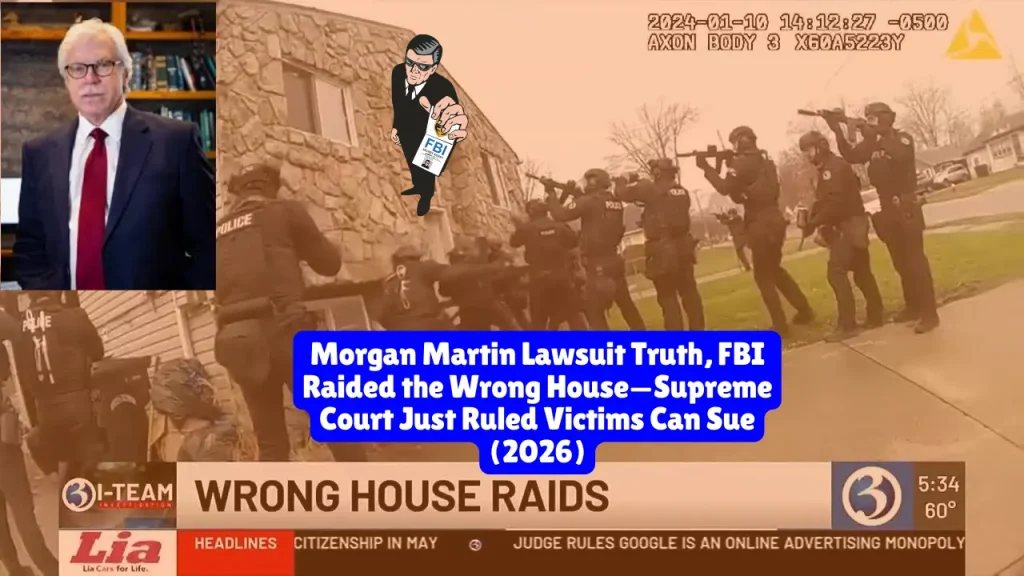
On October 18, 2017, FBI Special Agent Lawrence Guerra led a six-member SWAT team to execute warrants for a suspected gang member at 3741 Landau Lane. Instead, they stormed 3756 Denville Trace, where Curtrina Martin lived with her partner Hilliard Toi Cliatt and her 7-year-old son.
The agents broke down the door with a battering ram and detonated a flash-bang grenade. Cliatt initially considered reaching for his shotgun but hesitated, thinking the intruders might be law enforcement, and he and Martin hid in a closet while her son cried from another room and hid under his bed.
The error occurred because Agent Guerra relied on a personal GPS device and the team failed to notice the street sign for “Denville Trace” and the house number visible on the mailbox. Agent Guerra threw away his GPS device not long after the raid, so the exact cause couldn’t be confirmed later.
The Lasting Trauma
Martin quit her job as a track coach because the starting pistol reminded her of the flashbang grenade. Cliatt developed sleep problems that led him to quit his truck driving job. Martin’s son Gabe, now 13, stated in 2025 that the experience dramatically altered his life and he didn’t really have a childhood growing up because of the incident.
Who Are the Parties Involved
Plaintiffs:
- Curtrina Martin (also called Trina Martin)
- Hilliard Toi Cliatt (Martin’s partner at the time)
- G.W. (Martin’s son, identified by initials due to being a minor)
Defendant:
- United States of America (sued under the Federal Tort Claims Act)
- FBI Special Agent Lawrence Guerra (sued individually for Fourth Amendment violations)
The Legal Claims at Stake
In 2019, Martin and Cliatt sued the federal government under the Federal Tort Claims Act, bringing claims of false arrest, negligence, false imprisonment, and assault and battery.
They faced two major legal roadblocks. The district court dismissed their case in 2022, and the Eleventh Circuit affirmed in 2024, ruling that two legal doctrines barred their lawsuit.
Related Article: Bad Bunny Hit With $16M Lawsuit Days Before Super Bowl—Third Woman Claims Voice Theft (2026)
Current Status: What the Supreme Court Decided
On June 12, 2025, the Supreme Court vacated and remanded the case in a 9-0 unanimous decision written by Justice Neil Gorsuch. Justice Sonia Sotomayor filed a concurring opinion joined by Justice Ketanji Brown Jackson.
The Court rejected both legal defenses the government had used to dismiss the lawsuit.
What You Must Know About Federal Immunity
The Federal Tort Claims Act Explained in Plain English
Most people don’t realize the federal government can’t normally be sued. That’s called “sovereign immunity”—a centuries-old doctrine from British monarchy.
Before 1946, if someone was harmed by a federal employee, their only option was asking Congress to pass a “private bill” to provide individual relief, which was slow and led to unfair outcomes. In 1946, Congress enacted the Federal Tort Claims Act to allow private persons to sue the federal government when government employees commit torts while acting within the scope of their position.
But the FTCA includes exceptions that restore government immunity in certain situations. Two exceptions became critical in Martin’s case.
Why the Eleventh Circuit’s Approach Was Unique
The Eleventh Circuit used an approach that no other circuit court had adopted. Most courts handle these cases by first checking if the law enforcement proviso allows intentional tort claims to proceed, then asking whether the discretionary function exception bars either negligence or intentional tort claims.
The Eleventh Circuit proceeded differently—it applied the discretionary function exception only to negligence claims because it believed the law enforcement proviso overrode all other exceptions in the statute, including the discretionary function exception.
The court also created a second barrier. The Eleventh Circuit held that the Supremacy Clause barred FTCA claims when a federal employee’s actions have some nexus with furthering federal policy and can reasonably be characterized as complying with the full range of federal law.
What the Supreme Court Actually Said
The unanimous opinion held that under the plain meaning of the FTCA, the law enforcement proviso under the intentional tort exception does not extend to the discretionary function exception, and there is no Supremacy Clause defense.
On the law enforcement proviso: The proviso appears in the same subsection and sentence as the intentional-tort exception, so an ordinary reader would naturally presume the proviso modifies only that subsection.
On the Supremacy Clause: Justice Gorsuch concluded that the Eleventh Circuit’s Supremacy Clause defense is not permitted by the FTCA where the United States cannot point specifically to a constitutional text or federal statute that conflicts with the state law to be applied. The case the Eleventh Circuit relied on, In re Neagle, involved a federal officer’s immunity from state criminal prosecution for acts necessary in discharging federal duties, not the federal government’s liability under a statute that expressly subjects it to state tort law.
Justice Sotomayor’s Concurrence Signals Hope for Victims
Justice Sotomayor wrote separately to contend that the discretionary function exception should not apply to the plaintiffs’ claims, emphasizing that the exception protects only governmental actions based on considerations of public policy.
She expressed skepticism that executing a warrant always involves the kind of policy judgments the discretionary function exception was designed to protect. Her concurrence suggests some justices believe the discretionary function exception shouldn’t shield careless or mistaken law enforcement conduct.
What to Do Next
Where the Case Goes From Here
The case was vacated and remanded to the Eleventh Circuit to reconsider whether the discretionary function exception bars the plaintiffs’ claims and to assess liability under Georgia state law without reference to a Supremacy Clause defense.
The Eleventh Circuit must now undertake a fresh analysis. On remand, the court should consider whether the discretionary function exception bars either the plaintiffs’ negligent or intentional-tort claims, then ask whether under Georgia state law the United States would be liable for any surviving claims.
Legal scholars note that Martin is a vanishingly narrow decision, and chaos is likely to continue in the lower courts which struggle to interpret the FTCA despite decades of case law.
How to Follow This Case
The case will return to the Eleventh Circuit Court of Appeals. You can monitor developments through:
- PACER (Public Access to Court Electronic Records): The official federal court records system where all filings will appear
- SCOTUSblog: Provides excellent Supreme Court case tracking and analysis
- Institute for Justice: The organization representing the Martin family, which publishes updates on their website at ij.org
When to Seek Legal Counsel
If you’ve been a victim of a wrong-house raid or federal law enforcement misconduct, you should consult a civil rights attorney immediately. Time limits for filing FTCA claims are strict—you typically have two years from the date of injury, and you must first file an administrative claim with the federal agency before filing in court.
The Martin decision provides stronger legal ground for victims, but these cases remain complex. An experienced attorney can evaluate whether the discretionary function exception might still bar your claims and help navigate the procedural requirements.
Pro Tip: When researching your case, request any available body camera or surveillance footage immediately through a Freedom of Information Act (FOIA) request. Federal agencies often have retention policies that could result in footage being deleted if not preserved. Submit your FOIA request as soon as possible after the incident.
Frequently Asked Questions
Did Curtrina Martin win her case?
Not yet. The Supreme Court vacated the lower court’s dismissal and remanded the case back to the Eleventh Circuit, meaning Martin’s lawsuit can proceed to the next stage. The Eleventh Circuit must now reconsider whether other legal defenses might still bar some of her claims.
What is the Federal Tort Claims Act?
The FTCA is a federal law that allows private parties to sue the federal government for torts committed by people acting on behalf of the federal government. Before this law, the government enjoyed absolute immunity from such lawsuits.
Can the government still use the discretionary function exception as a defense?
Yes. The Supreme Court held that the law enforcement proviso does not override the discretionary function exception. The Eleventh Circuit must now determine whether Agent Guerra’s actions in preparing for and executing the warrant involved the kind of discretionary policy judgments that the exception was designed to protect.
What compensation could the Martin family receive?
The case hasn’t reached the damages stage yet. If Martin ultimately prevails, the FTCA imposes tort liability in accordance with the law of the state where the actions took place—in this case, Georgia law. Damages could include compensation for physical injuries, property damage, emotional distress, lost wages, and medical expenses including therapy costs.
How common are wrong-house raids?
Wrong-house raids have occurred throughout history—the Supreme Court referenced notorious 1973 Collinsville raids where federal narcotics agents busted down doors and terrorized two innocent families at gunpoint before realizing their mistake. Those raids garnered national attention and led Congress to amend the FTCA by adding the law enforcement proviso.
Does this decision apply to state and local police?
No. Martin v. United States specifically addresses federal law enforcement under the Federal Tort Claims Act. State and local police misconduct is governed by different legal frameworks, including state tort law and Section 1983 civil rights claims.
What was the Supremacy Clause defense the court rejected?
The Supremacy Clause provides that federal law prevails when in conflict with state law. The Eleventh Circuit had interpreted it to provide an affirmative defense to FTCA claims where law enforcement actions furthered federal policy and complied with federal law. The Supreme Court unanimously rejected this interpretation, finding no such defense exists in the FTCA.
Last Updated: January 11, 2026 — We keep this current with the latest legal developments
This article provides general information only and does not constitute legal advice. Laws and case outcomes vary by jurisdiction and individual circumstances.
Disclaimer: Information regarding Martin v. United States is provided for educational purposes only and should not be construed as legal advice specific to your situation. The Martin v. United States case remains ongoing at the appellate level following the Supreme Court’s June 2025 decision. Case outcomes and legal interpretations vary based on specific facts, jurisdiction, and applicable law. AllAboutLawyer.com does not provide legal services or case-specific legal advice. If you have been affected by federal law enforcement misconduct or believe you have a potential claim under the Federal Tort Claims Act, you should consult with a qualified civil rights attorney who can evaluate your specific circumstances and advise you on the applicable statutes of limitations and procedural requirements.
Resources: To follow the case’s progress, visit the Supreme Court’s official website or access court documents through PACER. The Institute for Justice represents the Martin family and provides case updates.
Stay informed, stay protected. — AllAboutLawyer.com
About the Author

Sarah Klein, JD, is a licensed attorney and legal content strategist with over 12 years of experience across civil, criminal, family, and regulatory law. At All About Lawyer, she covers a wide range of legal topics — from high-profile lawsuits and courtroom stories to state traffic laws and everyday legal questions — all with a focus on accuracy, clarity, and public understanding.
Her writing blends real legal insight with plain-English explanations, helping readers stay informed and legally aware.
Read more about Sarah