Michael Jordan Nascar Lawsuit, Michael Jordan Takes NASCAR to Court—NBA Legend’s Racing Team Fights Monopoly Claims as Trial Opens
Michael Jordan’s 23XI Racing and Front Row Motorsports launched their antitrust trial against NASCAR on December 1, 2025, in federal court, alleging the racing series operates as an illegal monopoly that forces teams into unfair charter agreements. The nine-member jury will decide whether NASCAR violated Section 2 of the Sherman Antitrust Act—a case that could dismantle the charter system or force Jordan’s team out of business.
The six-time NBA champion attended the opening day as his co-owner Denny Hamlin gave emotional testimony, describing how his father’s poor health and family sacrifices shaped his racing career. The stakes are enormous: a NASCAR victory could end both teams’ operations, while a loss for the racing giant could trigger a fundamental restructuring of how the entire sport operates.
What Is the Michael Jordan NASCAR Lawsuit?
23XI Racing—co-owned by basketball legend Michael Jordan, NASCAR driver Denny Hamlin, and business manager Curtis Polk—filed an antitrust lawsuit in October 2024 alongside Front Row Motorsports, owned by entrepreneur Bob Jenkins.
The teams claim NASCAR functions as a monopolist in premier stock car racing, using the charter system and restrictive contracts to suppress competition and limit teams’ commercial freedom.
Case details:
- Case number: 23XI Racing LLC et al v. National Association for Stock Car Auto Racing, LLC et al, 3:2024cv00886
- Filing date: October 2, 2024
- Court: U.S. District Court for the Western District of North Carolina
- Presiding judge: U.S. District Judge Kenneth D. Bell
- Trial dates: December 1-12, 2025 (10 in-court days over two weeks)
- Jury: Six men and three women
Related Lawsuit: Government Files 30+ Motions to Block Camp Lejeune Trials—What 400,000 Veterans Need to Know Now
The Specific Legal Claims Under Sherman Antitrust Act
The lawsuit originally included claims under both Section 1 and Section 2 of the Sherman Antitrust Act, but the teams voluntarily dismissed their Section 1 claims on November 6, 2025, to streamline the trial.
Current Section 2 Claims:
NASCAR has obtained a monopsony as a buyer of premier stock car racing team services, giving the series unlawful control over the market.
Anticompetitive practices alleged:
- No-sue provision: Section 13 of the charter agreement requires teams to waive all antitrust claims as a condition of participation
- Non-compete clause: Section 6 prevents teams from competing in rival racing series (though exceptions exist for Formula 1, IndyCar, and other series)
- Single-source parts mandate: NASCAR controls which vendors supply NextGen car components, eliminating competitive bidding
- Track exclusivity: NASCAR owns most Cup Series tracks through its previous merger with International Speedway Corporation
- “Take-it-or-leave-it” contracts: Teams faced a September 6, 2024 deadline to sign new charter agreements with no room for negotiation
The teams argue these restrictions are designed to suppress team revenue and prevent another racing series from acquiring their services.
Why Charter Agreements Are Central to This Case
The charter system, implemented in 2016, serves as NASCAR’s franchise model. Charters guarantee teams a spot in every Cup Series race and provide revenue sharing.
Financial terms:
- 2025 charter agreement: $12.5 million annual revenue per chartered car
- Previous agreement: $9 million per chartered car
- Recent charter sale price: $45 million
- Hamlin paid $4.7 million for 23XI’s first charter, $13.5 million for the second, and $28 million for the third acquired late last year
Why 23XI and Front Row refused to sign:
NASCAR presented the new 2025-2031 charter agreements at the start of the 2024 playoffs with a September 6 deadline. After more than two years of negotiations, the teams felt threatened and coerced into signing without securing permanent charters—their primary demand.
NASCAR Chairman Jim France was especially against making the charter system permanent, which became a breaking point in negotiations.
Current Status: Racing Without Charters Costs Millions
23XI Racing and Front Row Motorsports are the only two teams out of 15 that refused to sign the new charter agreements.
Consequences of “open team” status:
Both teams have competed as open (non-chartered) teams since July 2025 after an appeals court overturned their preliminary injunction. While their combined six cars made every race, it cost both organizations millions of dollars in purse money.
Open teams must qualify on speed for one of four non-chartered spots each race week, creating uncertainty and significantly reducing revenue compared to chartered teams.
December 1, 2025 Trial Opening: Michael Jordan in Court
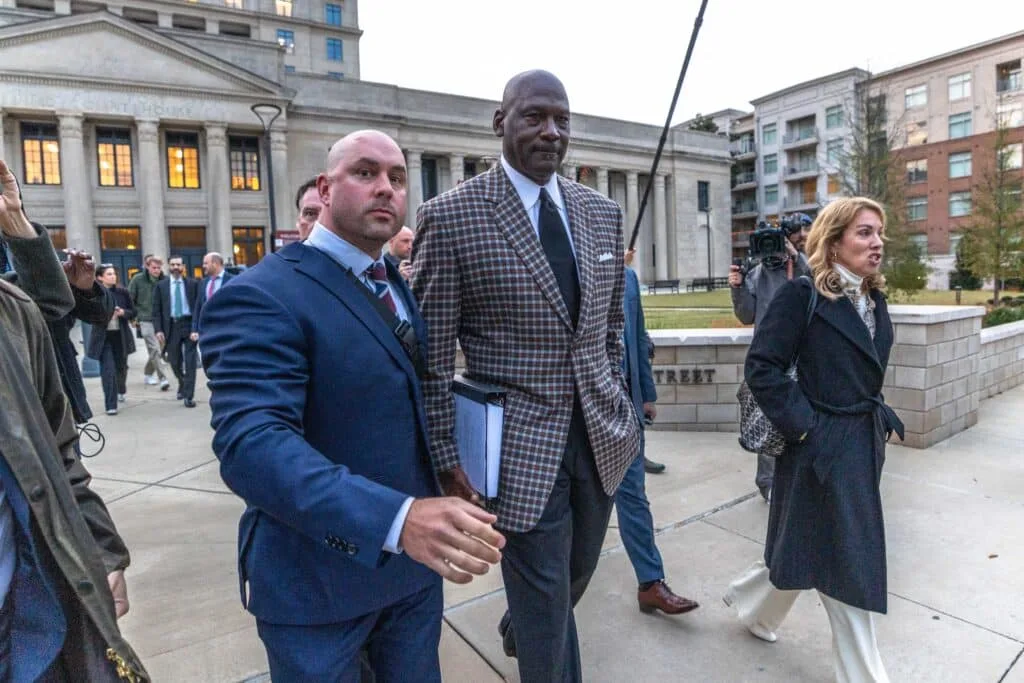
The trial opened Monday with Michael Jordan’s presence creating buzz—among jurors dismissed was one who said he couldn’t be impartial because “I like Mike” and another who had Jordan posters growing up.
Key moments from Day 1:
Denny Hamlin broke down in tears minutes into his testimony when asked how he got into racing, revealing his father is dying. He composed himself and continued for approximately 40 minutes before court adjourned.
Judge Bell banned exhibit presentations during opening statements because both sides included “impermissible arguments”, warning attorneys to be less confrontational.
Courtroom attendees:
- For plaintiffs: Michael Jordan, Denny Hamlin (testified Day 1), Curtis Polk, Bob Jenkins
- For NASCAR: Chairman Jim France, Vice Chair Lesa France Kennedy, Executive VP Ben Kennedy, Commissioner Steve Phelps, President Steve O’Donnell
Bell ruled that Hamlin and Polk will be sequestered after opening statements before they testify. Jordan received an exemption to remain in the courtroom for the entire trial.
What Lead Attorney Jeffrey Kessler Argued in Opening Statement
Renowned sports attorney Jeffrey Kessler represents 23XI and Front Row. His opening statement highlighted NASCAR’s profit model at teams’ expense.
Key arguments:
A NASCAR-commissioned study found 75% of teams lost money in 2024, while approximately $400 million flowed to the France Family Trust over a three-year period.
A 2023 Goldman Sachs evaluation valued NASCAR at $5 billion.
Kessler stated that Bob Jenkins has never turned a profit since starting Front Row in 2004, despite winning the 2021 Daytona 500. In contrast, 23XI has profited in all but one of its five seasons—largely due to Jordan’s star power attracting sponsors.
“What the evidence is going to show is Mr. France ran this for the benefit of his family at the expense of the teams and sport,” Kessler told the jury.
NASCAR’s Defense: Increased Payouts Prove Fair Competition
NASCAR’s lead attorney Christopher Yates argues the lawsuit amounts to “negotiation through litigation” by teams unhappy they didn’t get everything they wanted.
Core defense arguments:
NASCAR claims it cannot be acting anticompetitively when payouts to teams have increased and enterprise value of owning a charter has grown from $1 million to upwards of $50 million since 2016.
NASCAR emphasizes that open team spots exist for non-chartered teams to qualify based on performance, proving the market isn’t closed.
Strategic defenses:
NASCAR will argue that 23XI and Front Row purchased charters multiple times over the past decade and never raised antitrust concerns until after failing to secure their preferred terms.
The sanctioning body maintains that exclusivity provisions and non-compete clauses are legal business practices in sports, necessary to properly market events and prevent marketplace confusion.
Prior Court Rulings Favor the Teams
Several pretrial rulings have tilted the case toward 23XI and Front Row.
November 12, 2025: Market definition victory
Judge Bell ruled NASCAR controls the market for “premier stock-car racing” and that NASCAR’s argument teams could race in other series is moot. This critical ruling established that NASCAR operates a monopsony.
October 28, 2025: Counterclaim dismissal
Bell dismissed NASCAR’s counterclaim alleging the teams conspired with other race organizations to coerce better charter terms, ruling defendants “did not engage in an unreasonable restraint of trade”.
September 3, 2025: Preliminary injunction denied
Courts initially granted 23XI and Front Row a preliminary injunction to race as chartered teams during litigation, but the U.S. Court of Appeals for the 4th Circuit reversed this decision in June 2025.
November 6, 2025: Section 1 claims voluntarily dismissed
Following Bell’s market definition ruling, the teams dropped their Section 1 Sherman Act claims to streamline the trial and focus solely on Section 2 monopolization claims.
Explosive Text Messages Revealed in Discovery
The pretrial discovery process exposed damaging communications from both sides.
NASCAR executive texts:
NASCAR Commissioner Steve Phelps and other executives called Hall of Fame team owner Richard Childress a “dinosaur,” “idiot,” and “stupid redneck,” adding he “owes his entire fortune to NASCAR” and needed “to be taken out back and flogged”.
Another NASCAR executive suggested fans of the sport can’t read, and multiple leaders threatened to kill driver Tony Stewart’s SRX short-track series because NASCAR drivers were participating.
23XI/Front Row texts:
Denny Hamlin texted his partners: “Im in for the fight with NASCAR. My despise of the France family runs deep”.
The president of 23XI said NASCAR chairman Jim France had to die to receive favorable charter terms.
Michael Jordan texted business partner Curtis Polk about the charter fight: “I think people understand our fight. Good things will come from this. Teams are going to regret supporting us”.
One of Jordan’s advisers said Hamlin wasn’t a good businessman, and Jordan joked he loses more money in a casino than he pays one of his drivers.
Why Other NASCAR Teams Support NASCAR’s Position
Rick Hendrick and Roger Penske—the two most powerful team owners in American motorsports—both filed declarations supporting NASCAR’s charter system.
Hendrick’s statement:
“I think we worked really hard for two years and it got down to, you’re not going to make everybody happy. But in any negotiation, you’re not going to get everything you want, and so I felt it was a fair deal and we protected the charters, which was number one, we got the revenue increase.”
Hendrick added that the charter agreement is critical to NASCAR’s stability and that undoing what teams collectively negotiated would damage the sport.
Both Hendrick and Penske are on NASCAR’s witness list but filed motions asking not to be deposed or to limit questioning to charter-specific topics.
Declarations from multiple team owners showed unity among non-suing teams who do not want the charter system disbanded—which could happen if NASCAR loses.
What Happens If 23XI and Front Row Win
If the jury rules in favor of the teams, the consequences for NASCAR could be severe.
Potential outcomes:
Judge Bell would determine actual monetary damages, which he can adjust and even triple under antitrust law. Bell would also be charged with unraveling the monopoly.
Possible court orders:
- Force the France family to sell NASCAR
- Require NASCAR to sell the tracks it owns
- Dismantle the charter system entirely
- Order permanent charters
- Restructure revenue-sharing agreements
- Eliminate non-compete and no-sue provisions
The pretrial discovery process revealed NASCAR made more than $100 million in 2024, suggesting damages could reach hundreds of millions.
What Happens If NASCAR Wins
A victory for NASCAR would likely end 23XI Racing and Front Row Motorsports.
Co-owner Michael Jordan has hinted at shutting down the team if NASCAR wins.
If NASCAR wins, it’s unlikely 23XI and Front Row stay in business beyond 2026, and the six charters being held aside would likely be sold to other interested parties.
The last charter sold went for $45 million, and NASCAR has indicated pressing interest from potential buyers including private equity firms.
Jordan’s investment in the team—including the $28 million charter purchased late in 2024—would be at risk.
Michael Jordan’s Motivation: Fighting for Smaller Teams
When announcing the lawsuit in October 2024, Jordan explained his broader purpose beyond 23XI’s interests.
“I did it for the smaller teams as well. It’s not just me. I think everybody should have an opportunity to be successful in any business. My voice is saying that it hasn’t been happening.”
At a hearing, Jordan stated: “If I have to fight this to the end for the betterment of the sport, I will do it”.
Before the trial, Hamlin wrote on social media: “Our fans have been brainwashed with NASCAR’s talking points for decades. Lies are over starting Monday morning. It’s time for the truth. It’s time for change”.
Failed Settlement Attempts Despite Mediation
NASCAR Commissioner Steve Phelps said the series is “trying our hardest” to settle the lawsuit, representing the defendants’ most expansive comments on settlement efforts.
Settlement timeline:
- October 7, 2025: NASCAR asked the court to order a settlement conference
- October 8, 2025: Judge Bell ordered both parties to participate in settlement conference on October 21
- October 21, 2025: First day of mediation with Jeffrey Mishkin failed to produce agreement
- Bell helped mediate a failed two-day summit in October
- Teams reportedly demand permanent charters plus substantial damages and legal fees
NASCAR has since agreed to make charters permanent, but the snag is the amount of money 23XI and Front Row are demanding in damages and legal fees.
Other team owners have expressed frustration that NASCAR’s entire framework could collapse over monetary demands.
Legal Precedents in Sports Antitrust Cases
This case echoes broader tension between monopoly power in sports governance and antitrust accountability.
Similar sports litigation patterns:
Professional sports leagues typically defend their business practices by arguing that exclusivity arrangements are necessary for competitive balance, fan interest, and marketing effectiveness.
The Supreme Court has granted professional sports leagues limited antitrust exemptions (most notably MLB), but NASCAR doesn’t benefit from statutory protections.
Monopsony vs. monopoly:
This case focuses on monopsony power—where NASCAR is the only buyer of premier stock car racing team services—rather than monopoly power over selling racing to fans.
Monopsony claims are less common but equally powerful under Section 2 of the Sherman Act.
Understanding Section 2 of the Sherman Antitrust Act
Section 2 of the Sherman Act (15 U.S.C. § 2) prohibits monopolization, attempts to monopolize, or conspiracies to monopolize.
To prove a Section 2 violation, plaintiffs must show:
- Monopoly power: The defendant possesses power to control prices or exclude competition in the relevant market
- Willful acquisition or maintenance: The defendant acquired or maintained that power through anticompetitive conduct rather than superior business acumen
- Anticompetitive effects: The conduct harms competition, not just individual competitors
How this applies to NASCAR:
Judge Bell’s market definition ruling established NASCAR controls the premier stock car racing market, satisfying the first element.
The trial will focus on whether NASCAR’s charter system terms, no-sue provisions, non-compete clauses, and single-source supplier mandates constitute anticompetitive conduct—or legitimate business practices.
What Witness Testimony Will Cover
Plaintiff witnesses:
- Denny Hamlin (testified Day 1, continues Day 2)
- Michael Jordan
- Curtis Polk
- Steve Lauletta (23XI president)
- Gene Mason
- Bob Jenkins (Front Row owner)
- Jerry Freeze
NASCAR witnesses:
- Jim France (Chairman)
- Lesa France Kennedy (Vice Chair)
- Ben Kennedy (Executive VP)
- Brian Herbst
- Steve O’Donnell (President)
- Steve Phelps (Commissioner)
- Scott Prime
- Tim Clark
- Greg Motto
- John Probst
- Ron Draeger
Rick Hendrick and Roger Penske may also testify despite their requests to limit involvement.
Implications for US Sports Business and Franchise Models
This lawsuit reflects critical patterns in how professional sports balance commercial control with competitive fairness.
Broader questions raised:
Franchise system sustainability: Can major sports leagues impose restrictive terms on team owners under antitrust scrutiny?
Revenue distribution: How much control should sanctioning bodies have over team earnings in sports where teams bear significant operational costs?
Competitive market access: Do exclusivity agreements in professional sports serve procompetitive purposes, or do they unlawfully restrict competition?
Corporate governance in family-owned leagues: NASCAR remains privately controlled by the France family—does this model create unique antitrust vulnerabilities compared to publicly traded sports organizations?
Why This Case Matters to Racing Fans and Teams
The outcome will reshape NASCAR’s business model regardless of which side prevails.
For racing fans:
A plaintiff victory could lead to more competitive racing, better-funded teams, and potentially new racing series. A NASCAR victory would preserve the current structure but might discourage team ownership investment.
For current and prospective team owners:
The case determines whether NASCAR team ownership is a viable business or a money-losing venture subsidized by wealthy owners’ passion for racing.
Hamlin noted that 11 of the first 19 chartered teams are no longer in business, highlighting the financial challenges teams face.
For other motorsports:
The ruling could influence how other racing series structure their franchise agreements and revenue-sharing models.
Timeline of Key Dates in the Lawsuit
2022: Charter agreement negotiations begin for 2025-2031 term
September 6, 2024: Deadline for teams to sign new charter agreements; 13 teams sign, 23XI and Front Row refuse
October 2, 2024: 23XI Racing and Front Row Motorsports file antitrust lawsuit
December 19, 2024: Judge Bell grants preliminary injunction allowing teams to race as chartered entries during litigation
June 5, 2025: U.S. Court of Appeals for 4th Circuit reverses preliminary injunction
July 2025: 23XI and Front Row begin racing as open teams
October 7, 2025: NASCAR requests settlement conference
October 21, 2025: Court-ordered mediation fails to produce settlement
October 28, 2025: Judge Bell dismisses NASCAR’s counterclaim
November 6, 2025: Teams voluntarily dismiss Section 1 claims to streamline trial
November 12, 2025: Judge Bell rules NASCAR controls premier stock car racing market
December 1, 2025: Trial begins with jury selection and opening statements
December 1, 2025: Denny Hamlin gives emotional testimony on Day 1
December 12, 2025: Final scheduled trial day
What Team Owners and Investors Need to Know
Financial considerations for NASCAR team ownership:
Charter values have increased substantially (from $1 million to $45+ million), but most teams operate at a loss despite guaranteed charter revenue.
Risk factors:
- Uncertain legal status of charter agreements
- Potential for court-ordered restructuring
- Limited negotiating power with NASCAR
- Single-source supplier restrictions increase costs
- Revenue sharing may not cover operational expenses
Opportunity factors:
- High-profile partnerships (like Jordan’s involvement) can drive profitability through sponsorships
- Charter scarcity creates investment demand
- Private equity interest suggests long-term value potential
Frequently Asked Questions About the Michael Jordan NASCAR Lawsuit
What is the Michael Jordan NASCAR lawsuit about?
Michael Jordan’s 23XI Racing and Front Row Motorsports filed an antitrust lawsuit against NASCAR alleging the series operates an illegal monopoly through restrictive charter agreements, no-sue provisions, non-compete clauses, and single-source supplier mandates that suppress team revenue and eliminate competitive alternatives.
When did Michael Jordan file the lawsuit against NASCAR?
23XI Racing and Front Row Motorsports filed the lawsuit on October 2, 2024, in the U.S. District Court for the Western District of North Carolina, after refusing to sign NASCAR’s new 2025-2031 charter agreements.
What legal claims is Michael Jordan making against NASCAR?
The teams claim NASCAR violated Section 2 of the Sherman Antitrust Act by obtaining and maintaining monopsony power as the sole buyer of premier stock car racing team services through anticompetitive practices including take-it-or-leave-it contracts, mandatory antitrust waivers, non-compete clauses, and control over suppliers and race tracks.
Why did Michael Jordan refuse to sign NASCAR’s charter agreement?
Jordan and Front Row refused to sign because NASCAR wouldn’t make charters permanent, required teams to waive all antitrust claims, imposed restrictive non-compete clauses, and offered revenue terms the teams considered unfair after more than two years of negotiations.
What happened on the first day of the Michael Jordan NASCAR trial?
On December 1, 2025, a nine-member jury was seated with Michael Jordan present in the courtroom. Co-owner Denny Hamlin gave emotional testimony, breaking down in tears when discussing his dying father and his journey into racing. Judge Bell banned exhibit presentations during opening statements after both sides included impermissible arguments.
How much money could Michael Jordan win if he beats NASCAR?
The jury will determine actual monetary damages if the teams win, and Judge Kenneth Bell can adjust the figure and triple it under federal antitrust law. With NASCAR making over $100 million in 2024 and teams claiming years of suppressed revenue, damages could reach hundreds of millions of dollars.
What happens to 23XI Racing if NASCAR wins the lawsuit?
Michael Jordan has indicated he would shut down 23XI Racing if NASCAR wins. Without charters, the team cannot operate profitably long-term, and Jordan stated he’s not interested in continuing under the current business model if courts uphold NASCAR’s practices.
Who is the judge in the Michael Jordan NASCAR case?
U.S. District Judge Kenneth D. Bell of the Western District of North Carolina is presiding over the case. Bell previously granted a preliminary injunction favoring the teams (later overturned on appeal), dismissed NASCAR’s counterclaim, and ruled that NASCAR controls the premier stock car racing market.
What is Jeffrey Kessler’s role in the lawsuit?
Jeffrey Kessler is the lead attorney representing 23XI Racing and Front Row Motorsports. Kessler is a renowned sports attorney who has handled major antitrust cases across professional sports and is arguing that NASCAR runs the sport for the France family’s benefit at teams’ expense.
Will Rick Hendrick and Roger Penske testify in the NASCAR trial?
Both Hendrick and Penske are on NASCAR’s witness list despite filing motions to avoid testifying or limit their involvement. They submitted declarations supporting NASCAR’s charter system, creating tension given their status as the sport’s most powerful team owners.
How long will the Michael Jordan NASCAR trial last?
The trial is scheduled for 10 in-court days spanning two weeks, from December 1 through December 12, 2025. However, regardless of the verdict, the losing side is expected to appeal, potentially extending the legal battle into 2026 or beyond.
Can NASCAR and Michael Jordan still settle the lawsuit?
Yes, settlement remains possible at any time—before, during, or even after the trial verdict. NASCAR has reportedly agreed to permanent charters, but negotiations have stalled over the damages and legal fees 23XI and Front Row are demanding.
Resources and Official Sources
Court documents and filings:
- U.S. District Court for the Western District of North Carolina case docket
- 23XI Racing LLC et al v. NASCAR, Case No. 3:2024cv00886
- Sherman Antitrust Act, 15 U.S.C. § 1-7
- Clayton Act Section 4 (treble damages provision)
For NASCAR team owners and investors:
- Consult with sports law attorneys specializing in antitrust litigation
- Review charter agreement terms with legal counsel before purchasing charters
- Monitor court rulings that could affect charter values and operational rights
- Consider contingency planning for potential restructuring scenarios
Disclaimer: This article provides general information about the 23XI Racing v. NASCAR lawsuit and should not be construed as legal advice. Team owners, investors, and other affected parties should consult with qualified sports law attorneys to understand their specific rights and obligations.
About the Author

Sarah Klein, JD, is a licensed attorney and legal content strategist with over 12 years of experience across civil, criminal, family, and regulatory law. At All About Lawyer, she covers a wide range of legal topics — from high-profile lawsuits and courtroom stories to state traffic laws and everyday legal questions — all with a focus on accuracy, clarity, and public understanding.
Her writing blends real legal insight with plain-English explanations, helping readers stay informed and legally aware.
Read more about Sarah