
Michael Irvin Lawsuit, Michael Irvin Wins $100M Defamation Fight, How 45-Second Hotel Lobby Chat Nearly Destroyed His Career
Hall of Fame wide receiver Michael Irvin filed a $100 million defamation lawsuit against Marriott and a hotel employee after sexual misconduct allegations got him pulled from Super Bowl 2023 coverage. Marriott claimed Irvin made vulgar sexual comments to a female employee; Irvin’s surveillance footage showed a brief, friendly conversation. The case settled in September 2023 without Marriott paying—but Irvin got his NFL Network job back.
One 45-second conversation in a Phoenix hotel lobby. No criminal charges. No audio recording. Yet it nearly ended Michael Irvin’s broadcasting career forever.
What started as casual small talk between a Hall of Famer and a hotel worker spiraled into a legal nightmare that exposed deep flaws in how accusations get handled—and how quickly someone’s reputation can be destroyed without proof.
The Allegation That Shocked Super Bowl Week
On February 5, 2023, Michael Irvin returned to the Renaissance Phoenix Downtown Hotel after dinner and drinks during Super Bowl week. He was staying there while covering the big game for NFL Network.
According to Irvin, he had a brief, friendly chat with a Marriott employee in the lobby—talking football, shaking hands, nothing more.
The next day, February 6, the woman filed a complaint with hotel management claiming Irvin made sexually explicit comments and touched her arm without consent, making her visibly uncomfortable.
The allegation Marriott reported to the NFL:
Irvin allegedly asked the woman whether she knew anything about having a “big Black man inside of [her]”—a vulgar, sexually suggestive remark that crossed every line of workplace professionalism.
Marriott also claimed Irvin appeared intoxicated, leered at the woman, told a male employee “she bad, she bad,” and slapped himself in the face three times.
Within hours, Irvin’s world imploded.
He was “shockingly woken up by a crew of security” and kicked out of the hotel without explanation. NFL Network immediately pulled him from all Super Bowl coverage. ESPN canceled his scheduled appearances.
All of this happened before Irvin even knew what he was accused of.
Related Article: SiriusXM Class Action Lawsuit Exposed, $28M Settlement for Harassment Calls, Hidden Fees, and Impossible Cancellations
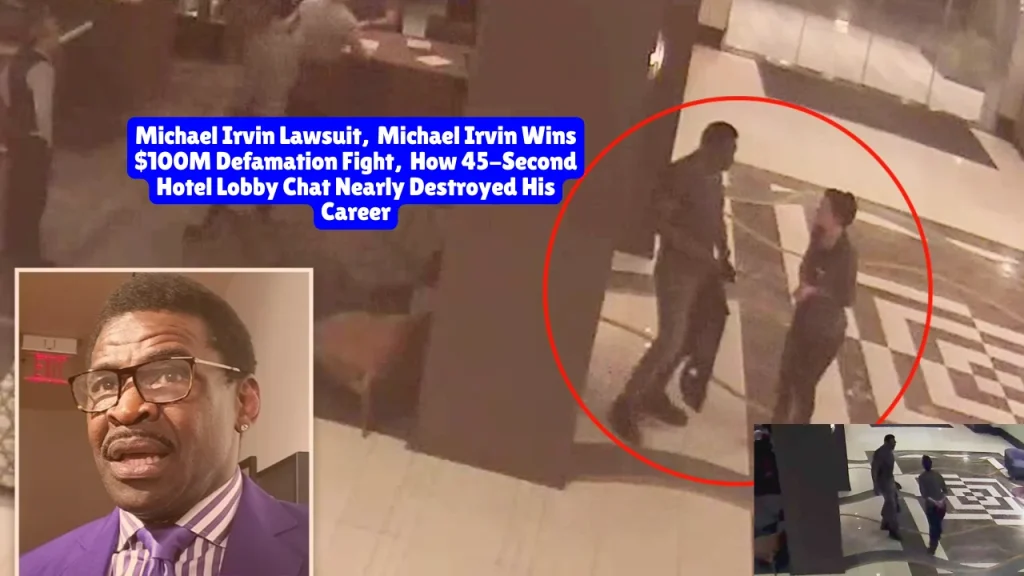
The Surveillance Video That Changed Everything
Irvin maintained his innocence from day one, but he had a problem: he’d been drinking that night and couldn’t remember specific details of the conversation.
“I don’t really recall that conversation, to tell you the truth. We were out drinking. It was just a friendly conversation,” Irvin told The Dallas Morning News. “This all happened in a 45-second conversation in the lobby.”
His only hope? Security camera footage.
Irvin’s attorney, Levi McCathern, fought Marriott in court to release the surveillance video. Marriott initially refused, only allowing McCathern to watch a short clip without taking notes or making copies.
Finally, on March 10, 2023, a federal judge ordered Marriott to hand over the unedited footage.
What the video actually showed:
The conversation lasted about 1 minute and 45 seconds—not 45 seconds as Irvin initially thought, but still a brief exchange. Irvin and the woman talked in the hotel lobby. He touched her arm twice briefly, shook her hand, and they parted ways.
There was no audio, so exactly what was said remains disputed.
But what the video didn’t show was arguably more important: there was no aggressive behavior, no visible distress from the woman during most of the conversation, and witnesses standing nearby saw nothing alarming.
Two eyewitnesses came forward publicly supporting Irvin’s version of events, saying they saw nothing inappropriate.
“The eye in the sky don’t lie,” Irvin said when releasing the footage. “We talk and tell lies, but the eye in the sky don’t lie.”
The $100 Million Lawsuit
On February 9, 2023—just three days after being kicked out of the hotel—Irvin filed a $100 million defamation lawsuit in Collin County, Texas.
Defendants named in the lawsuit:
- Marriott International, Inc.
- Renaissance Hotel Operating Company
- The female employee (identified as “Jane Doe”)
- Three other Marriott employees
Legal claims Irvin filed:
Defamation – Making false statements that damaged his reputation
Tortious interference in a business relationship – Reporting false information to NFL Network that cost him work
False light – Portraying him in a false, offensive manner
Irvin’s complaint alleged that Marriott “inaccurately and inflammatorily” accused him of misconduct based on a “brief, friendly interaction” that lasted under a minute with multiple witnesses present.
The lawsuit argued witnesses verified Irvin “casually exchanged pleasantries with one of the hotel employees, shook her hand, and went to his room alone.”
“Nonetheless, Marriott recklessly reported to the NFL that Mr. Irvin had somehow acted inappropriately,” the complaint stated, “even though in this brief interaction with multiple witnesses, nothing took place other than a friendly interaction that ended with a polite handshake.”
Irvin later refiled the case in Arizona (where the incident occurred) and added more defendants after learning additional details.
Marriott Fights Back With Explosive Court Filing
Marriott didn’t back down.
In court documents filed in March 2023, Marriott’s legal team defended the employee and disputed Irvin’s characterization of the encounter.
Marriott’s response alleged:
- Irvin appeared “visibly intoxicated”
- He was “aggressive in nature”
- He reached out and touched the woman’s arm without consent, causing her to step back and become visibly uncomfortable
- He made the alleged vulgar sexual remark about a “big Black man”
- The woman felt threatened when Irvin said he would find her later in her work week
Marriott accused Irvin’s attorneys of providing a “self-serving, inaccurate summary of the video footage.”
The hotel chain said the employee’s complaint was credible, and they stood behind their decision to report the incident to the NFL.
No criminal charges were ever filed, and police never investigated the allegation.
The Emotional Toll: “Hanging Brothers by a Tree”
The case took on deeper racial undertones when Irvin compared his treatment to lynching.
“This just blows my mind that in 2023 we’re still dragging and hanging brothers by a tree,” Irvin said emotionally at a March press conference. “I couldn’t even tell you what she looks like. I don’t even know who I’m talking about.”
Irvin felt he was being accused, condemned, and punished without evidence—mirroring a dark historical pattern where Black men faced false accusations from white women with devastating consequences.
“Like I’m going to hunt her down, kidnap somebody, kill somebody?” Irvin said in response to the allegation he threatened to find her later. “Come on.”
The situation also raised serious mental health concerns for Irvin. After being removed from the hotel, he revealed he was monitored for three days to ensure he wasn’t experiencing CTE-related symptoms.
“We all worry about it. We see what happens with our brethren and we now know about CTE,” Irvin explained. “How can you say I’m doing something and I don’t know it and you tell me to go home? I couldn’t go home. They put me in a hotel, other than in a Marriott, and they watch me…for three days to make sure that I wasn’t doing anything crazy, to make sure that I was OK mentally.”
Understanding Defamation Law for Public Figures
Irvin faced a high legal bar because he’s a public figure.
To win a defamation case, public figures must prove:
- The statement was false – What was said about you isn’t true
- Published to third parties – Others heard or saw the false statement
- Caused actual harm – You suffered reputational damage, lost income, or emotional distress
- Actual malice – The person knew it was false or showed reckless disregard for the truth
That last element—actual malice—is what makes defamation cases so hard for celebrities and public figures to win. Private individuals only need to prove negligence, but public figures must show the defendant either knew the statement was false or didn’t care whether it was true.
Key defamation terms explained:
Slander – Spoken defamatory statements (like what the employee allegedly told Marriott management)
Libel – Written defamatory statements (like court filings or public statements)
Tortious interference – When someone intentionally damages your business relationships
False light – Portraying someone in a misleading, offensive way
Irvin’s case centered on whether Marriott’s report to the NFL was false and whether they acted recklessly in making the accusation.

The Settlement: Who Really Won?
On September 10, 2023—just hours before the NFL season kickoff—news broke that Irvin and Marriott had settled.
Settlement terms:
Marriott paid Irvin nothing. Zero dollars.
Irvin dismissed his lawsuit with prejudice, meaning he can never refile those claims.
Marriott released a statement saying: “We have always stood behind our people and their version of events and believe Mr. Irvin’s suit had no merit whatsoever.”
So Marriott technically “won” the financial battle. But Irvin got what he really wanted: NFL Network immediately reinstated him, and he appeared on NFL GameDay Morning that same Sunday.
“Michael Irvin has been reinstated and will be a part of NFL Network’s coverage of the 2023 season,” NFL Media vice president Alex Riethmiller confirmed.
Industry observers speculate Irvin settled for less than he could have won at trial because he needed to end the lawsuit to get his job back. NFL Network likely wouldn’t reinstate him while litigation was ongoing.
So while no money changed hands, Irvin salvaged his broadcasting career—which was arguably worth more than any settlement amount.
What This Case Reveals About False Accusations
The Irvin case highlights troubling questions about how misconduct allegations are handled in 2023.
Problems exposed by this case:
Immediate career consequences without investigation – Irvin lost work opportunities within hours of an accusation, before any review of evidence
He-said, she-said with no audio evidence – The video showed interaction but not intent or exact words spoken
Power of accusations alone – Even without criminal charges or proof, the allegation nearly ended Irvin’s career
Difficulty proving defamation – Even with video evidence supporting his version, Irvin couldn’t definitively prove the accuser lied
Settlement pressure – Irvin may have accepted unfavorable settlement terms just to end the suspension
The case became a rallying point for critics of “cancel culture” who argue people face career destruction based on unproven accusations.
Similar Celebrity Defamation Cases
Irvin’s lawsuit fits a pattern of public figures fighting back against allegations.
Johnny Depp vs. Amber Heard (2022): Depp won $10 million in compensatory damages and $5 million in punitive damages (reduced to $350,000) after proving Heard defamed him with false domestic violence allegations. The jury found Heard acted with actual malice.
Kevin Spacey acquittal (2023): The actor was found not guilty on sexual assault charges in the UK after accusers’ stories fell apart under cross-examination.
Matt Araiza settlement (2025): The NFL punter was dropped from a civil sexual assault lawsuit in exchange for dropping his defamation counterclaim against his accuser.
These cases show how surveillance footage, witness testimony, and contemporaneous records can make or break misconduct allegations—and how devastating false accusations can be to careers, even when later disproven.
The Bigger Legal Implications
Irvin’s case raised concerns about proposed legislation that would make defamation lawsuits even harder to win.
Some states considered “Speak Your Truth” bills that would raise the burden of proof for defamation claims when someone accuses another of sexual misconduct.
Critics argue such laws would eliminate one of the few legal protections people have against false accusations, making it nearly impossible to clear your name even with video evidence.
“If that bill were to become law, anyone accused of sexual assault or sexual violence will face seemingly insurmountable obstacles in bringing a lawsuit and being able to defend their reputation,” legal analyst Darryl Goldberg noted.
The Irvin case demonstrates why these protections matter: without the ability to sue for defamation, he would have had no recourse when the accusation destroyed his career.
Where Things Stand Now
Michael Irvin returned to NFL Network in September 2023 and continues working as a sports analyst.
He also joined Fox Sports, appearing on both “Undisputed” with Skip Bayless and the “Big Noon Kickoff” college football pregame show.
The female employee’s identity remains protected as “Jane Doe,” and Marriott continues to stand by her version of events despite the settlement.
No criminal investigation ever occurred, and no charges were filed against Irvin.
FAQ: Everything You Need to Know
What exactly was Michael Irvin accused of?
A Marriott hotel employee accused Irvin of making sexually explicit comments to her in the hotel lobby on February 5, 2023. Specifically, she claimed he asked whether she knew anything about having a “big Black man inside of her” and touched her arm without consent, making her uncomfortable.
Did surveillance video prove Irvin’s innocence?
The video showed a brief conversation (about 1 minute 45 seconds) where Irvin touched the woman’s arm twice and shook her hand. There was no audio, so exactly what was said remains disputed. Witnesses said they saw nothing inappropriate.
Was Irvin charged criminally?
No. Police never filed criminal charges, and no criminal investigation occurred.
How much did Irvin get in the settlement?
Zero dollars. Marriott paid nothing. However, Irvin got his NFL Network job back immediately after settling, suggesting that was his real goal.
Why did Marriott settle if they believed the employee?
Marriott didn’t “settle” in the traditional sense—they paid no money. Irvin dropped the lawsuit. The settlement likely allowed both sides to move on without a lengthy, expensive trial where neither side could definitively prove their version of events.
What does “actual malice” mean in defamation cases?
For public figures like Irvin, proving defamation requires showing the defendant either knew the statement was false or showed “reckless disregard” for whether it was true. This is a much higher standard than what private citizens must prove.
Can you sue someone for false accusations?
Yes, through defamation lawsuits. But you must prove the statement was false, caused you harm, and (for public figures) was made with actual malice. These cases are notoriously difficult to win.
Why is defamation so hard to prove?
Because truth is an absolute defense. If the defendant can show their statement was true, the case fails. Also, opinions are generally protected. Public figures must meet the high “actual malice” standard, which requires proving the person knew it was false or didn’t care about the truth.
What is “tortious interference”?
It’s when someone intentionally damages your business relationships. Irvin claimed Marriott interfered with his NFL Network contract by reporting false information that got him suspended.
Did the settlement include any admission of wrongdoing?
No. Marriott specifically stated they believe their employee and stand by their actions. Irvin dropped his claims but doesn’t admit he did anything wrong either.
Resources for Defamation and False Accusations
Legal Information:
- Media Law Resource Center – Defamation law resources
- First Amendment Center – Free speech and defamation info
- ACLU Know Your Rights – Legal rights information
If You’re Falsely Accused:
- Consult a defamation attorney immediately
- Document everything: witnesses, timeline, communications
- Preserve evidence like videos, texts, emails
- Don’t publicly discuss the allegations before talking to a lawyer
Finding Legal Help:
- State bar associations offer lawyer referral services
- Many defamation attorneys offer free initial consultations
- Legal aid organizations can help if you can’t afford an attorney
Disclaimer: This article is based on court documents, public statements, and news reports about the Michael Irvin lawsuit. Settlement terms were not publicly disclosed. Both parties maintain their versions of events, and the exact words spoken during the hotel lobby encounter remain disputed. No criminal charges were filed.
About the Author

Sarah Klein, JD, is a licensed attorney and legal content strategist with over 12 years of experience across civil, criminal, family, and regulatory law. At All About Lawyer, she covers a wide range of legal topics — from high-profile lawsuits and courtroom stories to state traffic laws and everyday legal questions — all with a focus on accuracy, clarity, and public understanding.
Her writing blends real legal insight with plain-English explanations, helping readers stay informed and legally aware.
Read more about Sarah