
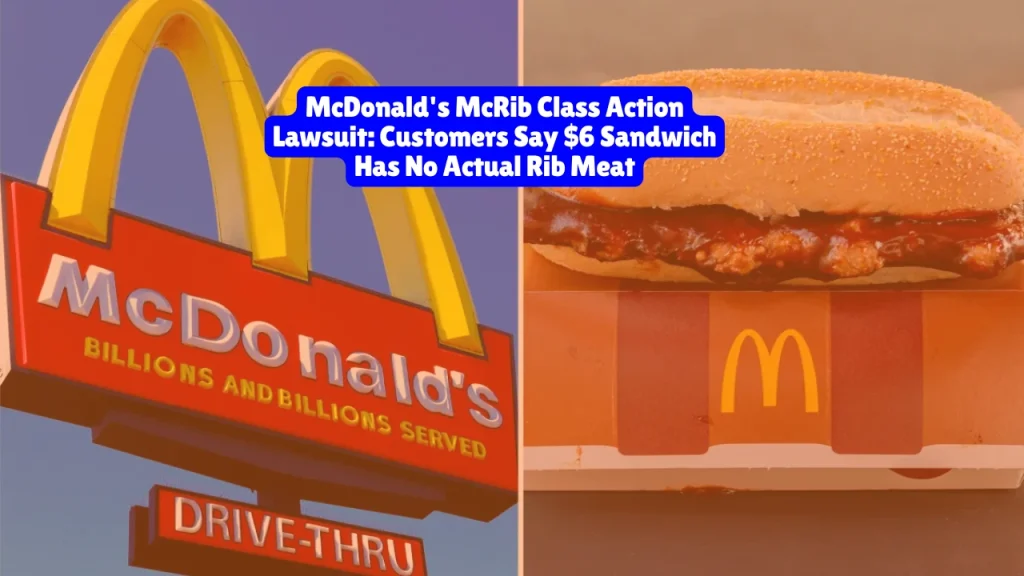
McDonald’s McRib Class Action Lawsuit, Customers Say $6 Sandwich Has No Actual Rib Meat
What the McRib Lawsuit Claims
Four consumers filed a class action lawsuit against McDonald’s on December 23, 2025, claiming the McRib sandwich misleads customers into believing it contains actual pork rib meat when it doesn’t. The 45-page complaint alleges McDonald’s uses the name “McRib” and shapes the patty like ribs to deceive consumers into paying premium prices for restructured pork made from shoulder, heart, tripe, and scalded stomach—none of which qualify as rib meat.
The lawsuit seeks to represent all U.S. consumers who purchased a McRib in the past four years. Plaintiffs claim McDonald’s charged an average of $5.63 per sandwich in December 2024—reaching $7.89 at some locations—while the Big Mac averaged $5.29 during the same period.
McDonald’s denies the allegations, stating the lawsuit “distorts the facts” and that the McRib is made with “100% pork sourced from farmers and suppliers across the U.S.”
The Price Point That Triggered the Lawsuit
Real pork rib meat commands premium prices. According to USDA National Daily Pork Report data from November 17, 2025, pork “rib” meat was valued at $152.32 per 100 pounds, compared to $108.84 for pork “butt” and $85.90 for pork “loin.”
That’s a 40% to 77% price premium for actual rib meat over other cuts.
Plaintiffs claim McDonald’s charged premium sandwich prices while using lower-quality cuts, leading consumers to believe they were getting higher-quality meat than they actually received.
The lawsuit states: “The McRib is among the most expensive individual menu items at McDonald’s, often priced higher than burgers made with 100% beef patties.”
The Four Plaintiffs and Their Purchases
Peter Le (California): Purchased a McRib on November 15, 2024, in Baldwin Park, California
Charles Lynch (New York): Made his purchase in New York
Dorien Baker (Illinois): Bought a McRib in Illinois
Derrick Wilson (Washington, D.C.): Purchased a McRib on November 28, 2024, in Washington, D.C.
All four claim they reasonably believed the sandwich contained actual rib meat based on the name, shape, and marketing.
What the Lawsuit Says Is Really in the McRib
The complaint alleges the McRib patty is “composed of exclusively lower-quality pork products, such as, inter alia, pork shoulder, heart, stomach and tripe.”
The lawsuit claims McDonald’s uses restructured meat—combining various cuts into a uniform patty—but never uses actual rib meat.
Here’s what makes this particularly contentious: The lawsuit argues McDonald’s deliberately shaped the patty to resemble spare ribs or baby back ribs, reinforcing the false impression that consumers were getting premium rib cuts.
McDonald’s Official Response
McDonald’s lists the McRib Pork Patty ingredients on their website as “Pork, Water, Salt, Dextrose, Rosemary Extract.”
A McDonald’s spokesperson told media outlets: “This lawsuit distorts the facts and many of the claims are inaccurate. Food quality and safety are at the heart of everything we do – that’s why we’re committed to using real, quality ingredients across our entire menu.”
The company specifically denied that hearts, tripe, or scalded stomach are included in the McRib, stating it uses “100 percent boneless pork with BBQ sauce, onions, and pickles.”
McDonald’s emphasizes the product is made with “100% pork sourced from farmers and suppliers across the U.S.”
The 16 Legal Claims Filed
The lawsuit cites 16 separate legal claims, including:
- Fraud
- Breach of warranty
- Contract violations
- Violations of state consumer protection laws
The complaint argues McDonald’s “knows or should know that consumers are so misled” by including the word “Rib” in the name and shaping the patty like ribs.
Plaintiffs claim McDonald’s intentionally failed to disclose the absence of rib meat despite having exclusive knowledge of the product’s actual composition.
Case Details and Court Information
Case Number: 1:25-cv-15609
Court: U.S. District Court for the Northern District of Illinois Eastern Division
Filed: December 23, 2025
Plaintiffs’ Attorney: Thiago M. Coelho of Wilshire Law Firm PLC
McDonald’s Corporate Address: 110 North Carpenter Street, Chicago, Illinois
Status: Early litigation; class certification pending
The timing of the December 23, 2025 filing positions the case for potential resolution during 2026, though complex class action litigation typically extends across multiple years.
Related article: Jason Arrington Lawsuit, Florida Man Shot With His Own Gun During Traffic Stop—Officer Fired, Settlement Talks Underway
Who Could Join This Class Action
The lawsuit seeks to represent:
Nationwide Class: All U.S. consumers who purchased a McRib from McDonald’s in the past four years (approximately December 2021 through December 2025)
State-Specific Subclasses:
- California consumers
- New York consumers
- Illinois consumers
- Washington, D.C. consumers
If the court certifies the class, eligible consumers who purchased the McRib during this period may have the opportunity to join the lawsuit.
No Settlement or Compensation Available Yet
This lawsuit was just filed in December 2025. There is no settlement, no approved compensation, and no claim forms available.
Early proceedings will address whether the court dismisses the case or allows it to proceed. If it proceeds, months or years of litigation typically follow before any settlement discussions begin.
Consumers cannot file claims or receive money at this time. Any website claiming to offer McRib settlement payments is likely a scam.
The McRib’s History of Limited Availability
McDonald’s first introduced the McRib in 1981 at a Kansas City, Kansas location. It went nationwide in 1982.
The sandwich has been removed and added to the menu multiple times over four decades, creating a cult following of fans who track its availability.
In 2022, McDonald’s announced the sandwich would be discontinued “for good” and even sold nostalgic McRib merchandise. However, it returned again in 2023.
The most recent run began in November 2025—just before this lawsuit was filed.
This limited-time availability strategy has only increased the hype, with devoted fans using tools like “McRib Locator” to track when and where it returns
What Legal Experts Say About the Case
Consumer protection attorneys note that food labeling lawsuits often hinge on what “reasonable consumers” would expect from a product name and marketing.
The legal question isn’t whether the sandwich contains pork (McDonald’s admits it does). The question is whether calling it a “McRib” and shaping it like ribs misleads consumers into believing it contains actual rib meat cuts.
Similar lawsuits have targeted other food products over naming and marketing issues. Results vary depending on whether courts find the branding inherently deceptive or whether reasonable consumers should understand the product from available information.
McDonald’s will likely argue that “boneless” and ingredient lists are clearly stated, and that no reasonable consumer would expect bones in a fast food sandwich.
Related Consumer Protection Cases
Fast food false advertising: Arby’s Lawsuit Over Half-Empty Sandwiches
Consumer protection litigation: Best Buy Fake Discount Lawsuit
Food industry cases: V-Shred $4M Settlement
Frequently Asked Questions
Can I get money from the McRib lawsuit?
Not yet. The lawsuit was just filed in December 2025. There’s no settlement, no approved class, and no claim forms. Any website claiming otherwise is likely a scam.
How long will this case take?
Class action lawsuits typically take 2-5 years from filing to settlement. Early proceedings will determine if the case survives dismissal attempts.
Did I waste money on the McRib?
That’s what the lawsuit claims—that consumers paid premium prices expecting rib meat but received restructured pork from other cuts instead.
What does “restructured pork” mean?
It means taking various cuts of pork, grinding or processing them, and forming them into a uniform patty shape.
Does the McRib really contain heart and stomach?
The lawsuit alleges this. McDonald’s denies it, stating the product contains “100% pork” with listed ingredients of pork, water, salt, dextrose, and rosemary extract.
Will McDonald’s stop selling the McRib?
Unknown. The company is defending the lawsuit and has made no announcements about discontinuing the product.
What Happens Next
McDonald’s will likely file a motion to dismiss, arguing the lawsuit lacks merit and that reasonable consumers aren’t misled by the McRib branding.
If the case survives dismissal, plaintiffs will seek class certification, which could take months or years.
Discovery would reveal internal McDonald’s documents about product development, marketing strategy, and ingredient sourcing.
Settlement negotiations could occur at any point, though McDonald’s appears positioned to defend the case vigorously.
Watch for updates throughout 2026 as early motions are decided.
This article provides general information about the McRib lawsuit and should not be considered legal advice. No settlement or claim forms are currently available.
About the Author

Sarah Klein, JD, is a licensed attorney and legal content strategist with over 12 years of experience across civil, criminal, family, and regulatory law. At All About Lawyer, she covers a wide range of legal topics — from high-profile lawsuits and courtroom stories to state traffic laws and everyday legal questions — all with a focus on accuracy, clarity, and public understanding.
Her writing blends real legal insight with plain-English explanations, helping readers stay informed and legally aware.
Read more about Sarah