
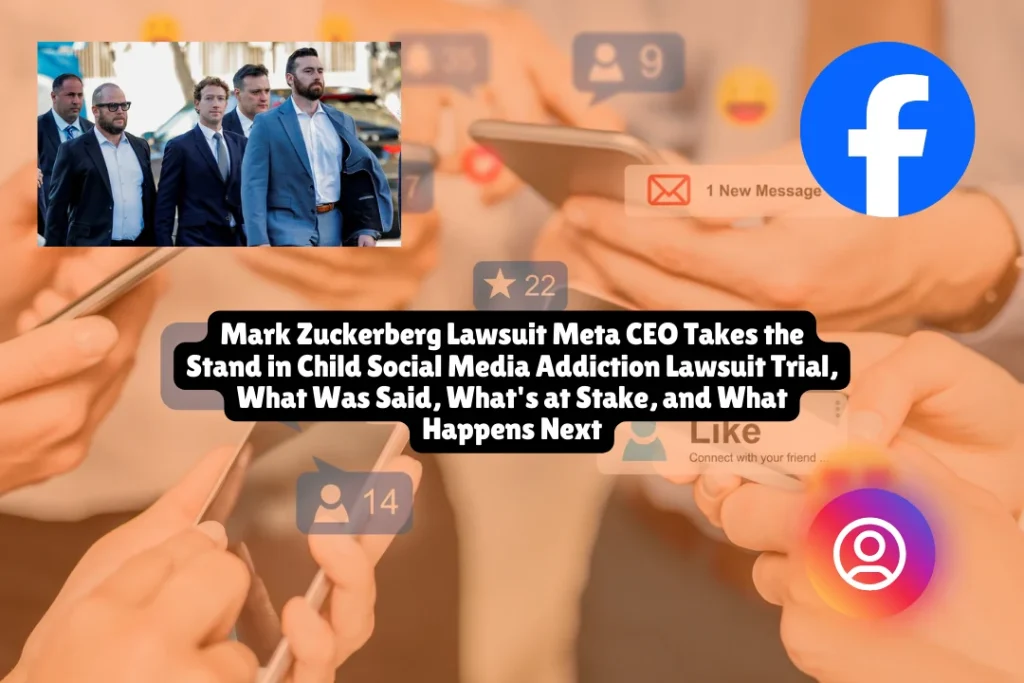
Mark Zuckerberg Lawsuit Meta CEO Takes the Stand in Child Social Media Addiction Lawsuit Trial, What Was Said, What’s at Stake, and What Happens Next
For the first time in history, Meta CEO Mark Zuckerberg testified before a jury on February 18, 2026, in a federal trial that could reshape how social media companies are held legally responsible for harming children. A 20-year-old California woman known in court documents only as KGM is suing Meta and Google’s YouTube, claiming Instagram deliberately addicted her as a child, worsening her depression and suicidal thoughts.
This article explains what the trial is about, what Zuckerberg said on the stand, who the parties are, what legal claims are being made, and what the outcome could mean for over 1,500 similar lawsuits waiting in line.
Case Facts at a Glance
| Detail | Information |
| Case Name | K.G.M. v. Meta Platforms, Inc., et al. |
| Case Number | 23SMCV03371 |
| Court | Los Angeles County Superior Court |
| Judge | Honorable Carolyn B. Kuhl |
| Trial Started | January 27, 2026 |
| Zuckerberg Testified | February 18, 2026 |
| Remaining Defendants | Meta (Instagram) and Google (YouTube) |
| Settled Before Trial | TikTok and Snap |
| Case Type | Bellwether trial — individual personal injury |
| Settlement Status | No settlement — active trial |
Who Is KGM and What Does She Allege?
At the center of the case is a 20-year-old California woman, identified in court papers only as KGM, who filed a lawsuit against Meta, TikTok, Google, and Snap in 2022. She accused the companies of following Big Tobacco’s playbook: instilling addictive behaviors in teens while dismissing their own research showing their products posed health risks.
Her lawsuit claims she began using social media young — YouTube at age 6, then Instagram at age 9. After becoming hooked on the platforms, she said her body image issues, depression, and suicidal thoughts worsened. The suit points to features like beauty filters, infinite scroll, and auto-play as being tantamount to a “digital casino.”
Evidence of the harms of these features was concealed from the public, the lawsuit says. KGM’s attorney, Mark Lanier, displayed a 35-foot-wide collage of hundreds of selfies KGM posted to Instagram to illustrate the depth of her engagement with the platform as a child.
What Did Zuckerberg Say on the Stand?
In his first time testifying about child safety in front of a jury, Meta CEO Mark Zuckerberg said the company does not seek to make Instagram addictive to younger users, pushing back against claims that the social media app is designed to be harmful to children. “I’m focused on building a community that is sustainable,” he said when asked whether Meta wants people to be addicted to its platforms. “If you do something that’s not good for people, maybe they’ll spend more time short term, but if they’re not happy with it, they’re not going to use it over time.”
Zuckerberg said that in 2019, before a birthdate rule was implemented, there was “some concern around privacy,” but said he thinks they eventually landed on the right policy. Lanier noted that the age verification features were not available when many children first joined Instagram — KGM got on the app at age 9. “I always wish we could have gotten there sooner,” Zuckerberg said of the safety tools Meta added in recent years.
At one point during the questioning, Zuckerberg became visibly testy. “That’s not what I’m saying at all,” said the tech billionaire. “I think you’re misunderstanding what I’m saying,” Zuckerberg responded.
What Are the Legal Claims?
The lawsuit relies on a legal theory that sidesteps the usual defenses social media companies use. For decades, Silicon Valley has maintained a legal shield in the form of Section 230 of the Communications Decency Act, a 1996 law that allows tech companies to avoid legal responsibility for what its users post. Now, lawyers are suing the tech companies under product liability laws. They argue that the platforms are essentially defective products because of features such as infinite scroll and autoplay.
Judge Carolyn Kuhl reinforced this legal theory in a key pretrial ruling. She determined that features like autoplay and reward-based notifications are “product designs,” not “speech.” This means they are not protected by the First Amendment, making social media companies potentially liable just like a manufacturer of a defective physical product.
The specific legal claims include negligence, negligent failure to warn, and products liability based on allegedly defective design. The plaintiff must prove that Instagram’s design was a substantial factor in causing her documented mental health harm.
What Is Meta’s Defense?
Meta has consistently denied all allegations. Meta’s defense has argued it does not dispute that KGM experienced mental health struggles, but disputes that Instagram was a substantial factor, citing other stressors documented in her records and contending she used social media as a coping mechanism.
Meta has also pointed to safety features such as parental oversight tools and “teen accounts,” which implement default privacy settings and content restrictions for users under the age of 18. Meta’s attorney Paul Schmidt told the jury in his opening statement that the company’s own records show KGM had a difficult home life predating her social media use, and that she sought out the platforms as an escape from those pre-existing struggles.
Why TikTok and Snap Are No Longer Defendants
The other defendants, Snap Inc. and TikTok, settled out of court in December 2025. The financial terms of both settlements remain confidential. Their decisions to settle before trial left Meta and Google’s YouTube as the sole remaining defendants.
Settling before trial means TikTok and Snap avoided having their executives testify under oath and avoided the risk of a public jury verdict against them. For a detailed breakdown of what TikTok’s settlement means for other pending cases, see our article on the TikTok pre-trial settlement and what it means for other social media addiction claims.
What Makes This a “Bellwether Trial”?
The lawsuit is the first of its kind to go to trial, and it is seen as a bellwether for several other lawsuits that have been filed across the country. A bellwether trial is a test case — its outcome does not automatically decide every other case, but it signals to both sides how juries are likely to react to the same evidence and legal arguments.
More than 1,500 similar lawsuits have been filed against social media companies, but KGM’s is the first to go to trial. A verdict for KGM could open the door to settlements in many of those cases. A verdict for Meta could make it significantly harder for other plaintiffs to pursue similar claims.
The Separate New Mexico Trial
In New Mexico, Meta is facing a separate civil enforcement trial brought by the state’s Attorney General Raúl Torrez, alleging Meta violated the state’s consumer protection laws by failing to disclose what it knew about risks and harmful effects to children. The state also alleges Meta created a public nuisance and fostered conditions that enabled child sexual exploitation.
The state’s investigators built parts of the case by using accounts that posed as minors and documenting sexual solicitations and Meta’s responses. Meta denies wrongdoing and has criticized the state’s investigative methods as “ethically compromised.”
Zuckerberg has not been ordered to testify in the New Mexico case. That trial is proceeding separately and simultaneously with the Los Angeles trial.
What Could Happen Next?
The Los Angeles trial is expected to last six to eight weeks total, meaning a jury verdict could come as early as March or April 2026. In the Los Angeles trial, which is in state court, the jury needs three-fourths agreement — 9 out of 12 jurors — to side with either KGM or the tech companies.
A win for the family could lead to serious monetary damages and platform-wide changes to social media apps. The outcome of this trial is anticipated to open the door to settlement talks for the hundreds of other suits.
If Meta wins, it strengthens the company’s legal position in the thousands of similar cases pending across the country. If KGM wins, it sets a legal framework that could fundamentally change how social media platforms design their products for young users — and what financial exposure tech companies face.
Attorneys general in more than 40 states have filed lawsuits against Meta, similarly alleging that its platforms harm children and contribute to mental health issues among young children. Those cases are watching the Los Angeles verdict closely.
FAQs
What is the Zuckerberg trial about?
Mark Zuckerberg testified on February 18, 2026, in a trial brought by a 20-year-old California woman known as KGM, who claims Instagram deliberately addicted her as a child and worsened her depression and suicidal thoughts. The case is being heard in Los Angeles County Superior Court, Case No. 23SMCV03371.
Is this a class action lawsuit?
No. This is an individual personal injury lawsuit selected as a bellwether trial. It is one case that will serve as a legal test for over 1,500 similar lawsuits filed by other plaintiffs against social media companies.
Did Zuckerberg admit Instagram was addictive?
No. Zuckerberg denied that Meta designs Instagram to be addictive and said the company is focused on building a sustainable community. He maintained that Meta works to protect young users and has added safety tools over the years.
Why are TikTok and Snap no longer in the trial?
TikTok and Snap both settled with KGM before trial — Snap in late 2025 and TikTok on January 26, 2026, the night before jury selection began. The financial terms of both settlements are confidential.
What legal theory is KGM using to sue Meta?
KGM’s lawyers are using product liability law, arguing that Instagram is a defective product because of design features like infinite scroll, beauty filters, and autoplay that were allegedly engineered to be addictive. This approach sidesteps Section 230, the federal law that normally shields tech companies from lawsuits over user-generated content.
Can other parents or children join this lawsuit?
This particular trial is an individual case and is not accepting new plaintiffs. However, there are thousands of similar lawsuits pending against social media companies. Anyone who believes their child was harmed by social media addiction should consult a qualified attorney who handles these types of cases.
What happens if Meta loses?
A loss for Meta could result in monetary damages awarded to KGM and could set a legal precedent making it easier for other plaintiffs in similar cases to pursue claims. It could also trigger settlement negotiations across the broader litigation.
When will the verdict be announced?
The trial began January 27, 2026, and is expected to last six to eight weeks. A verdict from the 12-person jury could come as early as March or April 2026. This article will be updated as the trial progresses.
Last Updated: February 19, 2026
Disclaimer: This article is for informational purposes only and does not constitute legal advice. Legal claims and outcomes depend on specific facts and applicable law. For advice regarding a particular situation, consult a qualified attorney.
About the Author

Sarah Klein, JD, is a licensed attorney and legal content strategist with over 12 years of experience across civil, criminal, family, and regulatory law. At All About Lawyer, she covers a wide range of legal topics — from high-profile lawsuits and courtroom stories to state traffic laws and everyday legal questions — all with a focus on accuracy, clarity, and public understanding.
Her writing blends real legal insight with plain-English explanations, helping readers stay informed and legally aware.
Read more about Sarah