
Mario Badescu Sued Over Class Action Claims Facial Spray Does Not Contain Rosewater Despite Product Label
Mario Badescu Skin Care, Inc. is facing a class action lawsuit alleging that its popular Skincare Facial Spray with Aloe, Herbs, and Rosewater is falsely labeled—the product allegedly contains rosehip extract instead of rosewater, misleading consumers about a key ingredient. Filed on December 18, 2025, in the U.S. District Court for the Southern District of New York (Case No. 1:25-cv-10510), the 17-page complaint argues that this mislabeling led consumers to purchase a product based on false claims about its skincare benefits.
What the Lawsuit Alleges About Mario Badescu’s Rosewater Claims
The class action centers on one specific claim: Mario Badescu’s facial spray prominently features “rosewater” on its front label, but the ingredient list reveals Rosa canina bud extract—the botanical source of rosehip extract—not rosewater from rose petals. Material misrepresentation—a false statement about a product’s key features that influences a consumer’s purchase decision—is the foundation of this lawsuit, with plaintiffs arguing that rosewater claims on the facial spray label were the primary reason they chose this product over competitors.
Plaintiff Mary Baker, who filed the lawsuit on behalf of herself and a proposed nationwide class as well as a New York subclass, claims the company “intentionally misleads consumers into believing that the product is made with rosewater.” The complaint states that “Defendant falsely and misleading labels its Product with the Rosewater Representation placed on the front of the Product packaging intentionally to mislead consumers into believing the Product contains rosewater… because rosewater is a popular and desirable ingredient in skincare.”
The Difference Between Rosewater and Rosehip Extract
Rosewater and rosehip extract are fundamentally different ingredients derived from different parts of rose plants through different extraction processes. Rose water, also known as Rosa damascena flower water or rose hydrosol, is created by steam-distilling the petals of Damask roses or similar varieties, resulting in a water-based product with aromatic and soothing properties. Rosehip oil or extract, by contrast, is obtained from the fruit or seed pods of wild rose plants, commonly Rosa canina, through cold-pressing or extraction methods.
These two ingredients provide substantially different skincare benefits—rose water is valued primarily for its calming, refreshing, and aromatherapeutic properties, while rosehip extract is known for its vitamin C content, linoleic acid, and anti-inflammatory capabilities that target fine lines, scars, and hyperpigmentation. Consumers seeking rosewater’s gentle hydration and fragrance receive a chemically distinct product when purchasing items containing rosehip extract instead.
Which Mario Badescu Products Are Named in the Lawsuit
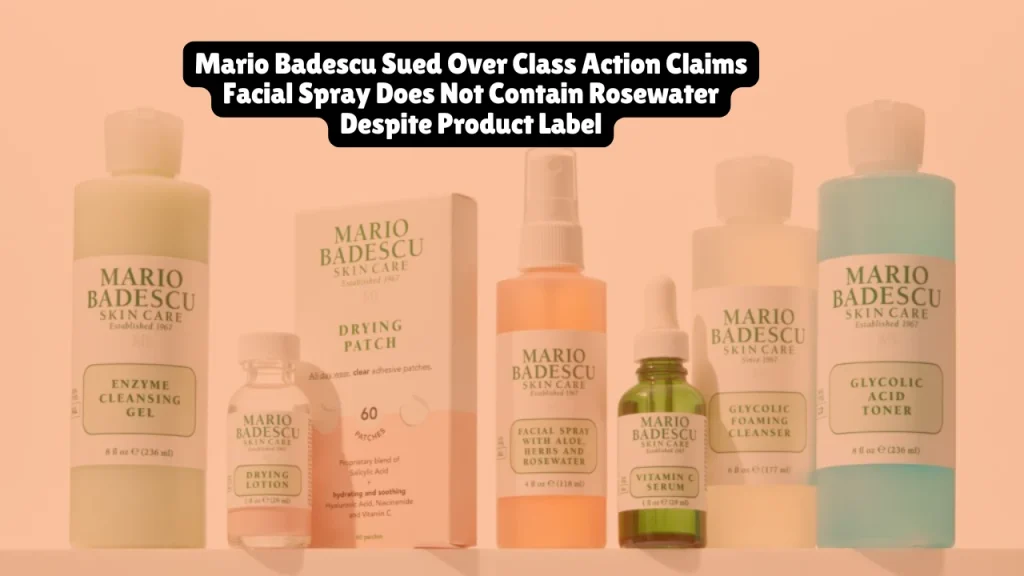
The lawsuit specifically targets Mario Badescu Skincare Facial Spray with Aloe, Herbs, and Rosewater. This facial spray is one of the company’s most popular products, widely sold at beauty retailers across the United States and online. The proposed class seeks to represent all individuals who purchased at least one of these facial sprays in the United States during the applicable statute of limitations period.
The complaint does not identify specific SKUs, production batch numbers, or date ranges for affected products, suggesting the allegations may apply to all units of this particular facial spray product sold within the relevant timeframe. Consumers who purchased Mario Badescu Skincare Facial Spray with Aloe, Herbs, and Rosewater—identifiable by the product name and rosewater claim on the label—may be part of the class.
What the Product Label Claims Versus What It Actually Contains
According to the complaint, Mario Badescu’s facial spray packaging prominently displays “Rosewater” as a key ingredient on the front label, creating consumer expectations about what the product contains. However, the ingredients list on the bottle reveals Rosa canina bud extract as one of the last listed ingredients—the purported source of rosehip extract.
The lawsuit alleges that nowhere on the ingredients list is there any mention of rosewater from rose petal extracts or Rosa damascena flower water, the botanical ingredient commonly associated with authentic rosewater in cosmetics. The case argues that Mario Badescu, as the manufacturer, “knows, or should have known, that it misrepresented the actual ingredients of its facial spray on its label.”
Rosa canina bud extract is derived from the wild rose’s fruit buds through an extraction process entirely different from the steam distillation method used to create true rosewater, and it delivers a different set of skincare compounds—primarily fatty acids, antioxidants from the fruit, and plant extracts rather than the aromatic hydrosol consumers expect from rosewater products.
What Consumer Protection Laws the Lawsuit Alleges Were Violated
The complaint alleges multiple legal violations: fraud, breach of express warranty, and violations of New York General Business Law. New York General Business Law includes provisions prohibiting false advertising and deceptive business practices—statutes designed to protect consumers from misleading product claims and unfair commercial conduct.
Breach of express warranty occurs when a product fails to meet specific promises or guarantees made by the manufacturer. In this case, the lawsuit argues that by labeling the facial spray as containing “rosewater,” Mario Badescu created an express warranty that the product would include this specific ingredient, and by allegedly substituting rosehip extract instead, the company breached that warranty.
The fraud claim alleges the company deliberately misled consumers, while the New York General Business Law violations encompass broader consumer protection statutes that prohibit deceptive acts and practices in commerce. Federal cosmetics labeling requirements under the FDA’s Federal Food, Drug, and Cosmetic Act mandate that cosmetic ingredient lists must accurately identify all ingredients in descending order of predominance, and misleading ingredient representations on product labels may constitute regulatory violations even beyond state law claims.
Rrelated article: $625,000 Educative Subscription Class Action Settlement, Automatic Payments for California Subscribers—No Claim Form Required
How Consumers Were Allegedly Misled and What Evidence Supports the Claims
The lawsuit’s central allegation is that Mario Badescu intentionally placed the “Rosewater Representation” on the front of the product packaging to mislead consumers into believing the product contains rosewater specifically because rosewater is a popular and desirable skincare ingredient. This alleged mislabeling matters because consumers make purchasing decisions based on ingredient claims, often paying premium prices for products containing sought-after botanical ingredients like rosewater.
Baker claims she and other consumers would not have purchased the facial spray, or would have paid less for it, had they known it did not contain rosewater. The evidentiary support cited in public reports about the lawsuit includes the product’s own ingredient list showing Rosa canina bud extract rather than rosewater ingredients, creating an internal contradiction between the front-label marketing and the actual ingredient disclosure.
While the complaint details have not been publicly released in full, class action lawsuits alleging cosmetics false advertising typically rely on laboratory testing comparing marketed ingredients to actual formulations, expert chemical analysis of botanical ingredients, and documentation showing material differences between what labels promise and what products deliver. Similar cosmetics labeling lawsuits have successfully proceeded when ingredient lists themselves reveal discrepancies between marketing claims and actual contents.
Current Status of the Class Action Lawsuit
The Mario Badescu facial spray class action was filed on December 18, 2025, in the U.S. District Court for the Southern District of New York. As of January 2026, the lawsuit is in its initial stages. Plaintiff Mary Baker is represented by Stacey Ann Van Malden of Goldberger & Dubin P.C. and Brittany S. Scott of Smith Krivoshey P.C.
Class certification—the procedural step where the court determines whether the case can proceed as a class action representing all affected consumers rather than just the named plaintiff—has not yet occurred. The case must progress through several procedural stages: Mario Badescu will likely file a motion to dismiss arguing the claims lack legal merit, the court will decide whether the case survives dismissal, discovery will proceed if the case continues, and the court will eventually rule on class certification before any trial or settlement discussions advance.
No public statements from Mario Badescu regarding the rosewater allegations, no announced product reformulations, and no label changes have been reported as of January 2026. The company has not issued official responses to the lawsuit that are available in public court records or press releases.
What You Must Know About the Mario Badescu Rosewater Lawsuit
How Statute of Limitations Affects Your Ability to Join the Class
Consumer fraud claims are subject to statute of limitations deadlines—time limits within which legal claims must be filed or they become permanently barred. In New York, consumer protection claims under General Business Law typically carry a three-year statute of limitations from the date of purchase or discovery of the fraud. The proposed class seeks to represent consumers who purchased at least one of the facial sprays “within the applicable statute of limitations period,” meaning purchases made within approximately three years before the December 18, 2025 filing date may be eligible.
If you purchased Mario Badescu Skincare Facial Spray with Aloe, Herbs, and Rosewater before late 2022, your claim may fall outside the recoverable period depending on how courts interpret the statute of limitations in this specific case. State law variations mean that consumers in different states may face different deadline rules, and the nationwide class allegations suggest attorneys will argue for application of the most favorable limitations periods for class members.
What Proof of Purchase You Need and How to Document Your Claim
Class action settlements for false advertising typically require some proof that you purchased the product during the class period. Acceptable documentation often includes original purchase receipts, credit card or bank statements showing transactions at retailers selling Mario Badescu products, online order confirmations from e-commerce sites, email receipts from beauty retailers, or loyalty program purchase histories.
If you no longer have the physical product, photograph the label if you still possess it, noting the product name “Skincare Facial Spray with Aloe, Herbs, and Rosewater” and the ingredients list showing Rosa canina bud extract. If you discarded the product, written records of the purchase—including the approximate date, retailer name, and price paid—can support your claim even without the original receipt.
Gather this documentation now rather than waiting for a settlement to be announced, as retrieving old financial records becomes more difficult as time passes and retailers may not retain transaction histories indefinitely.
How Similar False Advertising Cases in Cosmetics Have Proceeded
Kenvue Brands, doing business as Johnson & Johnson, recently faced a class action lawsuit alleging it falsely advertised Johnson’s Shea & Cocoa Butter Oil as being made from shea and cocoa butter, even though the product allegedly contains less than 1% of those ingredients. This parallel case demonstrates a pattern of cosmetics ingredient labeling litigation targeting discrepancies between prominent label claims and actual formulations.
False advertising class actions in the beauty industry often settle rather than proceed to trial, with settlement amounts varying based on the number of affected consumers, the product’s sales volume, and the strength of the evidence. Typical remedies include cash payments to class members based on purchase amounts, injunctive relief requiring label changes, and attorneys’ fees. Some settlements offer product vouchers instead of cash, though courts scrutinize these arrangements to ensure they provide meaningful compensation.
The FDA does not pre-approve cosmetics before they reach consumers, but it does require ingredient lists to be truthful and complete under the Federal Food, Drug, and Cosmetic Act. Companies that mislabel cosmetics face not only private lawsuits like this one but also potential FTC enforcement actions for deceptive advertising and FDA warning letters for ingredient disclosure violations.
What to Do Next If You Purchased Mario Badescu Facial Spray
How to Determine If You’re Eligible for the Class Action
Review your purchase history from the past three years to identify whether you bought Mario Badescu Skincare Facial Spray with Aloe, Herbs, and Rosewater. Check receipts, credit card statements, beauty retailer purchase histories (Sephora, Ulta, department stores), and online order confirmations from Mario Badescu’s website or other e-commerce platforms.
If you made purchases but no longer have documentation, contact the retailers where you typically shop and request transaction histories for the relevant time period. Many retailers maintain digital records of loyalty program members’ purchases and can provide detailed purchase reports upon request.
Look specifically for the product name containing “Rosewater” on the label—the lawsuit targets this specific facial spray variant, not Mario Badescu’s other facial sprays or product lines. If you purchased multiple bottles over time, document each purchase separately as settlement compensation often depends on the number of units purchased.
Where to Find Class Action Information and How to Register
As of January 2026, no settlement website or claims administrator has been established because the lawsuit remains in early litigation stages. Class action settlement websites typically launch only after a settlement agreement is reached and receives preliminary court approval, which may take months or years from the initial filing date.
To monitor the case status, search the U.S. District Court for the Southern District of New York’s public docket using the case number 1:25-cv-10510. PACER (Public Access to Court Electronic Records) provides access to federal court filings, though it charges per-page fees for document downloads. Free alternatives include legal news websites that track class action lawsuits and publish updates about settlements and court rulings.
You do not need to take action now to join the class. If the case is certified as a class action and proceeds to settlement, the court will require the parties to provide notice to all potential class members through a combination of direct mail (to identifiable purchasers), publication in consumer magazines or websites, and a settlement website where you can file a claim. Class members typically receive automatic notice and inclusion unless they affirmatively opt out.
How to File Complaints About False Cosmetics Labeling
Beyond joining the class action, you can report suspected cosmetics labeling violations to regulatory agencies that oversee product safety and advertising truthfulness. The FDA accepts cosmetics complaints through its MedWatch program at www.fda.gov/safety/medwatch-fda-safety-information-and-adverse-event-reporting-program, though the FDA’s cosmetics oversight focuses primarily on safety rather than advertising claims.
The Federal Trade Commission enforces truth-in-advertising laws and accepts consumer complaints about deceptive marketing at www.reportfraud.ftc.gov. The FTC investigates patterns of misleading advertising claims and can bring enforcement actions against companies that systematically deceive consumers about product ingredients or benefits.
Your state attorney general’s consumer protection division also handles complaints about false advertising and unfair business practices. In New York, the Attorney General’s office maintains a consumer helpline and online complaint portal. Filing complaints with multiple agencies creates a record of consumer harm and may prompt regulatory investigations that supplement private litigation.
Whether You Can Request a Refund Directly from Mario Badescu
Some consumers attempt to obtain refunds directly from manufacturers or retailers before waiting for class action settlements. Contact Mario Badescu’s customer service department, explain that you purchased the facial spray based on the rosewater claim and feel misled by the ingredient discrepancy, and request a refund as a remedy for the alleged mislabeling.
Document all communications with the company, including dates, representatives’ names, and responses received. If Mario Badescu offers a refund, accepting it may require you to sign a release waiving your right to participate in the class action lawsuit, so review any paperwork carefully before agreeing to settlement terms.
Retailers where you purchased the product may also have return policies allowing refunds for products that do not match their descriptions, even after normal return windows have closed. Explain the alleged false labeling and request a refund based on material misrepresentation of the product’s ingredients. Retailers sometimes issue refunds to preserve customer relationships even when the manufacturer has not admitted wrongdoing.
When Individual Legal Advice May Help
Most consumers who simply purchased the facial spray and felt misled about its ingredients will be adequately represented by the class action attorneys handling the case on behalf of all affected purchasers. However, individual legal consultation becomes valuable in specific circumstances beyond simple purchase claims.
If you suffered adverse skin reactions, allergic responses, or other health problems after using the facial spray believing it contained rosewater when it allegedly contained rosehip extract instead, you may have damages beyond the product’s purchase price. Personal injury claims from cosmetics typically require showing that the mislabeled ingredient caused actual physical harm, which may support individual lawsuits separate from the class action.
Consult a consumer protection attorney if you purchased unusually large quantities of the facial spray (for example, for professional use in a salon or spa), as your economic damages may exceed the typical per-person recovery in class action settlements and an individual lawsuit might provide better compensation. Similarly, if you own or operate a business that sold Mario Badescu products to consumers based on the rosewater claims, you may have separate legal claims for losses caused by the alleged misrepresentation.
Frequently Asked Questions About the Mario Badescu Rosewater Lawsuit
Which Mario Badescu Products Are Accused of Not Containing Rosewater?
The lawsuit specifically targets Mario Badescu Skincare Facial Spray with Aloe, Herbs, and Rosewater. This is the only product named in the December 2025 complaint. Mario Badescu manufactures other facial spray variants and skincare products, but the current lawsuit allegations apply only to the facial spray prominently labeled with “rosewater” claims while allegedly containing rosehip extract instead.
What Proof Is There That Mario Badescu Facial Spray Doesn’t Have Rosewater?
The complaint cites the product’s own ingredient list, which includes Rosa canina bud extract—the botanical source of rosehip extract—while listing no rosewater ingredients such as Rosa damascena flower water or rose petal extracts. The evidentiary basis is the discrepancy between the front-label rosewater claim and the back-label ingredient list showing a different botanical ingredient. Whether independent laboratory testing was conducted has not been publicly disclosed in reports about the lawsuit.
What Does Mario Badescu Facial Spray Actually Contain If Not Rosewater?
According to the lawsuit, the product contains Rosa canina bud extract, also known as rosehip extract, derived from the fruit buds of wild rose plants rather than from rose petals. Rosehip extract is rich in essential fatty acids, vitamin C, beta-carotene, and antioxidants that provide skin-regenerative and anti-inflammatory properties distinct from the aromatic, soothing characteristics of true rosewater. The facial spray may also contain other ingredients listed on the label including aloe and herbal extracts.
What Laws Did Mario Badescu Allegedly Violate With False Rosewater Claims?
The complaint alleges violations of New York General Business Law, which prohibits false advertising and deceptive business practices, along with fraud and breach of express warranty claims. New York’s consumer protection statutes allow private lawsuits by consumers harmed by misleading product representations, and successful claims can result in actual damages, statutory penalties, and injunctive relief requiring companies to correct false advertising.
How Do I Know If I Bought the Facial Spray Involved in the Lawsuit?
Check your purchase receipts, credit card statements, and beauty retailer transaction histories for Mario Badescu Skincare Facial Spray with Aloe, Herbs, and Rosewater. The product name will include “Rosewater” prominently on the label. If you still have the bottle, examine the front label for rosewater claims and the ingredient list for Rosa canina bud extract. Purchases made within approximately three years before December 18, 2025 likely fall within the class period.
Can I Get a Refund for Mario Badescu Facial Spray I Purchased?
You may attempt to request refunds directly from Mario Badescu or the retailer where you purchased the product by explaining the alleged mislabeling and requesting a remedy. Whether refunds are granted depends on company policies and individual circumstances. Alternatively, wait for potential class action settlement that would provide compensation to all affected consumers without requiring individual refund requests, though settlements may take months or years to finalize.
What Compensation Can I Get From the Mario Badescu Class Action?
The lawsuit requests declaratory relief and an award of actual, compensatory, statutory, nominal and/or punitive damages for the plaintiff and all class members. Actual damages would include refunds of purchase prices, while statutory damages under consumer protection laws can multiply recovery amounts. The specific compensation will depend on settlement negotiations or trial outcomes, and typically reflects the number of units purchased, the price paid, and the strength of the evidence supporting the false advertising claims.
Last Updated: January 16, 2026
Disclaimer: This article provides general legal information about the Mario Badescu rosewater class action lawsuit and is not legal advice. Consult with a qualified attorney for advice about your specific situation.
Take Action: If you purchased Mario Badescu Skincare Facial Spray with Aloe, Herbs, and Rosewater, gather your purchase receipts and product labels now, review the ingredient list for Rosa canina bud extract, and monitor the lawsuit’s progress. Consider consulting with class action attorneys if you have questions about your eligibility or potential recovery.
Stay informed, stay protected. — AllAboutLawyer.com
About the Author

Sarah Klein, JD, is a licensed attorney and legal content strategist with over 12 years of experience across civil, criminal, family, and regulatory law. At All About Lawyer, she covers a wide range of legal topics — from high-profile lawsuits and courtroom stories to state traffic laws and everyday legal questions — all with a focus on accuracy, clarity, and public understanding.
Her writing blends real legal insight with plain-English explanations, helping readers stay informed and legally aware.
Read more about Sarah