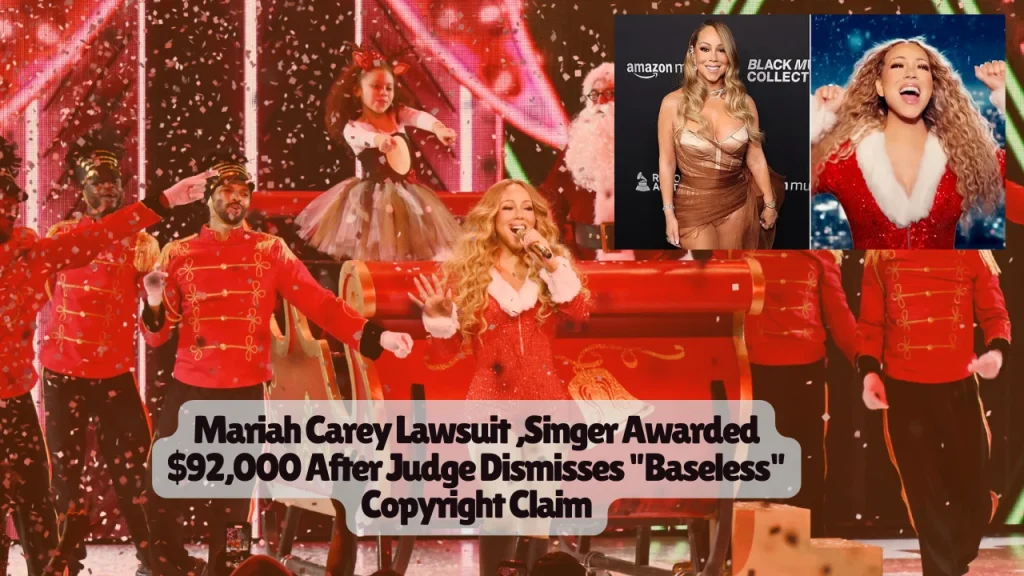
Mariah Carey Lawsuit, Singer Awarded $92,000 After Judge Dismisses “Baseless” Copyright Claim
Mariah Carey won a decisive legal victory on December 23, 2025, when Los Angeles Superior Court Judge Mónica Ramírez Almadani ordered songwriters Andy Stone and Troy Powers to pay $92,303.20 in sanctions for filing a “baseless” copyright lawsuit claiming her 1994 holiday anthem “All I Want for Christmas Is You” infringed their 1989 song of the same title. The judge dismissed the lawsuit in March 2025, finding Stone and Powers lacked sufficient evidence of infringement and engaged in “egregious” conduct that forced Carey to incur “needless expenses responding to frivolous legal arguments.” Total sanctions awarded to all defendants exceed $109,000.
What the Mariah Carey Lawsuit Was About
Songwriters Andy Stone (performing as Vince Vance) and Troy Powers sued Mariah Carey in November 2023, claiming her iconic 1994 Christmas song “All I Want for Christmas Is You” copied their 1989 country song with the identical title.
Plaintiffs: Andy Stone and Troy Powers of Vince Vance & the Valiants
Defendant: Mariah Carey, plus co-defendants Sony Music Entertainment, Kobalt Music Publishing, and producer Walter Afanasieff
Core allegation: Stone and Powers claimed they wrote and recorded their version in 1988, released it in 1989, and it received “extensive seasonal airplay” during Christmas 1993—one year before Carey’s version appeared on her 1994 album “Merry Christmas.”
Damages sought: At least $20 million
What plaintiffs claimed:
- Both songs share the same title
- Carey’s version was “derivative” of their earlier work
- She unjustly profited from their song since 1994
- The timing (their airplay in 1993, her release in 1994) proved copying
The lawsuit was actually the second attempt by Stone and Powers to sue Carey—they filed an identical $20 million lawsuit in June 2022 but withdrew it five months later in November 2022.
Timeline: From Filing to Sanctions
1988-1989: Stone and Powers write and record “All I Want for Christmas Is You” for Vince Vance & the Valiants.
1994: Mariah Carey releases her version of “All I Want for Christmas Is You” on the album “Merry Christmas,” co-written with Walter Afanasieff.
June 2022: Stone and Powers file first $20 million copyright lawsuit against Carey.
November 2022: Plaintiffs voluntarily withdraw the 2022 lawsuit.
November 2023: Stone and Powers refile essentially the same lawsuit with identical allegations.
March 20, 2025: Judge Mónica Ramírez Almadani dismisses the lawsuit, ruling Stone and Powers failed to meet the burden of proof showing Carey copied their song.
December 23, 2025: Judge Almadani issues sanctions order, awarding Carey $92,303.20 and ordering plaintiffs’ attorneys to pay additional amounts to Sony Music ($14,000+), Kobalt Publishing, and Afanasieff—totaling approximately $109,983 in sanctions.
December 2025: “All I Want for Christmas Is You” spends its 21st week at #1 on Billboard Hot 100, extending its own record. The song reaches 78 cumulative weeks on the Hot 100, becoming the longest-charting song ever by a female artist.
Related article: State Farm Class Action Lawsuits & $78.75M Delta Jet Fuel Dumping Settlement, Status & How to File Claims
Legal Claims: Copyright Infringement Under Federal Law
The lawsuit invoked the Copyright Act of 1976 (17 U.S.C. § 101 et seq.), which protects original musical compositions.
Elements plaintiffs must prove for copyright infringement:
- Ownership of valid copyright: Plaintiffs must show they own copyright to the allegedly infringed work
- Access: Defendant had opportunity to hear or view the copyrighted work
- Substantial similarity: The two works share substantial similarities in protected expression (not just ideas or common elements)
Stone and Powers’ theory:
They argued their 1989 recording received radio airplay in 1993, giving Carey “access” to their song before she recorded her version in 1994. They claimed the identical title and holiday theme proved copying.
Why the lawsuit failed:
Judge Almadani found Stone and Powers failed to demonstrate substantial similarity between the two songs’ actual musical compositions. Copyright protects specific musical expression—melodies, harmonies, rhythms—not generic titles or common themes like Christmas and love.
Song titles alone cannot be copyrighted under U.S. law. Two songs can share identical titles without infringing if their musical compositions differ.
Why the Judge Imposed Sanctions
Federal Rule of Civil Procedure 11 allows judges to impose sanctions when attorneys file frivolous lawsuits or make unsupported legal arguments.
Judge Almadani’s findings:
The court found Stone and Powers’ attorneys engaged in “egregious” conduct forcing defendants to incur “needless expenses responding to frivolous legal arguments and unsupported factual contentions.”
“Although each incident of sanctionable conduct, in isolation, may not warrant more than a stern reprimand, it is the aggregate of misconduct reflected in the record that compels the Court to award sanctions,” the dismissal document states.
Specific problems the judge identified:
Lack of evidence: Plaintiffs provided insufficient proof of substantial musical similarity between the compositions.
Frivolous arguments: Legal theories advanced had no merit under copyright law.
Attorney abandonment: Stone’s attorneys, Gerard Fox and Douglas M. Schmidt, made no mention of co-plaintiff Troy Powers in later filings and admitted they “no longer had contact” with him—violating their professional duty to represent all plaintiffs.
“Until leave to withdraw is granted, Fox and Schmidt remain under a professional duty to represent Powers’ interests to the best of their ability,” Judge Almadani wrote. “It does not appear that Plaintiffs’ counsel have upheld their ethical obligation to Powers.”
Repeat litigation: This was the second identical lawsuit Stone filed after voluntarily withdrawing the first one, suggesting bad faith.
Breakdown of Sanctions Awarded
Total sanctions: $109,983
Mariah Carey: $92,303.20 – Covering attorney fees and costs defending against the baseless claim
Sony Music Entertainment: $14,000+ – Compensation for legal expenses as co-defendant
Kobalt Music Publishing: Portion of remaining sanctions for defense costs
Walter Afanasieff (producer/co-writer): Portion of remaining sanctions
Sanctions are paid by Stone and Powers and their attorneys Gerard Fox and Douglas M. Schmidt—not by Carey or the other defendants. This financial penalty serves to deter future frivolous lawsuits.
What Makes This Case Legally Significant
The Mariah Carey sanctions order reinforces several important copyright and litigation principles:
1. Song titles cannot be copyrighted
The case demonstrates that identical titles alone never constitute copyright infringement. Copyright protects original expression in musical compositions—melodies, harmonies, lyrics, arrangements—not generic words or phrases.
Hundreds of songs share common titles like “Hold On,” “Stay,” or “I Love You” without infringing each other’s copyrights.
2. Access plus similarity both required
Even if Carey had heard Stone’s 1989 song (access), copyright requires substantial similarity in protected musical expression. Vague claims about “seasonal airplay” and identical titles don’t meet this burden.
3. Frivolous copyright claims have consequences
The substantial sanctions ($109,983) send a clear message: attorneys who file meritless copyright lawsuits without factual foundation face financial penalties. This protects artists from extortive litigation where plaintiffs hope defendants will settle nuisance claims rather than incur defense costs.
4. Repeat litigation after voluntary dismissal raises red flags
Stone’s pattern—filing a $20 million lawsuit, withdrawing it, then refiling the same claim—suggests litigation strategy rather than legitimate copyright protection. Courts view such tactics skeptically.
5. Professional responsibility to all clients
The judge’s criticism of Fox and Schmidt for abandoning co-plaintiff Powers highlights attorneys’ ethical obligations. Lawyers cannot simply stop representing co-plaintiffs without court permission.

Similar Cases: Copyright Claims Against Hit Songs
High-profile copyright lawsuits targeting successful songs often end badly for plaintiffs:
“Blurred Lines” – Robin Thicke/Pharrell Williams (2015): Marvin Gaye’s estate won $5.3 million verdict claiming “Blurred Lines” copied “Got to Give It Up.” Controversial outcome because similarity involved “feel” rather than specific musical elements—many copyright experts criticized the ruling.
“Dark Horse” – Katy Perry (2019-2020): Jury initially found Perry’s song infringed obscure Christian rap song “Joyful Noise.” Verdict overturned on appeal when judge ruled the allegedly similar musical elements were too basic and commonplace to receive copyright protection.
“Stairway to Heaven” – Led Zeppelin (2016-2020): After decades of speculation, jury found Led Zeppelin did not copy Spirit’s “Taurus.” Court ruled the similar descending chromatic pattern was common musical element not protected by copyright.
“Thinking Out Loud” – Ed Sheeran (2023): Sheeran won jury verdict over claims his song copied Marvin Gaye’s “Let’s Get It On.” Sheeran testified that chord progressions and harmonic structures at issue are basic musical building blocks used in countless songs.
Pattern: Courts increasingly scrutinize copyright claims targeting blockbuster hits, recognizing that common musical elements, generic themes, and basic song structures cannot be monopolized. Plaintiffs must prove copying of specific, original expression—not just similarities in mood, genre, or unprotectable musical ideas.
Why “All I Want for Christmas Is You” Keeps Winning in Court
Carey’s song has now successfully defended against two copyright challenges. Several factors explain why:
1. Original composition with documented creation
Carey co-wrote the song with Walter Afanasieff in 1994. The songwriting process is well-documented, with both writers explaining their creative choices in interviews over decades.
2. Musical dissimilarity
Despite sharing a title, the two songs have completely different melodies, chord progressions, tempos, and musical structures. Anyone listening to both immediately recognizes they’re distinct compositions.
3. Title is unprotectable generic phrase
“All I Want for Christmas Is You” expresses a common holiday sentiment in everyday language. Copyright cannot monopolize such generic phrases—otherwise, the first person to write a song called “I Love You” could sue everyone else who used those words.
4. Strong legal representation
Carey’s defense team methodically documented why Stone and Powers’ claims lacked merit, convincing the judge to not only dismiss but impose sanctions.
5. Commercial success doesn’t equal copying
Stone and Powers seemed to assume Carey’s massive commercial success proved she must have copied their obscure song. Courts reject this logic—successful songs can be wholly original, and obscure songs don’t automatically have copyright priority.
What This Means for Songwriters and Artists
For musicians facing copyright claims:
The sanctions award demonstrates that frivolous lawsuits have real consequences. Artists facing baseless claims should:
- Document the creation process (demos, notes, witnesses)
- Hire experienced copyright attorneys
- Consider requesting sanctions for frivolous claims
- Don’t settle meritless claims out of fear
For potential copyright plaintiffs:
The case warns that weak copyright claims can backfire spectacularly. Before filing:
- Obtain expert musicological analysis showing substantial similarity
- Ensure you have concrete evidence of access
- Remember that ideas, titles, and common musical elements aren’t protected
- Consider that defense costs for frivolous suits may be recovered through sanctions
For copyright attorneys:
Fox and Schmidt’s sanctioning highlights professional risks of pursuing weak claims. Attorneys must:
- Conduct thorough investigation before filing
- Ensure factual and legal bases for claims
- Maintain representation of all co-plaintiffs
- Avoid refiling dismissed claims without new evidence
Current Status December 2025
Procedural posture: Case dismissed March 20, 2025. Sanctions ordered December 23, 2025.
Next steps: Stone, Powers, and their attorneys have 30 days from the sanctions order to pay $109,983 to Carey and co-defendants. They could appeal the sanctions order, though appeals of sanctions decisions rarely succeed.
Likelihood of appeal: Low. Appealing sanctions typically requires showing the judge abused discretion—difficult when the underlying lawsuit was dismissed and the court documented multiple instances of misconduct.
Finality: Unless Stone and Powers appeal (extremely unlikely), this case is permanently closed. They cannot refile the same copyright claim after two dismissals.
Impact on Carey: The victory arrives during the song’s annual December chart dominance. “All I Want for Christmas Is You” currently sits at #1 on Billboard Hot 100 for its 21st week—a record for any holiday song—while also becoming the longest-charting song ever by a female artist with 78 cumulative weeks on the chart.
What Legal Experts Say
Entertainment attorneys see the sanctions as appropriate:
“This case exemplifies copyright trolling—filing weak lawsuits hoping defendants will settle nuisance claims,” explains entertainment lawyer analysis. “The sanctions send a strong deterrent message that courts won’t tolerate frivolous copyright litigation against successful artists.”
Copyright scholars emphasize title protection limits:
“Song titles are never copyrightable,” notes copyright law professors. “The plaintiffs’ entire theory rested on identical titles and vague similarity claims—legally insufficient from the start. Their attorneys should have recognized this before filing.”
The attorney abandonment issue raises ethical concerns:
“Losing contact with your co-plaintiff and failing to mention him in court filings is serious professional misconduct,” explains legal ethics experts. “The court’s criticism of Fox and Schmidt should concern any attorney—it suggests potential state bar discipline beyond just monetary sanctions.”
FAQ: Mariah Carey Lawsuit December 2025
What was the Mariah Carey lawsuit about?
Songwriters Andy Stone and Troy Powers sued Mariah Carey in November 2023, claiming her 1994 song “All I Want for Christmas Is You” copied their 1989 song with the same title. They sought at least $20 million in damages.
Who won the Mariah Carey lawsuit?
Mariah Carey won decisively. The judge dismissed the lawsuit in March 2025 and ordered Stone and Powers to pay Carey $92,303.20 in sanctions on December 23, 2025, for filing a baseless claim.
What are sanctions in a lawsuit?
Sanctions are financial penalties judges impose on parties or attorneys who file frivolous lawsuits, make unsupported legal arguments, or engage in litigation misconduct. The penalties compensate victims for unnecessary legal costs and deter future abusive litigation.
Why did the judge order sanctions against the plaintiffs?
Judge Mónica Ramírez Almadani found Stone and Powers’ lawsuit lacked merit, contained “frivolous legal arguments and unsupported factual contentions,” and forced Carey to incur “needless expenses” defending against a baseless claim. The judge called the aggregate misconduct “egregious.”
How much did Mariah Carey receive in sanctions?
Carey personally received $92,303.20. Co-defendants Sony Music Entertainment, Kobalt Music Publishing, and producer Walter Afanasieff received additional amounts, bringing total sanctions to approximately $109,983.
Can you copyright a song title?
No. Song titles cannot be copyrighted under U.S. law. Copyright protects original musical expression—melodies, harmonies, rhythms, lyrics—not generic words, phrases, or titles. Thousands of songs share common titles without infringing each other.
What evidence did Stone and Powers present?
Very little. They claimed their 1989 song received radio airplay in 1993 (one year before Carey’s release) and both songs shared the same title. The judge found this insufficient to prove copyright infringement because the songs’ actual musical compositions are completely different.
Is this the first time Andy Stone sued Mariah Carey?
No. Stone and Powers filed an identical $20 million lawsuit in June 2022 but voluntarily withdrew it in November 2022. They refiled essentially the same claim in November 2023—a pattern the court viewed skeptically.
What happened to co-plaintiff Troy Powers?
Stone’s attorneys admitted they “no longer had contact” with Powers and stopped mentioning him in court filings. Judge Almadani criticized this, stating the attorneys violated their professional duty to represent all plaintiffs and had not “upheld their ethical obligation to Powers.”
Can Stone and Powers appeal?
Technically yes, but appeals of sanctions decisions rarely succeed and would require showing the judge abused discretion. Given the thorough findings of misconduct and the underlying lawsuit’s dismissal, an appeal is extremely unlikely.
Could Stone and Powers sue Mariah Carey again?
No. After two dismissals of the same claim, they cannot refile. The case is permanently closed.
What does this mean for other artists facing copyright claims?
The substantial sanctions demonstrate that frivolous copyright lawsuits can backfire. Artists facing weak claims should document their creation process, hire experienced attorneys, and consider requesting sanctions rather than settling meritless cases.
Why is “All I Want for Christmas Is You” so successful?
The song currently holds the record for most weeks at #1 for any holiday song (21 weeks) and is the longest-charting song ever by a female artist (78 cumulative weeks on Billboard Hot 100). It generates massive streaming revenue every December and has become synonymous with the Christmas season globally.
How common are copyright lawsuits against hit songs?
Increasingly common. Successful songs attract copyright claims from writers of obscure earlier works hoping for settlements. However, high-profile cases like Ed Sheeran’s “Thinking Out Loud” and Katy Perry’s “Dark Horse” show courts scrutinizing such claims and protecting basic musical elements from monopolization.
Resources:
- U.S. Copyright Office: www.copyright.gov
- Copyright Act of 1976: 17 U.S.C. § 101 et seq.
- Federal Rule of Civil Procedure 11 (Sanctions)
- Los Angeles Superior Court case documents
- Billboard Hot 100 charts: www.billboard.com
For additional articles on entertainment law, copyright litigation, and music industry legal issues, visit AllAboutLawyer.com’s legal resources.
About the Author

Sarah Klein, JD, is a licensed attorney and legal content strategist with over 12 years of experience across civil, criminal, family, and regulatory law. At All About Lawyer, she covers a wide range of legal topics — from high-profile lawsuits and courtroom stories to state traffic laws and everyday legal questions — all with a focus on accuracy, clarity, and public understanding.
Her writing blends real legal insight with plain-English explanations, helping readers stay informed and legally aware.
Read more about Sarah