
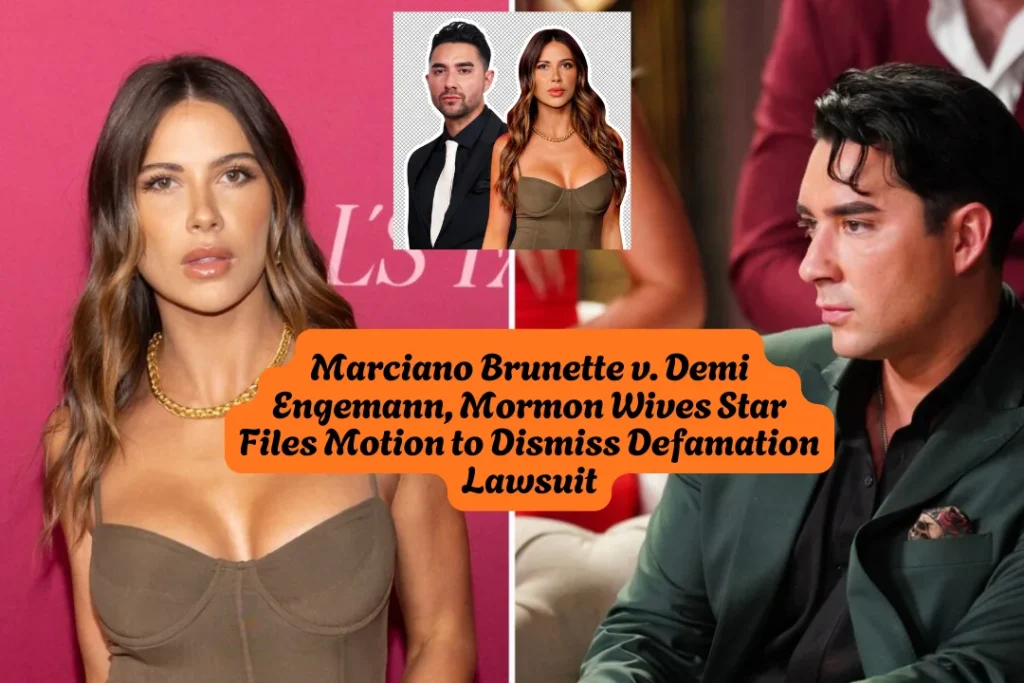
Marciano Brunette v. Demi Engemann Lawsuit, Mormon Wives Star Files Motion to Dismiss Defamation Lawsuit
Secret Lives of Mormon Wives star Demi Engemann filed a motion in February 2026 asking a federal judge to dismiss a defamation lawsuit brought against her by Vanderpump Villa star Marciano Brunette. Engemann is asking a judge to toss Marciano’s lawsuit, which she claims was brought “solely to gain media attention” and to “punish her for exercising her First Amendment right to speak out.” The case, filed in December 2025, remains active and unresolved. No damages have been awarded.
Quick Case Snapshot
| Field | Detail |
| Plaintiff | Marciano Brunette |
| Defendant | Demi Engemann; Jeff Jenkins Productions LLC |
| Court | U.S. District Court, District of Utah |
| Case Number | 2:25-cv-01102-DAO |
| Filing Date | December 5, 2025 |
| Judge | Magistrate Judge Daphne A. Oberg |
| Claims Alleged | Defamation; republication of allegedly false sexual misconduct claims |
| Damages Sought | Not disclosed |
| Current Status | Motion to dismiss (anti-SLAPP) pending — court ruling awaited |
What the Lawsuit Alleges
Brunette’s legal team filed the defamation suit on December 5, 2025, naming both Demi Engemann and Jeff Jenkins Productions LLC as defendants, alleging that certain accusations damage reputations on contact.
During a 2024 crossover between Vanderpump Villa and Secret Lives of Mormon Wives, Demi claimed Marciano touched her without consent, then went on to call him a “sexual predator.” The complaint alleges Engemann’s characterization was false and calculated to serve her own interests.
Brunette’s theory is motive plus convenience: the more public scrutiny Engemann faced about flirting, kissing, and storyline fallout, the more she allegedly reframed a consensual moment into “sexual misconduct” and then “sexual assault.” Marciano also sued the production company, arguing it amplified and profited from the accusation by building a major Season 3 storyline around the allegations, repeatedly airing and republishing them.
The lawsuit alleges Brunette suffered concrete harm: he claims he lost a role on an unnamed reality dating show, put his DJ career on hold after losing a high-profile Las Vegas nightclub gig, and experienced harassment by strangers resulting from widespread circulation of Engemann’s statements on television and social media.
Demi Engemann’s Response
In February 2026, Engemann filed a motion to dismiss under Utah’s Uniform Public Expression Protection Act — an anti-SLAPP law designed to protect people from lawsuits intended to silence speech on matters of public interest.
Engemann’s legal team called the lawsuit a “sham,” arguing Brunette is not trying to get justice for defamation but rather trying to get even. Her lawyers also noted that the day after filing the lawsuit, Marciano posted an Instagram Reel featuring a trending sound about “getting even,” which they argued undermined his stated legal purpose.
Engemann went further in her motion, alleging that Brunette was “proud” of his bedroom reputation and bragged about how his employers had to enact a “special policy prohibiting him from sleeping with other employees,” and that he told her he had “slept with an ‘extraordinary’ number of employees.” Her legal team also pointed to a performer agreement Brunette signed related to the show, which warned that participating could lead to personal or embarrassing information becoming public.
Engemann is asking the court to dismiss the lawsuit and to order Brunette to pay her attorneys’ fees and costs.
What Laws Are Involved?
Utah’s Uniform Public Expression Protection Act (anti-SLAPP law) — Utah’s anti-SLAPP statute allows defendants to seek early dismissal of lawsuits they believe were filed to silence protected speech on matters of public concern. If a court grants an anti-SLAPP motion, the case is dismissed before discovery begins and the party who filed the lawsuit may be required to pay the opposing side’s legal fees.
Federal Defamation Law — To prevail on a defamation claim, a plaintiff must prove that the defendant made a false statement of fact, published it to third parties, acted with the required level of fault, and caused measurable harm. Because both Brunette and Engemann are public figures as reality television personalities, Brunette must meet the higher “actual malice” standard — meaning he must show Engemann knew her statements were false or acted with reckless disregard for the truth. This is a significantly harder bar to clear than the standard applied to private individuals.
Republication Liability — Brunette’s claims against Jeff Jenkins Productions rest on the legal principle that those who repeat or broadcast false statements can be held liable in the same way as the original speaker, particularly when they do so for editorial and commercial purposes.
Legal Context
The case highlights a growing legal trend: alleged assailants increasingly use defamation suits to contest sexual misconduct accusations, particularly when criminal statutes of limitations have passed or no criminal charges were filed.
Anti-SLAPP motions succeed in a substantial majority of cases where they are granted an early hearing. However, anti-SLAPP protections do not shield statements that are provably false — the court must determine whether Brunette’s complaint presents sufficient evidence to suggest Engemann’s statements were knowingly or recklessly false, rather than her genuine account of events.
This case is one of several high-profile entertainment industry defamation disputes currently before U.S. courts involving competing accounts of interpersonal incidents on reality television. For another active defamation case involving a reality television personality, see AllAboutLawyer.com’s coverage of the Mizkif defamation lawsuit against Asmongold, which similarly involves competing accounts of sexual misconduct allegations circulated through entertainment platforms.
Current Status & What Happens Next
- The court must now rule on whether Engemann’s anti-SLAPP motion succeeds. If the judge grants it, Brunette’s defamation claims could be dismissed early in the case.
- If the motion is denied, the case would proceed to a discovery phase in which both sides could be compelled to produce evidence, communications, and testimony.
- Jeff Jenkins Productions has not filed a separate public response; its procedural status mirrors Engemann’s at this stage.
- Anti-SLAPP rulings in federal court applying state anti-SLAPP statutes involve a procedural question currently unsettled across circuits — some federal courts have questioned whether state anti-SLAPP laws apply in federal diversity cases, which could affect how the Utah law operates here.
- Civil defamation cases typically take 18 to 36 months from filing to resolution. Complex cases involving discovery disputes, multiple defendants, and cross-country witnesses often exceed two years.
This page will be updated as the case develops.
Important Case Dates
| Milestone | Date |
| Lawsuit Filed | December 5, 2025 |
| Engemann Anti-SLAPP Motion Filed | February 2026 |
| Defendant Answer Due | TBD — pending anti-SLAPP ruling |
| Discovery Period | TBD — contingent on motion outcome |
| Class Certification Hearing | N/A — individual lawsuit |
| Trial Date | TBD |
| Settlement | TBD |
Frequently Asked Questions
Is the Marciano Brunette lawsuit against Demi Engemann real?
Yes. The complaint was filed on December 5, 2025, in U.S. District Court for the District of Utah and is assigned case number 2:25-cv-01102-DAO before Magistrate Judge Daphne A. Oberg. It is a matter of public record verifiable through the PACER federal court docket.
What is an anti-SLAPP motion and why did Demi file one?
An anti-SLAPP motion asks a court to dismiss a lawsuit that targets protected speech on matters of public concern. Engemann filed hers under Utah’s Uniform Public Expression Protection Act, arguing that Brunette’s lawsuit was designed to punish her for speaking out, not to vindicate a legitimate defamation injury. If successful, the case ends before discovery begins.
What does Marciano say happened?
Brunette claimed the interaction was “obviously consensual” and that Engemann later reframed it as “sexual misconduct and then as sexual assault” to give herself a storyline on the show.
What does Demi say happened?
Engemann told Us Weekly in May 2025 that she “came out with a pretty bold and true statement” because Brunette was “lying” about her and that she stood by calling him a predator, adding there was “more happening behind the scenes that will come to light.”
Could Demi be required to pay Brunette’s legal fees if she loses the anti-SLAPP motion?
No — if the anti-SLAPP motion fails, the case simply proceeds to discovery. It is Brunette who would owe Engemann’s fees if the anti-SLAPP motion succeeds and the judge finds the lawsuit was filed to silence protected speech.
What happens to the case against Jeff Jenkins Productions?
Jeff Jenkins Productions is a co-defendant and faces the same defamation claims. Brunette sued the production company on the grounds that it amplified and profited from Engemann’s accusations by building them into a Season 3 storyline. The production company’s procedural timeline will likely track with Engemann’s unless it files separate motions.
Sources & References
Related Reading on AllAboutLawyer.com: For background on the original December 2025 filing, see our earlier report: Marciano Brunette Lawsuit 2025: Reality TV Star Sues Demi Engemann for Sexual Assault Defamation Claims.
Last Updated: March 14, 2026
This article is for informational purposes only and does not constitute legal advice. Allegations in a complaint are not findings of fact. All parties are presumed innocent unless and until proven otherwise in court.
About the Author

Sarah Klein, JD, is a licensed attorney and legal content strategist with over 12 years of experience across civil, criminal, family, and regulatory law. At All About Lawyer, she covers a wide range of legal topics — from high-profile lawsuits and courtroom stories to state traffic laws and everyday legal questions — all with a focus on accuracy, clarity, and public understanding.
Her writing blends real legal insight with plain-English explanations, helping readers stay informed and legally aware.
Read more about Sarah