
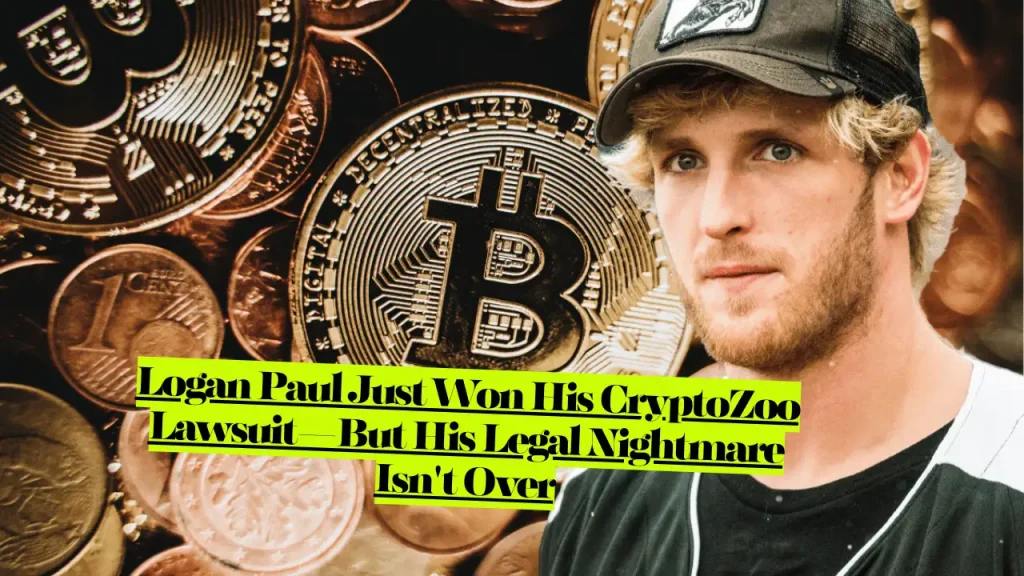
Logan Paul Just Won His CryptoZoo Lawsuit—But His Legal Nightmare Isn’t Over
A Texas federal judge dismissed the CryptoZoo class action lawsuit against Logan Paul on October 29, 2025, ruling his promotional statements were “puffery” rather than fraud. The court found Paul’s claims the project would be “a really fun game that makes you money” constituted exaggerated marketing hype. But Paul still faces a defamation trial against YouTuber Coffeezilla, with jury selection scheduled for October 14, 2025 in San Antonio federal court.
The dismissed class action involved 140 investors who lost between $100 and $350,000 each after buying into CryptoZoo. Judge Alan D. Albright ruled the plaintiffs failed to prove Paul personally profited from the failed NFT project.
What Is the Logan Paul CryptoZoo Lawsuit?
Don Holland, a Texas police officer, filed the class action lawsuit in February 2023 against CryptoZoo Inc., Logan Paul, and several associates, alleging they executed a “rug pull” cryptocurrency scheme. The lawsuit claimed Paul and his team promoted the blockchain game to consumers unfamiliar with digital currency, then abandoned the project while keeping investor funds.
CryptoZoo launched in 2021 as an NFT game where players could buy “eggs” that would hatch into digital animals for breeding and earning cryptocurrency. The game never fully materialized. In early 2024, Paul offered to buy back $2.3 million worth of CryptoZoo NFTs at 0.1 ETH each—but only if claimants agreed not to sue him.
The Legal Claims
The lawsuit alleged:
- Fraud and fraudulent misrepresentation
- Breach of contract
- Unjust enrichment
- Violation of Texas Deceptive Trade Practices Act
- Negligence
Magistrate Judge Ronald C. Griffin found plaintiffs failed to provide evidence of Paul’s personal enrichment from the venture.
Related Lawsuit: Costco Lawsuit Against Trump, Costco Sues Trump Administration Over Emergency Tariff Orders—Company Faces December Refund Deadline

Court Ruling: Why Paul Won
Judge Albright dismissed the case with prejudice, meaning it cannot be refiled. The ruling hinged on the legal concept of “puffery.”
The judge wrote that “puffery” means “an exaggerated, blustering, and boasting statement upon which no reasonable buyer would be justified in relying”. He noted that if Paul had promised a specific launch date and failed to deliver, that might have been grounds for fraud—but his vague promotional claims didn’t meet that standard.
The court found that Paul’s project collaborators Eduardo Ibanez and Jake Greenbaum “sold large amounts of [CryptoZoo] for an immediate and large profit,” while Paul did not.
Logan Paul vs. Coffeezilla: The Defamation Battle
Paul’s legal troubles aren’t over. In June 2024, Paul filed a defamation lawsuit against Stephen Findeisen (known as Coffeezilla) in San Antonio federal court, seeking $75,000 in compensatory damages.
What Did Coffeezilla Say?
Coffeezilla labeled four videos with “scam” in the title—one reached over 10 million views—and called Paul a “serial scammer”. Paul’s complaint alleges Findeisen “perpetuated the false narrative that Paul scammed and defrauded his own fans” to enhance his own profile and increase viewership.
Notably, Paul isn’t suing over Coffeezilla’s original CryptoZoo investigation videos from 2022, but over later videos and posts advocating for user refunds.
Court Says the Case Continues
On March 26, 2025, Magistrate Judge Henry J. Bemporad denied Coffeezilla’s motion to dismiss, ruling that his use of the word “scam” met the defamatory definition and could be understood as an assertion of fact rather than opinion.
The judge found that disclaimers in Coffeezilla’s video descriptions were only visible when viewers expanded the description section and did little to offset the factual presentation of his accusations.
A federal judge ordered both parties to participate in mediation by November 10, 2025, ahead of the scheduled May 4, 2026 trial date. However, court records show a pretrial conference set for October 8, 2025, with jury selection and trial scheduled for October 14, 2025.
Other Logan Paul Legal Battles
Prime Energy Drink Lawsuits
Paul’s beverage company Prime Hydration has faced multiple legal challenges:
U.S. Olympic Committee Trademark Case In July 2024, the U.S. Olympic and Paralympic Committee sued Prime in Colorado federal court for trademark infringement, alleging the company used Olympic-related phrases including “OLYMPIC,” “OLYMPIAN,” “TEAM USA” and “GOING FOR GOLD” in marketing featuring NBA star Kevin Durant. The USOPC called Prime’s conduct “willful, deliberate, and in bad faith”.
PFAS “Forever Chemicals” Class Action A class action lawsuit filed in April 2024 in the Northern District of California accused Prime of fraudulently marketing its drinks as healthy despite containing extremely high levels of per- and poly-fluoroalkyl substances (PFAS) in its grape-flavored drink. Paul denied the allegations on TikTok, stating the company uses top bottle manufacturers and follows federal regulations.
Caffeine Content Lawsuit An April 2024 lawsuit filed in New York alleged Prime energy drinks contain between 215-225 milligrams of caffeine instead of the advertised 200 milligrams. A federal judge in Kentucky dismissed this case in August 2024, finding the claims lacked sufficient specificity under heightened fraud pleading standards.
Bottler Dispute Refresco filed a lawsuit in August 2024 in Delaware seeking $67.7 million, alleging Congo Brands (Prime’s parent company) backed out of an agreement to produce 55.5 million cases over three years. Refresco invested significantly in a dedicated production line with custom equipment for Prime bottles.
Heritage Auctions Case—Dropped
Paul sued Dallas-based Heritage Auctions in September 2024 after paying $562,555 for an 8-by-8-foot piece of court Michael Jordan played on, then raising authenticity concerns. Paul dropped the lawsuit in November 2024. Heritage maintained the item was authenticated by multiple third-party services.
Private Jet Door Incident—Dismissed
Private jet charter service Rennia Global sued Paul over damages exceeding $400,000 after he opened a plane door during a flight. In April 2025, the company dropped the lawsuit after Paul shared footage showing the flight attendant worked with him to open the door because the plane was pressurizing early.
Can Paul Shift Blame to CryptoZoo Co-Founders?
In January 2024, Paul filed a counterclaim against CryptoZoo co-founders Eduardo Ibanez and Jake Greenbaum, accusing them of fraud and causing the project’s collapse. In July 2025, Magistrate Judge Ronald Griffin advised Paul cannot avoid the investor lawsuit by shifting blame to co-founders who haven’t responded to the case.
Griffin wrote that allowing Paul’s bid “would undeniably result in inconsistent judgments” given the shared defenses and interconnected claims among defendants.
Applicable Federal and State Law
Defamation Standards in Texas
Texas defamation law requires plaintiffs to prove:
- The defendant published a false statement of fact
- The statement was defamatory concerning the plaintiff
- The defendant acted with actual malice (for public figures) or negligence
- The statement caused damages
Judge Bemporad noted that Findeisen’s role as a crypto investigator would lead an “objectively reasonable reader” to understand his statements as assertions of fact rather than opinion. This distinction is critical—opinions are protected speech, but false statements of fact can constitute defamation.
Securities and Consumer Protection
Plaintiffs in the CryptoZoo case adequately pleaded the tokens were securities under federal law, but failed to meet pleading requirements for their securities fraud claims. The Texas Deceptive Trade Practices Act provides additional consumer protections against false or misleading business practices.
The “Puffery” Defense
Courts distinguish between actionable false advertising and non-actionable “puffery”—exaggerated claims no reasonable person would take literally. This defense proved successful in Paul’s case because his promotional language lacked specific, measurable promises.
What This Means for Content Creators and Influencers
The CryptoZoo dismissal creates troubling precedent. Critics argue courts struggle to keep pace with cryptocurrency cases, with some legal observers suggesting judges may not fully understand how blockchain systems and NFTs function.
For influencers, the ruling suggests vague promotional language may shield them from fraud liability. However, making specific promises with dates or measurable outcomes could expose creators to legal risk.
The Coffeezilla defamation case tests First Amendment protections for investigative journalism on YouTube. If Paul prevails, it could chill critical commentary about influencer business ventures. If Coffeezilla wins, it reinforces journalists’ rights to report on potentially fraudulent schemes.
Coffeezilla’s documented communications with the FBI and SEC regarding CryptoZoo suggest he had genuine reasons to believe his reporting was accurate, which could undermine Paul’s claims.
Current Status: What Happens Next
CryptoZoo Class Action: Dismissed with prejudice. Case closed.
Paul v. Findeisen (Coffeezilla): Heading to trial. Jury selection scheduled for October 14, 2025, before Judge Orlando L. Garcia in the Western District of Texas. Court ordered mediation by November 10, 2025.
Prime Lawsuits: Multiple cases ongoing in different jurisdictions with varying claims about product safety, trademark infringement, and contract disputes.
Paul’s legal team has aggressively defended him across all cases. His attorneys stated they’re “pleased with the report and would continue litigating until his name’s cleared”.
Frequently Asked Questions About Logan Paul Lawsuits
Did Logan Paul get sued for CryptoZoo?
Yes. A class action lawsuit filed in February 2023 accused Paul of executing a cryptocurrency “rug pull” scheme. The case was dismissed on October 29, 2025.
Did Logan Paul win the CryptoZoo lawsuit?
Yes. Judge Alan D. Albright dismissed the class action with prejudice, ruling Paul’s promotional statements were legal “puffery” rather than fraud.
Is Logan Paul still being sued by Coffeezilla?
Yes. The defamation case is scheduled for trial on October 14, 2025. A judge ordered both parties to attempt mediation by November 10, 2025.
How much money did people lose in CryptoZoo?
The 140 plaintiffs claimed losses between $100 and $350,000 each. Paul offered a $2.3 million buyback program in early 2024.
What court is handling the Logan Paul defamation case?
The U.S. District Court for the Western District of Texas in San Antonio, with Judge Orlando L. Garcia presiding.
Did Logan Paul profit from CryptoZoo?
Paul claims he “never sold the token” and “never made a dollar from this project”. The court found plaintiffs failed to provide evidence of Paul’s personal enrichment.
What is the status of Prime energy drink lawsuits?
Multiple cases remain active. One caffeine labeling case was dismissed in August 2024. The Olympic trademark case, PFAS chemicals case, and bottler dispute continue in various federal courts.
The Bigger Picture: Celebrity Accountability in Digital Business
Logan Paul’s legal saga highlights growing tensions between traditional legal frameworks and digital-age business models. Cryptocurrency projects, NFTs, and influencer-backed products operate in regulatory gray areas where consumer protection laws struggle to keep pace.
The CryptoZoo dismissal raises questions about when promotional hype crosses into fraud. The Coffeezilla case tests whether investigative journalists face defamation liability for criticizing public figures’ business ventures.
For US audiences following entertainment law, these cases demonstrate how public figures navigate complex legal terrain while maintaining their brands. The outcomes will shape how influencers launch products, how journalists cover them, and how courts hold celebrities accountable for failed business ventures.
Note: This article covers information current as of December 2025. Legal cases are ongoing and developments may occur. For the most current information, consult official court records and verified news sources.
About the Author

Sarah Klein, JD, is a licensed attorney and legal content strategist with over 12 years of experience across civil, criminal, family, and regulatory law. At All About Lawyer, she covers a wide range of legal topics — from high-profile lawsuits and courtroom stories to state traffic laws and everyday legal questions — all with a focus on accuracy, clarity, and public understanding.
Her writing blends real legal insight with plain-English explanations, helping readers stay informed and legally aware.
Read more about Sarah