
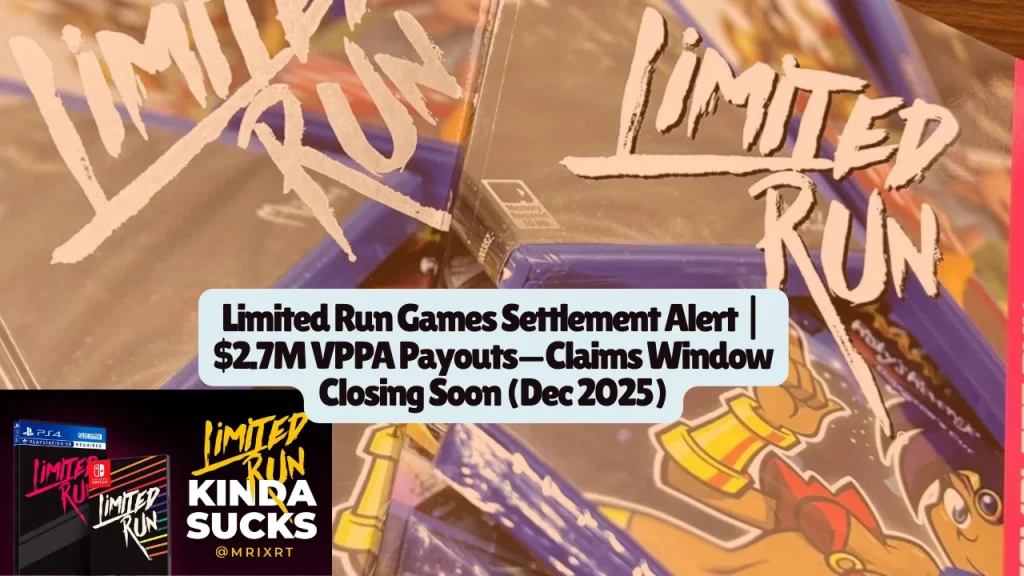
Limited Run Games Settlement Alert | $2.7M VPPA Payouts—Claims Window Closing Soon (Dec 2025)
As of December 19, 2025, consumers who watched videos or purchased video games from Limited Run Games between January 1, 2016, and June 20, 2025, can file claims for payment from a $2.72 million class action settlement. The final approval hearing is scheduled for March 11, 2026, at 2:00 PM, with claim forms due by January 20, 2026. The settlement resolves allegations that Limited Run Games violated the Video Privacy Protection Act by sharing customers’ video-watching data with Meta Platforms (Facebook) and Google without consent.
What Is the Current Status of the Limited Run Games Class Action Lawsuit?
The case, Carbone v. Limited Run Games, Inc., Case No. 2:24-cv-08861-NJC-JMW, was filed in the U.S. District Court for the Eastern District of New York. Limited Run Games agreed to the $2.72 million settlement in July 2025, with preliminary approval granted by the court.
The settlement is currently in the notice and claims period. Class members have until January 20, 2026, to submit claim forms or opt out of the settlement. If the court grants final approval in March 2026, payments will be distributed shortly thereafter.
Key Dates:
- July 2025: Preliminary settlement approval
- December 19, 2025: Settlement notice issued to class members
- January 20, 2026: Deadline to file claims, opt out, or object
- March 11, 2026: Final approval hearing
What Claims Were Made Against Limited Run Games?
The lawsuit alleges Limited Run Games disclosed subscribers’ personally identifiable information (PII) to Meta Platforms, Inc. and other third parties without consent, violating the Video Privacy Protection Act, 18 U.S.C. § 2710.
Plaintiffs John Carbone and Ryan Adkins claimed that Limited Run Games:
- Embedded the Meta Pixel tracking tool on its website
- Transmitted video titles and user identifiers (like Facebook IDs) to Meta
- Shared information about video game cutscenes watched by customers
- Failed to obtain written consent before disclosing video-watching behavior
- Allowed third parties to track which pre-recorded videos users viewed
Limited Run Games denies any wrongdoing or violation of law, and the Court has not decided who is right. The company agreed to settle to avoid ongoing litigation costs and uncertainties.
Related article: Three Stages of a Records Lifecycle: Creation, Use & Disposition — Legal Requirements & Best Practices

What Is the Video Privacy Protection Act (VPPA)?
The VPPA is a 1988 federal privacy law that protects consumers’ video-watching habits. The VPPA defines PII to include information which identifies a person as having requested or obtained specific video materials or services from a video tape service provider.
VPPA Prohibitions:
- Video service providers cannot knowingly disclose what videos consumers watch
- Written consent is required before sharing video-watching data with third parties
- Violations carry statutory damages of up to $2,500 per violation
- The law applies to streaming services and websites offering video content
While originally targeting physical video rental stores, courts have interpreted the VPPA to cover modern streaming platforms and websites that provide video content.
How Does the Meta Pixel Trigger VPPA Violations?
The Meta Pixel is a tracking tool used by companies for targeted advertising that can transmit certain information about a user’s interaction with a video on a website. When embedded in a website’s code, the pixel:
- Records when users watch videos
- Captures video titles and URLs
- Sends user identifiers (Facebook IDs, device cookies) to Meta
- Enables targeted advertising based on viewing behavior
- Operates invisibly without user knowledge
According to a March 2024 report, about 47 percent of websites use Meta Pixel, including 55 percent of those in the S&P 500. This widespread use has triggered hundreds of VPPA lawsuits across multiple industries.
Who Qualifies as a Settlement Class Member?
You are included if you are a person in the United States who, from January 1, 2016, to and through June 20, 2025, watched a pre-recorded video through Limited Run Games Service and/or purchased a video game containing cutscenes from Limited Run Games Service.
Eligibility Criteria:
- U.S. residents only
- Accessed Limited Run Games website or service
- Watched pre-recorded videos OR purchased games with cutscenes
- Activity occurred between January 1, 2016, and June 20, 2025
You qualify even if you only watched free trailers or brief video clips on the Limited Run Games website.
What Payment Can Class Members Receive?
The settlement fund is $2,720,000, from which class member payments, administrative costs, attorneys’ fees, and class representative awards will be deducted.
Each class member who files a valid claim will receive a proportionate (pro rata) share of the settlement fund after costs, expenses, administrative fees, and incentive awards have been paid out. The exact payment amount depends on how many valid claims are submitted.
Payment Structure:
- Pro rata distribution based on valid claims filed
- Individual payment amounts unknown until claim deadline passes
- Similar VPPA settlements have paid $5-$50 per claimant
- No proof of damages required to file a claim
Related article: Washington State Patrol Trooper Injured After Elderly Driver Rear-Ends Patrol SUV on I-90 Near Cle Elum

How to File a Claim for the Limited Run Games Settlement
Visit the official settlement website at www.limitedrungamessettlement.com or call (833) 621-6124 for assistance.
Steps to File:
- Visit www.limitedrungamessettlement.com
- Complete the online claim form
- Provide your contact information
- Confirm you accessed Limited Run Games and watched videos or purchased games with cutscenes
- Submit by January 20, 2026
Claim Form Deadline: All claims must be postmarked or submitted online by January 20, 2026.
What Are Your Options as a Class Member?
Class members have three options: file a claim to receive payment, exclude themselves from the settlement, or object to the settlement terms.
Option 1: File a Claim (Recommended)
- Submit claim form by January 20, 2026
- Receive pro rata payment from settlement fund
- Remain bound by settlement terms
- Cannot sue Limited Run Games separately for these claims
Option 2: Exclude Yourself (Opt Out)
- Send written exclusion request postmarked by January 20, 2026
- Preserve right to sue Limited Run Games independently
- Receive no settlement payment
- Bear all costs of separate litigation
Option 3: Object to Settlement
- File written objection by January 20, 2026
- Attend final approval hearing on March 11, 2026
- Remain part of settlement if court approves
- Must explain basis for objection
What Happens at the Final Approval Hearing?
The final approval hearing is scheduled for Wednesday, March 11, 2026, at 2:00 PM. Judge Nusrat Jahan Choudhury of the U.S. District Court for the Eastern District of New York will determine whether to grant final approval.
What the Court Will Consider:
- Fairness and adequacy of settlement terms
- Reasonableness of payment amounts
- Attorneys’ fees request (filed by December 15, 2025)
- Service awards for class representatives John Carbone and Ryan Adkins
- Any objections filed by class members
If the court grants final approval, payments will be processed and distributed to class members who submitted valid claims.
What Attorneys’ Fees Will Be Requested?
Class Counsel will file their request for attorneys’ fees with the Court and post it on the settlement website by December 15, 2025. Typical class action settlements award attorneys 25-33% of the settlement fund plus litigation expenses.
For the $2.72 million settlement, attorneys could request approximately $680,000 to $900,000 in fees, leaving $1.8-2 million for class member payments after administrative costs.
What Makes This Case Legally Significant?
VPPA Enforcement Wave: Limited Run Games is one of hundreds of companies facing VPPA lawsuits over Meta Pixel usage. The Second Circuit’s decision in Salazar v. NBA accelerated this litigation trend by confirming the VPPA applies to modern streaming services.
Circuit Split on PII Definition: The Second, Third, and Ninth Circuits adopted the “ordinary person” standard for determining personally identifiable information under the VPPA, requiring information be readily understandable by an ordinary person. However, the First Circuit uses a broader “reasonable foreseeability” standard.
Settlement Value: At $2.72 million, this ranks among the larger VPPA settlements. Forbes agreed to $7.5 million for similar claims, while Boston Globe Media Partners paid $5 million.
What Similar VPPA Cases Exist?
GoodRx, a telehealth organization, agreed to a $25 million class action settlement for disclosing health information through Meta Pixel and other tracking technologies.
Recent VPPA Settlements:
- Forbes Media: $7.5 million settlement (2025)
- Boston Globe Media Partners: $5 million settlement
- GoodRx: $25 million settlement plus $1.5 million FTC fine
- The Athletic: Active litigation over Facebook Pixel tracking
- Multiple streaming services facing similar claims
These settlements demonstrate that companies offering video content face substantial liability for using tracking pixels without proper consent mechanisms.
What Does Recent Case Law Say About Meta Pixel Claims?
The Second Circuit in Solomon v. Flipps Media held that strings of code transmitted by the Meta Pixel do not constitute personally identifiable information because an ordinary person cannot readily identify a specific individual’s video-watching behavior from the code itself.
However, this defense has limitations:
In Heerde v. Learfield Communications, the court held that a Facebook ID could constitute PII if the person’s profile is publicly accessible and includes sufficient identifying information such as name, gender, birthday, and career.
The Limited Run Games settlement suggests the company determined it faced sufficient risk despite these developing defenses.
What Defenses Did Limited Run Games Raise?
While settlement terms prevent full discovery, typical defenses in VPPA pixel cases include:
“Ordinary Person” Standard: Arguing transmitted code doesn’t constitute PII under the Second Circuit’s Solomon decision
No Video Tape Service Provider: Some courts found defendants aren’t engaged in the business of delivering audiovisual materials as defined by the statute
Written Consent: Claiming terms of service provided adequate consent
Arbitration Clauses: Many companies require website visitors to assent to arbitration provisions prior to subscribing or making a purchase
Limited Run Games chose to settle rather than litigate these defenses, likely due to litigation costs and evolving case law.
What Can Other Companies Learn From This Case?
Audit Tracking Technologies: Review all pixels, cookies, and tracking tools embedded on websites offering video content.
Implement Consent Mechanisms: The VPPA requires explicit, written consent forms notifying users that video-watching data will be shared with third parties.
Evaluate Risk vs. Benefit: Businesses should only use pixels on websites that include streaming video if they deem the value of the data is enough to justify the risk of being sued for VPPA violations.
Consider Alternative Analytics: Use first-party analytics that don’t share data with third parties to avoid VPPA exposure.
Frequently Asked Questions
Do I need proof of purchase to file a claim?
No. You only need to confirm you accessed Limited Run Games and watched videos or purchased games with cutscenes during the class period. No documentation is required.
What if I no longer have my Limited Run Games account?
You can still file a claim. The settlement covers anyone who accessed the service, regardless of current account status.
How much will I receive from the settlement?
Payment amounts depend on total valid claims filed. Each claimant receives an equal pro rata share of the net settlement fund.
Can I still sue Limited Run Games separately?
If you file a claim or don’t opt out by January 20, 2026, you release your right to sue separately for these VPPA claims. Opt out by the deadline to preserve litigation rights.
What is the Meta Pixel?
The Meta Pixel is tracking code that websites embed to collect data about user interactions, including video-watching behavior, for advertising purposes.
Why did Limited Run Games settle?
The parties agreed to settle to avoid the uncertainties and expenses associated with continuing the case. Litigation is costly, and VPPA statutory damages can accumulate quickly.
What happens if the court rejects the settlement?
If the court denies final approval, the case would continue in litigation, and no settlement payments would be distributed.
Settlement Website: www.limitedrungamessettlement.com
Phone: (833) 621-6124
Settlement Administrator: Kroll Settlement Administration
Sources: Carbone v. Limited Run Games, Inc., Case No. 2:24-cv-08861-NJC-JMW (E.D.N.Y.), Kroll Settlement Administration notices, verified reporting from Law360, Bloomberg Law, PR Newswire, and established legal news outlets.
Last Updated: December 20, 2025
This article will be updated as new developments occur in the Limited Run Games class action settlement.
Legal Disclaimer
This article is provided for informational purposes only and does not constitute legal advice. The information presented is based on publicly available court documents, settlement notices, and verified news reports current as of December 20, 2025. Settlement terms are subject to court approval, and outcomes may differ from any analysis provided herein.
Readers should not rely on this article as a substitute for professional legal counsel. If you require legal advice regarding the Limited Run Games settlement, VPPA claims, or related matters, please consult a qualified attorney licensed in your jurisdiction.
AllAboutLawyer.com makes no representations or warranties regarding the accuracy, completeness, or timeliness of the information provided. Settlement terms may change pending final court approval, and readers are encouraged to verify current information through the official settlement website and legal counsel.
About the Author

Sarah Klein, JD, is a licensed attorney and legal content strategist with over 12 years of experience across civil, criminal, family, and regulatory law. At All About Lawyer, she covers a wide range of legal topics — from high-profile lawsuits and courtroom stories to state traffic laws and everyday legal questions — all with a focus on accuracy, clarity, and public understanding.
Her writing blends real legal insight with plain-English explanations, helping readers stay informed and legally aware.
Read more about Sarah