
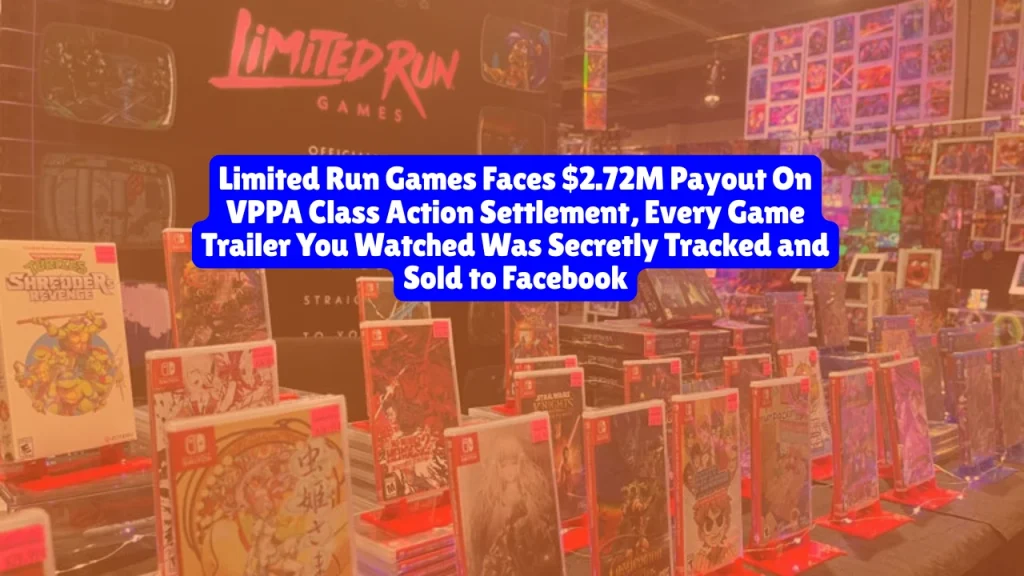
Limited Run Games Faces $2.72M Payout On VPPA Class Action Settlement, Every Game Trailer You Watched Was Secretly Tracked and Sold to Facebook
Limited Run Games agreed to pay $2.72 million to settle claims it violated federal privacy law by using Meta Pixel tracking to secretly share your video-watching activity with Facebook—without ever asking permission. If you watched videos or bought games with cutscenes from Limited Run Games between January 2016 and June 2025, you can claim your share. The deadline is January 20, 2026.
You clicked on a game trailer. Maybe you watched a developer interview or browsed gameplay footage while deciding whether to pre-order that limited physical edition. What you didn’t know? Every single video you watched was being tracked, recorded, and transmitted to Facebook through invisible code embedded in Limited Run Games’ website.
That’s exactly what a class action lawsuit claimed—and now Limited Run Games is paying $2.72 million to make it go away.
What Limited Run Games Allegedly Did
John Carbone and Ryan Adkins, two customers, filed a lawsuit in 2024 claiming Limited Run Games violated the Video Privacy Protection Act by installing Meta Pixel tracking technology on their website.
Here’s what allegedly happened behind the scenes: When you visited limitedrungames.com and watched a video—whether it was a game trailer, unboxing video, or cutscene from a game you purchased—Meta Pixel automatically captured that activity. It collected information linking your Facebook account to exactly which videos you watched.
Then it transmitted all that data to Meta (Facebook’s parent company) and potentially Google, according to court filings. The lawsuit claimed this happened without users ever providing written consent, which violates a federal privacy law that’s been on the books since 1988.
Limited Run Games denies doing anything wrong. But rather than fight the case in court, the company agreed to settle for $2.72 million.
The Law That Started Because of Robert Bork’s Movie Rentals
The Video Privacy Protection Act sounds like something that shouldn’t matter in 2025. It was passed in 1988—back when people rented VHS tapes from Blockbuster.
Congress created the law after a newspaper published Supreme Court nominee Robert Bork’s video rental history from his local video store. The list of 146 films Bork and his family rented became public without their consent, sparking outrage and embarrassment.
Reagan signed the VPPA into law to prevent video rental stores from sharing customer data without permission. The law says video providers can’t disclose what videos you watch unless you give written consent. Violators face up to $2,500 per violation, plus potential punitive damages and attorney fees.
Fast forward to 2025, and that “dinosaur statute” (as one court called it) has become one of the most powerful weapons for privacy lawsuits. Turns out, the law applies to websites streaming videos just as much as it applied to old-school video stores.
Related Article: Tyson and Cargill Settlement Details, $87.5M Class Action Lawsuit Settlement Payout—Here’s How to Claim Your Share Before June 30
Who Can Claim Money From This Settlement
You’re eligible if you meet all three of these requirements:
You accessed Limited Run Games’ service in the United States
You watched a pre-recorded video OR purchased a video game containing cutscenes
You did this between January 1, 2016, and June 20, 2025
That’s it. You don’t need receipts. You don’t need to prove you had a Facebook account (though the tracking allegedly required one). You just need to have watched videos or bought games with cutscenes during that nine-year period.
Even if you only watched free game trailers without buying anything, you still qualify. Even if you closed your Limited Run Games account years ago, you still qualify.
How Much Money Can You Get?
The settlement fund is $2,720,000. But there’s a catch—everyone who files a valid claim splits the money equally (pro rata) after deductions.
Those deductions include:
- Settlement administration costs (paying the company handling all the paperwork)
- Attorney fees (the lawyers who brought the case)
- Service awards for the class representatives (Carbone and Adkins)
Based on similar VPPA settlements, payments typically range anywhere from $10 to $100+ per person depending on how many people file claims. The more people who claim, the less each person receives.
For context, a recent AARP settlement for the same type of violation estimated payments between $47 and $237 per person. Another settlement involving Scientific American paid out from a $900,000 fund.
Nobody knows exactly what you’ll receive until all claims are counted. But here’s the thing about class action settlements: 96% of settlement funds go unclaimed because people don’t file or miss the deadline.
How to File Your Claim – Step by Step
Filing takes about 5 minutes. Here’s exactly what to do:
Option 1: File Online (Fastest Method)
Go to www.limitedrungamessettlement.com and click “File a Claim”
You’ll need to provide:
- Your name and contact information
- The email address associated with your limitedrungames.com account (if you remember it)
- If you don’t have your account email, provide the URL of videos you watched or games you purchased (if you remember)
Submit before January 20, 2026
Option 2: Mail a Paper Claim
Download the claim form from the settlement website
Fill it out completely
Mail it postmarked no later than Tuesday, January 20, 2026 to:
Carbone v. Limited Run Games Inc.
c/o Kroll Settlement Administration LLC
P.O. Box 225391
New York, NY 10150-5931
Questions? Call the settlement administrator at 833-621-6124
When Will You Get Paid?
Patience required. The settlement process moves slowly because courts want to ensure everything is fair.
The final approval hearing is scheduled for March 11, 2026, at 2:00 PM. Judge Nusrat Jahan Choudhury of the U.S. District Court for the Eastern District of New York will decide whether to grant final approval.
If the judge approves the settlement and nobody appeals the decision, payments will be distributed approximately 100 days later—likely sometime in summer 2026.
If someone objects to the settlement or files an appeal, it could take even longer.
What Limited Run Games Must Do Besides Pay Money
The settlement isn’t just about cash. Limited Run Games also agreed to change how it operates Meta Pixel on its website to better comply with privacy laws going forward.
The company claims it never “sold data to Meta” and that using Facebook Pixel is standard practice for e-commerce sites running targeted advertising. Limited Run Games’ co-founder even defended the company on social media, calling the lawsuit unfair.
But the settlement forces the company to be more careful about user privacy—which benefits everyone who visits their site in the future.
Why This Settlement Matters Beyond Limited Run Games
Limited Run Games isn’t alone. Hundreds of companies are facing nearly identical VPPA lawsuits over Meta Pixel tracking.
Recent settlements include:
- AARP: $12.5 million settlement (payments estimated at $47-$237 per person)
- Scientific American: $900,000 settlement
- Lane v. Facebook: $9.5 million settlement over Facebook Beacon
According to a March 2024 report, about 47% of websites use Meta Pixel, including 55% of companies in the S&P 500. That’s why there’s been an explosion of VPPA lawsuits in recent years.
The lawsuits all follow the same pattern: Websites embed Meta Pixel to track user behavior and improve targeted advertising. The pixel captures what videos users watch and sends that data to Facebook. Plaintiffs claim this violates VPPA because users never provided written consent.
What You’re Giving Up If You Claim
Here’s the legal fine print: If you file a claim or don’t opt out by the deadline, you give up your right to sue Limited Run Games separately for these specific VPPA violations.
You’re releasing all claims related to Limited Run Games sharing your video-watching data with Meta and other third parties between January 2016 and June 2025.
If you want to preserve your right to sue individually, you must opt out (exclude yourself) by mailing a written request postmarked no later than January 20, 2026 to the settlement administrator. Your opt-out letter must include your name, address, phone number, signature, and a clear statement that you want to be excluded.
But if you opt out, you can’t claim any settlement money.
Could This Settlement Fail?
It’s possible but unlikely. The judge already granted preliminary approval, meaning the settlement terms seem fair enough to move forward.
At the March 11, 2026 hearing, the judge will hear any objections before deciding whether to grant final approval.
You can object to the settlement if you’re a class member who disagrees with the terms. Your objection must be filed with the court by January 20, 2026, explaining specifically what you disagree with and why.
Common objections in settlements like this include complaints that attorney fees are too high or that the settlement amount is too low compared to the alleged violations.
Check Your Spam Folder
Important note: Many Limited Run Games customers reported that the settlement notification email landed in their spam or junk folder.
If you haven’t seen an email about this settlement, check your spam immediately. The email comes from the settlement administrator (Kroll) with subject lines about the “Limited Run Games VPPA Settlement.”
Don’t ignore it assuming it’s fake—this is a real, court-approved settlement.
The Bigger Picture: Your Privacy Is Valuable
This settlement is part of a massive trend in privacy litigation. Companies are learning the hard way that quietly tracking user behavior—even for seemingly harmless purposes like improving ads—can trigger multimillion-dollar lawsuits.
The VPPA was created to protect Judge Bork from embarrassment over his movie rentals. Today, it’s protecting you from having your digital behavior tracked and monetized without permission.
Whether you watched game trailers, browsed collector’s editions, or bought limited physical releases, Limited Run Games was allegedly watching—and now they’re paying for it.
Don’t let your share go unclaimed. File before January 20, 2026.
Frequently Asked Questions
Do I need proof I bought games or watched videos?
No. You don’t need receipts, screenshots, or any documentation. Simply confirm you accessed Limited Run Games and watched videos or purchased games with cutscenes during the class period (Jan 1, 2016 – June 20, 2025).
What if I deleted my Limited Run Games account?
You can still file a claim. The settlement covers anyone who accessed the service during the class period, regardless of current account status.
How much money will I actually get?
Payment amounts depend on total valid claims filed. Each claimant receives an equal pro rata share of the net settlement fund after deductions for admin costs, attorney fees, and service awards. Based on similar settlements, expect anywhere from $10 to $100+.
What is Meta Pixel and why is it a problem?
Meta Pixel is tracking code that websites embed to collect data about user interactions for advertising purposes. It’s legal when users consent, but the lawsuit claimed Limited Run Games never obtained proper written consent required by VPPA.
Can I claim even if I only watched free trailers?
Yes. The settlement covers anyone who watched pre-recorded videos on Limited Run Games’ website, whether you purchased anything or not.
What happens if I file a claim?
You’ll receive a proportionate payment once the settlement receives final court approval and any appeals are resolved (estimated summer 2026). You also give up your right to sue Limited Run Games separately for these claims.
How do I know this settlement is real and not a scam?
The official settlement website is www.limitedrungamessettlement.com. The case number is Carbone v. Limited Run Games Inc., Case No. 2:24-cv-08861-NJC-JMW in the U.S. District Court for the Eastern District of New York. You can verify the case through federal court records.
What if I miss the January 20, 2026 deadline?
You forfeit your right to claim settlement money. The deadline is firm—no exceptions.
Did Limited Run Games admit wrongdoing?
No. Limited Run Games denies violating any laws but agreed to settle to avoid ongoing litigation costs and uncertainty. The court has not determined who is right.
What if I want to sue Limited Run Games separately instead?
You must opt out (exclude yourself) by mailing a written request postmarked by January 20, 2026. If you opt out, you can’t claim settlement money but preserve your right to file your own lawsuit.
Important Resources:
- Official Settlement Website – File claims and get case updates
- FTC Privacy and Data Security – Learn about your privacy rights
- Top Class Actions Database – Track other open settlements you may qualify for
- Electronic Privacy Information Center (EPIC) – Privacy advocacy and legal resources
This article is for informational purposes only and does not constitute legal advice. Consult with a qualified attorney about your specific situation.
About the Author

Sarah Klein, JD, is a licensed attorney and legal content strategist with over 12 years of experience across civil, criminal, family, and regulatory law. At All About Lawyer, she covers a wide range of legal topics — from high-profile lawsuits and courtroom stories to state traffic laws and everyday legal questions — all with a focus on accuracy, clarity, and public understanding.
Her writing blends real legal insight with plain-English explanations, helping readers stay informed and legally aware.
Read more about Sarah