
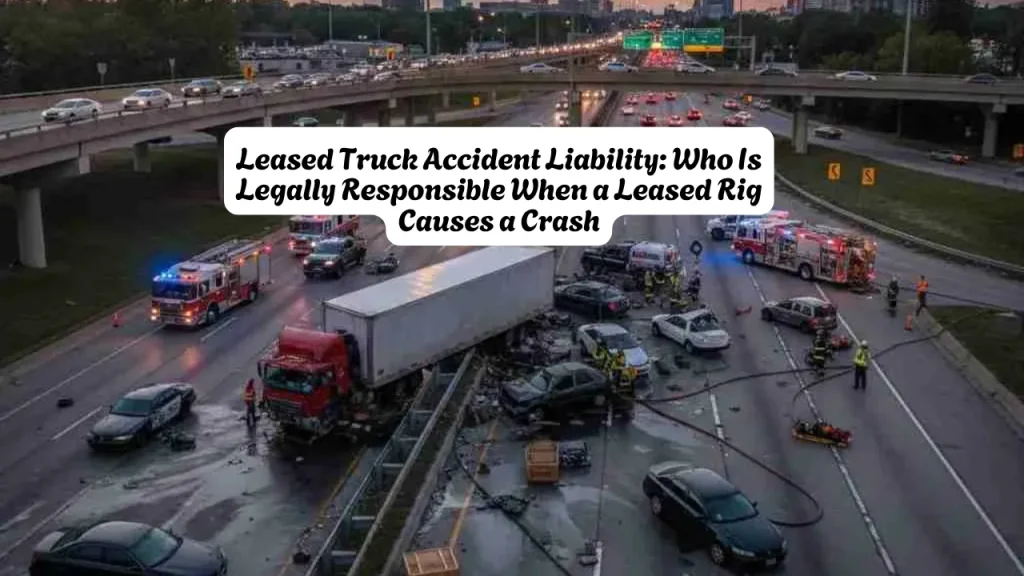
Leased Truck Accident Liability, Who Is Legally Responsible When a Leased Rig Causes a Crash
When a leased truck causes an accident, liability can fall on the driver, the motor carrier operating the truck under their DOT authority, the leasing company that owns the vehicle, or all three simultaneously. Federal FMCSA lease regulations make motor carriers legally responsible for leased trucks operating under their authority — regardless of who technically owns the vehicle
Who is liable when a leased truck causes an accident?
When a leased truck causes an accident, liability can fall on the driver, the motor carrier operating the truck under their DOT authority, the leasing company that owns the vehicle, or all three simultaneously. Federal FMCSA lease regulations make motor carriers legally responsible for leased trucks operating under their authority — regardless of who technically owns the vehicle.
Commercial trucking runs on leased equipment. Millions of trucks on American highways aren’t owned by the companies whose names appear on the door — they’re leased from equipment companies, financed through third-party lessors, or operated by owner-operators under formal lease agreements with motor carriers.
That layered ownership structure creates one of the most legally tangled questions in trucking accident law: when a leased truck causes a crash, who actually pays?
The answer depends on the type of lease arrangement, which entity held the truck’s DOT authority at the moment of the accident, what the lease agreement said about maintenance and insurance obligations, and whether federal regulations override what any private contract claims. Insurance companies and trucking carriers exploit this complexity aggressively — pointing fingers at each other while injured victims wait for answers and medical bills pile up.
This article cuts through every layer of that complexity. You’ll learn exactly how different leasing arrangements create different liability outcomes, which federal regulations protect victims regardless of private lease terms, how to identify every responsible party, and what damages you can recover. If a leased truck injured you or someone you love, understanding this liability structure is the foundation of getting full compensation.
The Three Types of Truck Leasing Arrangements — and Why Each One Creates Different Liability
Not all truck leases work the same way. The specific structure of the leasing arrangement at the time of your accident determines which parties face liability and under which legal theories. Your attorney’s first task is identifying exactly which type applied.
Equipment Leases — Trucking Company Leases the Truck
In an equipment lease, a motor carrier leases a truck from a commercial vehicle leasing company. The carrier puts their own driver behind the wheel, operates the truck under their DOT number, and uses it like company-owned equipment. The leasing company simply owns the physical asset and collects lease payments.
In this arrangement, the motor carrier bears primary liability for accidents. Their driver, their authority, their operations — their responsibility. The equipment lessor generally escapes liability unless they leased a truck they knew was mechanically defective.
Related article: Should I Get a Lawyer for a Car Accident That Wasn’t My Fault?
Carrier Leases — Owner-Operator Leases Their Truck to a Carrier
In a carrier lease, an owner-operator who owns their own truck signs a lease agreement with a motor carrier. The owner-operator hauls loads under the carrier’s DOT number and operating authority. This is the most common leasing arrangement in American trucking — and the one that generates the most liability disputes after accidents.
Federal regulations under 49 CFR Part 376 govern these leases specifically. When a carrier accepts a truck under this arrangement and places it under their DOT authority, they become the statutory employer of that driver. Their liability follows the truck, not the ownership papers.
Finance Leases and Long-Term Rental Arrangements
Some trucks operate under long-term finance leases where the driver or company is building toward ownership. Others are rented short-term from commercial fleet companies. These arrangements create additional questions about who maintained the vehicle, who was responsible for its roadworthiness, and whether the finance company or rental entity played any role in the condition that caused the accident.
How Federal Lease Regulations Make Carriers Liable Regardless of Ownership
This is the most important legal principle in leased truck accident cases — and the one trucking industry lawyers work hardest to obscure.
Under 49 CFR Part 376, the FMCSA’s leasing regulations create a clear rule: when a motor carrier leases a truck and operates it under the carrier’s DOT authority, the carrier is legally responsible for that truck’s safe operation. This responsibility exists regardless of:
- Who owns the truck
- What the private lease agreement says about independent contractor status
- Whether the driver is classified as an employee or a contractor
- Whether the carrier’s name appears on the truck’s door
The moment a carrier’s DOT number is on that vehicle and the carrier is directing the load, federal law holds them accountable. Courts have applied this doctrine consistently across decades of trucking litigation to protect injured victims from being left with only the driver’s personal policy — which frequently carries minimum coverage that falls far short of catastrophic injury damages.
This federal override is powerful precisely because it cannot be contracted away. A carrier cannot insert a clause into a lease agreement that strips victims of their right to hold the carrier responsible under federal law. Private contracts between business entities cannot eliminate public safety obligations created by federal regulation.
The Tracy Morgan Walmart truck accident case demonstrated exactly how far corporate liability extends in trucking crashes — the lawsuit alleged violations of FMCSA regulations and established that trucking companies cannot escape liability by blaming individual drivers when corporate policies contribute to accidents. The same principle applies when those corporate policies involve operating leased vehicles under company authority.
When the Equipment Leasing Company Also Bears Liability
Most leased truck accident cases focus on the motor carrier and driver. But the company that owns and leased out the truck can also face direct liability under specific circumstances — and identifying that additional defendant can significantly expand your total recovery.
An equipment leasing company faces liability when:
| Scenario | Legal Theory | What Evidence Proves It |
| Leased a truck with known mechanical defects | Negligent entrustment | Maintenance records showing pre-existing failures the lessor knew about |
| Failed to perform required safety inspections before leasing | Negligence in vehicle preparation | Missing inspection certificates, deferred repair orders |
| Leased to a carrier with a documented poor safety record | Negligent entrustment | FMCSA safety data showing the lessor ignored red flags |
| Contractually retained maintenance responsibility but failed to perform it | Breach of contract creating negligence | Lease agreement clauses plus maintenance failure records |
| Provided a truck with tires, brakes, or lighting below legal standards | Product or premises liability theory | Post-accident inspection reports, DOT out-of-service records |
The key question is whether the leasing company retained any operational control or maintenance responsibility over the truck — and whether they knew or should have known the vehicle posed a danger when they put it on the road.
Even when the leasing company successfully argues the carrier bore all operational responsibility, evidence that the truck was mechanically compromised when it left the leasing company’s possession creates powerful leverage in settlement negotiations and at trial.
The Deadhead and Bobtail Problem — Liability Gaps When the Truck Runs Empty
One of the trickiest liability questions in leased truck accidents involves what happens when the truck is moving without a loaded trailer — either between pickups, returning from a delivery, or operating for personal reasons.
This is called bobtailing when the tractor runs without any trailer, and deadheading when it pulls an empty trailer. Both situations create coverage gaps that insurance companies exploit to deny claims.
Here’s the problem. When an owner-operator runs under a carrier’s lease:
- The carrier’s primary liability policy typically covers the truck only when it’s operating under the carrier’s dispatch — meaning actively hauling a company load
- When the driver is between loads, returning a delivered trailer, or driving for personal reasons, the carrier argues their policy doesn’t apply
- The driver’s own bobtail or non-trucking liability policy is supposed to fill this gap — but these policies carry lower limits and contain their own exclusions
Courts have pushed back hard on carriers who try to use this gap to escape liability. The test most courts apply is whether the driver’s activity at the time of the crash was part of the broader commercial operation — not just whether a specific load was physically on the truck at that moment. A driver returning from a delivery to pick up the next assigned load is still operating in the carrier’s commercial interest, and courts frequently hold the carrier responsible.
Your attorney must immediately determine what the driver was doing at the precise moment of your accident, which policy applies, and whether the carrier’s attempt to claim the bobtail exclusion holds up under the facts of your specific case.
Evidence That Determines Which Party Pays in Leased Truck Accidents
Building a leased truck accident case requires a targeted evidence strategy that goes well beyond standard crash investigation. You need documentation that establishes the exact nature of the lease relationship, which entity controlled the truck at the moment of impact, and whether any party’s negligence contributed to the conditions that caused the crash.
Here is the complete evidence sequence your attorney should pursue:
- Obtain the lease agreement immediately. Every clause about operational control, maintenance responsibility, insurance obligations, and DOT authority determines which party faces which category of liability. Carriers and lessors will not volunteer this document — it must be subpoenaed quickly.
- Confirm whose DOT number was on the truck. The DOT placard on the cab door or the USDOT number in official records identifies which entity held operating authority at the moment of the crash. This single fact triggers or defeats statutory employer liability.
- Pull FMCSA records for both the carrier and the lessor. The Safety Measurement System database shows each entity’s inspection history, violation citations, out-of-service orders, and crash data. A carrier or lessor with a pattern of safety failures faces a much harder defense.
- Preserve all electronic data from the truck. Black box data, ELD records, GPS tracking logs, and any telematics data the carrier monitored remotely must be preserved immediately through a legal hold notice. This data disappears fast.
- Request complete maintenance records for the leased vehicle. Who performed scheduled maintenance, who certified the truck as roadworthy before each dispatch, and whether any pre-existing mechanical issues were known and ignored — these records define the maintenance liability question.
- Subpoena dispatch records and load assignments. Proof that the carrier assigned the load, tracked the driver’s progress, and communicated operational instructions confirms the carrier exercised control — and defeats the argument that the driver was operating independently.
- Identify every insurance policy that applies. The carrier’s primary commercial policy, the driver’s bobtail or non-trucking policy, the leasing company’s equipment insurance, and any umbrella coverage — each one represents a potential source of compensation.
How Multiple Defendants and Insurance Policies Maximize Your Recovery
The multi-party nature of leased truck accident cases is actually an advantage for injured victims — when an experienced attorney pursues every responsible party simultaneously rather than stopping at the most obvious defendant.
Consider a typical carrier lease accident scenario. The driver negligently caused the crash. The motor carrier operated the truck under their DOT authority and directed the load. The equipment leasing company leased a vehicle with documented brake issues it failed to repair. Three defendants. Three insurance policies. Three potential sources of compensation for your injuries.
Pursuing only the driver leaves you limited to their personal policy — often the minimum required $750,000 for general freight. Adding the carrier’s commercial policy brings coverage of $1 million to $5 million into play. Adding the leasing company’s equipment liability policy creates a third source. In catastrophic injury cases where damages run into the millions, this multi-policy approach is not just preferable — it may be the only path to full recovery.
You may have claims against multiple parties — the truck driver, the trucking company, the cargo owner, and potentially others. An experienced truck accident attorney can identify all responsible parties and sources of compensation.
Additionally, when evidence shows a carrier systematically used lease arrangements to evade safety obligations — skipping driver qualification steps, ignoring vehicle maintenance, or exploiting bobtail coverage gaps to leave victims undercompensated — punitive damages become available against the carrier. Punitive awards in trucking cases with documented regulatory evasion have reached well into the millions beyond compensatory damages.
Understanding how settlement proceeds are ultimately structured and what financial considerations affect your final recovery helps you make fully informed decisions at every stage of your case. Get a clear breakdown of how trucking accident settlements work and what affects the final payout.
What Damages Victims of Leased Truck Accidents Can Recover
Proving liability against a carrier, a driver, and a leasing company opens access to comprehensive compensation covering every dimension of your loss.
Economic damages address every measurable financial harm:
- Emergency medical treatment, trauma care, and hospitalization
- Ongoing medical costs — surgery, rehabilitation, specialist visits, prescription medication
- Lost income throughout your entire recovery period
- Permanently reduced earning capacity if your injuries prevent returning to your previous work
- Future medical care costs for long-term or permanent injuries
- Property damage to your vehicle and personal property
- Out-of-pocket expenses directly caused by the accident
Non-economic damages compensate for losses that carry no invoice:
- Physical pain and ongoing suffering
- Emotional trauma, anxiety, and post-traumatic stress
- Loss of enjoyment of life and daily activities
- Permanent disability or disfigurement
- Loss of companionship and consortium in wrongful death cases
Punitive damages apply when evidence shows the carrier, driver, or leasing company acted with reckless disregard for public safety — for example, a carrier knowingly dispatching a truck with documented brake failures, a leasing company repeatedly ignoring out-of-service orders, or a carrier using lease structures specifically to avoid FMCSA safety obligations while maintaining full operational control.
A truck accident attorney with experience in leased truck liability cases can simultaneously pursue the driver, the carrier, and the leasing company — identifying every applicable insurance policy, subpoenaing every relevant document, and building the strongest possible case across all three defendants. The tractor-trailer accident legal team at All About Lawyer handles exactly these complex multi-party leasing cases and can evaluate your claim at no cost.
Frequently Asked Questions
Who is liable when a leased truck causes an accident?
Liability in leased truck accidents typically involves the truck driver, the motor carrier who operated the truck under their DOT authority, and potentially the equipment leasing company that owned the vehicle. Under FMCSA regulations at 49 CFR Part 376, motor carriers are legally responsible for all trucks operating under their DOT number regardless of ownership. Your attorney will investigate every party’s role to identify all available sources of compensation.
How long do I have to file a claim after a leased truck accident?
Most states set a statute of limitations of two to three years from the accident date for personal injury claims. However, critical evidence in leased truck cases — lease agreements, ELD data, GPS records, and maintenance logs — disappears rapidly. Carriers and leasing companies are not legally obligated to preserve this evidence unless they receive a formal legal hold notice. Contacting a truck accident attorney as soon as possible after the crash protects your right to this evidence before it disappears permanently.
Does it matter whose name is on the lease agreement when determining liability?
The lease agreement matters but doesn’t control the outcome. Courts look beyond private contract terms to examine which entity held DOT operating authority, which entity exercised operational control over the driver, and which entity bore maintenance responsibility under the agreement. Federal FMCSA regulations create statutory liability that overrides certain private contract provisions — carriers cannot contractually eliminate the public safety responsibilities that federal law places on them when they operate a truck under their DOT number.
What if the leased truck driver was running empty between loads when the accident happened?
Coverage during bobtail or deadhead operations is one of the most disputed issues in leased truck accident law. The carrier’s primary policy may exclude coverage when no load is actively in transit, while the driver’s bobtail insurance fills part of that gap. Courts examine whether the driver’s activity at the time of the crash served the carrier’s commercial interests — drivers returning from deliveries or moving toward the next assigned load are often found to be acting within the carrier’s operational scope regardless of whether cargo was physically on the truck.
Can I sue both the motor carrier and the equipment leasing company?
Yes. When evidence shows the leasing company leased a mechanically defective truck, failed to perform required safety inspections, or retained maintenance responsibilities they then ignored, they face liability alongside the carrier and driver. Pursuing all three defendants simultaneously gives you access to multiple insurance policies and creates significantly greater pressure for a full and fair settlement than single-defendant claims.
How does proving the carrier was the statutory employer affect my compensation?
Establishing statutory employer status under FMCSA lease regulations shifts primary liability to the motor carrier and gives you access to their commercial insurance policy — which typically carries $1 million to $5 million in coverage compared to the much lower limits on individual driver policies. It also opens the door to negligent hiring, negligent supervision, and negligent maintenance claims against the carrier as an organization, which can support punitive damages when the carrier’s conduct reflects a pattern of safety violations rather than an isolated incident.
Legal Terms Used in This Article
Equipment Lease: A leasing arrangement where a motor carrier rents a truck from a commercial vehicle leasing company and operates it with their own drivers under their own DOT authority. The carrier bears primary operational liability; the leasing company bears liability only for vehicle condition.
Carrier Lease: An arrangement where an owner-operator leases their own truck to a motor carrier and hauls loads under the carrier’s DOT authority. Federal regulations make the carrier the statutory employer of the driver for liability purposes.
Statutory Employer: A legal status created by FMCSA regulations under 49 CFR Part 376, making motor carriers legally responsible for trucks and drivers operating under their DOT authority regardless of ownership or independent contractor agreements.
DOT Number: The unique identifier issued by the FMCSA to commercial carriers authorized to operate interstate. The presence of a specific DOT number on a truck at the time of an accident identifies which entity bears statutory employer liability under federal leasing regulations.
Bobtail Insurance: Coverage that applies when an owner-operator drives their tractor without a trailer, typically between loads or during personal use. This policy fills the coverage gap when the carrier’s primary policy excludes non-dispatch operations.
Deadheading: Operating a truck while pulling an empty trailer, typically between a delivery and the next pickup. Coverage disputes frequently arise over whether the carrier’s policy applies during deadhead operations.
Negligent Entrustment: A liability theory holding that a party who provides a vehicle to another person can be held responsible if they knew or should have known the recipient was unfit to safely operate it, or that the vehicle was mechanically unsafe.
49 CFR Part 376: The federal regulation governing lease agreements between motor carriers and equipment owners. This regulation creates the statutory employer relationship that makes carriers liable for leased trucks operating under their DOT authority.
When a leased truck leaves you or a loved one seriously injured, the carrier, the equipment company, and their insurers immediately begin building their defenses — each pointing at the other and hoping you give up before untangling who truly owes you compensation. Don’t let that happen. The lease agreement, the DOT records, the maintenance logs, and the dispatch communications that prove your case exist right now — and they won’t stay available forever.
Contact a truck accident attorney today for a free consultation. An experienced lawyer will identify every responsible party across the entire leasing chain, issue legal hold notices before critical evidence disappears, and pursue the maximum compensation available from every applicable insurance policy. You deserve full accountability from every party that contributed to your crash — and the right attorney will pursue each one relentlessly.
Disclaimer: This article is for general informational purposes only and does not constitute legal advice. No attorney-client relationship is formed by reading this content. Laws vary by state and individual circumstances differ. Consult a licensed attorney in your jurisdiction for advice specific to your situation.
About the Author

Sarah Klein, JD, is a former civil litigation attorney with over a decade of experience in contract disputes, small claims, and neighbor conflicts. At All About Lawyer, she writes clear, practical guides to help people understand their civil legal rights and confidently handle everyday legal issues.
Read more about Sarah