
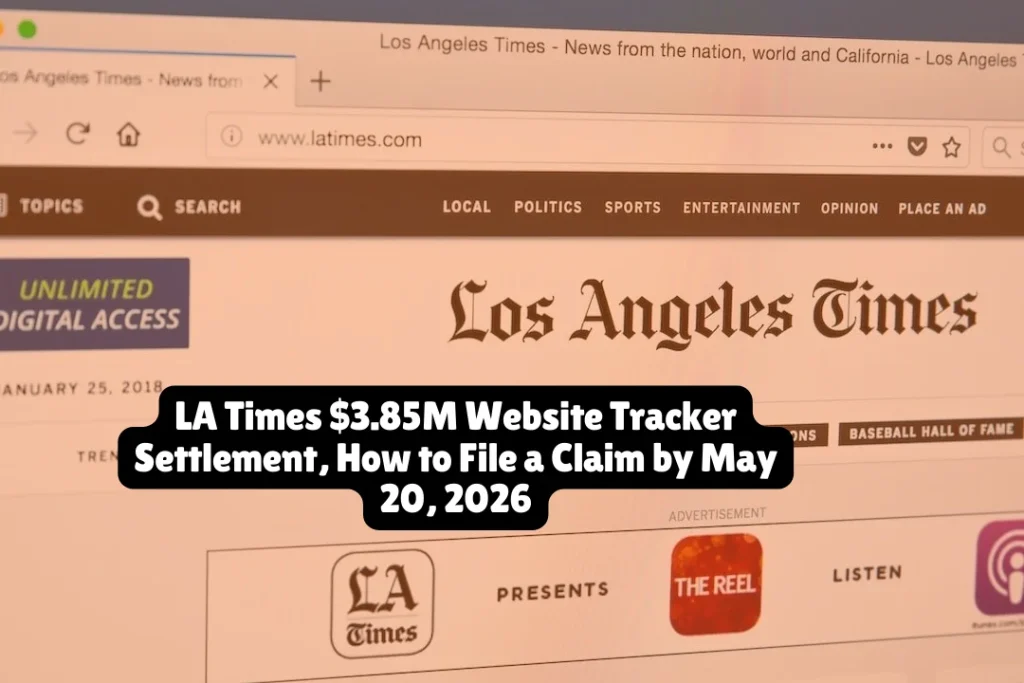
LA Times $3.85M Website Tracker Settlement, How to File a Claim by May 20, 2026
A $3.85 million class action settlement has been reached with the Los Angeles Times over alleged website tracking practices that may have violated California privacy law. If you accessed the LA Times website or mobile app in California between January 31, 2023 and December 19, 2025, you may be entitled to a payment. No proof of purchase is required. The claim deadline is May 20, 2026. File at LATimesCIPASettlement.com.
KEY DATES
| Event | Date |
| Settlement Preliminary Approval | December 19, 2025 |
| Claim Filing Deadline | May 20, 2026 — OPEN NOW |
| Opt-Out / Exclusion Deadline | April 22, 2026 |
| Objection Deadline | April 22, 2026 |
| Final Approval Hearing | June 26, 2026 at 10 a.m. PT (via Zoom) |
| Estimated Payment Date | ~90 days after final approval |
| Official Settlement Website | LATimesCIPASettlement.com |
| Administrator Phone | (833) 754-7789 |
| Administrator | Kroll Settlement Administration LLC |
Current Status
The LA Times agreed to settle the lawsuit, and a $3.85 million settlement was preliminarily approved on December 19, 2025. The claim window is open right now. The final approval hearing is scheduled for June 26, 2026 at 10 a.m. PT via Zoom. If the court grants final approval, payments will follow approximately 90 days later.
This is one of the most accessible settlements open in 2026 — you do not need to be a paid subscriber, you do not need a receipt, and the online form takes only a few minutes.
What the Lawsuit Alleges
The Three Trackers
The lawsuit claimed that the Los Angeles Times Communications, LLC installed and used three trackers — the TripleLift Tracker, GumGum Tracker, and Audiencerate Tracker — on website visitors’ internet browsers, without consent and in violation of Section 638.51(a) of the California Invasion of Privacy Act (CIPA).
These are advertising and data collection technologies. When a visitor loaded LATimes.com or the mobile app, the lawsuit alleges these trackers silently collected data about the visitor — without ever asking for or receiving consent.
The Law Behind the Case
CIPA — California’s Invasion of Privacy Act — prohibits businesses from installing tracking technologies on users’ devices without consent. The settlement resolves claims that certain tracking technologies were used without proper consent. Unlike federal privacy law, CIPA gives California residents a private right to sue and does not require proof of actual financial harm.
What the LA Times Says
The defendant denies that it violated any law, but has agreed to the settlement to avoid the uncertainties and expenses associated with continuing the case.
Who Qualifies?
The settlement class is defined as all persons who accessed LA Times online via website or mobile app in California and had their information collected by tracking technologies between January 31, 2023 through to, and including, December 19, 2025.
You qualify if all three of these apply to you:
- You were physically located in California when you accessed the site
- You visited LATimes.com (or any subdomain) or used the LA Times mobile app
- Your visit occurred between January 31, 2023 and December 19, 2025
You do not need to be a paid subscriber — anyone who visited the site or used the app in California during this period qualifies.
Settlement Fund Breakdown
| Component | Amount |
| Total Settlement Fund | $3,850,000 |
| Attorney Fees (up to one-third) | Up to ~$1,283,333 |
| Class Representative Award | Up to $5,000 |
| Administration Costs | Deducted from fund |
| Net Fund for Claimants | Remainder split pro rata |
Class Counsel is entitled to seek no more than one-third of the $3.85 million settlement fund, but the Court may award less than this amount.
How Much Will You Get?
The settlement payout per person is estimated at $5.00 per class member. However, the final amount is dependent on how many people file claims — the payout per person is estimated to be between $40.32 and $216.63.
Here is what that means in plain terms: the fewer people who file, the larger each individual payment. The $5 estimate assumes near-maximum participation. If claim volume is lower — as is common in privacy settlements — each valid claimant receives a significantly higher share.
Low-participation scenario: If 50,000 Californians file valid claims and the net fund after fees is approximately $2.5M, each claimant receives roughly $50.
Mid-participation scenario: If 20,000 claims are filed, each claimant could receive approximately $125.
Low-claim scenario: If only 10,000 people file, payouts could approach the $216 upper-end estimate cited in court documents.
Disclosed assumption: These figures use the estimated $2.5M net fund range. Final amounts depend entirely on total valid claims filed and attorney fees awarded by the court.
How to File Your Claim — Step by Step
Step 1 — Go to the official website. Visit LATimesCIPASettlement.com — this is the only court-authorized settlement website.
Step 2 — File online or by mail. To submit a claim online, claimants must provide their class member ID. If you received a notice in the mail, your class member ID is printed on it. If you did not receive a notice but believe you qualify, you can still submit a claim online.
Step 3 — No proof needed. No proof of purchase or proof of visiting the website is required. Simply submit a valid claim form confirming you accessed the LA Times online in California during the class period.
Step 4 — Choose your payment method. Your payment will come by check unless you elect to receive payment electronically by PayPal or Venmo. All checks expire and become void 180 days after they are issued.
Step 5 — Submit before May 20, 2026. Class members must submit claims online or by mail by May 20, 2026. Mailed forms must be postmarked by that date. Online submission is faster, free, and takes only minutes.
Mail-in address: Mirmalek v. Los Angeles Times Communications, LLC c/o Kroll Settlement Administration LLC P.O. Box 225391, New York, NY 10150-5391
The Mass Arbitration Alternative
There is a separate legal path some California subscribers are choosing instead of the class settlement. Attorneys working with ClassAction.org are gathering LATimes.com subscribers who live in California to take action through mass arbitration — a process outside of court where hundreds or thousands of consumers bring individual arbitration claims against the same company at the same time.
Importantly, if you sign up for the LA Times privacy arbitration, you will give up your right to file a claim in the class action settlement. While there are no guarantees, it is possible that consumers who sign up could be owed hundreds of dollars more than the class settlement payment.
This is a choice only you can make. The class settlement is simpler, faster, and guaranteed (pending final approval). Mass arbitration carries higher potential value but more uncertainty and a longer timeline.
Frequently Asked Questions
Q: Do I need to have been a paid subscriber?
No. Anyone who visited the site or used the app in California during the class period qualifies — free readers, occasional visitors, and paid subscribers alike.
Q: What if I live outside California?
You do not qualify for this settlement. CIPA is a California state law. If you accessed the LA Times from another state, you are not a class member in this case.
Q: What are TripleLift, GumGum, and Audiencerate?
These are third-party advertising technology platforms. TripleLift and GumGum serve targeted display ads. Audiencerate is an audience data platform. The lawsuit alleges all three collected user data from LA Times visitors without consent.
Q: What if I want to opt out?
To exclude yourself from the settlement, you must mail a letter stating you want to be excluded, including your name, address, signature, and the case name (Mirmalek v. Los Angeles Times Communications, LLC, Case No. 3:24-CV-01797-CRB) no later than April 22, 2026.
Q: What rights do I give up by filing a claim?
If the settlement becomes final, you will give up your right to sue the defendant for the claims this settlement resolves — specifically, claims related to the alleged disclosure of your information collected through the LA Times website or mobile app.
Q: Who represents me as a class member?
The court has appointed the law firm of Bursor & Fisher, P.A. to represent the settlement class. You will not be charged for these lawyers. If you want to be represented by your own lawyer, you may hire one at your own expense.
Q: When will I actually get paid?
Eligible class members whose claims were approved will receive payment 90 days after the settlement has been finally approved and any appeals process is complete. The final approval hearing is June 26, 2026 — meaning the earliest possible payments arrive around late September or October 2026.
Q: What if I received a notice but lost my class member ID?
Contact Kroll Settlement Administration directly at (833) 754-7789 or visit LATimesCIPASettlement.com to retrieve your ID or submit a claim without one.
Official Contact Information
| Resource | Details |
| Official Settlement Website | LATimesCIPASettlement.com |
| Administrator Phone | (833) 754-7789 |
| Mail Claims To | Kroll Settlement Administration LLC, P.O. Box 225391, New York, NY 10150-5391 |
| Class Counsel | Bursor & Fisher, P.A. |
| Court | U.S. District Court, Northern District of California |
| Case Number | 3:24-CV-01797-CRB |
This article is for informational purposes only and does not constitute legal or tax advice. Settlement terms, eligibility, and payment amounts are subject to court approval and may change. For official information, always refer to the settlement administrator or the official settlement website at LATimesCIPASettlement.com.
Last Updated: March 4, 2026 | AllAboutLawyer.com
About the Author

Sarah Klein, JD, is a licensed attorney and legal content strategist with over 12 years of experience across civil, criminal, family, and regulatory law. At All About Lawyer, she covers a wide range of legal topics — from high-profile lawsuits and courtroom stories to state traffic laws and everyday legal questions — all with a focus on accuracy, clarity, and public understanding.
Her writing blends real legal insight with plain-English explanations, helping readers stay informed and legally aware.
Read more about Sarah