
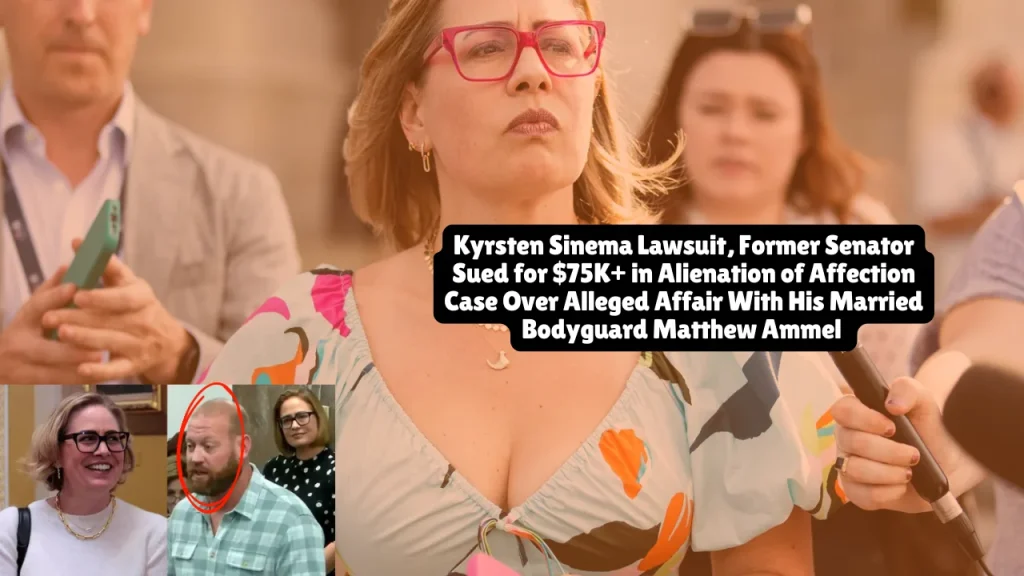
Kyrsten Sinema Lawsuit, Former Senator Sued for $75K+ in Alienation of Affection Case Over Alleged Affair With His Married Bodyguard Matthew Ammel
Former U.S. Senator Kyrsten Sinema faces a civil lawsuit alleging she destroyed a 14-year marriage by engaging in a romantic relationship with her married bodyguard Matthew Ammel. Filed in North Carolina federal court on January 15, 2026, the lawsuit seeks at least $75,000 in damages under the state’s rare “alienation of affection” law, which allows spouses to sue third parties for interfering with their marriages.
Who Is Involved in the Sinema Lawsuit
The plaintiff is Heather Ammel of Whispering Pines, North Carolina, a mother of three children who was married to Matthew Ammel for 14 years before their separation in November 2024. The defendant is Kyrsten Sinema, who served one term as a U.S. Senator representing Arizona from 2019 to 2025, first as a Democrat before switching to Independent status in 2022. Sinema declined to seek reelection and now works as a senior advisor at Hogan Lovells, a Washington D.C.-based law firm.
Matthew Ammel, though not a defendant in the lawsuit, is central to the case. He retired from the U.S. Army in 2022 after multiple deployments to Afghanistan and the Middle East, suffering from post-traumatic stress disorder, traumatic brain injuries, and substance abuse issues related to his military service. He joined Sinema’s security detail in 2022 and later became a Defense and National Security Fellow on her Senate staff in 2024.
What the Lawsuit Alleges About the Relationship
The complaint alleges Sinema knowingly pursued a romantic and sexual relationship with Matthew Ammel despite being aware he was married. Alienation of affection—a civil claim allowing a spouse to sue a third party for interfering with their marriage by destroying the love and affection between spouses—requires proof that a valid marriage existed, genuine love and affection existed between the spouses, and the defendant’s wrongful and malicious acts alienated that affection.
According to court documents, Heather Ammel discovered the alleged relationship in early 2024 when she found “romantic and lascivious” messages between Sinema and her husband exchanged through Signal, an encrypted messaging app. The messages allegedly included explicit photos of Sinema wrapped in a towel and conversations that “exceeded the bounds of a normal working relationship.”
The lawsuit details numerous alleged incidents demonstrating the inappropriate nature of the relationship. These include Sinema becoming “handsy” with Matthew Ammel at the Innings Festival in Arizona, the two staying together for hours during a trip to San Francisco, attending a Taylor Swift concert together in Miami (after Matthew Ammel arranged for his wife and children to attend), and drinking Dom Pérignon in Cindy McCain’s private suite during a U2 concert at The Sphere in Las Vegas.
Allegations of Drug Use and Campaign Finance Violations
Beyond the affair allegations, the complaint includes claims that raise potential legal concerns beyond the civil alienation of affection claim. The lawsuit alleges Sinema told Matthew Ammel to bring MDMA (ecstasy or molly) on a work trip so she could “guide him through a psychedelic experience.” In May 2024, Sinema allegedly paid for Matthew Ammel to receive psychedelic treatment in Nashville, Tennessee, before flying him to Napa Valley, California, to provide security for a concert where they stayed together in a private Airbnb.
Related article: Heidi Feek Lawsuit, Faith-Based Community Sues Musician for Defamation After Family Custody Dispute Over Sister With Down Syndrome

Sinema has publicly advocated for psychedelic drug research since leaving the Senate. In March 2025, she discussed Matthew Ammel’s use of ibogaine in Mexico to treat migraines in interviews with Phoenix New Times, confirming she knew about his psychedelic substance use for treatment purposes.
The lawsuit further alleges Sinema used campaign committee funds to pay for the romantic relationship, including international travel to Europe, trips to Boston and California wine country, and expensive outings like the Taylor Swift Eras Tour in Miami and the U2 concert in Las Vegas. Campaign finance violations—the misuse of political contributions for personal benefit rather than legitimate campaign expenses—can result in civil penalties from the Federal Election Commission and potential criminal charges for willful violations.
What Laws and Legal Standards Apply
North Carolina is one of only seven states that still recognize alienation of affection lawsuits, along with Hawaii, Illinois, Mississippi, New Mexico, South Dakota, and Utah. The tort is a relic from an era when wives were considered property, though it now applies equally regardless of gender. North Carolina handles approximately 200 alienation of affection cases annually.
To prevail on an alienation of affection claim in North Carolina, the plaintiff must prove: (1) a valid marriage existed, (2) genuine love and affection existed between the spouses, (3) the defendant’s wrongful and malicious acts alienated and destroyed that affection, and (4) the plaintiff suffered damages as a result. Notably, proving an actual affair occurred is not strictly required—only that the defendant knowingly engaged in conduct that led to the loss of marital affection.
The complaint also seeks punitive damages, alleging Sinema’s actions were “willful, wanton, intentional, malicious, and in reckless disregard of Plaintiff’s marital rights.” Punitive damages—compensation awarded to punish particularly egregious conduct beyond compensating for actual harm—require proof of aggravating circumstances showing the defendant acted with malice or reckless indifference.
Current Status and Timeline of the Lawsuit
The lawsuit was originally filed in Moore County Superior Court, North Carolina, in September 2025 but went largely unreported at that time. The case was removed to federal court and officially filed in the U.S. District Court for the Middle District of North Carolina on January 15, 2026. The removal to federal court occurred because the parties are from different states (North Carolina and Arizona) and the amount in controversy exceeds $75,000.
Heather Ammel is represented by North Carolina litigator Thomas Van Camp. As of January 16, 2026, Sinema has not responded publicly to the lawsuit allegations, and her attorney has not issued statements to the media. The case remains in early procedural stages with no trial date set.
Matthew Ammel formally filed for divorce in January 2026. The divorce proceedings in North Carolina involve heated disputes over assets and custody of the couple’s three children, with court filings showing each spouse accusing the other of being an unfit parent prone to angry outbursts.
What Damages and Relief the Lawsuit Seeks
Heather Ammel seeks at least $75,000 in compensatory and punitive damages plus attorneys’ fees. Compensatory damages would cover emotional distress, loss of consortium (the loss of benefits of the marital relationship including companionship, affection, and sexual relations), and financial hardship allegedly caused by the destroyed marriage.
The complaint alleges Heather Ammel “emphasized her role as a dutiful spouse and mother, holding the family together through Matthew Ammel’s multiple military deployments and supporting him through serious health challenges.” The financial impact includes loss of household income, increased expenses from separation, and costs associated with establishing separate residences and navigating divorce and custody proceedings.
What You Must Know About Alienation of Affection Lawsuits
How North Carolina Alienation of Affection Cases Typically Resolve
Recent North Carolina alienation of affection verdicts demonstrate the potential financial exposure defendants face. In November 2025, a Durham County jury ordered TikTok influencer Brenay Kennard to pay $1.75 million in the Brenay and Akira lawsuit TikTok influencer Brenay Kennard ordered to pay $1.75M in Akira Montague lawsuit for alienation of affection case, showing juries can award substantial damages when evidence of intentional interference is compelling.
However, settlement amounts vary widely. Some cases settle for tens of thousands, while others result in million-dollar verdicts depending on the defendant’s wealth, the strength of evidence, and the egregiousness of conduct. Sinema’s current position at a major law firm and public profile may influence settlement negotiations and potential jury perceptions.
Whether Campaign Finance Allegations Could Lead to Separate Investigation
The lawsuit’s allegations that Sinema used campaign funds for personal romantic expenses raise questions beyond the civil alienation claim. The Federal Election Commission prohibits using campaign contributions for personal benefit unrelated to campaign activities. If the allegations prove true, Sinema could face FEC investigation, civil penalties, or criminal referral for willful violations.
Arizona attorney Tom Ryan told Fox 10 Phoenix: “There seems to be an allegation here that Senator Sinema was taking funds that she was not entitled to use for her own personal benefit. If that in fact is true, she has more serious problems to be worried about than just an alienation of affections lawsuit.” Former members of Congress have faced criminal prosecution for campaign fund misuse, making these allegations potentially significant beyond the civil lawsuit.
What to Do Next to Stay Informed
Where to Find Official Court Documents and Case Updates
Federal court filings are available through PACER (Public Access to Court Electronic Records) at pacer.uscourts.gov. The case is Ammel v. Sinema, filed in the U.S. District Court for the Middle District of North Carolina. PACER charges $0.10 per page with a cap of $3 per document.
Legal news databases including Law360, Bloomberg Law, and Courthouse News Service provide updates on significant developments. North Carolina media outlets including WRAL News and The Assembly NC have covered the case extensively given the state’s unique alienation of affection law.
How to Understand Alienation of Affection Legal Concepts
Alienation of affection lawsuits remain controversial. Critics argue they’re archaic “heart-balm torts” from an era treating women as property that foster bitterness and monetize marital breakdowns. Supporters contend they provide accountability for intentional interference in marriages and compensate spouses who suffer genuine harm from third-party conduct.
Understanding these cases requires recognizing that proving an affair alone isn’t sufficient—plaintiffs must demonstrate the defendant’s conduct actually caused the alienation rather than the marriage failing for independent reasons. Defense strategies often argue the marriage was already broken before the defendant’s involvement.
Frequently Asked Questions About the Sinema Lawsuit
What Is the Sinema Lawsuit About?
The lawsuit alleges former Senator Kyrsten Sinema destroyed Heather Ammel’s 14-year marriage by engaging in a romantic and sexual relationship with Heather’s husband Matthew Ammel, who worked as Sinema’s bodyguard and later Senate staffer. The case is filed under North Carolina’s alienation of affection law.
Who Is Suing Kyrsten Sinema?
Heather Ammel of Whispering Pines, North Carolina, filed the lawsuit. She is the ex-wife of Matthew Ammel, who served on Sinema’s security detail from 2022 until their separation in November 2024.
What Are the Legal Claims in the Sinema Lawsuit?
The primary claim is alienation of affection, a civil tort recognized in North Carolina that allows spouses to sue third parties for intentionally destroying marital love and affection. The lawsuit also seeks punitive damages for allegedly willful, malicious conduct.
What Is the Current Status of the Lawsuit?
The case was filed in federal court on January 15, 2026, and remains in early procedural stages. No trial date has been set, and Sinema has not yet publicly responded to the allegations.
How Much Money Is Being Sought in the Sinema Lawsuit?
Heather Ammel seeks at least $75,000 in compensatory and punitive damages plus attorneys’ fees. The actual amount could be substantially higher if the case proceeds to trial and a jury awards significant punitive damages.
Could This Lawsuit Lead to Criminal Charges?
The civil lawsuit itself does not result in criminal charges. However, allegations that Sinema used campaign funds for personal romantic expenses could trigger separate Federal Election Commission investigation or criminal referral if evidence supports willful campaign finance violations.
When Will the Sinema Lawsuit Be Resolved?
Civil lawsuits typically take 12-24 months from filing to trial, though settlement negotiations often occur before trial. The timeline depends on discovery, motions practice, settlement discussions, and court scheduling.
Last Updated: January 16, 2026
Disclaimer: This article provides general information about the Sinema lawsuit and is not legal advice. For specific legal questions, consult with a qualified attorney.
Take Action: Stay informed about case developments by monitoring federal court dockets and legal news sources. If you have questions about alienation of affection laws or similar legal matters, consult with an attorney licensed in your state.
Stay informed, stay protected. — AllAboutLawyer.com
About the Author

Sarah Klein, JD, is a licensed attorney and legal content strategist with over 12 years of experience across civil, criminal, family, and regulatory law. At All About Lawyer, she covers a wide range of legal topics — from high-profile lawsuits and courtroom stories to state traffic laws and everyday legal questions — all with a focus on accuracy, clarity, and public understanding.
Her writing blends real legal insight with plain-English explanations, helping readers stay informed and legally aware.
Read more about Sarah