
Kamehameha Schools Lawsuit 2025, Anti-Affirmative Action Group Challenges 137-Year-Old Native Hawaiian Admissions Policy
Students for Fair Admissions filed a federal lawsuit against Kamehameha Schools on October 20, 2025, claiming the private institution’s 137-year-old admissions policy giving preference to Native Hawaiian students violates federal civil rights law (42 U.S.C. § 1981). The complaint seeks a permanent injunction stopping the school from considering ancestry in admissions, arguing the preference constitutes illegal race-based discrimination. As of December 2025, no court hearing has been scheduled. Kamehameha Schools—Hawaii’s largest private school system with a $15 billion endowment established by Princess Pauahi Bishop in 1887—vows to “vigorously defend” its policy, which it successfully protected in similar lawsuits 20 years ago.
What the Kamehameha Schools Lawsuit Is About
The lawsuit challenges the core mission of Kamehameha Schools: educating Native Hawaiian children as directed in Princess Bernice Pauahi Bishop’s 1883 will.
Plaintiff: Students for Fair Admissions (SFFA)—the Virginia-based nonprofit led by conservative activist Edward Blum that successfully challenged affirmative action at Harvard and UNC in 2023.
Defendant: The Trustees of the Estate of Bernice Pauahi Bishop, operating Kamehameha Schools.
Core claim: Kamehameha’s admissions policy violates 42 U.S.C. § 1981, which prohibits racial discrimination in contracting. Because admission involves application agreements, enrollment contracts, and tuition payments, SFFA argues the school illegally discriminates based on race.
What SFFA alleges:
- Kamehameha admits Native Hawaiian applicants first; non-Hawaiian children considered only if seats remain
- The school ensures leftover seats “never exist”
- No non-Native Hawaiian student has attended in at least 15 years (lawsuit says “only two” attended from 1966-2009)
- This constitutes a “categorical racial bar” violating federal civil rights law
What SFFA seeks:
- Permanent injunction prohibiting ancestry-based admissions
- Declaration that current policy violates federal law
- Court order requiring Kamehameha to “desegregate with all deliberate speed”
The lawsuit represents two anonymous Hawaii families (Family A and Family B) whose daughters—in 9th and 2nd grade respectively—want to attend but haven’t applied because they’re not Native Hawaiian.
Related article: Mariah Carey Lawsuit, Singer Awarded $92,000 After Judge Dismisses “Baseless” Copyright Claim
Timeline: From Princess Pauahi’s Will to Federal Court 2025
October 31, 1883: Princess Bernice Pauahi Bishop establishes her will, dedicating vast landholdings to create schools for Native Hawaiian children in perpetuity.
1887: First Kamehameha School opens, honoring Pauahi’s directive to educate Native Hawaiians amid catastrophic population decline following Western contact.
2003: Doe v. Kamehameha Schools—first major legal challenge. A non-Hawaiian teenager seeks admission. U.S. District Court rules in favor of Kamehameha, finding the policy is privately funded and designed to correct educational imbalances Native Hawaiians face.
2006: District court finds admissions policy “designed to counteract the significant, current educational deficits of Native Hawaiian children in Hawaii.”
2007: Kamehameha pays $7 million to settle before case reaches U.S. Supreme Court, preserving policy but avoiding high court ruling.
2011: Second Doe lawsuit reaches U.S. Supreme Court, but court declines to take the case.
June 2023: U.S. Supreme Court strikes down affirmative action in college admissions in SFFA v. Harvard and SFFA v. UNC, ruling 6-3 that race cannot be a factor in admissions.
September 2025: SFFA launches KamehamehaNotFair.org seeking plaintiffs. Edward Blum faces death threats and hostile messages.
October 20, 2025: SFFA files federal lawsuit in U.S. District Court for the District of Hawaii (Case No. 1:25-cv-00450).
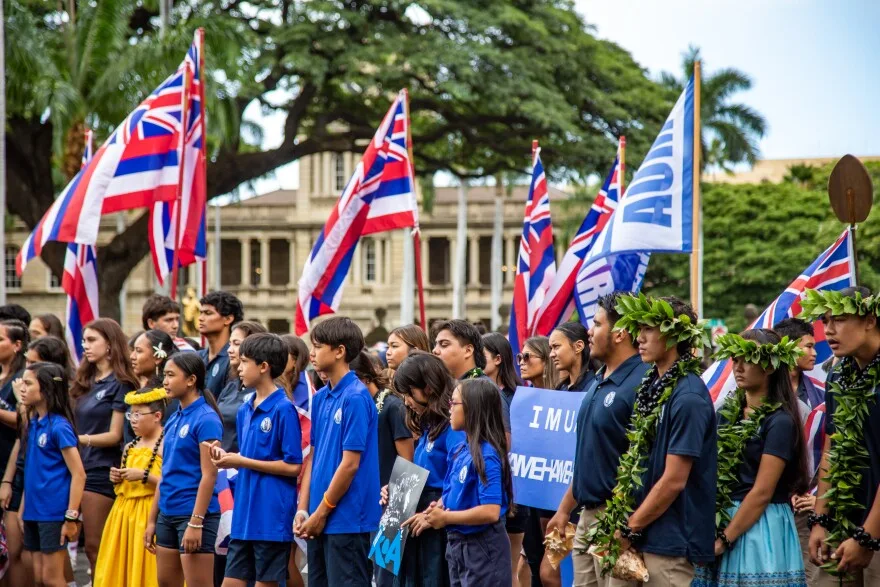
October 21, 2025: Hundreds rally at ‘Iolani Palace in Honolulu supporting Kamehameha Schools.
November 7, 2025: Maui County Council unanimously passes resolution supporting Kamehameha Schools.
December 2025: Democratic National Committee passes resolution condemning the lawsuit and reaffirming Native Hawaiian political status. Kamehameha announces tuition will be eliminated starting 2026-27 school year, pending probate court approval.
December 24, 2025: Case remains in preliminary stages. No court hearing scheduled. No motions filed yet.
Legal Claims: What Federal Law SFFA Invokes
42 U.S.C. § 1981 (Civil Rights Act of 1866):
This Reconstruction-era statute guarantees “all persons shall have the same right to make and enforce contracts as is enjoyed by white citizens.”
Courts have interpreted this to prohibit racial discrimination in private contracting relationships—including private school admissions that involve contracts.
SFFA’s argument:
Because Kamehameha requires:
- Application agreements
- Enrollment contracts
- Tuition payments (approximately $5,676-$12,000 annually before recent elimination announcement)
…admissions decisions constitute “contracting” under federal law, and race-based preferences violate § 1981.
Rice v. Cayetano precedent (2000):
SFFA cites this Supreme Court case which held that Native Hawaiian ancestry is a racial classification, not a political one, when striking down voting restrictions for Office of Hawaiian Affairs elections.
Supreme Court affirmative action ruling (2023):
The lawsuit argues principles from SFFA’s successful Harvard/UNC cases—that racial classifications in admissions violate equal protection—apply equally to K-12 private schools.
Kamehameha Schools’ Defense: Political Status, Not Race
Kamehameha Schools and Native Hawaiian advocates argue SFFA fundamentally misunderstands Hawaiian legal status.
Core defense arguments:
1. Native Hawaiians are a political class, not a racial group:
“Native Hawaiians are a political entity. We are recognized in over 150 federal statutes and many other forms of recognition so we are not a race. We are a political class of America,” said Kuhio Lewis, CEO of Hawaiian Council.
This distinction matters legally: Congress has authority to benefit indigenous peoples as political entities (like tribes), even when race-based classifications would be prohibited.
2. Private trust implementing testamentary directive:
Kamehameha operates as a private charitable trust created by Princess Pauahi’s will—not a public institution subject to government anti-discrimination rules.
“The United States government should not be interfering with the business of a private trust’s ability to implement the kauoha [sacred trust] of a high-ranking Hawaiian Kingdom chiefess,” Kamehameha stated.
3. Remedial purpose addressing documented educational disparities:
Current data shows Native Hawaiian students in public schools face significant educational gaps:
- 35% tested proficient in reading vs. 50%+ of all students
- 25% scored proficient in math vs. 41% of all students
- 35% chronic absenteeism rate vs. lower rates for other groups
- 79% graduate high school on time vs. 83% statewide average
The 2003-2006 court rulings found these disparities justified Kamehameha’s preference policy.
4. Previous legal victories:
Kamehameha successfully defended its policy 20 years ago. Crystal Kauilani Rose, current Board of Trustees chair who served as outside counsel in those cases, said: “We understand the law and the facts, and the law and the facts are on our side.”
5. No federal funding:
Unlike most schools, Kamehameha receives zero state or federal financial assistance. The $15 billion endowment from Princess Pauahi’s estate funds operations entirely.
What Makes This Case Legally Significant
The lawsuit tests critical questions about civil rights law, indigenous peoples’ status, and private institutions:
1. Does Rice v. Cayetano control?
The 2000 Supreme Court case said Native Hawaiian ancestry is racial for voting rights purposes. Does that automatically extend to private educational institutions implementing a 19th-century chiefess’s will?
2. Can private schools have race-conscious admissions?
The 2023 Supreme Court affirmative action ruling addressed public universities and private universities receiving federal funds. Kamehameha is purely privately funded. Does § 1981 prohibit what the Constitution doesn’t?
3. Political status vs. racial classification:
If Native Hawaiians are a political class (like federally recognized tribes), Congress may authorize benefits unavailable for purely racial classifications. This case could clarify that distinction.
4. Testamentary freedom vs. civil rights law:
Can modern anti-discrimination law override a 19th-century testator’s directive to benefit a specific indigenous group? Where do donor intent protections end and civil rights obligations begin?
5. Post-Harvard implications:
SFFA’s Harvard/UNC victory emboldened challenges to diversity policies nationwide. Success against Kamehameha could threaten indigenous-focused institutions across the U.S.
Why This Lawsuit Differs from Harvard/UNC
Key distinctions from SFFA’s previous victories:
Funding source: Kamehameha receives no federal or state money; Harvard and UNC receive substantial federal funding.
Legal basis: Princess Pauahi’s will created an explicit, legally-binding directive to educate Native Hawaiians. Universities had no similar foundational documents.
Political status: Native Hawaiians have unique federal recognition unlike racial groups in college affirmative action cases.
Educational context: K-12 schools (especially serving children in cultural preservation contexts) receive different legal treatment than universities.
Scale of preference: Kamehameha’s preference is near-absolute; college affirmative action was one factor among many.
Historical context: Founded in 1887 specifically to address Native Hawaiian population collapse and cultural genocide—not general diversity goals.
Community Response: Massive Support for Kamehameha
The lawsuit triggered unprecedented solidarity:
October 21, 2025 rally: Hundreds gathered at ‘Iolani Palace wearing blue, waving Hawaiian flags, singing and chanting support.
Student testimony: Kamehameha students testified before Maui County Council about opportunities and pride the school provides.
Political backing:
- Maui County Council: Unanimous resolution supporting Kamehameha (November 7, 2025)
- Democratic National Committee: Unanimous resolution condemning lawsuit (December 2025)
- ACLU of Hawaii: Supporting Kamehameha’s position
- Office of Hawaiian Affairs: Defending policy
Petition: Over 30,000 signatures supporting admissions policy.
Threats against SFFA: The lawsuit includes 8 pages documenting profanity-laced death threats, antisemitic comments, and violent messages directed at Edward Blum and plaintiffs, explaining why families remain anonymous.
Current Status: Early Stages, No Court Action Yet
As of December 24, 2025:
Procedural posture: Case filed October 20, 2025 in U.S. District Court for the District of Hawaii (Case No. 1:25-cv-00450-LEK-RT).
Court activity: No hearings scheduled. No motions filed. No judge rulings issued.
Discovery: Not yet commenced.
Expected timeline: Based on similar cases:
- Kamehameha will file motion to dismiss (likely Q1 2026)
- SFFA will oppose dismissal motion
- Court hearing on dismissal (likely Q2 2026)
- If case survives, discovery extends 12-18 months
- Trial unlikely before 2027
Recent development: December 23, 2025—Kamehameha announces all tuition will be eliminated starting 2026-27 school year, pending probate court approval. Current tuition ranges from $2,800-$12,000 annually depending on program.
This move removes one of SFFA’s arguments that tuition creates a “contract” subject to § 1981.
What This Means for Native Hawaiian Families
For families with children at Kamehameha:
- No immediate impact on current students
- School operations continue normally
- Tuition elimination coming 2026-27 strengthens school’s position
- Legal battle could extend years
For families seeking admission:
- Admissions policy remains in effect during litigation
- Non-Hawaiian families still cannot apply based on current policy
- If SFFA wins, policy could be overturned, opening admissions
- If Kamehameha wins, policy remains protected
For the broader Native Hawaiian community:
This lawsuit threatens the single largest educational resource for Native Hawaiians—a school system serving approximately 7,000 students annually across three K-12 campuses on Oahu, Maui, and Hawaii Island, plus 30 preschools.
Loss could eliminate preference policy established 137 years ago specifically to preserve Native Hawaiian culture and address educational disparities that persist today.
Implications for Indigenous Education Nationwide
Beyond Hawaii, the case could impact indigenous-focused institutions across the U.S.:
Tribal schools and colleges: If courts rule Native Hawaiian political status doesn’t protect Kamehameha, similar logic could threaten institutions serving Native American tribes.
Charitable trusts with cultural missions: Many foundations support specific ethnic or cultural communities. This case tests whether modern civil rights law overrides donor intent in private charitable giving.
Cultural preservation efforts: Indigenous language immersion schools, cultural programs, and community institutions could face challenges if ancestry-based preferences are ruled illegal.
Private school autonomy: The case tests limits on private institutions’ freedom to define their missions and beneficiaries without government interference.
What Legal Experts Predict
SFFA’s advantages:
“After Harvard and UNC, SFFA has momentum and Supreme Court precedent that racial classifications are disfavored,” notes civil rights attorney analysis. “The conservative Supreme Court majority is skeptical of race-conscious policies.”
Kamehameha’s advantages:
“This case is fundamentally different from college admissions,” explains education law experts. “Native Hawaiian political status, private funding, testamentary directive, and remedial purpose addressing documented disparities create multiple defenses unavailable to Harvard or UNC.”
Most likely outcome:
Legal observers predict:
- District court dismissal (40% probability): Judge finds Kamehameha’s defenses valid, dismisses case. SFFA appeals to Ninth Circuit.
- Ninth Circuit upholds Kamehameha (30% probability): Even if district court rules for SFFA, Ninth Circuit could reverse based on 2006 precedent and indigenous peoples’ special status.
- Supreme Court review (20% probability): Given SFFA’s track record and conservative majority, case could reach high court regardless of lower court outcomes.
- Settlement (10% probability): Least likely given both sides’ conviction and broader principles at stake.
Timeline: Final resolution likely 3-5 years away given appeals process.
Similar Cases: Precedents Involving Indigenous Education
Doe v. Kamehameha Schools (2003-2007):
The most direct precedent. U.S. District Court Judge Alan Kay ruled Kamehameha’s policy was valid because:
- School is privately funded
- Policy addresses documented educational disparities
- Native Hawaiians have special relationship with U.S. government
- Ninth Circuit upheld 8-7 en banc
Kamehameha settled for $7 million before Supreme Court could rule, preserving policy but leaving ultimate legal question unanswered.
Santa Clara Pueblo v. Martinez (1978):
Supreme Court held tribal membership rules are internal tribal matters where federal courts should not intervene, respecting tribal sovereignty. Could support argument that indigenous groups can define their own communities and beneficiaries.
Morton v. Mancari (1974):
Supreme Court upheld Bureau of Indian Affairs employment preferences for Native Americans, ruling that preferences for indigenous peoples based on political status (not race) are constitutional. Key precedent for political vs. racial classification distinction.
Rice v. Cayetano (2000):
Supreme Court struck down Native Hawaiian voting restrictions, calling them racial classifications. SFFA relies heavily on this case, but courts have distinguished voting rights from educational remedial programs.
FAQ: Kamehameha Schools Lawsuit 2025
What is the Kamehameha Schools lawsuit about?
Students for Fair Admissions sued Kamehameha Schools on October 20, 2025, claiming the school’s 137-year-old policy giving preference to Native Hawaiian students violates federal civil rights law (42 U.S.C. § 1981). SFFA seeks to force the school to stop considering ancestry in admissions.
Who is suing Kamehameha Schools?
Students for Fair Admissions (SFFA), a Virginia-based nonprofit led by conservative activist Edward Blum. SFFA successfully challenged affirmative action at Harvard and UNC in 2023. The group represents two anonymous Hawaii families (Family A and Family B) whose non-Hawaiian daughters want to attend Kamehameha.
What does Kamehameha Schools say?
Kamehameha vows to “vigorously defend” its admissions policy, stating “the facts and the law are on our side, and we are confident that we will prevail.” The school argues it’s a private trust implementing Princess Pauahi Bishop’s will, and Native Hawaiians are a political class (not racial group) eligible for special federal recognition.
Has any court ruled on the lawsuit yet?
No. As of December 24, 2025, no hearings have been scheduled and no motions filed. The case is in preliminary stages. Court rulings likely won’t come until mid-2026 at earliest.
Why does Kamehameha Schools give preference to Native Hawaiians?
Princess Bernice Pauahi Bishop’s 1883 will established the school specifically to educate Native Hawaiian children amid catastrophic population decline and cultural suppression. The policy has existed since the school opened in 1887. Current data shows Native Hawaiian students in public schools face significant educational gaps compared to other groups.
Is Kamehameha Schools public or private?
Private. Kamehameha receives zero state or federal funding. The school operates entirely on Princess Pauahi’s $15 billion endowment from her estate. This distinction is legally significant because private institutions have more autonomy than public schools.
Can non-Hawaiian students attend Kamehameha Schools now?
The policy gives preference to Native Hawaiian applicants “to the extent permitted by law.” In practice, no non-Native Hawaiian students have attended in at least 15 years according to the lawsuit. The school admits Native Hawaiians first and only considers others if seats remain—which they ensure doesn’t happen.
What happens if SFFA wins the lawsuit?
If courts rule in SFFA’s favor, Kamehameha would be forced to eliminate ancestry-based admissions preferences, potentially opening enrollment to non-Hawaiian students. This would fundamentally change the school’s 137-year mission to serve Native Hawaiian children specifically.
What happens if Kamehameha wins the lawsuit?
The admissions policy remains protected, preserving Princess Pauahi’s directive to educate Native Hawaiian children. The school continues serving its core mission addressing educational disparities Native Hawaiians face.
Has Kamehameha faced lawsuits before?
Yes. In 2003-2007, the school successfully defended its policy in Doe v. Kamehameha Schools. A U.S. District Court ruled the policy was valid; the Ninth Circuit upheld this 8-7. Kamehameha settled for $7 million before the Supreme Court could review, preserving the policy.
How is this different from the Harvard/UNC affirmative action case?
Major differences:
- Kamehameha receives no government funding (Harvard/UNC receive federal funds)
- Founded specifically to serve Native Hawaiians per Princess Pauahi’s will (universities had general diversity goals)
- Native Hawaiians have special federal political status (unlike racial groups in college cases)
- K-12 education vs. university admissions receive different legal treatment
Who supports Kamehameha Schools?
Overwhelming support includes:
- Maui County Council (unanimous resolution)
- Democratic National Committee (unanimous resolution)
- ACLU of Hawaii
- Office of Hawaiian Affairs
- Over 30,000 petition signatures
- Hundreds who rallied at ‘Iolani Palace
What is SFFA’s argument?
SFFA claims admissions constitute “contracting” under federal law because applications involve agreements, enrollment contracts, and tuition. They argue 42 U.S.C. § 1981 prohibits racial discrimination in contracts, and Native Hawaiian ancestry is a racial (not political) classification based on Rice v. Cayetano (2000).
How long will this lawsuit take?
Based on similar cases, expect:
- Initial motions: Q1-Q2 2026
- District court ruling: Late 2026
- Appeals: 2027-2028
- Possible Supreme Court: 2028-2029
Final resolution likely 3-5 years away.
Can families join the lawsuit?
The lawsuit is brought by SFFA on behalf of its members, including two anonymous families. Other families cannot directly “join” but could contact SFFA through KamehamehaNotFair.org if they want to support the case.
Will tuition changes affect the lawsuit?
Possibly. Kamehameha announced December 23, 2025 that tuition will be eliminated starting 2026-27 (pending court approval). This removes SFFA’s argument that tuition creates a “contract” subject to anti-discrimination law, potentially strengthening Kamehameha’s defense.
What’s at stake beyond this one school?
The case could impact indigenous-focused educational institutions nationwide, tribal schools, cultural preservation programs, and private charitable trusts serving specific ethnic communities. It tests whether modern civil rights law overrides donor intent in private charitable giving and whether indigenous peoples’ political status protects ancestry-based programs.
Resources:
- U.S. District Court for the District of Hawaii: Case No. 1:25-cv-00450-LEK-RT
- Kamehameha Schools: www.ksbe.edu
- Students for Fair Admissions: www.studentsforfairadmissions.org
- Office of Hawaiian Affairs: www.oha.org
- 42 U.S.C. § 1981 (Civil Rights Act of 1866)
- Rice v. Cayetano, 528 U.S. 495 (2000)
- Doe v. Kamehameha Schools, 470 F.3d 827 (9th Cir. 2006)
For additional articles on civil rights law, education law, and discrimination litigation, visit AllAboutLawyer.com’s legal resources.
About the Author

Sarah Klein, JD, is a licensed attorney and legal content strategist with over 12 years of experience across civil, criminal, family, and regulatory law. At All About Lawyer, she covers a wide range of legal topics — from high-profile lawsuits and courtroom stories to state traffic laws and everyday legal questions — all with a focus on accuracy, clarity, and public understanding.
Her writing blends real legal insight with plain-English explanations, helping readers stay informed and legally aware.
Read more about Sarah