
Johnson’s “Shea & Cocoa Butter” Baby Oil Contains Less Than 1% of What’s On the Label—New Class Action Lawsuit on Allegedly Deceptive Baby Oil Labeling
Kenvue (doing business as Johnson & Johnson) faces a new class action lawsuit alleging its Johnson’s Shea & Cocoa Butter Oil is falsely advertised. Plaintiff Michael Douma claims the product marketed as containing shea and cocoa butter oil actually contains less than 1% of these moisturizing ingredients, with the majority being mineral oil—a petroleum byproduct. The lawsuit, filed December 3, 2025 in New Jersey federal court (Case No. 2:25-cv-18129), seeks damages for Maryland consumers who purchased the product during the four years before the complaint was filed.
Here’s what’s shocking: Johnson & Johnson products reach an estimated 1 billion consumers worldwide. Millions of parents trust this brand with their babies’ skin. And according to this lawsuit, what they’re buying isn’t what the label promises.
What the Lawsuit Claims: You’re Buying Petroleum, Not Butter
Picture this scenario: You’re shopping for baby oil. You see Johnson’s Shea & Cocoa Butter Oil. The name screams moisturizing, natural ingredients.
You buy it thinking you’re getting a product made from shea and cocoa butter—ingredients famous for their moisturizing properties.
Then you read the fine print on the ingredient list. Mineral oil is listed first. Shea and cocoa butter? They’re near the bottom.
Here’s what the lawsuit alleges:
According to the class action complaint, Kenvue advertises its shea and cocoa butter oil product as being made primarily from shea and cocoa butter oil. However, the product actually contains less than 1% of these ingredients, with the majority of the product being composed of mineral oil, a petroleum byproduct.
Why this matters:
FDA regulations require cosmetic ingredients to be listed in descending order of predominance. When mineral oil is listed first and shea/cocoa butter appear near the end, it means the product is overwhelmingly petroleum-based with only trace amounts of the advertised butter ingredients.
Douma argues that Johnson & Johnson markets the shea and cocoa butter oil as a moisturizing baby oil, even though the product allegedly contains only trace amounts of the moisturizing agents.
The legal violations claimed:
- Federal Food, Drug and Cosmetic Act violations (misbranded cosmetics)
- Maryland consumer protection law violations
- False advertising
- Breach of warranty
- Unjust enrichment
Which Products Are Affected?
The lawsuit specifically targets Johnson’s Shea & Cocoa Butter Oil products.
Product details:
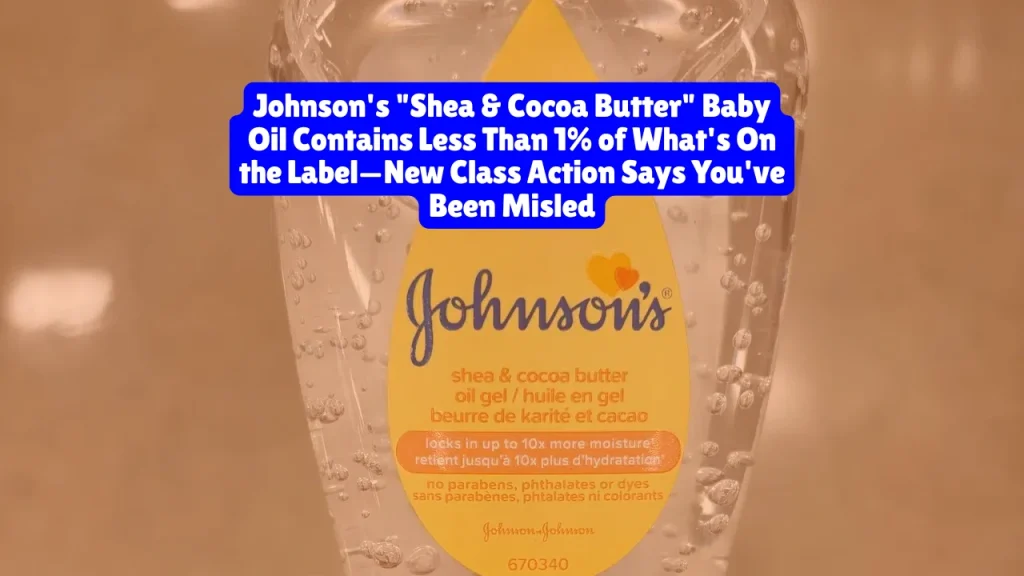
- Product name: Johnson’s Shea & Cocoa Butter Oil (also sold as “Oil Gel”)
- Marketed as: Moisturizing baby oil made from shea and cocoa butter
- Actual composition: Primarily mineral oil (petroleum byproduct) with less than 1% shea and cocoa butter
- Where sold: Nationwide retailers including drugstores, supermarkets, big-box stores, and online platforms
- Time period: Four years preceding December 3, 2025 (approximately December 2021 – December 2025)
Important: The lawsuit focuses on Maryland purchasers, but could expand to other states if additional plaintiffs join or the class is broadened.
Related Article: Tom’s of Maine Class Action Lawsuit, Made Toothpaste With Bacteria-Contaminated Water—FDA Found Black Mold One Foot From Production Equipment
The Mineral Oil Issue: What You’re Actually Putting On Your Baby’s Skin
Let’s talk about what mineral oil actually is and why this matters.
What Is Mineral Oil?
Mineral oil is a petroleum byproduct—basically, it’s derived from crude oil, the same stuff that becomes gasoline and diesel fuel.
In cosmetics, mineral oil is:
- Cheap (far less expensive than shea or cocoa butter)
- Shelf-stable (doesn’t go rancid like natural oils)
- Occlusive (sits on top of skin rather than absorbing)
Why Consumers Seek Shea and Cocoa Butter
Douma says Kenvue’s misrepresentations are material to consumers, who specifically seek out products containing shea and cocoa butter for their moisturizing properties.
Shea butter benefits:
- Rich in vitamins A and E
- Deeply moisturizing
- Anti-inflammatory properties
- Natural, plant-derived
- Absorbs into skin
Cocoa butter benefits:
- High in fatty acids
- Nourishes and hydrates
- Creates protective barrier
- Natural antioxidants
- Absorbs into skin
Mineral oil properties:
- Sits on skin surface (doesn’t absorb)
- No nutritional value
- No vitamins or fatty acids
- Creates barrier but doesn’t moisturize from within
- Petroleum-derived
The Price Premium Problem
Products advertised as containing shea and cocoa butter typically cost more than plain mineral oil baby products. Consumers pay that premium believing they’re getting superior moisturizing ingredients.
As a result, consumers are misled into purchasing a product that does not deliver the promised benefits, the class action lawsuit claims.
Who Can Join This Lawsuit?
The lawsuit seeks class action status, meaning it would represent multiple consumers affected by the same alleged deceptive practices.
Likely eligibility requirements:
Who qualifies:
- Purchased Johnson’s Shea & Cocoa Butter Oil
- Purchased in Maryland (current proposed class)
- Purchased during the four-year period before December 3, 2025 (approximately December 2021 – December 2025)
- Would not have purchased or would have paid less if aware of true composition
You likely DON’T need:
- Receipts (though they help)
- Proof of harm or injury
- Evidence of skin reactions
Important: This lawsuit could expand to cover other states as additional plaintiffs join or if the class definition is broadened during litigation.
The Legal Claims: Why This Allegedly Violates The Law
The lawsuit pursues multiple legal theories based on federal and state consumer protection laws.
1. Misbranded Cosmetics (Federal Law)
The lawsuit argues that Kenvue’s labeling practices are unlawful under both state and federal law. The Federal Food, Drug and Cosmetic Act prohibits cosmetics from being misbranded, meaning the label contains a statement that is “false or misleading in any particular.”
Why this matters: Federal law makes it illegal to label cosmetics in ways that deceive consumers about what they’re actually buying.
2. Maryland Consumer Protection Violations
Similarly, Maryland law prohibits the misbranding of cosmetics and drugs, the class action lawsuit says.
Maryland’s consumer protection statutes provide remedies when companies engage in deceptive trade practices.
3. Breach of Warranty
The prominent labeling of “Shea & Cocoa Butter” creates an express warranty—a promise about what the product contains and what benefits it delivers.
When the product is primarily mineral oil with less than 1% of the advertised ingredients, that warranty is allegedly breached.
4. Unjust Enrichment
Kenvue allegedly profited from consumers paying premium prices for a product marketed as containing expensive moisturizing butters when it actually contains cheap petroleum oil.
This constitutes unjust enrichment—keeping money obtained through misleading practices.
Current Lawsuit Status: Early Stages
As of January 2026, the lawsuit is in its earliest phases.
Timeline:
- December 3, 2025: Complaint filed in U.S. District Court for the District of New Jersey
- January 2026: Defendant Kenvue has not yet filed a response
- Expected next steps: Kenvue will likely file a motion to dismiss or answer the complaint
Typical class action timeline:
- Motion to dismiss (defendant argues claims should be thrown out)
- Discovery (if case survives dismissal, both sides collect evidence)
- Class certification motion (determining whether case can proceed as a class action representing multiple consumers)
- Settlement negotiations or trial
Similar case outcome:
In a related Johnson & Johnson case, a plaintiff challenged Neutrogena “Oil-Free Face Moisturizer” that allegedly contained oils. That case (Noohi v. Johnson & Johnson Consumer Inc.) was certified as a class action in California and proceeded through litigation, showing courts take these labeling claims seriously.
Potential Compensation: What Could Class Members Receive?
If the lawsuit succeeds through settlement or verdict, class members could receive various forms of relief.
The class action lawsuit seeks damages, restitution and injunctive relief to prevent Kenvue from continuing its allegedly deceptive labeling practices.
Typical remedies in false advertising settlements:
Monetary relief:
- Full refund of purchase price (with proof of purchase)
- Partial refund per product (without receipts, typically $3-8 per product, capped at certain number)
- Economic damages for price premium paid
Non-monetary relief:
- Corrective advertising
- Changes to labeling practices
- Ingredient composition changes
- Enhanced disclosure requirements
For comparison, similar baby product settlements:
- Barlean’s Organic Oils coconut oil: $1.6 million settlement for false “healthy” advertising
- Various “natural” product claims: Settlements ranging from $1-5 million for ingredient misrepresentation
How This Compares to Other Johnson & Johnson Lawsuits
Kenvue/Johnson & Johnson faces extensive consumer protection litigation beyond this baby oil case.
Related Active Cases
1. Neutrogena “Oil-Free” Moisturizer (Certified Class Action)
- Alleged “oil-free” products contained oils and oil-based ingredients
- California class certified
- Similar labeling deception claims
2. Baby Powder Talc Litigation
- Over 60,000 lawsuits alleging asbestos contamination
- Billion-dollar verdicts and settlements
- Different issue (safety vs. labeling), but shows pattern of consumer trust violations
In other litigations against Johnson & Johnson, a Minnesota jury has awarded a mother of three $65.5 million in a lawsuit over claims the company’s talc products exposed her to asbestos and contributed to cancer in her abdominal lining.
3. Various “Natural” and “Hypoallergenic” Claims
- Multiple lawsuits challenging vague marketing terms
- Allegations that products don’t match marketing promises
What This Reveals About Baby Product Labeling
This lawsuit exposes broader issues with cosmetic labeling and consumer protection.
The Regulatory Loophole
According to FDA guidance, cosmetic companies are responsible for ensuring their products are safe and not misbranded. However, the FDA does not pre-approve cosmetics before they go to market.
What that means:
- Companies don’t need FDA approval for products or labeling
- Companies are responsible for their own safety and accuracy
- FDA regulates reactively (after problems emerge)
- No verification of marketing claims before products hit shelves
The “Name Game” Loophole
Here’s where companies get creative: They name the product “Shea & Cocoa Butter Oil” but bury the actual composition in the ingredient list.
Most consumers:
- Read the product name (not ingredient list)
- Trust the brand
- Assume “Shea & Cocoa Butter Oil” means that’s what’s in the bottle
- Don’t realize they need to check ingredient order
The result: Companies can put tiny amounts of premium ingredients in cheap petroleum-based formulas and charge premium prices.
FAQ: Everything You Need To Know About This Lawsuit
Q: Did I buy this product?
Check your bathroom. The product is labeled “Johnson’s Shea & Cocoa Butter Oil” or “Johnson’s Shea & Cocoa Butter Oil Gel.” It typically comes in a clear bottle showing the oil color, sold in drugstores, supermarkets, Target, Walmart, and online.
Q: Do I need receipts to join the lawsuit?
Not necessarily. Most class action settlements offer two tiers: full refunds with receipts, and smaller fixed payments without receipts (typically $3-8 per product, capped at a certain number).
Q: I used this product on my baby—is it dangerous?
The lawsuit alleges deceptive labeling, not safety issues. Mineral oil is commonly used in baby products and is generally considered safe. The issue is that you paid for shea and cocoa butter but got petroleum oil instead.
Q: How much could I get from this lawsuit?
It’s too early to know. Settlements in similar false advertising cases have ranged from $1.6 million to over $5 million, with individual payments ranging from a few dollars to full refunds depending on purchase history.
Q: Do I need to do anything right now?
Not yet. The case is in early stages. If class certification is granted, there will be a notice process informing eligible consumers. You can monitor the case or sign up for updates from plaintiff attorneys.
Q: Why is this only for Maryland consumers?
The current proposed class covers Maryland purchasers, likely because that’s where the plaintiff bought the product. Class definitions often expand to nationwide as litigation progresses or additional plaintiffs from other states join.
Q: What’s the difference between mineral oil and shea/cocoa butter?
Mineral oil is a petroleum byproduct that sits on skin’s surface. Shea and cocoa butter are natural plant-derived ingredients rich in vitamins and fatty acids that absorb into skin. They’re also significantly more expensive.
Q: Can I still use the product I have?
That’s your decision. The lawsuit alleges misleading labeling, not safety issues. The product likely works as a baby oil—it’s just primarily mineral oil rather than the shea and cocoa butter you thought you were buying.
Q: Has Kenvue/Johnson & Johnson responded?
As of early January 2026, the company had not yet filed a public response to the lawsuit.
Q: How long will this take?
Class action lawsuits typically take 1-3 years from filing to settlement or verdict. The case must survive dismissal motions, complete discovery, achieve class certification, and either settle or go to trial.
What To Do If You Purchased This Product
Step 1: Check Your Purchases
Look through your bathroom products. The lawsuit covers purchases made approximately between December 2021 and December 2025 in Maryland.
Step 2: Save Your Evidence
- Keep any remaining product packaging
- Look for receipts (credit card statements, online order confirmations)
- Take photos of product labels
- Note approximately when and where you purchased
Step 3: Monitor the Case
The plaintiff is represented by Sergei Lemberg of Lemberg Law LLC. You can:
- Monitor federal court dockets through PACER
- Sign up for case notifications if/when settlement website is created
Step 4: Wait for Class Notice
If the class is certified, there will be a formal notice process. You don’t need to hire a lawyer—class action attorneys work on contingency (paid from settlement fund).
Official Resources & Case Information
Court Information:
- Court: U.S. District Court for the District of New Jersey
- Case name: Douma v. Kenvue Brands LLC d/b/a Johnson & Johnson
- Case number: 2:25-cv-18129
- Filed: December 3, 2025
Plaintiff Attorney:
- Sergei Lemberg, Lemberg Law LLC
Regulatory Resources:
Consumer Protection:
The Bottom Line: What This Means For You
You trusted a brand with your baby’s skin. You read “Shea & Cocoa Butter Oil” and believed that’s what you were buying.
According to this lawsuit, you got petroleum oil with less than 1% of what the label promised.
This isn’t about safety—it’s about honesty. When companies charge premium prices for “butter” products but deliver petroleum products, that’s allegedly false advertising.
Three things to remember:
- Check your products: Johnson’s Shea & Cocoa Butter Oil purchased in Maryland between December 2021-2025
- Save your evidence: Packaging, receipts, purchase records
- Monitor the case: Class certification will trigger notice to eligible consumers
The case is Douma v. Kenvue Brands LLC d/b/a Johnson & Johnson, Case No. 2:25-cv-18129, pending in the U.S. District Court for the District of New Jersey.
You paid for butter. You allegedly got petroleum. The courts will decide if that’s legal.
Related Articles:
- Olipop Prebiotic Soda Class Action: $3 Drinks Are Just Sugared Water
- Supergoop “Mineral” Sunscreen Contains Synthetic Ingredients
- Holmes Nutrition 75% Protein Powder Had Only 3.4g
Disclaimer: This article is for informational purposes only and does not constitute legal advice. If you need legal assistance regarding this lawsuit, consult with a licensed attorney in your jurisdiction.
About the Author

Sarah Klein, JD, is a licensed attorney and legal content strategist with over 12 years of experience across civil, criminal, family, and regulatory law. At All About Lawyer, she covers a wide range of legal topics — from high-profile lawsuits and courtroom stories to state traffic laws and everyday legal questions — all with a focus on accuracy, clarity, and public understanding.
Her writing blends real legal insight with plain-English explanations, helping readers stay informed and legally aware.
Read more about Sarah