
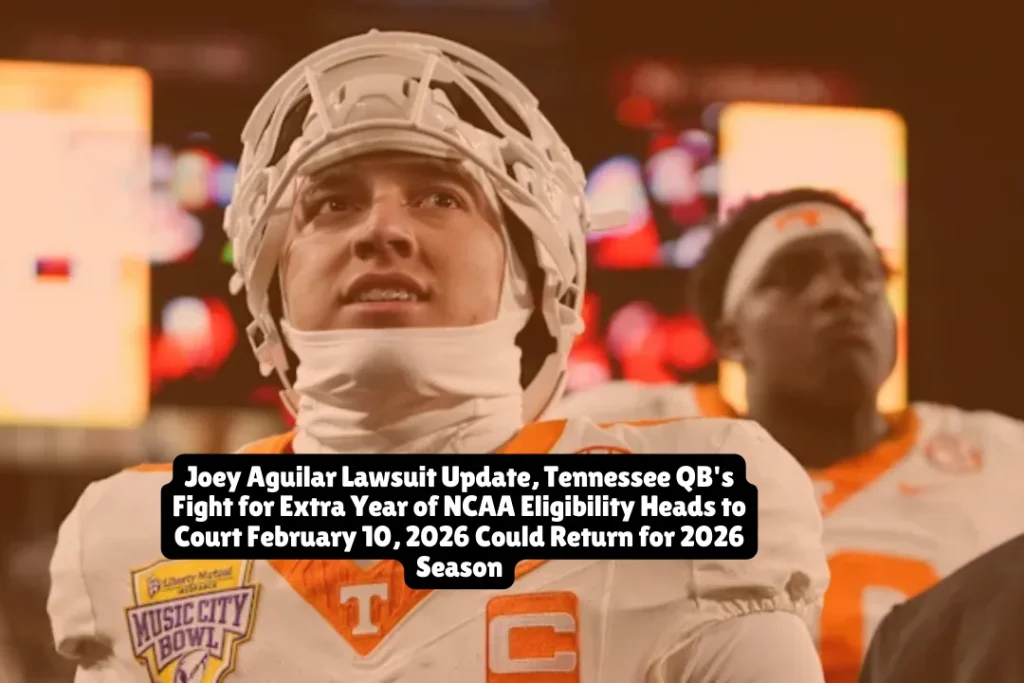
Joey Aguilar Lawsuit Update, Tennessee QB’s Fight for Extra Year of NCAA Eligibility Heads to Court February 10, 2026 (Could Return for 2026 Season)
Tennessee quarterback Joey Aguilar’s battle for one more year of college football eligibility reaches a critical hearing on February 10, 2026, in Nashville federal court. The 24-year-old joined 25 other former junior college players in an amended lawsuit challenging NCAA rules that count JUCO seasons against Division I eligibility—a fight that could give Aguilar a fifth year at Tennessee or end his college career after the 2025 Music City Bowl.
What Is the Joey Aguilar Lawsuit?
Joey Aguilar is a plaintiff in Pavia v. National Collegiate Athletic Association, Case No. 3:24-cv-01336, filed in the U.S. District Court for the Middle District of Tennessee at Nashville. The lawsuit was originally filed on November 8, 2024, by Vanderbilt quarterback Diego Pavia, who sued the NCAA under Section 1 of the Sherman Antitrust Act claiming NCAA eligibility bylaws illegally restrict former junior college players from competing and earning Name, Image, and Likeness (NIL) compensation.
Aguilar joined the lawsuit through an amended complaint filed on November 21, 2025. He is now one of 26 plaintiffs represented by attorneys Ryan Downton of The Texas Trial Group and Salvador M. Hernandez of Riley & Jacobson PLC. Chief U.S. District Judge William L. Campbell Jr. is presiding over the case.
The lawsuit challenges three specific NCAA bylaws that the plaintiffs claim violate federal antitrust law by restraining competition in the labor market for Division I college football players.
Why Is Joey Aguilar Suing the NCAA?
Aguilar played two seasons at Diablo Valley Community College in Pleasant Hill, California before transferring to Appalachian State University, where he started for two seasons (2023 and 2024). He briefly transferred to UCLA in early 2025 after learning he had one more year of eligibility, then transferred again to Tennessee in May 2025 when former Vols quarterback Nico Iamaleava went to UCLA.
Under current NCAA rules, Aguilar’s five-year eligibility clock expires after the 2025 season. But the lawsuit argues that if you exclude his two junior college seasons, he has only competed in three Division I seasons over three years—meaning he should have one more year of eligibility remaining.
The core legal argument is straightforward: junior colleges are not NCAA member institutions, so why should time spent at those schools count against NCAA eligibility? The plaintiffs argue this rule unfairly restricts JUCO transfers compared to athletes who delay entering Division I to attend prep school, serve in the military, or even compete professionally in other sports.
What NCAA Rules Does the Lawsuit Challenge?
The lawsuit specifically challenges three NCAA bylaws:
NCAA Bylaw 12.02.6 (Intercollegiate Competition Rule): This rule counts all seasons played at junior colleges toward a player’s Division I eligibility, even though JUCO institutions aren’t NCAA members. Aguilar’s complaint states this wrongfully equates competition at the junior college level (where little to no NIL compensation is available) with NCAA Division I football where substantial NIL opportunities exist.
NCAA Bylaw 12.8 (Five-Year Rule): Limits athletes to four seasons of competition within five years, with the clock starting when they first enroll at any collegiate institution including junior colleges. The lawsuit argues the eligibility clock should only begin when players first enroll at an NCAA member school, not at JUCO schools.
NCAA Bylaw 14.3.3 (JUCO Transfer Cap): Limits junior college transfers to a maximum of three years at Division I schools. Combined with the Five-Year Rule, this effectively gives former JUCO players less opportunity to compete and earn NIL compensation than athletes who never attended junior college.
What Is the Current Status as of February 2026?
As of February 2026, the case is proceeding rapidly due to NCAA transfer portal timing. According to court documents and legal reporting from Knox News and 247Sports, a preliminary injunction hearing is scheduled for 1:00 p.m. on February 10, 2026, in Nashville.
By February 3, 2026, both parties had to submit affidavits, witness lists, exhibit lists, depositions, deposition designations, and stipulations. A conference call between Judge Campbell and attorneys occurred on January 12, 2026, but no resolution came from that meeting.
The February 10 hearing will determine whether the court grants a preliminary injunction that would allow Aguilar and the other 25 plaintiffs to compete in 2026 and potentially 2027 while the full case proceeds. A ruling may not come for days or possibly weeks after the hearing.
Related Article: Conduent Data Breach Update, 14.7 Million Victims in Texas Alone, 10+ Class Actions Filed, Free Credit Monitoring Deadline March 31, 2026
The NCAA transfer portal window closed on January 16, 2026, creating urgency for Tennessee’s quarterback situation. If Aguilar doesn’t get an injunction, Tennessee will enter the 2026 season with redshirt freshman George MacIntyre and true freshman five-star Faizon Brandon as their only scholarship quarterbacks.
How Does This Compare to Similar NCAA Lawsuits?
The Joey Aguilar lawsuit is part of a wave of eligibility challenges against the NCAA following landmark antitrust decisions. The Diego Pavia lawsuit update shows how Vanderbilt’s quarterback won a preliminary injunction in December 2024 that forced the NCAA to issue a blanket waiver for the 2025 season, allowing former JUCO players like Aguilar one extra year of eligibility.
That waiver expires at the end of the 2025-26 academic year, which is why Aguilar and the other plaintiffs are seeking a new preliminary injunction for 2026 and beyond.
Other recent NCAA eligibility lawsuits include:
Langston Patterson v. NCAA: A Vanderbilt linebacker challenging redshirt rules, seeking five full years of eligibility instead of five years to play four seasons. Judge Campbell denied this preliminary injunction in January 2026.
Trinidad Chambliss v. NCAA: The Ole Miss quarterback filed a lawsuit on January 16, 2026, in Mississippi state court after the NCAA denied his medical waiver for a sixth year. This case involves medical hardship rather than JUCO eligibility.
Alberto Osuna v. NCAA: A former Tennessee baseball player sought similar relief to Pavia in December 2024 but was denied on grounds of insufficient demonstration of “substantial anticompetitive harm.”
More than 35 athletes have filed eligibility lawsuits against the NCAA since December 2024, creating a patchwork of conflicting rulings across different federal districts.
What Legal Precedents Support the Joey Aguilar Lawsuit?
The lawsuit relies on two major Supreme Court antitrust victories against the NCAA:
O’Bannon v. NCAA (2014): Established the NCAA violated antitrust law by restricting compensation related to athletes’ names, images, and likenesses.
Alston v. NCAA (2021): The Supreme Court unanimously ruled NCAA limits on education-related benefits violated antitrust law. Justice Brett Kavanaugh’s concurrence questioned the entire amateurism model, writing that “the NCAA’s business model would be flatly illegal in almost any other industry in America.”
Judge Campbell’s December 2024 ruling granting Pavia’s preliminary injunction cited these precedents, explicitly stating we’re in a “post-Alston world” where NCAA rules must be scrutinized as restraints on competition in a labor market.
What Happens Next for Joey Aguilar and Tennessee?
The February 10, 2026 hearing will be critical. If Judge Campbell grants the preliminary injunction, Aguilar could return to Tennessee for the 2026 season. If the injunction is denied, his college career ends after the Music City Bowl on December 30, 2025.
Aguilar led the SEC with 3,444 passing yards during the 2025 regular season—the fourth-most in a single season in Tennessee history. He completed 67% of his passes for 3,565 total yards with 24 touchdowns through the air and four more on the ground.
Tennessee head coach Josh Heupel stated in December 2025 that the Vols would need to add a transfer quarterback if Aguilar doesn’t return. Tennessee pursued several high-profile transfer quarterbacks including Cincinnati’s Brendan Sorsby (committed to Texas Tech), Arizona State’s Sam Leavitt (committed to LSU), and Missouri’s Beau Pribula (committed to Virginia), but struck out on all targets.
As of early February 2026, Tennessee has also hosted veteran transfer Ryan Staub as a potential depth option while waiting on the Aguilar ruling.
Frequently Asked Questions
What is the Joey Aguilar lawsuit about?
Joey Aguilar joined Diego Pavia’s federal antitrust lawsuit challenging NCAA rules that count junior college seasons against Division I eligibility. The lawsuit argues these rules illegally restrict JUCO transfers from competing and earning NIL money compared to other athletes.
When will Joey Aguilar find out if he gets another year?
A preliminary injunction hearing is scheduled for February 10, 2026, in Nashville federal court. Judge Campbell could rule immediately or take days or weeks to issue a decision on whether Aguilar can play in 2026.
Why does Joey Aguilar think he deserves another year of eligibility?
Aguilar played two seasons at Diablo Valley Community College (JUCO) and three seasons at the Division I level. The lawsuit argues his JUCO years shouldn’t count against his NCAA eligibility since junior colleges aren’t NCAA member institutions.
Has any other athlete won this type of lawsuit?
Yes. Diego Pavia won a preliminary injunction in December 2024 that gave him an extra year and forced the NCAA to issue a blanket waiver for all JUCO transfers for the 2025 season only. That waiver expires after 2025-26.
What happens if Joey Aguilar loses the lawsuit?
If the injunction is denied, Aguilar’s college career ends and he would likely enter the 2026 NFL Draft. Tennessee would proceed with George MacIntyre and Faizon Brandon as their quarterback options for 2026.
Is Joey Aguilar the only player in this lawsuit?
No. The amended complaint filed in November 2025 includes 26 total plaintiffs—all former junior college players seeking additional eligibility. Diego Pavia remains the lead plaintiff even though he plans to enter the 2026 NFL Draft.
Could this lawsuit change NCAA rules permanently?
Potentially yes. The attorneys are seeking class-action certification which could establish nationwide precedent and permanently change how the NCAA counts junior college seasons for all future JUCO transfers.
Last Updated: February 3, 2026
Legal Disclaimer: This article provides general information about the Joey Aguilar lawsuit but does not constitute legal advice for specific situations.
Stay informed, stay protected. — AllAboutLawyer.com
About the Author

Sarah Klein, JD, is a licensed attorney and legal content strategist with over 12 years of experience across civil, criminal, family, and regulatory law. At All About Lawyer, she covers a wide range of legal topics — from high-profile lawsuits and courtroom stories to state traffic laws and everyday legal questions — all with a focus on accuracy, clarity, and public understanding.
Her writing blends real legal insight with plain-English explanations, helping readers stay informed and legally aware.
Read more about Sarah