
Joey Aguilar Lawsuit, JUCO QB Fights NCAA (2026)
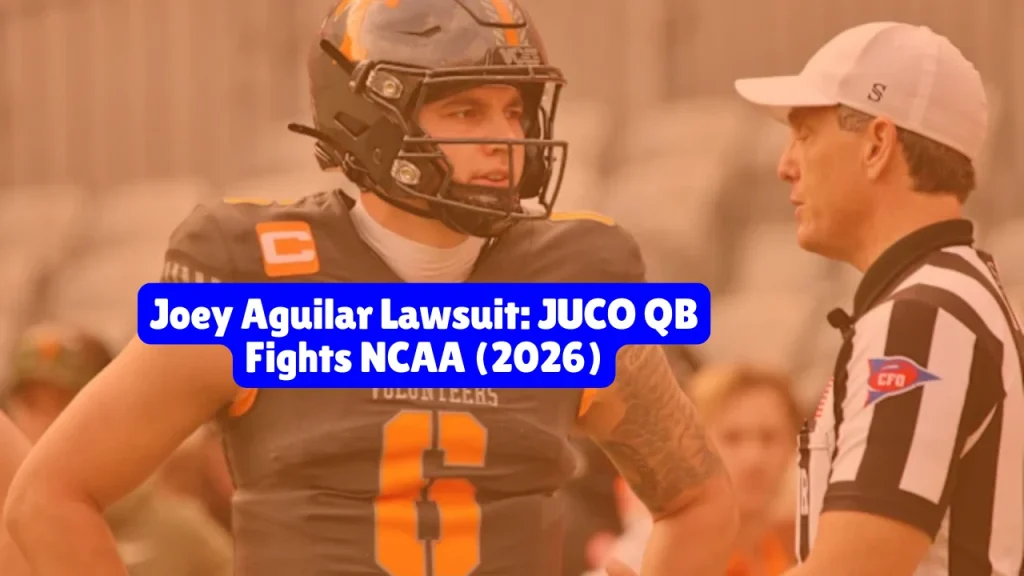
Tennessee quarterback Joey Aguilar joined one of the biggest NCAA eligibility fights in college sports history. The 24-year-old is among 26 players suing the NCAA over rules that count junior college seasons against Division I eligibility. A federal court conference is scheduled for January 12, 2026, and the outcome could determine whether Aguilar plays another college season or enters the 2026 NFL Draft.
Here’s what’s happening with the Joey Aguilar lawsuit and why it matters for college athletes who started at junior colleges.
What Happened: Why Joey Aguilar Joined the Lawsuit
On November 21, 2025, Joey Aguilar became a plaintiff in Vanderbilt quarterback Diego Pavia’s federal lawsuit against the NCAA. The case challenges NCAA bylaws that count junior college seasons toward Division I eligibility limits.
The NCAA’s Five-Year Rule gives athletes five years to compete in four seasons. Junior college time counts against that clock—even though JUCO schools aren’t NCAA members.
Aguilar spent two seasons at Diablo Valley Community College in California (2021-22) before playing three NCAA Division I seasons: two at Appalachian State (2023-24) and one at Tennessee (2025). He’s 24 years old and has seven total years of college football under his belt.
Under current NCAA rules, Aguilar’s college career ends after the 2025 Music City Bowl. But if the lawsuit succeeds, his JUCO years wouldn’t count—giving him one more season of Division I eligibility for 2026.
According to court documents filed in U.S. District Court for the Middle District of Tennessee at Nashville, the 26 plaintiffs seek immediate injunctive relief to stop the NCAA from enforcing its junior college eligibility restrictions. They argue these rules violate Section 1 of the Sherman Antitrust Act by restraining competition in the labor market for Division I athletes.
What You Came to Know: The Core Legal Claims
The Joey Aguilar lawsuit centers on antitrust violations. The plaintiffs claim NCAA eligibility bylaws illegally restrict former junior college players from competing and earning Name, Image, and Likeness (NIL) money at Division I schools.
The specific NCAA rules under attack:
Bylaw 12.02.6: Counts junior college seasons toward NCAA eligibility even though JUCO institutions aren’t NCAA members
The Five-Year Rule: Athletes get five years to play four seasons, with the clock starting at any “collegiate institution” regardless of NCAA membership
JUCO Transfer Cap: Limits former junior college players to a maximum of three years at Division I schools
Attorney Ryan Downton, representing the plaintiffs, argues the NCAA treats JUCO years differently than professional sports experience. In December 2025, he cited the NCAA granting four years of eligibility to a 21-year-old European professional basketball player who was drafted by an NBA team—while denying similar treatment to JUCO transfers.
The lawsuit claims this disparity violates federal antitrust law. Players who spent time at junior colleges face restricted earning opportunities through NIL deals compared to athletes who never played JUCO ball.
Diego Pavia won a preliminary injunction in December 2024 that forced the NCAA to issue a blanket waiver for the 2025 season. That waiver allowed Aguilar and Tennessee tight end Miles Kitselman to play this past season despite having used up their eligibility under the old rules.
But the NCAA’s waiver expires at the end of the 2025-26 academic year. That’s why Aguilar and 25 other players filed an amended complaint in late December 2025 asking Judge William Campbell to extend the injunction through the 2026-27 and 2027-28 seasons while the case proceeds.
Related Article: Tracy Morgan Lawsuit, $90M Walmart Truck Crash
What You Must Know: Timeline and Current Status
The Joey Aguilar lawsuit is moving fast because of the NCAA transfer portal timeline. The portal window opened January 2, 2026 and closes January 16, 2026. Tennessee needs to know whether Aguilar will return or if they need to recruit a transfer quarterback.
Here’s the critical timeline:
November 21, 2025: Aguilar added as plaintiff to amended complaint
December 19, 2025: NCAA’s deadline to respond to the lawsuit (passed)
December 27, 2025: Plaintiffs filed motion requesting January hearing before portal closes
December 30, 2025: Aguilar played in Music City Bowl against Illinois—potentially his final college game
January 12, 2026: Conference call scheduled between Judge Campbell, NCAA attorneys, and plaintiffs’ lawyers
January 16, 2026: NCAA transfer portal window closes
The January 12 meeting could be pivotal. According to Knox News, the reason for the conference call is unknown, but it’s part of the broader Pavia lawsuit challenging NCAA eligibility rules for former JUCO players.
Aguilar led the SEC with 3,444 passing yards in 2025—the fourth-most in a single season in Tennessee history. He threw for 23 consecutive games with a touchdown pass. Tennessee would love to have him back, especially with uncertainty at the quarterback position for 2026.
But time is running out. Even if Judge Campbell grants relief on January 12, the narrow window between that ruling and the portal closing on January 16 creates massive pressure on Tennessee’s quarterback planning.
💡 Pro Tip The Sherman Antitrust Act isn’t just for corporations—it applies to any restraints on competition in labor markets. When the NCAA started allowing NIL deals, courts began treating college sports eligibility rules as restrictions on athletes’ ability to earn money, bringing them under antitrust scrutiny. This is why Diego Pavia’s lawsuit has gained traction where previous eligibility challenges failed.
The Bigger Picture: What This Means for JUCO Athletes
The Joey Aguilar lawsuit is part of a wave of eligibility challenges hitting the NCAA. More than 35 athletes filed their own lawsuits challenging various NCAA eligibility restrictions since Pavia’s December 2024 preliminary injunction.
The problem: federal judges in different districts have issued conflicting rulings. Some athletes won injunctions while others were denied, leaving eligibility to the whims of local courts.
That’s precisely why Pavia’s lawyers are pursuing class-action status—to establish nationwide precedent that would apply to all former JUCO players, not just those who can afford to sue individually.
The lawsuit builds on two landmark Supreme Court decisions where college athletes defeated the NCAA:
O’Bannon v. NCAA (2014): Established the NCAA violated antitrust law by restricting compensation related to athletes’ names, images, and likenesses
Alston v. NCAA (2021): Supreme Court unanimously ruled NCAA limits on education-related benefits violated antitrust law, with Justice Brett Kavanaugh’s concurrence questioning the entire amateurism model
Judge Campbell’s ruling in Pavia’s case explicitly referenced we’re in a “post-Alston world” where NCAA rules must be scrutinized as restraints on competition in a labor market. For a deeper understanding of how antitrust law applies to sports, see the Diego Pavia lawsuit update.
If the class action succeeds, the implications ripple far beyond Aguilar’s 2026 season. Thousands of current and future JUCO transfers could gain additional years of Division I eligibility and NIL earning opportunities.
Real Example: How the Waiver Already Changed Lives
The December 2024 preliminary injunction that forced the NCAA to issue a blanket waiver didn’t just help Diego Pavia. It allowed Joey Aguilar to transfer from Appalachian State (via UCLA) to Tennessee for the 2025 season.
Without that waiver, Aguilar’s college career would have ended after his 2024 season at Appalachian State. He had spent two years at Diablo Valley Community College, and the NCAA counted those JUCO seasons against his eligibility clock.
The waiver gave him one more year. He used it to lead Tennessee’s offense to one of the highest-scoring attacks in college football, throwing for over 3,400 yards and climbing into the Volunteers’ record books.
Now Aguilar—and 25 other players in similar situations—are asking Judge Campbell to extend that same relief through at least the 2026-27 season. According to court filings reported by Ross Dellenger, the plaintiffs want the court to judicially extend the NCAA’s waiver until the conclusion of the case, not just through one season.
What to Do Next: Understanding Your Options
If you’re a former JUCO athlete with NCAA eligibility questions, timing is everything. The Joey Aguilar lawsuit shows how quickly things can change—but also how uncertain they remain.
Here’s what to consider:
Don’t wait for the lawsuit: NCAA eligibility decisions are individual. Even if Aguilar and other plaintiffs win their case, you still need to work with your school’s compliance office and potentially file your own waiver request.
Document everything: Keep records of your JUCO seasons, COVID impacts, redshirt years, and any communications with the NCAA or your school about eligibility.
Understand the risks: The Joey Aguilar lawsuit could drag on for months or years. Short-term injunctions might provide temporary relief, but permanent rule changes require either a final court judgment or NCAA policy changes.
For guidance on understanding complex legal processes like the one in the Joey Aguilar lawsuit, you might find useful information about how antitrust claims work in federal court. Additionally, if you’re dealing with any NCAA eligibility issues, the Riley Gaines transgender NCAA lawsuit demonstrates how athletes are successfully challenging NCAA policies in federal court.
Athletes facing eligibility questions should consult with qualified sports attorneys who understand NCAA compliance and federal antitrust law. The National Collegiate Athletic Association maintains official records and policy documents at NCAA.org, and federal court records can be accessed through PACER.
Frequently Asked Questions
When will we know if Joey Aguilar can play in 2026?
The January 12, 2026 conference call between Judge Campbell and the parties could provide answers. However, even if the judge grants relief that day, the timing creates massive uncertainty with the transfer portal closing January 16.
How many players are part of the Joey Aguilar lawsuit?
As of late December 2025, 26 former JUCO players joined the amended complaint seeking additional eligibility. The list includes Diego Pavia, Joey Aguilar, and athletes from various Division I programs.
What happens if the lawsuit fails?
If Judge Campbell denies the injunction request, Aguilar’s college career ends after the Music City Bowl. He would likely enter the 2026 NFL Draft. The same applies to other plaintiffs who have exhausted their NCAA eligibility under current rules.
Can Tennessee recruit a transfer quarterback while waiting?
Yes, and they’re actively doing so. Tennessee is reportedly involved in the quarterback transfer market as a contingency plan. The Vols can’t afford to wait indefinitely for a court ruling.
Does this lawsuit affect all college athletes?
No. The Joey Aguilar lawsuit specifically challenges how the NCAA counts JUCO seasons. It doesn’t affect athletes who never played junior college sports or those challenging different NCAA eligibility rules (like redshirt policies).
Disclaimer
This article provides general information only and is not legal advice.
Last Updated: January 11, 2026 — We keep this current with the latest legal developments
If you’re dealing with NCAA eligibility questions or want to understand more about how antitrust law applies to college sports, explore more legal guides at AllAboutLawyer.com. You can also search for qualified sports attorneys through your state bar association’s attorney referral service.
Stay informed, stay protected. — AllAboutLawyer.com
About the Author

Sarah Klein, JD, is a licensed attorney and legal content strategist with over 12 years of experience across civil, criminal, family, and regulatory law. At All About Lawyer, she covers a wide range of legal topics — from high-profile lawsuits and courtroom stories to state traffic laws and everyday legal questions — all with a focus on accuracy, clarity, and public understanding.
Her writing blends real legal insight with plain-English explanations, helping readers stay informed and legally aware.
Read more about Sarah