
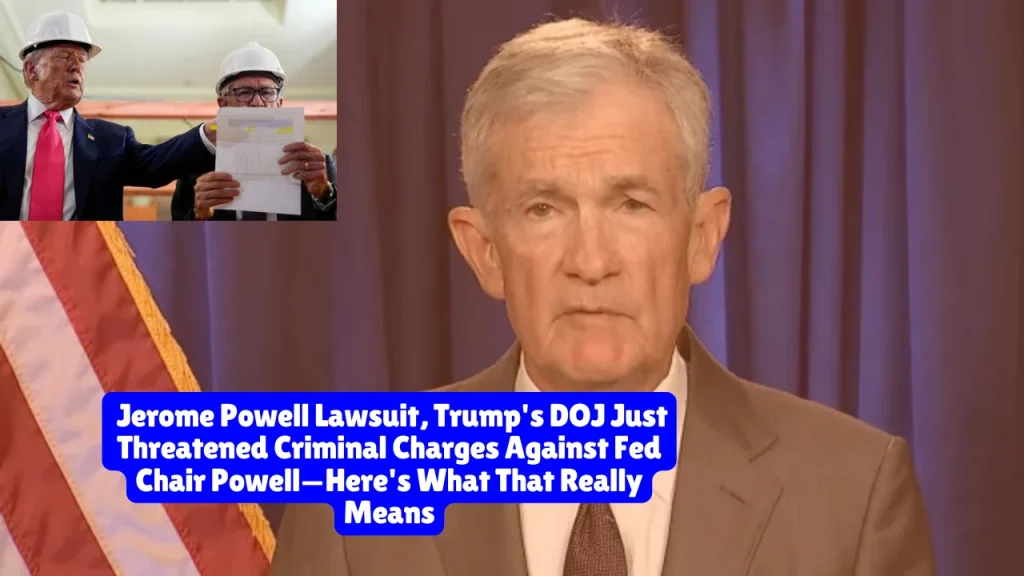
Jerome Powell Lawsuit, Trump’s DOJ Just Threatened Criminal Charges Against Fed Chair Powell—Here’s What That Really Means
Federal prosecutors served Federal Reserve Chair Jerome Powell with grand jury subpoenas on January 10, 2026, threatening a criminal indictment over his June 2025 congressional testimony about the Fed’s $2.5 billion headquarters renovation. This is not a lawsuit—it’s a criminal investigation that could lead to charges. Is Jerome Powell being sued or investigated?
On January 11, 2026, Powell released an unprecedented video statement calling the DOJ probe a “pretext” for political intimidation and declaring he will not bow to pressure on interest rates—sending shockwaves through financial markets and triggering bipartisan condemnation.
Why This Investigation Affects More Than Just Powell
This affects you if you’re concerned about Federal Reserve independence, invested in financial markets, tracking government accountability, or worried about interest rates and inflation.
Understanding this investigation reveals how the Trump administration is weaponizing federal prosecutors against officials who won’t comply with presidential demands. The Federal Reserve was designed to be insulated from political pressure so it can make unpopular economic decisions based on evidence rather than politics.
If prosecutors succeed in intimidating Powell—or whoever replaces him in May 2026—your mortgage rates, investment returns, and economic stability could be dictated by whoever sits in the White House instead of sound monetary policy.
What Is the Powell Investigation About?
This Is a Criminal Investigation, Not a Lawsuit
There is no “Powell lawsuit” in the traditional sense. The Department of Justice opened a criminal investigation into Powell, serving the Federal Reserve with grand jury subpoenas on Friday, January 10, 2026.
Plain English: A grand jury is a group of citizens who review evidence to decide whether someone should be criminally charged (indicted). Grand jury subpoenas demand documents and testimony under penalty of law. This is the investigative phase before any charges are filed—and it’s deadly serious.
What Prosecutors Say They’re Investigating
The DOJ claims it’s investigating Powell’s testimony before the Senate Banking Committee on June 25, 2025, about the Federal Reserve’s headquarters renovation project.
The project’s cost ballooned from $1.9 billion to $2.5 billion. During the Senate hearing, Chairman Tim Scott grilled Powell about luxury features including rooftop terraces, custom elevators opening into VIP dining rooms, white marble finishes, and a private art collection.
Rep. Anna Paulina Luna (R-FL) referred Powell to the DOJ in July 2025, alleging perjury and false statements to federal officials about the renovation project.
Related article: Apple Watch Band Lawsuit, “Forever Chemicals” Found in Sport Bands—Status Update, Claims & Compensation
Plain English: Perjury means lying under oath to Congress. False statements to federal officials is a separate crime involving lying to government agencies. Both are felonies carrying prison time.
What Powell Says This Is Really About
Powell called the renovation focus a smokescreen. In his January 11 video statement, he declared the criminal threats are consequences of the Fed refusing to follow Trump’s preferences on interest rates.
Powell said he has carried out his duties without political fear or favor, with the sole purpose of upholding the Fed’s dual mandate of price stability and maximum employment.
Trump has demanded the Fed cut interest rates much faster and more aggressively than Powell believes is economically sound.
Timeline: How Trump’s Pressure Campaign Escalated
November 2024: Trump wins presidential election, immediately begins criticizing Powell
June 25, 2025: Powell testifies before Senate Banking Committee about Fed headquarters renovation
July 24, 2025: Trump personally tours the Fed construction site with Powell, criticizes costs publicly
July 2025: Rep. Anna Paulina Luna refers Powell to DOJ for alleged perjury and false statements
August 2025: Trump fires Fed Governor Lisa Cook over unsubstantiated mortgage fraud allegations (Cook is suing to keep her position)
December 29, 2025: Trump tells reporters he’s considering bringing a lawsuit against Powell for incompetence over the building renovation
January 10, 2026: DOJ serves Federal Reserve with grand jury subpoenas threatening criminal indictment
January 11, 2026: Powell releases video statement condemning the probe as political intimidation
Who Is Conducting the Investigation?
The Department of Justice Under Pam Bondi
Attorney General Pam Bondi leads the DOJ and has instructed U.S. Attorneys to prioritize investigating abuse of taxpayer dollars, according to DOJ spokesperson Chad Gilmartin.
The DOJ declined to comment on the specific Powell investigation but confirmed this policy directive.
Plain English: U.S. Attorneys are federal prosecutors who work in different regions (districts) across the country. They investigate and prosecute federal crimes on behalf of the United States government.
Which Prosecutor’s Office Is Handling This?
Reports indicate U.S. Attorney Jeanine Pirro’s office may be involved, though her office didn’t immediately respond to inquiries. The specific district handling the investigation hasn’t been officially confirmed.
Grand jury proceedings are secret by law, so prosecutors won’t disclose details about witnesses, documents, or evidence being examined.
Trump’s Claimed Ignorance
In an NBC News interview January 11, Trump said he didn’t know anything about the investigation into Powell. When asked if the investigation is intended to pressure Powell on rates, Trump said no and that he wouldn’t think of doing it that way.
However, Trump has repeatedly attacked Powell publicly and told The New York Times in early January 2026 that he’d already selected Powell’s replacement.
What Could Powell Be Charged With?
Potential Criminal Charges Under Examination
Perjury (18 U.S.C. § 1621): Lying under oath to Congress. Maximum penalty is five years in federal prison.
False Statements (18 U.S.C. § 1001): Making false statements to federal officials. Maximum penalty is five years in federal prison.
Obstruction of Congress (various statutes): Intentionally misleading congressional oversight. Penalties vary.
Plain English: Federal prosecutors would need to prove Powell knowingly and intentionally lied—not just that he was mistaken, gave incomplete answers, or characterized facts differently than critics prefer.
What Makes This Case Unprecedented
No Federal Reserve Chair has ever faced criminal investigation for congressional testimony. The Fed is designed as an independent agency precisely to prevent this type of political pressure.
Former federal prosecutors and legal experts have expressed shock at the DOJ’s move. White-collar criminal defense attorneys note that perjury cases are extremely difficult to prove and rarely prosecuted unless the lies are clear-cut and material to important matters.
Disagreements over building costs, design decisions, or budget management typically don’t rise to criminal conduct—especially when extensive documentation exists about the renovation project.
What You Must Know
Why This Investigation Matters Beyond Powell
Federal Reserve independence hangs in the balance. Central bank independence is considered essential for economic stability worldwide. Investors and economists prize the Fed’s ability to make long-term monetary policy decisions without short-term political pressure.
If the DOJ can threaten criminal charges against Fed officials who don’t follow presidential preferences, the Fed becomes just another political tool.
Financial markets are reacting negatively. S&P 500 futures dropped, the dollar weakened, gold prices spiked, and the VIX “panic index” jumped following Powell’s announcement. Analysts at Evercore ISI warned of a “sell-America trade” similar to April 2025’s tariff shock.
The precedent for government accountability is dangerous. If criminal investigations become weapons against officials exercising independent judgment, few qualified people will accept positions requiring tough, unpopular decisions.
Powell’s term ends in May 2026, but his board seat continues until January 2028. Powell could remain on the Fed’s Board of Governors even after losing the chairmanship, potentially frustrating Trump’s plans to fully control the Fed.
How Federal Criminal Investigations Typically Proceed
Investigation phase (current stage): Federal prosecutors issue subpoenas, collect documents, interview witnesses, and present evidence to a grand jury. This phase can last months or years.
Grand jury decision: After reviewing evidence, the grand jury votes on whether to indict (formally charge) the target. Grand juries indict in over 99% of cases presented by federal prosecutors—but prosecutors also decline to present weak cases.
Indictment (if charges filed): The accused is arrested or surrenders, arraigned in court, and enters a plea. Pre-trial motions follow, along with discovery (evidence exchange between prosecution and defense).
Trial or plea deal: Most federal criminal cases (over 90%) end in plea bargains before trial. High-profile political cases may go to trial, which could take 1-2 years from indictment.
Plain English: Federal investigations move slowly but deliberately. The fact that Powell has been served with grand jury subpoenas means prosecutors are actively presenting evidence to a grand jury, but indictment isn’t guaranteed or imminent.
What Legal Experts and Political Analysts Are Saying
Republican Sen. Thom Tillis (NC), who sits on the Senate Banking Committee, condemned the investigation: “It is now the independence and credibility of the Department of Justice that are in question.” Tillis vowed to oppose any Fed nominee until the investigation is resolved—potentially blocking Trump’s replacement chair pick.
Senate Minority Leader Chuck Schumer (D-NY) called it “an assault on the Fed’s independence” and typical Trump bullying.
Sen. Elizabeth Warren (D-MA), ranking member of the Banking Committee, said Trump is abusing DOJ authority “like a wannabe dictator so the Fed serves his interests, along with his billionaire friends.” Warren said the committee shouldn’t move forward with any Trump Fed nominees.
Financial analyst Krishna Guha at Evercore ISI wrote he was “stunned by this deeply disturbing development which came out of the blue after a period in which tensions between Trump and the Fed seemed to be contained.”
Brian Jacobsen, chief economist at Annex Wealth Management, predicted Powell might stage a “sit-in” by remaining on the Fed’s Board of Governors through January 2028 to prevent Trump from installing another loyalist.
Legal experts note that perjury prosecutions require proof of knowingly false statements on material matters—not just disagreements over facts, characterizations, or judgments. Congressional testimony about building renovations rarely meets that standard.
What to Do Next
How to Follow the Investigation
Official Fed statements: The Federal Reserve posts official statements at federalreserve.gov/newsevents. Powell’s January 11, 2026 video statement is archived there.
DOJ announcements: The Department of Justice publishes press releases about investigations and indictments at justice.gov. However, grand jury proceedings are secret, so details may not emerge until charges are filed (or declined).
Congressional oversight: The Senate Banking Committee will hold hearings on Powell’s replacement nomination. Watch for statements from Chairman Tim Scott and ranking member Elizabeth Warren.
Court filings (if charges filed): If Powell is indicted, court documents will be available through PACER (Public Access to Court Electronic Records) at pacer.gov, the federal court document system.
What to Watch For in Upcoming Developments
Powell’s replacement announcement (expected January 2026): Trump told The New York Times he’s already chosen Powell’s replacement. Leading contenders include Kevin Hassett (Director of the National Economic Council) and former Fed Governor Kevin Warsh.
Grand jury decision (timeline uncertain): The grand jury could vote to indict Powell, or prosecutors could decline to bring charges if evidence is weak. This decision could come within weeks or months.
Powell’s decision on staying past May 2026: While Powell’s chairmanship ends in May, his Board of Governors seat continues until January 2028. He hasn’t said whether he’ll resign or remain.
Supreme Court ruling on Lisa Cook (January 21, 2026): The Supreme Court will hear oral arguments on whether Trump can fire Fed Governor Lisa Cook. This ruling could affect Powell’s situation.
Senate confirmation hearings: Any Trump nominee to replace Powell must be confirmed by the Senate Banking Committee, where Sen. Tillis has pledged to block nominees until the Powell investigation resolves.
Market reactions: Watch stock market volatility, dollar strength, Treasury yields, and gold prices for signs of investor concern about Fed independence.
Where to Find Expert Legal Analysis
Legal publications: Law360, Bloomberg Law, and Reuters Legal provide daily coverage of high-profile federal investigations and white-collar criminal cases.
Financial news: The Wall Street Journal, Financial Times, Bloomberg, and CNBC analyze the economic and market implications of Fed developments.
Government accountability coverage: Politico, The Washington Post, and The New York Times cover federal investigations of government officials and separation-of-powers issues.
Legal expert commentary: Former federal prosecutors, white-collar criminal defense attorneys, and constitutional law professors frequently analyze these cases on Twitter, in op-eds, and through media interviews.
Frequently Asked Questions
Is Jerome Powell being sued or investigated?
Powell is under criminal investigation by the Department of Justice, not being sued in civil court. Federal prosecutors served the Fed with grand jury subpoenas on January 10, 2026, threatening a criminal indictment. A criminal investigation can lead to criminal charges (indictment), which is far more serious than a civil lawsuit—it could result in prison time if convicted.
What is Powell accused of?
Federal prosecutors are investigating whether Powell committed perjury (lying under oath) or made false statements to federal officials during his June 25, 2025 Senate Banking Committee testimony about the Fed’s headquarters renovation. The project cost $2.5 billion, and critics allege Powell mischaracterized luxury features and cost overruns.
Who is investigating Powell?
The U.S. Department of Justice under Attorney General Pam Bondi is conducting the investigation. A grand jury has been empaneled, and federal prosecutors (U.S. Attorneys) are presenting evidence to determine whether to indict Powell on criminal charges.
When did the Powell investigation start?
The investigation became public on January 11, 2026, when Powell released a video statement saying the Fed received grand jury subpoenas on January 10. Rep. Anna Paulina Luna referred Powell to the DOJ in July 2025, so prosecutors may have been investigating since mid-2025.
Could Powell be charged with a crime?
Yes, Powell could potentially be charged with perjury or making false statements to federal officials—both felonies carrying up to five years in prison. However, perjury cases are notoriously difficult to prove, requiring evidence of knowingly false statements about material facts, not just disagreements over characterizations or judgments.
Will Powell resign as Fed Chair?
Powell’s term as Fed Chair ends in May 2026 regardless of the investigation. However, his term on the Federal Reserve’s Board of Governors doesn’t expire until January 2028. Powell hasn’t said whether he’ll resign or remain on the board past May, potentially complicating Trump’s plans to fully control the Fed.
What happens to the Federal Reserve during this investigation?
The Fed continues operating normally. The Federal Open Market Committee (FOMC) still sets interest rates, and other Fed governors share voting power. However, the investigation creates uncertainty about Fed independence, which has already caused market volatility and could affect investor confidence in U.S. economic policy.
Pro Tip: Understanding Investigation vs. Charges
Investigation means federal prosecutors are gathering evidence and presenting it to a grand jury to decide whether to bring criminal charges. No charges have been filed yet—Powell has not been arrested or indicted.
Indictment means a grand jury voted to formally charge someone with a crime. Only after indictment does someone become a criminal defendant facing trial.
Conviction requires a trial where prosecutors prove guilt beyond reasonable doubt. Being investigated, or even indicted, doesn’t mean someone is guilty.
The gap between investigation and conviction can be months or years—and many investigations end without charges being filed if prosecutors determine the evidence is insufficient.
Disclaimer: This article provides general information about the federal investigation into Federal Reserve Chair Jerome Powell and should not be considered legal advice. The Powell investigation is an active, developing legal matter with significant implications for Federal Reserve independence, financial markets, and government accountability. Legal situations evolve rapidly, especially in high-profile political cases involving federal prosecutors, grand jury proceedings, and potential criminal charges. AllAboutLawyer.com does not provide legal services, represent any parties in this matter, or offer opinions on the merits of potential charges against Powell. If you’re involved in a federal investigation, face questions from federal prosecutors, or need guidance on white-collar criminal defense, consult a qualified criminal defense attorney licensed in your jurisdiction who can review your specific situation and provide personalized legal representation.
Want to understand how federal investigations work? Learn about perjury charges on Google and when testimony becomes criminal.
Stay informed, stay protected. — AllAboutLawyer.com
Last Updated: January 12, 2026 — We keep this current with the latest legal developments in the Powell investigation as DOJ actions and Federal Reserve responses unfold.
About the Author

Sarah Klein, JD, is a licensed attorney and legal content strategist with over 12 years of experience across civil, criminal, family, and regulatory law. At All About Lawyer, she covers a wide range of legal topics — from high-profile lawsuits and courtroom stories to state traffic laws and everyday legal questions — all with a focus on accuracy, clarity, and public understanding.
Her writing blends real legal insight with plain-English explanations, helping readers stay informed and legally aware.
Read more about Sarah