
Jason Killinger’s Lawsuit, AI Facial Recognition Got It Wrong — Jason Killinger’s 11-Hour Nightmare and $20M Fight for Justice
Jason Killinger is a UPS truck driver who was wrongfully arrested for 11 hours in September 2023 after Peppermill Casino’s AI facial recognition system misidentified him as a banned patron. The Jason Killinger lawsuit now seeks damages from Reno Police Officer R. Jager, alleging fabricated evidence and civil rights violations. How could showing multiple valid IDs still result in handcuffs, bruises, and a criminal record?
In July 2025, Killinger filed a federal lawsuit claiming Officer Jager knowingly falsified arrest reports and ignored fingerprint evidence that proved his identity. The case is headed to trial in 2026. Killinger already settled with Peppermill Casino for an undisclosed amount, but his fight against police misconduct continues.
This lawsuit matters if you’ve been wrongfully detained based on faulty technology, questioned by police despite providing valid identification, or believe law enforcement violated your constitutional rights. Understanding this case reveals how facial recognition errors can spiral into wrongful arrests—and what legal protections exist when officers ignore evidence.
Who Is Jason Killinger and What Happened?
Jason Killinger’s Background
Jason Killinger worked as a long-haul truck driver for UPS. On September 17, 2023, he stopped at Peppermill Casino in Reno, Nevada, after completing a delivery route. He wasn’t gambling or causing trouble—just taking a break during his shift.
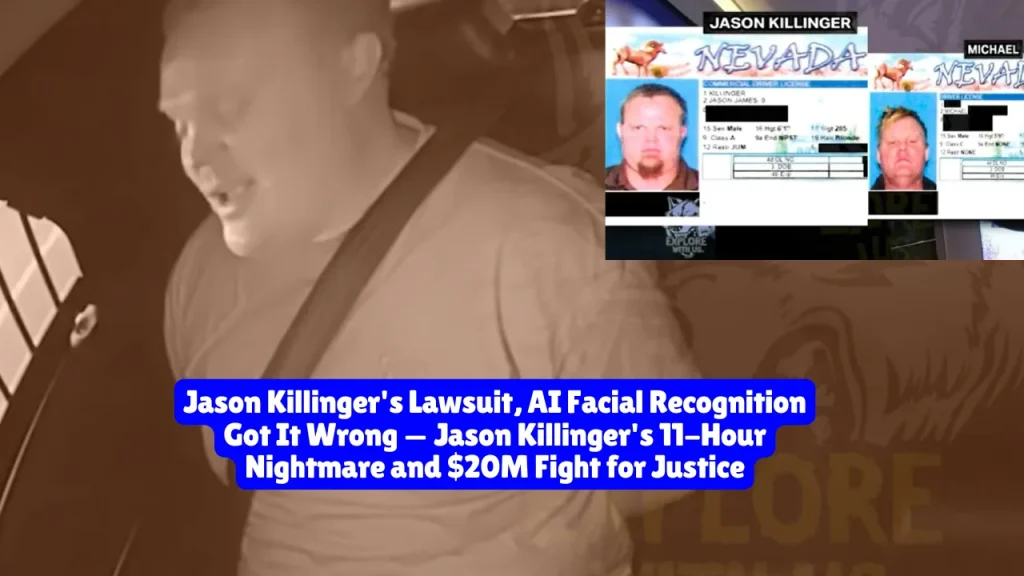
Killinger had no criminal history. He carried a valid Nevada driver’s license, Nevada commercial driver’s license (CDL), UPS pay stubs, vehicle registration, and his Peppermill player’s card. Everything showed the same name and matched his physical appearance.
The AI Misidentification
As Killinger entered the casino, its facial recognition system flagged him as a “100% match” for Michael Ellis, a man who had been banned from the property in March 2023 for sleeping on the premises. Ellis’s ban was set to expire September 26, 2023—nine days after Killinger’s arrest.
The problem? Killinger and Ellis were different people. According to reports, they had different heights, weights, and eye colors. But the AI system focused only on facial features and declared a perfect match.
Casino security confronted Killinger and accused him of trespassing. He presented his driver’s license proving he was Jason Killinger, not Michael Ellis. Security refused to believe him and called police.
The 11-Hour Detention
Officer R. Jager, described in court filings as a rookie Reno Police Department officer, arrived and reviewed Killinger’s documentation. Killinger showed:
- Nevada driver’s license with his photo and correct physical description
- UPS payslip with his name
- Vehicle registration matching his identity
- Peppermill player’s card
All documents were consistent. Yet Jager accused Killinger of using fraudulent identification. According to the lawsuit, Jager suggested Killinger “probably has a DMV hook-up”—implying he obtained fake IDs through inside connections at the Department of Motor Vehicles.
Jager handcuffed Killinger and took him to the police station. Killinger was kept in handcuffs for approximately four hours, causing bruising and shoulder pain. He remained detained for 11 total hours.
Eventually, police took his fingerprints. The fingerprint check conclusively proved Killinger was exactly who he said he was—Jason James Killinger, not Michael Ellis. Only then was he released.
Related Article: BSA Lawsuit Update (2026), Supreme Court Just Cleared $2.46 Billion For 82,000 Boy Scout Abuse Survivors
What Is the Jason Killinger Lawsuit About?
Legal Claims Against Officer Jager
On July 30, 2025, Killinger filed a federal civil rights lawsuit in U.S. District Court for the District of Nevada (Case No. 3:25-cv-00388). The lawsuit names Officer R. Jager as defendant and alleges:
Fourteenth Amendment Violations: The lawsuit claims Jager violated Killinger’s constitutional right to due process by arresting him without probable cause and fabricating evidence to justify the arrest.
Fabricated Police Reports: Court filings allege Jager “knowingly inserted false statements” into his incident report and arrest declaration, specifically claiming Killinger’s identification documents “conflicted” and “appeared to be fraudulent” when all IDs actually matched.
Malicious Prosecution: The complaint accuses Jager of deliberately pursuing trespassing charges despite knowing or having reason to know Killinger was not Michael Ellis.
Omission of Exculpatory Evidence: The lawsuit alleges Jager’s reports omitted critical evidence—specifically, the fingerprint results that proved Killinger’s identity—and falsely portrayed Killinger as uncooperative and using multiple identities.
Fabrication by Concealment: Legal filings argue these omissions amounted to deliberate concealment of evidence that would have exonerated Killinger immediately.
What the Police Reports Actually Said
In his official report, Jager wrote that Killinger had “conflicting identification” despite every ID showing the same name and matching details. Jager stated he “lacked satisfactory evidence to reasonably assure me that he was who he claimed to be.”
The lawsuit characterizes these statements as “deliberate falsification” intended to “manufacture probable cause” after Jager realized the casino’s allegations didn’t align with the documentation Killinger provided.
According to court documents, after Killinger’s identity was confirmed through fingerprints, his arrest paperwork was changed from “John Doe” to “Jason Killinger.” This resulted in Killinger being prosecuted for trespassing—even though only Michael Ellis had been trespassed from the casino, not Killinger.
The trespassing charge was eventually dismissed, but Killinger now has a criminal record from the incident.
Who Is Affected and What Is the Current Status?
Settlement with Peppermill Casino
Before filing the lawsuit against Officer Jager, Killinger sued Peppermill Casino. That case settled for an undisclosed amount. The casino has not publicly commented on the settlement or the underlying incident.
Ongoing Lawsuit Against Officer Jager
The case against Officer Jager is actively proceeding through litigation. As of January 2026, the lawsuit remains pending in federal court. Recent developments show:
- Court Location: U.S. District Court for the District of Nevada
- Case Number: 3:25-cv-00388
- Expected Trial Date: Reports indicate the case is scheduled for trial in 2026
- Current Status: The case is in the pre-trial phase, likely involving discovery where both sides exchange evidence and witness information
The Reno Police Department has denied any wrongdoing in the case.
What Killinger Is Seeking
The lawsuit seeks compensatory damages (payment for actual harm suffered), special damages (specific economic losses), and punitive damages (additional money intended to punish wrongful conduct and deter future violations).
No specific dollar amounts have been publicly disclosed in court filings. Killinger’s attorney has not revealed a settlement demand.
What You Must Know About Your Rights
Understanding Civil Rights in Police Encounters
When police stop or arrest you, the Fourth Amendment protects you from unreasonable searches and seizures. The Fourteenth Amendment guarantees due process—meaning the government can’t deprive you of liberty without fair procedures.
You have the right to:
- Not be arrested without probable cause (reasonable belief you committed a crime)
- Have evidence fairly evaluated, not fabricated or concealed
- Present identification and have it properly considered
- Challenge false arrest through civil lawsuits
What “fabrication of evidence” means: This occurs when police knowingly create false information in reports, omit exculpatory evidence (evidence that clears you), or mischaracterize facts to make it appear you committed a crime. Courts take this seriously because it violates your right to fair treatment.
How Technology Creates Legal Risks
Facial recognition technology analyzes faces and compares them to databases. While marketed as highly accurate, these systems make mistakes—especially across different races, lighting conditions, and camera angles.
The legal problem: When police rely on technology over human judgment, errors can cascade. If an officer trusts a “100% match” claim and dismisses contradicting evidence, wrongful arrests follow.
Your protection: Police must have probable cause based on the totality of circumstances, not just technology. Valid identification showing you’re a different person should override an AI system’s claim.
Similar Cases and Trends
Killinger’s case isn’t unique. Multiple lawsuits across the country involve wrongful arrests after facial recognition misidentification:
- A Detroit woman was arrested while pregnant based on facial recognition error
- A New Jersey man spent 10 days in jail after false AI match
- Multiple Black individuals have sued after being misidentified by facial recognition systems that perform worse on darker skin tones
These cases reveal growing concerns about law enforcement’s reliance on AI without adequate verification procedures.
What to Do If You’re Affected
If You Were Wrongfully Arrested or Detained
Document everything immediately:
- Write down dates, times, locations, and what happened in detail
- List everyone present (officers’ names and badge numbers if visible, witnesses)
- Photograph any injuries (bruises from handcuffs, etc.)
- Keep all paperwork—arrest records, citations, court documents
Gather supporting evidence:
- Copies of identification you showed police
- Receipts or records proving you were somewhere else or are who you say
- Phone records, GPS data, or surveillance footage if available
- Medical records documenting injuries from the arrest
Understand your timeframe: Civil rights lawsuits have statutes of limitations—deadlines to file. In federal court, you typically have 2-3 years depending on the claim, but state law claims may have shorter deadlines. Don’t delay consulting an attorney.
Your Legal Options
42 U.S.C. § 1983 lawsuits: This federal law allows you to sue government officials (including police) for constitutional violations. You can recover damages for:
- Physical injuries and medical expenses
- Emotional distress and mental anguish
- Lost wages if the arrest caused you to miss work
- Damage to reputation
- Punitive damages in cases of deliberate misconduct
State law claims: You may also have state-level claims for false arrest, false imprisonment, malicious prosecution, or intentional infliction of emotional distress.
Attorney consultation: Police misconduct and civil rights cases are complex. Most civil rights attorneys offer free consultations and work on contingency (they get paid a percentage of any recovery, so you don’t pay upfront).
Where to Find Help
Legal assistance:
- American Civil Liberties Union (ACLU): Provides resources and sometimes representation for civil rights violations
- State bar association: Most offer attorney referral services to find civil rights lawyers
- Legal aid organizations: If you can’t afford an attorney, legal aid may help depending on income eligibility
Filing complaints:
- Police department internal affairs: You can file complaints about officer conduct
- Civilian review boards: Some cities have independent boards reviewing police misconduct
- FBI Civil Rights Division: For serious federal civil rights violations
Support resources:
- National Association for the Advancement of Colored People (NAACP): Advocates for civil rights and can connect you with legal resources
- Local advocacy organizations: Many cities have groups focused on police accountability
Frequently Asked Questions
Who is Jason Killinger?
Jason Killinger is a UPS truck driver who was wrongfully arrested in September 2023 after a casino’s AI facial recognition system misidentified him as a banned patron. Despite showing multiple valid IDs proving his identity, he was detained for 11 hours and now has a criminal record from the dismissed trespassing charge.
What is the Jason Killinger lawsuit about?
The lawsuit alleges Reno Police Officer R. Jager violated Killinger’s constitutional rights by fabricating evidence in police reports, omitting exculpatory fingerprint results, and pursuing malicious prosecution despite knowing Killinger was not the person the casino banned. Killinger is seeking compensatory, special, and punitive damages.
What happened during Jason Killinger’s arrest?
Killinger was detained after Peppermill Casino’s facial recognition flagged him as a “100% match” for someone else. He showed his driver’s license, payslip, and registration—all matching his identity—but Officer Jager accused him of using fake IDs with help from a “DMV hook-up.” Killinger was handcuffed for four hours and held 11 hours total before fingerprints proved his identity.
Is there a settlement in the Jason Killinger case?
Killinger settled his lawsuit against Peppermill Casino for an undisclosed amount. However, his federal Progressive class action lawsuit against Officer Jager remains active and is expected to go to trial in 2026. No settlement has been reached with the police officer.
Am I affected by the Jason Killinger lawsuit?
This is an individual lawsuit between Killinger and Officer Jager, not a class action. You’re not automatically part of this case. However, if you’ve experienced similar treatment—wrongful arrest based on facial recognition, police ignoring your valid identification, or fabricated police reports—you may have your own legal claims to pursue.
What should I do if police wrongfully arrested me?
Document everything about the arrest including dates, locations, officers’ names, and witnesses. Photograph any injuries. Gather all paperwork and evidence supporting your identity or innocence. Consult a civil rights attorney immediately—most offer free consultations. Don’t wait, as legal deadlines apply to filing lawsuits.
When will the Jason Killinger lawsuit be resolved?
The case is expected to go to trial in 2026. Civil rights lawsuits typically take 1-3 years to resolve. Many settle before trial, but if it goes to verdict, appeals could extend the timeline. The Reno Police Department has denied wrongdoing, suggesting they may fight the case rather than settle quickly.
PRO TIP: If you’re ever detained or arrested, immediately ask if you’re free to leave. If officers say no, ask why you’re being detained and what crime they suspect. Don’t resist, but don’t consent to searches. Say clearly: “I do not consent to any searches. I want to speak with an attorney.” This protects your rights without escalating the situation.
Last Updated: January 14, 2026 — We keep this current with the latest legal developments.
Disclaimer: This article provides information about the Jason Killinger lawsuit based on publicly available court documents, legal filings, and verified news reports. It is not legal advice. The Jason Killinger case details may change as litigation proceeds. AllAboutLawyer.com does not represent any party to this lawsuit and does not provide legal services. If you have specific legal questions about wrongful arrest, civil rights violations, or police misconduct, consult a qualified attorney in your jurisdiction who can evaluate your individual circumstances.
Need help understanding your rights after a wrongful arrest? Learn more about pursuing civil rights claims in our comprehensive guide to James Hodges civil rights lawsuit procedures and protections.
Stay informed, stay protected. — AllAboutLawyer.com
About the Author

Sarah Klein, JD, is a licensed attorney and legal content strategist with over 12 years of experience across civil, criminal, family, and regulatory law. At All About Lawyer, she covers a wide range of legal topics — from high-profile lawsuits and courtroom stories to state traffic laws and everyday legal questions — all with a focus on accuracy, clarity, and public understanding.
Her writing blends real legal insight with plain-English explanations, helping readers stay informed and legally aware.
Read more about Sarah