
James Hodges Lawsuit, Blind Navy Veteran Arrested for Carrying a Cane
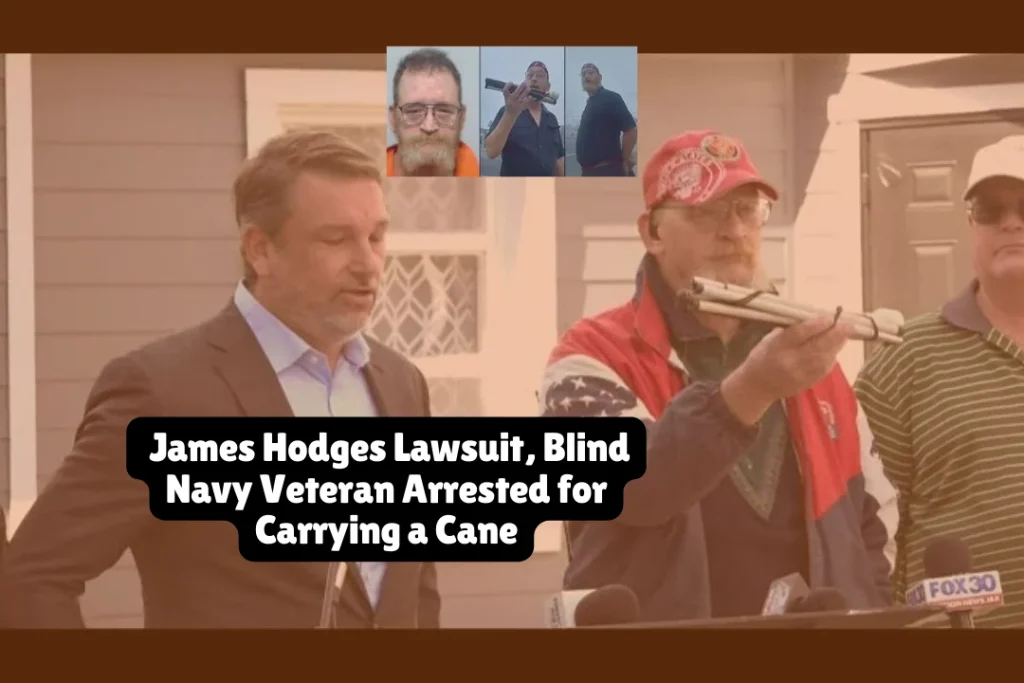
In October 2022, a visually impaired Navy veteran was arrested in Lake City, Florida after a sheriff’s deputy mistook his folding white cane for a firearm. The incident was captured on body camera, went viral, and eventually led to a federal civil rights lawsuit. The case raised significant questions about how law enforcement interacts with people with disabilities, the limits of qualified immunity, and what accountability looks like when officers make serious mistakes. Here is the full story, what the lawsuit claimed, and how it was resolved.
What Happened on October 31, 2022?
On October 31, 2022, Columbia County Florida Sheriff’s Office Deputy Jayme Gohde stopped James Hodges to investigate an item in his back pocket as he was walking. Sergeant Randy Harrison also responded. Hodges showed the deputies that the item was a folding cane.
Hodges, who has been legally blind since 1995, was walking home from jury duty when Gohde approached him. Hodges immediately removed the folded cane to show Gohde that the “gun” was nothing of the sort, and asked, “What’s the problem, are you a tyrant?” according to the complaint, which says Gohde responded, “Yeah, I am, actually. What is your name and date of birth?”
Instead of admitting her mistake, Gohde detained Hodges and called for a supervisor. When Sgt. Randall Harrison arrived, Hodges showed him his cane, demonstrating for a second time that he was not armed. But when Hodges asked to leave, the pair instead put him in handcuffs and searched him. As Hodges demanded Gohde and Harrison’s badge numbers, Harrison turned to Gohde and said, “You know what? Put him in jail for resisting.”
Hodges sat in jail for 26 hours before he was released. The charges were dropped within days once the body camera footage was reviewed.
How Did Hodges Lose His Sight?
Hodges said he has been blind since 1995 following a random act of violence on the streets of Baltimore. He came out the door to run a drunk off his porch and ended up in a fight with five men, sustaining a traumatic brain injury. He did not realize the severity of his injuries until after his stitches were removed, when he went to the hospital complaining of a headache. He woke up a month and a half later having been in a coma, and found himself totally blind. He later served in the U.S. Navy despite his disability.
What Did the Sheriff’s Office Do Immediately After?
On November 3, 2022, the department opened an internal investigation. On November 7, 2022, the charges against Hodges were dropped. On November 8, 2022, the department finished their internal investigation. Harrison was demoted and suspended for seven days without pay.
Sheriff Hunter issued a public video apology to James Hodges and acknowledged several policy violations by the two deputies involved. Hunter said he took full responsibility for the incident and required both deputies to undergo remedial training pertaining to civil rights.
The public response to the body camera footage was significant. The video went viral nationally and internationally, prompting widespread debate about how officers are trained to interact with people with disabilities.
What Did the Lawsuit Claim?
On November 20, 2023, Hodges filed a federal lawsuit against the Sheriff, Harrison, and Gohde for violation of his rights under the First and Fourth Amendments and other charges.
The lawsuit was filed in the U.S. District Court for the Middle District of Florida under 42 U.S.C. § 1983 — the primary federal law that allows individuals to sue government officials for violations of their constitutional rights. In plain terms, Section 1983 allows a person to seek damages when a government actor — such as a police officer — violates their constitutional rights while acting in an official capacity.
Hodges asserted a claim against the Sheriff premised on failure to train and supervise Harrison and Gohde, arguing that as the head of the Columbia County Sheriff’s Office, the Sheriff was responsible for properly training officers in the constitutional limitations during reasonable investigations.
The complaint described the officers’ actions as “a malicious, ill-willed desire to punish him” and argued that body camera footage directly contradicted Gohde’s arrest report, which accused Hodges of obstructing an investigation by refusing to identify himself.
What Is Qualified Immunity and Why Did Hodges Care About It?
One of Hodges’ stated goals in pursuing the lawsuit was to spark a national conversation about qualified immunity — a legal doctrine that shields government officials, including police officers, from personal liability unless they violated a “clearly established” law that a reasonable person would have known about.
Hodges said those deputies should have been prosecuted. “They broke the law. Instead, the sheriff said, ‘I’m deeply saddened.’ And that’s about all.” He argued that qualified immunity too often allows officers who commit clear legal violations to escape personal financial or criminal accountability, leaving the burden of any settlement on taxpayers rather than the individuals responsible.
Qualified immunity has been the subject of significant national debate, with critics arguing it creates an unreasonably high bar for holding officers accountable and supporters arguing it is necessary to protect officers from second-guessing in fast-moving situations.
What Obstacle Did the Lawsuit Hit in Court?
The case faced a significant legal hurdle when the court addressed the claims against the Sheriff directly. The court concluded that Hodges had not plausibly alleged that the Sheriff knew of omissions in training that led to the constitutional violations, finding that Hodges had not alleged a single instance of similar conduct occurring before his encounter with Harrison and Gohde, and had not alleged facts suggesting a pattern of misconduct.
This ruling reflected a well-established legal standard in Section 1983 cases — it is generally not enough to show that one incident occurred. Plaintiffs typically must show that a pattern of similar behavior existed and that the supervising official was aware of it but failed to act. Meeting that standard is often one of the most difficult aspects of civil rights litigation against municipal defendants.
How Did the Case Resolve?
The lawsuit had two distinct paths. On August 23, 2024, Hodges agreed to drop his case with prejudice, meaning it cannot be refiled. However, a related proceeding reached a different outcome. A lawsuit filed by Hodges was settled out of court just after Sheriff Hunter left office in January 2025, following his loss in the 2024 reelection bid.
Hodges’ attorney confirmed the case was resolved with a settlement and discipline to the officer. The specific financial terms of the settlement were not publicly disclosed, which is common in civil rights settlements involving law enforcement agencies.
The fact that the sheriff who oversaw the incident lost his reelection campaign — at least in part due to public attention the case generated — was cited by observers as a form of political accountability beyond the courtroom.
A Broader Pattern
The James Hodges case did not stand alone. A 2025 investigative series titled “Blind Justice” examined multiple cases of people with disabilities being mistaken for non-compliant suspects by law enforcement across the country. The series highlighted systemic gaps in officer training around disability awareness — including how visual impairments, hearing loss, autism, and other conditions can be misread as defiance or suspicious behavior.
Advocates for disability rights have used the Hodges case to call for mandatory training on disability recognition and interaction as part of standard law enforcement curricula nationwide.
FAQs
What happened to James Hodges in 2022?
James Hodges, a visually impaired Navy veteran, was stopped by Columbia County sheriff’s deputies while walking home from jury duty. Deputies mistook his collapsible white cane for a firearm. After Hodges showed them it was a cane, he was nonetheless arrested for resisting without violence and held in jail for 26 hours before being released.
Was James Hodges convicted of any crime?
No. The charges against Hodges were dropped on November 7, 2022 — within days of the incident — after body camera footage contradicted the arrest report.
What happened to the deputies involved?
Harrison was demoted and suspended for seven days without pay following the department’s internal investigation. Both deputies were required to undergo remedial training pertaining to civil rights. Sheriff Hunter publicly apologized and took responsibility for the incident.
Did James Hodges win his lawsuit?
The outcome was mixed. One portion of the federal case was dropped with prejudice in August 2024. A related lawsuit was settled out of court in early 2025. The settlement included both a financial component and discipline to the officer. The exact settlement amount was not publicly disclosed.
What is Section 1983 and why was it used in this case?
Section 1983 is a federal law that allows individuals to sue government officials — including police officers — for violations of their constitutional rights. Hodges used it to argue that the deputies violated his First and Fourth Amendment rights by detaining and arresting him without legal justification.
What is qualified immunity and why did Hodges raise it?
Qualified immunity is a legal doctrine that protects government officials from personal liability unless they violated a clearly established law. Hodges argued that the deputies broke the law but faced no personal criminal consequences, and he wanted to use his case to start a national conversation about whether qualified immunity provides too much protection to officers who commit clear violations.
What happened to Sheriff Hunter?
Hunter lost his 2024 reelection bid and left office in January 2025, just as Hodges’ lawsuit was being settled.
Last Updated: March 3, 2026
Disclaimer: This article is for informational purposes only and does not constitute legal advice. Laws and legal procedures vary by jurisdiction and may change over time. For advice regarding a specific situation, consult a qualified attorney or the appropriate authority.
About the Author

Sarah Klein, JD, is a licensed attorney and legal content strategist with over 12 years of experience across civil, criminal, family, and regulatory law. At All About Lawyer, she covers a wide range of legal topics — from high-profile lawsuits and courtroom stories to state traffic laws and everyday legal questions — all with a focus on accuracy, clarity, and public understanding.
Her writing blends real legal insight with plain-English explanations, helping readers stay informed and legally aware.
Read more about Sarah