
Jaahnavi Kandula Lawsuit Settled For $29 Million—Seattle Pays Family After Police Officer Killed Indian Student At 74 MPH 2026
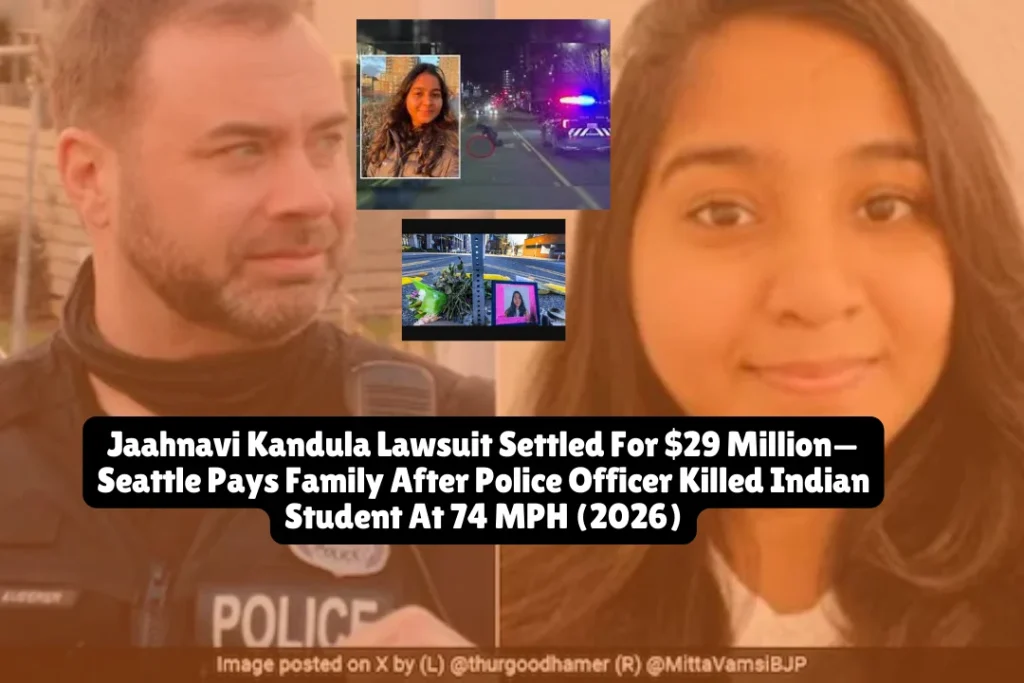
The city of Seattle has reached a $29 million settlement with the family of a 23-year-old graduate student from India who was struck by a speeding police officer as she crossed a street in 2023. The agreement, announced on February 11, 2026, resolves a $110 million wrongful death lawsuit filed by Kandula’s family in 2024 against the City of Seattle and former Seattle Police Department officer Kevin Dave.
The settlement comes more than two years after Jaahnavi Kandula’s death sparked global outrage, particularly when body camera footage revealed another officer laughing and saying her life had “limited value.”
Who Was Jaahnavi Kandula And What Happened
Jaahnavi Kandula was a 23-year-old graduate student from India who pursued a master’s degree in information systems at Northeastern University’s Seattle campus. She was struck and killed on January 23, 2023, while crossing Dexter Avenue at Thomas Street in South Lake Union.
Jaahnavi Kandula was hit by Officer Kevin Dave, who was driving as fast as 74 mph in a 25-mph zone as he responded to a drug overdose call. He had his emergency lights on and had been using his siren at intersections.
Kandula was crossing Dexter Avenue at Thomas Street when she was killed on the evening of January 23, 2023. The impact was catastrophic. According to court filings, attorneys wrote that Kandula “experienced terror, severe emotional distress, and severe pain and suffering before dying”.
The case drew international attention when bodycam footage surfaced months later showing Seattle Police Officers Guild vice chairman Daniel Auderer laughing about the incident and suggesting the city should “just write a check” because Kandula’s life had “limited value.”
Legal Claims Filed In The Wrongful Death Lawsuit
The legal complaint filed a $110 million wrongful death lawsuit, plus an additional $11,000 against the City of Seattle and former Seattle Police Department officer Kevin Dave. The $11,000 figure referenced Auderer’s callous remarks about Kandula’s worth.
The legal complaint was filed by Kandula’s mother and father, Vijaya Laksmi Gundapuneedi and Sreekanth Kandula, who both live in India. Their attorneys argued the city and officer Dave were liable for wrongful death, negligence, and assault.
The legal claims centered on several key allegations similar to those in Tracy Morgan Lawsuit Update, $90M Settlement Resolved—What Happened And Where The Case Stands Now, which also involved vehicle negligence. These included violations of Federal Motor Carrier Safety Administration-style protocols for emergency vehicle operation and failure to exercise reasonable care for pedestrian safety.
Interim police chief Sue Rahr fired Auderer in July 2024 after the civilian watchdog found his comments damaged the department’s reputation and undermined public trust. Dave was also terminated from the police department and was cited for negligent driving and ordered to pay a $5,000 fine.
Settlement Amount And Terms
The settlement totals at least $29 million, plus at least $11,000, according to a source familiar with its details. About $20 million of the settlement is expected to be covered by the city’s insurance, meaning Seattle taxpayers will be responsible for approximately $9 million.
The parties filed a notice of settlement in King County Superior Court last Friday, formally ending the civil litigation. While the terms remain largely confidential, the settlement represents one of the largest pedestrian fatality settlements involving law enforcement in recent years.
King County prosecutors declined to file felony charges against him, saying they could not prove he was deliberately disregarding safety when he struck Kandula. This means Dave faces no criminal liability, only the traffic citation with a $5,000 fine.
Seattle City Attorney Erika Evans stated: “Jaahnavi Kandula’s death was heartbreaking, and the city hopes this financial settlement brings some sense of closure to the Kandula family. We also recognize that her loss has left unimaginable pain. Jaahnavi Kandula’s life mattered. It mattered to her family, to her friends, and to our community”.
Who Receives Compensation From The Settlement
Only Kandula’s immediate family members—her parents, Vijaya Laksmi Gundapuneedi and Sreekanth Kandula—are eligible to receive the $29 million settlement. This is not a class action lawsuit like the Conduent Data Breach Class Action 2026 10 Feb Update, 25M+ Victims, 10+ Lawsuits Filed—Free Credit Monitoring Deadline March 31 where multiple victims can file claims.
The settlement payment structure and timeline have not been publicly disclosed. Settlement agreements in wrongful death cases typically include provisions for structured payments or lump sum distributions, with payment timelines ranging from 30 to 90 days after final court approval.
No claim filing process is required for this settlement, as it’s a direct payment to the named plaintiffs in the lawsuit.
Current Status And What Happens Next
The case is fully resolved as of February 2026. The settlement notice filed in King County Superior Court on February 7, 2026 officially ends all civil litigation between Kandula’s family and the City of Seattle.
However, the case sparked several ongoing developments. Officer Daniel Auderer, who was fired for his insensitive comments, has sued the city for wrongful termination. His lawsuit alleges his remarks were taken out of context and claims he was criticizing how attorneys typically respond to such incidents, not mocking Kandula’s death.
In November 2024, in response to community outrage over the collision, SPD released new policies on emergency driving which direct officers to “drive no faster than their skill and training allows and [what] is reasonably necessary to safely arrive at the scene”.
The diplomatic fallout also continues. Indian government officials sought accountability for what they viewed as racial insensitivity, and the incident damaged Seattle’s relationship with international student communities.
What You Must Know About Wrongful Death Settlements
How Wrongful Death Settlements Differ From Criminal Cases
Many people confuse civil settlements with criminal prosecutions. King County prosecutors declined to file felony charges against Dave, saying they could not prove he was deliberately disregarding safety when he struck Kandula. This doesn’t mean he wasn’t at fault—it means prosecutors couldn’t meet the higher burden of proof required for criminal convictions.
Civil wrongful death lawsuits require a lower standard of proof (preponderance of evidence, or “more likely than not”) compared to criminal cases (beyond a reasonable doubt). This is why families can win civil settlements even when criminal charges aren’t filed, similar to outcomes in Tracy Morgan Lawsuit, $90M Walmart Truck Crash.
Common Mistakes Families Make After Police-Involved Fatalities
Waiting too long to consult an attorney is the biggest mistake. Washington state has a three-year statute of limitations for wrongful death claims, but evidence deteriorates quickly. Body camera footage, witness memories, and physical evidence all degrade over time.
Failing to preserve evidence is another critical error. If your loved one is killed in a similar incident, immediately request all police reports, body camera footage, and witness information through public records requests. Don’t rely on police departments to voluntarily provide this information.
Accepting early settlement offers without legal representation almost always results in inadequate compensation. The Kandula family initially sought $110 million and settled for $29 million—still a substantial amount that required skilled negotiation.
2025-2026 Police Accountability Developments
Seattle’s policy changes following Kandula’s death represent a broader trend toward stricter emergency vehicle operation standards. Multiple jurisdictions nationwide have revised pursuit and emergency response policies after high-profile pedestrian fatalities.
The Washington State Legislature considered several police reform bills in 2025, including proposals to limit emergency vehicle speeds in residential zones and require independent investigations of all police-involved deaths. While most didn’t pass, the Kandula case fueled ongoing reform discussions.
What To Do If A Loved One Is Killed By Police
Immediate Steps After A Police-Involved Death
Contact a wrongful death attorney within 48 hours. Do not give recorded statements to police or insurance companies without legal representation. Everything you say can be used to minimize your family’s compensation.
Request all evidence immediately through public records requests, including body camera footage, dash camera recordings, police reports, witness statements, and 911 call recordings. Washington’s Public Records Act requires agencies to respond within five business days.
Document everything yourself, including taking photographs of the scene, identifying witnesses, and creating a timeline of events. Police reports often contain errors or omissions that favor officers.
How To Find Qualified Legal Representation
Look for attorneys who specialize in police misconduct and wrongful death cases, not general personal injury lawyers. Vonda Sargent, an attorney for the Kandula family, has specialized experience in law enforcement accountability cases.
Most wrongful death attorneys work on contingency fees, typically 33-40% of any settlement or verdict. This means no upfront costs, and you only pay if you win. Ask potential attorneys about their experience with similar cases, settlement amounts they’ve secured, and their trial record.
The Washington State Bar Association maintains a lawyer directory at wsba.org. Look for attorneys with specific experience in civil rights violations under 42 U.S.C. § 1983 (federal civil rights law) and state tort claims against municipalities.
When To Consider Settlement Versus Trial
Settlement offers certainty and faster resolution, while trials risk getting nothing but can potentially result in higher awards. The Kandula family’s decision to settle for $29 million instead of pursuing the full $110 million at trial reflects this calculation.
Trials also expose families to intense scrutiny and reliving trauma in public. The discovery process can take years, and appeals can extend litigation even further. Consider your family’s emotional capacity for prolonged litigation.
However, some cases should go to trial to establish precedent or hold bad actors accountable beyond monetary compensation. If the defendant’s conduct was particularly egregious or systemic reform is necessary, a verdict may be more valuable than a settlement.
Frequently Asked Questions
What is the Jaahnavi Kandula lawsuit about?
The lawsuit was a wrongful death claim filed by Jaahnavi Kandula’s parents against Seattle and Officer Kevin Dave after he struck and killed the 23-year-old graduate student while driving 74 mph in a 25 mph zone. The case settled for $29 million in February 2026.
Who is Jaahnavi Kandula?
Jaahnavi Kandula was a 23-year-old Indian graduate student at Northeastern University’s Seattle campus pursuing a master’s degree in information systems. She was killed on January 23, 2023 when struck by a speeding Seattle police vehicle.
What are the legal claims in this case?
The lawsuit included claims for wrongful death, negligence, and assault against both the City of Seattle and Officer Kevin Dave. The complaint alleged Dave violated pedestrian safety standards by driving at excessive speeds without proper justification.
Has the case been settled or decided?
Yes, the case settled for $29 million in February 2026. The parties filed a notice of settlement in King County Superior Court on February 7, 2026, ending all civil litigation.
Am I eligible for compensation?
No. This settlement only applies to Jaahnavi Kandula’s immediate family members. It is not a class action where others can file claims. Only her parents receive the settlement proceeds.
How much compensation is available?
The total settlement is $29 million plus $11,000. About $20 million will be paid by Seattle’s insurance, with the city covering the remaining $9 million from taxpayer funds.
How do I file a claim or apply for compensation?
There is no claim filing process for this settlement. The $29 million goes directly to Kandula’s parents as the named plaintiffs in the lawsuit. If you have a separate police misconduct case, you must file your own lawsuit.
What is the deadline for filing a claim?
Washington state’s wrongful death statute of limitations is three years from the date of death. For a death occurring on January 23, 2023, claims must be filed by January 23, 2026. This deadline has now passed for the Kandula incident.
Where can I get help with a similar case?
Contact civil rights attorneys through the Washington State Bar Association. Organizations like the American Civil Liberties Union (ACLU) of Washington can provide referrals. For immediate support, the National Police Accountability Project maintains a network of attorneys who handle police misconduct cases nationwide.
Last Updated: February 12, 2026
Disclaimer: This article provides general information about the Jaahnavi Kandula wrongful death settlement and should not be considered legal advice. For specific guidance about wrongful death claims or police misconduct cases, consult a qualified attorney.
If you’ve lost a loved one to police negligence or excessive force, document everything immediately and consult with an experienced wrongful death attorney to protect your rights.
Stay informed, stay protected. — AllAboutLawyer.com
About the Author

Sarah Klein, JD, is a licensed attorney and legal content strategist with over 12 years of experience across civil, criminal, family, and regulatory law. At All About Lawyer, she covers a wide range of legal topics — from high-profile lawsuits and courtroom stories to state traffic laws and everyday legal questions — all with a focus on accuracy, clarity, and public understanding.
Her writing blends real legal insight with plain-English explanations, helping readers stay informed and legally aware.
Read more about Sarah