
Is Jaywalking Legal in California? What the Freedom to Walk Act Allows
Jaywalking is partially decriminalized in California under the Freedom to Walk Act (AB 2147), effective January 1, 2023. Police cannot cite pedestrians for crossing outside crosswalks unless a reasonably careful person would realize there is immediate danger of collision. Safe mid-block crossings are now legal, but dangerous jaywalking still carries fines up to $196 plus court fees.
What Is the Freedom to Walk Act (AB 2147)?
Governor Gavin Newsom signed Assembly Bill 2147 into law on September 30, 2022, with implementation beginning January 1, 2023. The legislation fundamentally changed how California enforces pedestrian crossing laws.
The Act amended 13 sections of California Vehicle Code governing pedestrian behavior: CVC 21451, 21452, 21453, 21456, 21461.5, 21462, 21950, 21953, 21954, 21955, 21956, 21961, and 21966. Each section now includes language prohibiting officers from stopping pedestrians unless their crossing creates immediate collision danger.
Assemblymember Phil Ting of San Francisco authored AB 2147 to address disproportionate enforcement in communities of color. Data showed African Americans were five times more likely to receive jaywalking citations than other demographics, often facing $198 fines plus court costs for crossing empty streets.
The law defines enforcement standards clearly: officers can issue citations only when “a reasonably careful person would realize there is an immediate danger of a collision with a moving vehicle or other device moving exclusively by human power.”
California Vehicle Code Sections on Jaywalking
CVC 21955 – Crossing Between Controlled Intersections: Prohibits crossing between adjacent intersections controlled by traffic signals without using crosswalks. This section specifically addresses mid-block crossing in areas where both nearby intersections have traffic lights or officer control.
CVC 21954 – Pedestrians Outside Crosswalks: Requires pedestrians crossing outside crosswalks to yield right-of-way to vehicles. This applies when no crosswalk exists or when pedestrians choose to cross elsewhere.
CVC 21956 – Walking on Roadways: Mandates pedestrians walk on the left side facing traffic when no sidewalk exists outside business or residential districts. Right-side walking is permitted where left-side conditions endanger pedestrians.
CVC 21950 – Right-of-Way at Crosswalks: Requires drivers to yield to pedestrians within marked or unmarked crosswalks at intersections. Pedestrians cannot suddenly leave curbs into vehicle paths without allowing adequate stopping time.
CVC 21966 – Bicycle Path Usage: Prohibits pedestrians from using bicycle lanes when adjacent pedestrian facilities exist.
AB 2147 amended these sections to prevent citations for safe crossings while maintaining existing safety requirements.
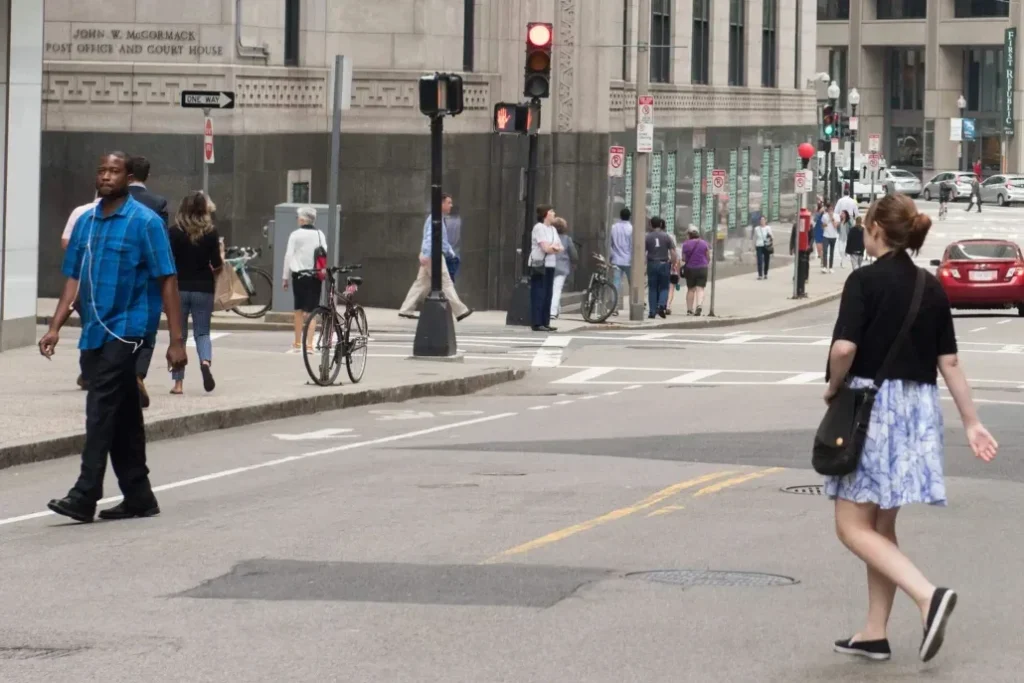
When Is Crossing Outside a Crosswalk Legal?
Safe jaywalking became legal when pedestrians cross without creating immediate collision hazards. Officers evaluate whether reasonably careful individuals would recognize danger before issuing citations.
Legal crossing scenarios:
- No vehicles approaching within stopping distance
- Clear sight lines in both directions
- Low-traffic residential streets with minimal vehicle presence
- Mid-block crossing when nearest crosswalk is unreasonably distant
- Emergency situations requiring immediate street crossing
Still illegal crossing scenarios:
- Vehicles approaching too close for safe crossing
- Darting into traffic without checking for cars
- Crossing during poor visibility conditions creating hazards
- Impeding traffic flow unnecessarily
- Crossing against signals when danger exists
The law does not eliminate pedestrian duty of care. Pedestrians must still exercise caution and assess traffic conditions before crossing outside designated areas.
Penalties for Jaywalking in California
Base fines for dangerous jaywalking violations reach $196 under California Vehicle Code 21955. Total costs exceed $250 when including court administrative fees and assessments.
Pre-AB 2147 enforcement resulted in fines ranging from $197 to $250 depending on jurisdiction. Los Angeles and San Francisco issued thousands of citations annually, generating substantial revenue while disproportionately affecting low-income communities.
Current enforcement focuses only on dangerous crossings. Citations dropped significantly since January 2023 as officers can no longer stop pedestrians for safe mid-block crossings.
Jaywalking infractions do not add points to California driving records. However, unpaid citations can lead to late fees, license holds, and vehicle registration restrictions.
Pedestrians receiving citations have options to contest tickets in court. Strong defenses include photographic evidence showing no immediate danger, witness testimony confirming safe crossing conditions, or documentation proving traffic signals were malfunctioning.
How California Cities Enforce Jaywalking Laws
Enforcement varies significantly across California municipalities despite statewide legislation.
Los Angeles: LAPD issued over 10,000 jaywalking citations annually before AB 2147. Enforcement concentrated in South Los Angeles, where communities of color faced disproportionate ticketing. Post-2023 enforcement dropped substantially, though officers still cite dangerous crossings in high-traffic areas like Downtown LA and Hollywood.
San Francisco: SFPD reduced jaywalking enforcement dramatically following AB 2147 implementation. The city focuses resources on traffic safety improvements rather than pedestrian citations. Vision Zero initiatives prioritize infrastructure over enforcement.
San Diego: Maintains moderate enforcement in busy commercial districts like Gaslamp Quarter and Little Italy. Officers primarily cite pedestrians creating genuine traffic hazards rather than technical violations.
Sacramento: Experienced protests over jaywalking enforcement practices before AB 2147. Current enforcement targets only egregious violations posing immediate collision risks.
Oakland: Reduced citations by over 80% since 2023. Community advocacy groups successfully pushed for enforcement policy changes prioritizing safety education over ticketing.
Local authorities retain power to establish additional pedestrian regulations under CVC 21961, though AB 2147’s immediate danger standard applies statewide.
Pedestrian Rights in California
California law grants pedestrians specific rights while imposing corresponding responsibilities.
Pedestrian rights include:
- Using marked and unmarked crosswalks at intersections with automatic right-of-way
- Crossing mid-block safely without police interference
- Accessing public roadways in areas without sidewalks
- Filing negligence claims against drivers violating pedestrian right-of-way
- Contesting unfair jaywalking citations
Pedestrian responsibilities include:
- Yielding to vehicles when crossing outside crosswalks per CVC 21954
- Exercising due care for personal safety regardless of legal crossing status
- Obeying traffic signals and posted pedestrian crossing instructions
- Avoiding sudden curb departures into vehicle paths
- Maintaining awareness of surrounding traffic conditions
California follows pure comparative negligence in pedestrian accident cases. Pedestrians can recover damages even when partially at fault, though compensation reduces proportionally to their fault percentage.
Recent Changes to California Jaywalking Law
AB 2147 represents California’s second attempt to reform jaywalking enforcement. Governor Newsom vetoed predecessor AB 1238 in 2021, citing concerns about potentially increasing pedestrian fatalities.
The revised AB 2147 addressed Newsom’s concerns by maintaining jaywalking’s illegal status while restricting when officers can issue citations. This compromise satisfied safety advocates while reducing discriminatory enforcement.
Assemblymember Laura Friedman of Glendale co-authored AB 2147, emphasizing infrastructure improvements over enforcement. “If people are jaywalking a lot in an area, it’s probably because they don’t have a good way to get across the street,” Friedman explained.
Virginia implemented similar legislation in March 2021, with no measurable increase in pedestrian fatalities through year-end. This data supported California’s reform efforts.
California’s pedestrian fatality rate remains 25% higher than national averages. Around 1,000 pedestrians die annually in traffic accidents statewide, with thousands more injured. The California Sheriff’s Association opposed AB 2147, arguing it would reduce law enforcement’s ability to protect pedestrian safety.
Critics noted the law’s reliance on officer discretion for determining “immediate danger” could lead to inconsistent enforcement. Tamika Butler, social justice advocate and transportation policy consultant, warned about continued disparities: “There’s still that piece of officer discretion.”
How to Contest a Jaywalking Ticket
Receiving a jaywalking citation requires prompt action. Tickets include court appearance dates or fine payment deadlines, typically within 21-30 days.
Steps to contest citations:
1. Request a court hearing before the deadline indicated on the ticket. Missing deadlines results in automatic convictions and late fees.
2. Gather evidence supporting your defense. Photograph the crossing location showing sight lines and traffic conditions. Document distance to nearest crosswalks, traffic signal status, and any relevant signage. Obtain witness statements confirming no immediate danger existed.
3. Prepare legal arguments based on AB 2147 standards. Challenge whether a reasonably careful person would recognize immediate collision danger. Argue that safe crossing conditions existed when cited. Question officer’s subjective determination of immediate hazard.
4. Present evidence at hearing. Courts evaluate whether crossing created genuine safety risks. Strong photographic evidence and witness testimony strengthen defense claims.
5. Consider traffic school or community service alternatives. Some courts offer these options for first-time offenders facing financial hardship.
Successful defenses often demonstrate no vehicles approached within safe stopping distance, clear visibility existed in all directions, or traffic signals malfunctioned creating confusion.
Marked vs. Unmarked Crosswalks in California
California recognizes both marked and unmarked crosswalks with distinct legal implications.
Marked crosswalks feature painted lines, signs, or signals designating pedestrian crossing areas. These appear at intersections and mid-block locations throughout California cities. Drivers must yield to pedestrians within marked crosswalks per CVC 21950.
Unmarked crosswalks exist at most intersections where sidewalks meet, even without painted lines or signage. California law extends crosswalk protections to these unmarked areas, requiring drivers to yield to crossing pedestrians.
The Freedom to Walk Act applies regardless of crosswalk type. Officers cannot cite pedestrians for crossing between controlled intersections unless immediate danger exists, whether marked crosswalks are present or not.
Mid-block crossing legality depends on safety conditions rather than crosswalk proximity. Pedestrians can legally cross mid-block when no immediate collision hazard exists, though using nearby crosswalks when available remains advisable.
Impact on Pedestrian Accident Claims
AB 2147 significantly affects liability determinations in pedestrian accident cases.
Pre-2023, jaywalking violations often established automatic partial liability for pedestrians struck by vehicles. Insurance companies routinely reduced settlements claiming pedestrians contributed to accidents by crossing illegally.
The Freedom to Walk Act changed this dynamic. Pedestrians crossing safely outside crosswalks can now demonstrate legal compliance under AB 2147, potentially increasing driver liability when collisions occur.
Key implications for accident claims:
Comparative negligence still applies. Even when crossing legally, pedestrians may bear partial fault if they failed to exercise reasonable care. Darting into traffic or crossing without checking for vehicles reduces compensation proportionally.
Driver duty of care remains absolute. California Vehicle Code 21950 requires drivers to exercise due care for pedestrian safety everywhere, not just at crosswalks. Drivers cannot claim reduced liability simply because pedestrians crossed mid-block.
Evidence quality determines outcomes. Dash cam footage, traffic camera recordings, and witness statements proving safe crossing conditions strengthen pedestrian claims. Documentation showing no immediate danger existed when crossing supports full compensation recovery.
Insurance companies adjust strategies. Insurers can no longer automatically reduce settlements citing jaywalking violations. Claims adjusters now evaluate whether crossings created genuine hazards rather than technical violations.
Pedestrians injured while crossing outside crosswalks should immediately document conditions proving compliance with AB 2147 standards. Photographs, video evidence, and witness contact information preserve crucial evidence supporting injury claims.
What Drivers Need to Know
California’s jaywalking law changes impose additional responsibilities on drivers.
Drivers must maintain heightened awareness for pedestrians crossing outside designated areas. AB 2147’s legalization of safe mid-block crossing means more pedestrians will cross between intersections.
Driver obligations include:
- Yielding to pedestrians in all marked and unmarked crosswalks
- Exercising due care for pedestrian safety on entire roadways
- Reducing speed in areas with high pedestrian activity
- Remaining alert for mid-block crossings in residential neighborhoods
- Avoiding aggressive driving near pedestrians regardless of crossing location
Striking pedestrians crossing legally outside crosswalks creates significant driver liability. Courts and insurance companies evaluate whether drivers maintained reasonable vigilance and took appropriate evasive action when pedestrians appeared.
Hit-and-run accidents involving pedestrians carry felony charges regardless of jaywalking status. Drivers must stop, render aid, and exchange information when collisions occur.
Frequently Asked Questions
Is jaywalking completely legal in California now?
No. Jaywalking remains technically illegal, but police can only issue citations when crossings create immediate collision danger. Safe mid-block crossing is legal in practice because officers cannot stop pedestrians absent immediate hazards.
What does “immediate danger” mean under AB 2147?
Immediate danger exists when a reasonably careful person would recognize collision risk with approaching vehicles or devices. Officers evaluate vehicle proximity, speed, visibility conditions, and whether adequate stopping distance exists.
Can I get a ticket for jaywalking on empty streets?
No. The Freedom to Walk Act prohibits citations when no immediate danger exists. Crossing empty streets without approaching vehicles does not meet the immediate danger standard.
Do jaywalking citations add points to my license?
No. Jaywalking violations are infractions that do not add DMV points to California driving records. However, unpaid tickets can lead to license holds and registration restrictions.
What if I get hit by a car while jaywalking?
You can still file injury claims against negligent drivers. California’s comparative negligence laws allow recovery even when partially at fault. Your compensation reduces proportionally to your fault percentage. Document that your crossing was safe under AB 2147 standards to minimize liability.
Are there places where jaywalking is never legal?
Yes. Freeways, bridges, tunnels, and other restricted roadways prohibit all pedestrian access under CVC 21960. Signage marks these restrictions. Crossing in these areas remains illegal regardless of traffic conditions.
How do local city ordinances affect jaywalking laws?
Cities can establish additional pedestrian regulations under CVC 21961, but AB 2147’s immediate danger standard applies statewide. Local ordinances cannot override the Freedom to Walk Act’s protections for safe crossing.
Sources:
- California Assembly Bill 2147 – Freedom to Walk Act
- California Vehicle Code Section 21955
- California Vehicle Code Section 21954
- California DMV Pedestrian Safety
- California Office of Traffic Safety
Last Updated: December 18, 2025
About the Author

Sarah Klein, JD, is a licensed attorney and legal content strategist with over 12 years of experience across civil, criminal, family, and regulatory law. At All About Lawyer, she covers a wide range of legal topics — from high-profile lawsuits and courtroom stories to state traffic laws and everyday legal questions — all with a focus on accuracy, clarity, and public understanding.
Her writing blends real legal insight with plain-English explanations, helping readers stay informed and legally aware.
Read more about Sarah