
Is Horse Meat Legal in America? Shocking Truth About What You Can’t Buy
Horse meat is technically legal to eat in most US states, but you cannot legally buy it commercially because federal funding restrictions have banned USDA inspections of horse slaughterhouses since 2007. Without federal inspection, horse meat cannot be sold for human consumption under the Federal Meat Inspection Act. Seven states—California, Florida, Georgia, Illinois, New Jersey, New York, and Texas—have explicitly banned horse slaughter. Meanwhile, over 19,000 American horses are exported annually to Canada and Mexico for slaughter.
The Federal Legal Status: A De Facto Ban Without an Actual Ban
Here’s the confusing reality: No federal law explicitly prohibits eating horse meat or slaughtering horses.
But horse slaughter hasn’t occurred on US soil since 2007. Why?
Congress created a de facto ban through budget restrictions. Since fiscal year 2006, annual appropriations bills have prohibited USDA from spending federal funds to inspect horse slaughter facilities.
Under the Federal Meat Inspection Act (21 U.S.C. § 601 et seq.), horses are an “amenable species”—meaning horse meat intended for human consumption must undergo USDA inspection before it can be sold commercially or transported across state lines.
No inspection funding = no inspections. No inspections = no legal commercial sale.
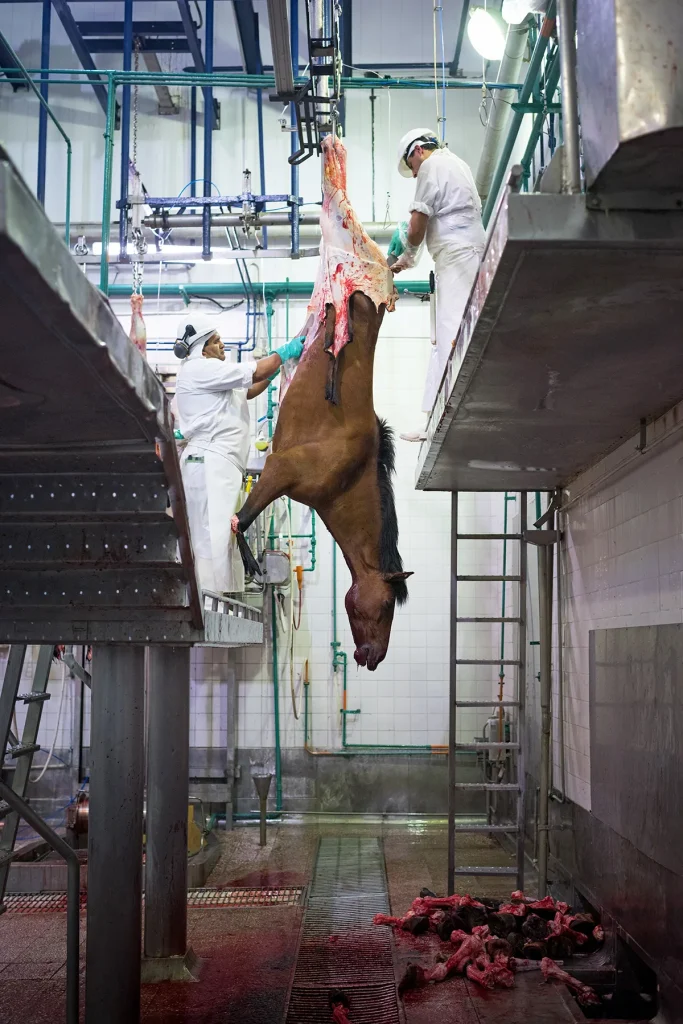
The last three US horse slaughterhouses closed in 2007:
- Two in Texas (Dallas Crown and Beltex Corporation)
- One in Illinois (Cavel International)
These were all foreign-owned operations exporting horse meat to Europe and Asia.
How USDA Funding Restrictions Create the Ban
The appropriations rider preventing USDA horse meat inspection funding has been renewed nearly every year since 2006.
Key timeline:
- FY 2006-2011: Funding ban in place; last slaughterhouses close by May 2007
- FY 2012: Rider not renewed; slaughter could theoretically resume
- FY 2012-2013: Renewed but with one-year gap in 2012
- FY 2014-present: Consistently renewed every year
The most recent fiscal year 2025 appropriations bill continues blocking inspection funding.
This language from FY 2025 bills states: “None of the funds made available by this Act may be used to pay the salaries or expenses of any person or personnel to inspect horses under section 3 of the Federal Meat Inspection Act.”
Why this matters: Without USDA inspection, companies cannot legally process or sell horse meat. The Federal Meat Inspection Act requires inspection for all meat sold commercially. Violating this federal law carries serious penalties.
In 2007, when remaining slaughterhouses tried to pay for their own inspections, the US District Court for the District of Columbia ruled this illegal. Horse slaughterhouses cannot circumvent the funding ban by self-financing inspections.
Related Article: Sealy Class Action Lawsuit Over Inflated Thread Counts — Claim Up to $5 Per Product in $750K Settlement by May 12, 2026
State Laws: Where Horse Slaughter Is Explicitly Banned
While federal restrictions prevent horse slaughter nationwide, seven states have gone further with explicit bans:
California (since 1998)
- Proposition 6 banned horse slaughter for human consumption
- First successful state initiative against horse slaughter
- California has the largest equine population in the US
Texas (since 1949)
- Texas law prohibits sale, possession, and transportation of horse meat for human consumption
- Law upheld by 5th Circuit Court of Appeals in 2007
- Texas remains a hub for shipping horses to foreign slaughterhouses despite ban
Illinois (since 2007)
- State law bans horse slaughter
- Closed Cavel International, the last Illinois slaughterhouse
New Jersey
- State ban on horse slaughter for human consumption
Florida
- Florida Statute § 500.451 criminalizes horse meat offenses
- Bans slaughter of horses for human consumption
Georgia
- State law bans horse slaughter
New York (since 2023)
- Most comprehensive state ban
- Prohibits slaughter for both human AND animal consumption
- Sets “gold standard” beyond other states’ human-consumption-only bans
Arizona
- Requires special license to slaughter horses
- Not an outright ban but creates regulatory barriers
Penalties vary by state: Most states with bans impose criminal penalties including fines and potential jail time for violations.
Can You Legally Buy or Sell Horse Meat?
The short answer: Almost never commercially.
For buying: You cannot find horse meat in grocery stores or restaurants because:
- Domestic slaughter is effectively banned through USDA funding restrictions
- Imported horse meat faces strict regulations and minimal supply
- Cultural taboo means virtually zero consumer demand
For selling: It’s illegal to commercially sell horse meat for human consumption in the US because:
- Federal Meat Inspection Act requires USDA inspection
- No inspection funding available
- Interstate commerce of uninspected meat is federal crime
Exception—personal consumption: In most states (except the seven with explicit bans), it’s technically legal to:
- Kill your own horse for personal consumption on your property
- Eat horse meat you legally obtained
But this is extraordinarily rare. Most Americans view horses as companions, not food.
Import and Export Rules: The Foreign Slaughter Loophole
Importing horse meat INTO the US:
It’s legally permissible under strict conditions. The Food Safety and Inspection Service (FSIS) requires:
- Meat must originate from countries with USDA-equivalent inspection systems
- Subject to FSIS re-inspection upon arrival
- Must meet all animal health requirements from Animal and Plant Health Inspection Service (APHIS)
In reality, imported horse meat volume is negligible. Few suppliers are approved, and there’s virtually no market demand.
Exporting US horses FOR slaughter abroad:
This is where the controversy explodes. Exporting live horses for slaughter remains completely legal despite domestic bans.
Approximately 19,000-20,000 American horses were exported for slaughter in 2024—down from over 166,000 in 2012, but still significant.
These horses are trucked to facilities in Canada and Mexico, where:
- Horse slaughter is legal and regulated
- Meat is exported to Europe, Asia, and other markets
The journey is brutal. Horses are legally shipped for over 24 hours in crowded trucks without food, water, or rest. Many arrive injured, dehydrated, or ill.
Animal welfare organizations document horses:
- Shipped with broken legs, blindness, or pregnancy
- Killed while conscious due to inadequate stunning
- Suffering “shipping fever” (respiratory disease from transport stress)
The USDA confirmed American horses in Mexican slaughterhouses through yellow USDA stickers on animals awaiting slaughter.
The SAFE Act: Proposed Permanent Federal Ban
On February 27, 2025, Congress reintroduced the Save America’s Forgotten Equines (SAFE) Act.
House Bill: H.R. 1661 Senate Bill: S. 775
Sponsors:
- House: Reps. Vern Buchanan (R-FL) and Jan Schakowsky (D-IL)
- Senate: Sens. Lindsey Graham (R-SC) and Ben Ray Luján (D-NM)
What it would do:
- Permanently ban horse slaughter in the United States
- Close the export loophole—prohibit transporting horses across borders for slaughter
- Expand the 2018 Dog and Cat Meat Prohibition Act to include equines
The SAFE Act has over 100 bipartisan cosponsors in the House—enough votes to pass if it reaches the floor.
The problem: It keeps dying in committee. The bill has been reintroduced repeatedly for over a decade but never receives a floor vote.
Lawmakers hope to include SAFE Act language in the 2025 Farm Bill, which Congress must pass roughly every five years. This could provide a path to passage.
Public support is overwhelming: 83% of Americans oppose horse slaughter according to 2021 national polling.
Why Did the US Stop Slaughtering Horses?
The closure of US horse slaughterhouses in 2007 culminated from years of animal welfare advocacy and public opposition.
Key factors:
Cultural attitudes: Americans view horses as companions and work partners, not food. Unlike cattle raised specifically for meat, horses are treated as:
- Recreational animals (riding, racing)
- Working animals (ranching, therapy)
- Companion animals (pets)
This cultural distinction makes horse consumption taboo similar to eating dogs or cats.
Animal welfare concerns: Investigation exposed brutal conditions:
- Horses transported long distances in overcrowded trailers
- Inadequate stunning leading to consciousness during slaughter
- Horses not raised as food animals, often given medications unsuitable for human food chain
Food safety issues: American horses receive medications throughout their lives—dewormers, anti-inflammatories, antibiotics—that are prohibited in food animals. Horse meat from US horses poses potential human health risks.
The European Union banned horse meat imports from Mexico in 2014 partly due to these contamination concerns.
Economic arguments: Horse slaughter generates minimal economic benefit. The three US facilities employed about 100 workers total. Communities that hosted slaughterhouses experienced environmental problems and economic drain.
Notably, both Texas and Illinois—states where slaughter occurred—passed laws banning the practice after experiencing it firsthand.
Legislative momentum: In 2005, animal rights groups intensified campaigns. By 2006, Congress included the first appropriations rider blocking inspection funding.
State legislatures in Texas and Illinois enacted bans. Courts upheld these laws despite industry challenges.
By 2007, all facilities closed.

Penalties for Violating Horse Meat Laws
Federal violations:
Selling uninspected meat for human consumption violates the Federal Meat Inspection Act:
- Criminal penalties up to 3 years imprisonment
- Fines up to $10,000
- Civil penalties and seizure of products
Transporting uninspected meat across state lines compounds federal crimes.
State penalties vary:
California: Misdemeanor charges; fines up to $5,000 per violation
Texas: Criminal offense; fines and potential jail time
Illinois: Class A misdemeanor; up to 1 year imprisonment, fines up to $2,500
Florida: Felony charges for horse meat offenses; significant fines and imprisonment
New York: Criminal penalties for violating comprehensive slaughter ban
Each horse involved can constitute a separate violation, multiplying penalties.
Enforcement is limited but serious. While violations are rare (due to effective ban), documented cases result in prosecution. Federal agencies prioritize food safety violations.
Cultural and Ethical Considerations in US Law
US horse meat prohibition reflects deeper cultural values embedded in law.
Historical context: Pope Gregory III in 723 AD called eating horses “filthy and abominable,” linking it to pagan religious practices. Catholic Church condemnation influenced Western cultures for centuries.
In Ireland, 7th century Canon Law imposed 4-year penance on bread and water for eating horse meat.
These religious prohibitions distinguished Christians from pagans and established cultural taboos that persist today.
Modern ethical arguments:
Horses as companions: Unlike livestock raised for food, horses form bonds with humans. They’re work partners, athletes, therapy animals, and pets.
“Conscientious omnivory” debate: Some ethicists argue horse meat bans are inconsistent. If ethical meat consumption depends on animals having “lives worth living,” horses raised under pastoral conditions face fewer welfare concerns than factory-farmed chickens or pigs.
Yet cultural attitudes trump logical consistency. Americans accept cattle slaughter but reject horse slaughter despite similar animal intelligence and sentience.
Legal classification complexity: Horses occupy a unique legal status as both:
- Livestock under agricultural laws
- Companions under public perception and some animal welfare statutes
This dual status creates policy tensions reflected in legislation.
The SAFE Act would resolve this by classifying equines similarly to dogs and cats—companion animals protected from slaughter.
How This Compares to Other Countries
Countries where horse meat is consumed:
Europe: France, Belgium, Italy, Switzerland—horse meat is traditional delicacy served in restaurants and butcher shops
Asia: Japan, China, Kazakhstan—regular part of diet, often considered healthful alternative to beef
South America: Argentina, Uruguay, Chile—horse meat consumed and exported
Canada and Mexico: Legal horse slaughter industries primarily export meat to Europe and Asia
Regulatory approaches vary:
Canada: Regulated slaughter for export; CFIA (Canadian Food Inspection Agency) inspects facilities; strict animal welfare standards theoretically enforced
Mexico: Less stringent regulations; documented welfare violations; facilities primarily near US border processing exported American horses
European Union: Strict import standards; requires documentation of medications given to horses; banned Mexican imports in 2014 due to contamination concerns; Canadian imports face scrutiny
Australia: Previously exported horses to Japan; public outcry led to export restrictions; some domestic slaughter continues with regulation
The US stands nearly alone among Western nations in its effective ban, reflecting uniquely strong cultural opposition to horse consumption.
Recent Legislative Developments
SAFE Act reintroduction (February 27, 2025): Bipartisan support with 100+ House cosponsors. Advocates push for inclusion in 2025 Farm Bill.
FY 2025 appropriations (passed December 2024): Continues inspection funding ban; lawmakers led by Reps. Buchanan and Schakowsky secured language blocking USDA inspection funding permanently within that bill.
State-level activity:
New York (2023): Passed most comprehensive state ban covering human AND animal consumption
Colorado: Proposed bills to ban horse slaughter; bills died but advocacy continues
Other states: Animal welfare groups lobby for additional state bans as backup to federal action
Industry opposition: Small but vocal groups support reopening slaughter:
- Some livestock organizations argue it provides “disposal option” for unwanted horses
- Veterinary organizations (AVMA, AAEP) have historically opposed ban, arguing slaughter is preferable to neglect
Counter-arguments demolish industry claims:
92.3% of horses at slaughterhouses were in “good” condition—not old, sick, or unwanted animals needing “humane disposal.”
Horse slaughter is not euthanasia. Euthanasia is gentle death by veterinarian; slaughter is industrial killing with inadequate stunning.
No documented rise in neglect cases after slaughter bans. California data shows 34% decrease in horse theft after banning slaughter.
Court challenges: No recent successful legal challenges to state bans. Federal preemption arguments failed. Supreme Court in 2007 denied review of circuit court decisions upholding state bans.
What Consumers and Horse Owners Need to Know
If you own horses:
Your horse could enter the slaughter pipeline through:
- Kill buyers at auctions: Professional buyers purchase horses specifically to export for slaughter, often outbidding potential adopters
- Deceptive ads: Kill buyers pose as good homes responding to rehoming advertisements
- Theft: Horse theft feeds slaughter pipeline; microchipping and registration help prevent this
Protection strategies:
- Screen potential buyers carefully; require contracts prohibiting resale for slaughter
- Work with reputable rescue organizations
- Consider lifetime care planning or humane euthanasia rather than selling aged horses
- Support the SAFE Act to close export loophole
If you’re curious about trying horse meat:
It’s nearly impossible to obtain legally in the US. Don’t attempt to:
- Smuggle horse meat from abroad (customs violation)
- Purchase from unlicensed sources (health risk, potentially illegal)
- Slaughter horses for sale (federal crime)
If you live in a state without explicit ban and own horses on your property, personal consumption may be technically legal—but social stigma is extreme and finding processing facilities impossible.
If you encounter horse meat sales:
Report to:
- USDA Food Safety and Inspection Service: 1-800-535-4555
- State agriculture department
- Local law enforcement
Selling uninspected meat for human consumption endangers public health and violates federal law.
The Economic Reality: Why Slaughter Won’t Return
Even without funding restrictions, economics make domestic horse slaughter unlikely:
Minimal profit margins: Horse slaughter generated little economic benefit. Foreign-owned facilities employed few workers, provided minimal tax revenue, and created environmental cleanup costs.
No domestic market: Americans don’t eat horse meat. Entire industry depended on export.
State prohibitions: Seven states ban slaughter. Facilities couldn’t reopen in Texas, Illinois, or California—the only states with prior operations.
Community opposition: No community wants a horse slaughterhouse. Applications face local zoning battles, protests, and political resistance.
Alternative industries thrive: Equine recreation, racing, therapy, and tourism generate billions annually. Protecting horses from slaughter supports these economic drivers.
Environmental costs: Slaughterhouses create contamination issues. Texas facilities left environmental problems communities paid to remediate.
The humane horse care industry—veterinary services, rescue organizations, sanctuaries—provides more jobs and economic value than slaughter ever did.
Frequently Asked Questions
Q: Is it legal to eat horse meat in the United States?
Eating horse meat is not explicitly illegal federally or in most states. However, you cannot legally purchase it commercially because USDA inspection funding is blocked, making it impossible to sell horse meat for human consumption. Seven states explicitly ban horse slaughter.
Q: Why can’t you buy horse meat in US grocery stores?
The Federal Meat Inspection Act requires USDA inspection for all meat sold commercially. Since 2006, Congress has blocked funding for horse meat inspections through annual appropriations riders. Without inspection, horse meat cannot be legally sold.
Q: Can I slaughter my own horse to eat?
In most states (except California, Florida, Georgia, Illinois, New Jersey, New York, and Texas), it’s technically legal to slaughter your own horse for personal consumption on your property. However, this is extremely rare due to cultural taboos and practical difficulties. Selling the meat would violate federal law.
Q: Is horse meat imported into the US?
Technically yes, but actual imports are negligible. Imported horse meat must meet strict USDA and APHIS requirements, come from approved foreign facilities, and undergo re-inspection. There’s virtually no market demand, so imports are minimal to nonexistent.
Q: Can US horses be exported for slaughter?
Yes, and this is the major controversy. While domestic horse slaughter is effectively banned, exporting live horses for slaughter remains legal. Approximately 19,000-20,000 American horses were exported to Canada and Mexico for slaughter in 2024. The proposed SAFE Act would close this loophole.
Q: What is the SAFE Act and will it pass?
The Save America’s Forgotten Equines (SAFE) Act (H.R. 1661/S. 775) would permanently ban horse slaughter in the US and prohibit exporting horses for slaughter. Reintroduced February 27, 2025, with 100+ House cosponsors. Despite strong support, similar bills have repeatedly died in committee over the past decade. Advocates hope to include it in the 2025 Farm Bill.
Q: What countries eat horse meat?
Horse meat is consumed in many countries including France, Belgium, Italy, Switzerland, Japan, China, Kazakhstan, Argentina, and others. It’s considered a delicacy in some cultures and a regular protein source in others. Canada and Mexico slaughter horses primarily for export to these markets.
Q: What are the penalties for selling horse meat illegally?
Federal penalties for selling uninspected meat include up to 3 years imprisonment and $10,000 fines under the Federal Meat Inspection Act. State penalties vary but can include misdemeanor to felony charges, significant fines, and jail time. Each horse can constitute a separate violation.
This article is for informational purposes only and does not constitute legal advice. Federal and state laws regarding horse meat are subject to change through legislation. For specific legal questions, consult an attorney in your jurisdiction.
About the Author

Sarah Klein, JD, is a licensed attorney and legal content strategist with over 12 years of experience across civil, criminal, family, and regulatory law. At All About Lawyer, she covers a wide range of legal topics — from high-profile lawsuits and courtroom stories to state traffic laws and everyday legal questions — all with a focus on accuracy, clarity, and public understanding.
Her writing blends real legal insight with plain-English explanations, helping readers stay informed and legally aware.
Read more about Sarah