
Is Gay Marriage Legal in Japan? Japan Remains G7’s Last Holdout as High Courts Declare Same-Sex Marriage Ban Unconstitutional
No, same-sex marriage is not legal in Japan. Despite multiple high court rulings declaring the ban unconstitutional, Japan’s national government does not recognize same-sex marriages. Japan remains one of only two G7 nations to not formally recognize same-sex marriage, alongside Italy. However, over 459 municipalities covering 85% of Japan’s population now issue partnership certificates providing limited recognition.
Japan’s constitutional framework, established in 1946, defines marriage through Article 24 as requiring the consent of “both sexes” with rights for “husband and wife.” The Civil Code reinforces this language, and Japanese authorities interpret these provisions as limiting marriage to opposite-sex couples.
Japan’s Constitutional Framework: Why Same-Sex Marriage Remains Banned
Article 24(1) of the Constitution provides that “marriage shall be based only on the mutual consent of both sexes and it shall be maintained through mutual cooperation with the equal rights of husband and wife as a basis”.
Conservative lawmakers argue this text explicitly requires opposite-sex marriage. However, legal scholars and advocates note Article 24 was written in 1946 to abolish arranged marriages and establish gender equality—not to address same-sex relationships, which weren’t considered during drafting.
The Civil Code uses terms like “husband and wife” throughout marriage provisions, reinforcing the interpretation that only opposite-sex couples can marry. When same-sex couples apply for marriage registration, municipal offices reject applications based on these statutes.
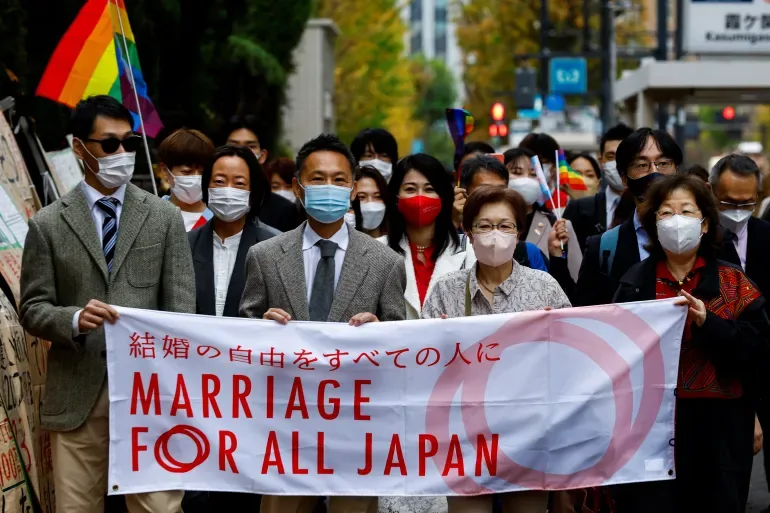
Historic Court Rulings: The Constitutional Challenge
Sapporo District Court (March 2021)
On 17 March 2021, a district court in Sapporo ruled the same-sex marriage ban unconstitutional, arguing that laws or regulations that deprive same-sex couples of the legal benefits of marriage constitute “discriminatory treatment without a rational basis” and as such violate Article 14 of the Constitution of Japan.
The court determined Article 24 doesn’t explicitly prohibit same-sex marriage—it simply addresses opposite-sex marriages without banning others.
Sapporo High Court (March 2024)
The Sapporo High Court issued a verdict stating that the same-sex marriage ban violated the Constitution, the first time an appellate court had reached such a conclusion. The ruling found violations of Article 14 (equality), Article 24(1), and Article 24(2), making it the most comprehensive constitutional challenge to date.
Tokyo High Court (October 2024)
The Tokyo High Court issued a similar ruling in the first Tokyo appeal on 30 October 2024, holding that the ban was unconstitutional under both articles 14 and 24(2) of the Constitution. Judge Sonoe Taniguchi ruled that “there is no rational basis for maintaining a situation in which sexual orientation, an attribute that cannot be chosen or changed at will, creates a distinction between the enjoyment of important legal benefits”.
Fukuoka High Court (December 2024)
In relatively quick succession, the Fukuoka High Court issued another ruling recognizing same-sex couples’ constitutional right to marry.
The Osaka Exception (June 2022)
Only the Osaka District Court ruled the ban constitutional, finding reasonable grounds for differential treatment based on traditional marriage definitions. This ruling remains an outlier among Japanese courts.
Recent Setback: Tokyo High Court Split Decision (November 2024)
A Japanese court on Friday ruled that the country’s ban on same-sex marriage is constitutional, becoming the only high court to uphold the state’s position among six rulings on similar lawsuits filed nationwide. This November 2024 Tokyo High Court ruling contrasts with five earlier high court decisions finding the ban unconstitutional, demonstrating ongoing judicial division.
Critical limitation: Court rulings in Japan don’t automatically change laws. Only the Diet (Parliament) can amend the Civil Code and related statutes to legalize same-sex marriage nationally.
Municipal Partnership Certificates: What Recognition Exists?
A survey conducted jointly by NPO Nijiiro Diversity and Shibuya municipal government in Tokyo found that 459 Japanese prefectures and municipalities have adopted same-sex partnership systems as of June 2024. At present, 85.1% of the population in Japan has access to such systems with a total of 7,351 partnership certificates having been issued to couples as of May 31.
Shibuya and Setagaya (Tokyo wards) launched Japan’s first partnership systems in November 2015. By October 2024, 20 prefectures including Tokyo, Osaka, Kyoto, Fukuoka, Aichi, and Hyogo have established prefectural systems.
What Partnership Certificates Provide
Partnership certificates allow same-sex couples to:
- Apply for municipal housing
- Be recognized by some private landlords
- Access certain hospital visitation rights
- Receive acknowledgment from participating employers
What Partnership Certificates Don’t Provide
Partnership certificates are not legally binding under national law. They don’t grant:
- Inheritance rights
- Joint tax filing
- Immigration/spousal visa recognition
- Parental rights over partner’s children
- Social security survivor benefits
- Legal decision-making authority
Over 530 municipalities and prefectures across Japan have introduced partnership certificate systems. These certificates provide limited, non-legally-binding recognition and can help with certain administrative procedures. However, these systems have significant limitations: They are not national law and may not be recognized outside the issuing municipality or prefecture. Private institutions are not legally obligated to honor them.
Inter-Municipal Recognition Network
On April 1, 2024, the governments of Osaka, Kyoto and Hyōgo prefectures established the Partnership System Inter-Municipality Collaboration Network as a common mutual agreement through which signatory jurisdictions, including prefectures, cities, towns and villages, may recognize and process each other’s partnership registries for purposes of travel or relocation. By October 2024, 17 additional prefectures had joined this network.
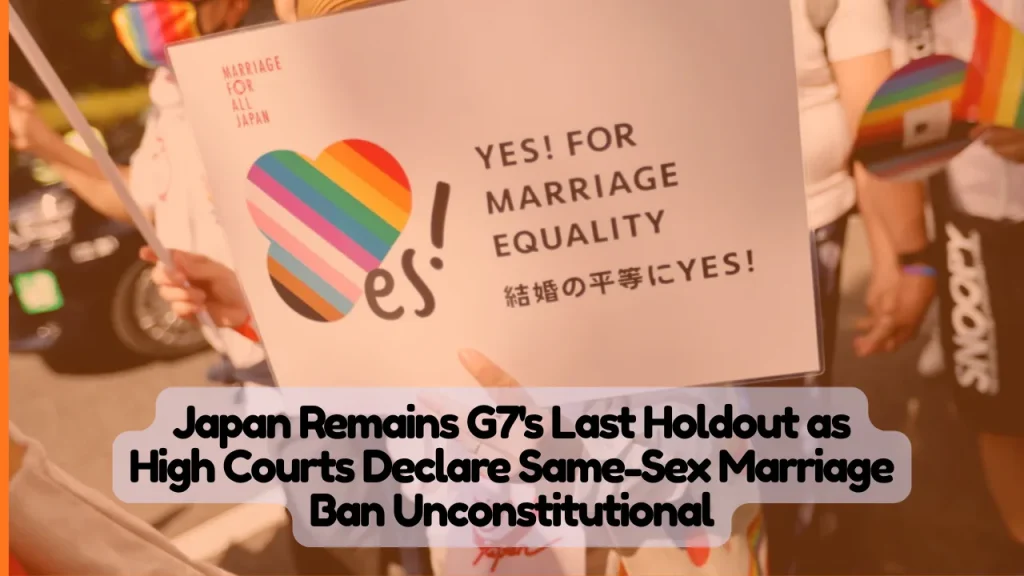
Recent Legislative Developments and Government Response
The government has decided to allow same-sex couples to be treated as being in de facto marriages under a total of nine more laws and ordinances, including the disaster condolence grant law. This followed a Supreme Court ruling recognizing same-sex couples under the crime victim benefit law.
However, the government maintains the position that same-sex partners are not covered by 120 laws and ordinances, including those related to taxes and social security.
Political Party Positions
Opposition to same-sex marriage:
- Liberal Democratic Party (LDP) – Japan’s ruling party since 1955 (with brief interruptions)
- Conservative Party
- Sanseitō
Support for same-sex marriage:
- Constitutional Democratic Party
- Japanese Communist Party
- Social Democratic Party
- Reiwa Shinsengumi
- Komeito
- Japan Innovation Party (believes constitutional amendment needed)
In September 2024, while running for prime minister, Ishiba said “he would consider the possibility of developing a law on same-sex marriage”. However, no concrete legislative proposals have advanced through the Diet.
The Constitutional Democratic Party announced plans in 2019 to introduce a bill amending the Civil Code to legalize same-sex marriage, but the bill has not progressed.
Recent Political Developments
Following the 2024 elections, the governing LDP lost its parliamentary majority for the first time since 2009, and a slight majority of the newly elected Parliament is reported as being in favour of same-sex marriage (51% support, 25% undecided and 24% opposed).
Practical Implications for Same-Sex Couples in Japan
Immigration and Visa Issues
Foreign partners of Japanese nationals cannot obtain spousal visas. Even same-sex couples legally married abroad face rejection when applying for residency based on marriage. Japan treats legally married same-sex couples from other countries as unrelated individuals.
Inheritance and Estate Planning
Without legal marriage recognition, same-sex partners have no automatic inheritance rights. Couples must create wills and legal agreements, which family members can challenge in court.
Healthcare Decision-Making
Same-sex partners aren’t automatically recognized as next-of-kin. Hospitals may deny visitation rights, refuse to share medical information, or exclude partners from treatment decisions unless couples carry partnership certificates—and even then, recognition depends on individual hospital policies.
Parenting and Family Recognition
Only biological or legally adopted children are recognized. If one partner gives birth or adopts, the other partner has no legal parental rights. The Family Register (koseki) system doesn’t accommodate same-sex couples, making family recognition impossible at the national level.
Taxation and Financial Benefits
Same-sex couples cannot:
- File joint tax returns
- Inherit spouse’s pension benefits
- Receive spousal deductions
- Access survivor benefits from social security
Employment Benefits
Whether same-sex partners receive employment benefits depends entirely on individual company policies. Some progressive companies like Nintendo have announced recognition of same-sex partnerships equal to marriage, but this isn’t mandated by law.
How Japan Compares to the UK and Other Countries
United Kingdom
The UK legalized same-sex marriage in England and Wales in March 2014, in Scotland in December 2014, and in Northern Ireland in January 2020. Same-sex couples in the UK enjoy full legal equality including:
- Automatic inheritance rights
- Joint tax filing
- Parental rights for both partners
- Immigration/spousal visas
- Full social security benefits
British nationals can marry same-sex partners through consular marriages in Japan, but these marriages aren’t recognized under Japanese law for purposes of visas, residence, or legal rights in Japan.
G7 Comparison
Japan stands as the only G7 country without same-sex marriage recognition. All other G7 members (Canada, France, Germany, Italy, the UK, and the US) provide legal recognition through marriage or comprehensive civil unions. Italy, while not recognizing same-sex marriage, established civil unions in 2016 granting most marital rights.
Asia-Pacific Region
- Taiwan: Legalized same-sex marriage in May 2019, first in Asia
- Thailand: Lower house passed marriage equality bill in 2024; awaiting final approval
- Nepal: Technically permits same-sex marriage following 2023 court ruling, though implementation remains incomplete
- Other Asian countries: No legal recognition
Public Opinion and Cultural Attitudes
Polling suggests high levels of support for same-sex marriage among the Japanese public, notably among women and the younger generation.
Recent surveys show:
- 2023 NHK poll: 71% support legalizing same-sex marriage
- Among ages 18-30: 90% of women and 75% of men support marriage equality
- Among LDP supporters: 58% favor same-sex marriage
- Public opinion has shifted significantly over the past decade
This represents higher support than the US had when the Supreme Court legalized same-sex marriage nationwide in 2015 (58% American support at that time).
International Pressure and Future Outlook
International Advocacy
US Ambassador Rahm Emanuel and other foreign diplomats have publicly urged Japan to advance marriage equality, particularly around G7 summits where Japan’s outlier status draws attention.
Business Community Pressure
Major corporations including Nintendo, Japan Airlines, and numerous financial institutions have adopted internal policies recognizing same-sex partnerships, creating pressure for legal reform. International companies recruiting in Japan view marriage equality as essential for attracting global talent.
Supreme Court Trajectory
The plaintiff legal team has stated their intent to appeal all cases to the Supreme Court, and it is reported that the case is likely to be referred to the Grand Bench. A Supreme Court ruling would create binding precedent across Japan.
However, Japan’s Supreme Court historically exercises restraint, rarely striking down legislation. Between 1947 and 2019, the Court declared only 10 statutes unconstitutional, compared to hundreds in other democracies.
Timeline Uncertainty
Despite overwhelming public support and consistent high court rulings, the LDP-controlled Diet has not advanced legislative reform. Political calculations around “traditional family values” and concerns about conservative voter backlash have stalled progress.
The accumulation of high court rulings creates mounting legal and political pressure, but without Diet action, same-sex marriage remains prohibited regardless of judicial findings.
Frequently Asked Questions
Can same-sex couples legally marry in Japan today?
No. Same-sex marriage is not recognized under Japanese law. Multiple courts have ruled the ban unconstitutional, but only the Diet can change the law.
What’s the difference between partnership certificates and marriage?
Partnership certificates provide symbolic recognition and limited benefits (housing applications, some hospital recognition) within specific municipalities. They don’t grant legal rights like inheritance, immigration visas, tax benefits, or parental rights. Marriage would provide all these protections under national law.
If I’m married in the UK, will Japan recognize my marriage?
No. Japan doesn’t recognize same-sex marriages performed abroad. You’ll be treated as legally unrelated individuals for visa, immigration, inheritance, and all legal purposes in Japan.
Can I get a spousal visa if I’m in a same-sex relationship with a Japanese citizen?
No. Japan doesn’t grant spousal visas to same-sex partners, even if you’re legally married in another country. Foreign partners must obtain visas through other means (work visas, student visas, long-term resident status).
Which cities in Japan issue partnership certificates?
As of June 2024, 459 municipalities and prefectures issue partnership certificates, covering 85% of Japan’s population. Major areas include Tokyo, Osaka, Kyoto, Fukuoka, Aichi, Hyogo, Sapporo, Nagoya, and most large cities. Check your specific city’s website for current availability.
Will Japan legalize same-sex marriage soon?
Uncertain. Public support is strong (71%), and multiple high courts have ruled the ban unconstitutional. However, the ruling LDP opposes reform, and no legislative timeline exists. The 2024 election reduced the LDP’s majority, with 51% of newly elected MPs supporting same-sex marriage, potentially improving prospects.
How does the Japanese Supreme Court ruling process work?
Cases are being appealed to the Supreme Court’s Grand Bench. If the Supreme Court rules the ban unconstitutional, it would create binding precedent nationwide. However, even a Supreme Court ruling wouldn’t automatically legalize same-sex marriage—the Diet must still amend the Civil Code and Family Register Act.
What legal protections can same-sex couples in Japan obtain now?
Same-sex couples can:
- Obtain partnership certificates in most major cities
- Create wills specifying inheritance
- Establish medical directives
- Sign rental agreements (with landlord approval)
- Access benefits from employers with inclusive policies
These measures don’t provide the comprehensive protections of marriage but offer some legal documentation and recognition.
Official Sources:
- Japanese Constitution – Article 24
- Marriage For All Japan – Advocacy Organization
- Tokyo Partnership Oath System
- Japanese Ministry of Justice
Last updated: December 2024. Laws and court decisions may change. Consult a qualified family law attorney in Japan for advice specific to your situation.
About the Author

Sarah Klein, JD, is a licensed attorney and legal content strategist with over 12 years of experience across civil, criminal, family, and regulatory law. At All About Lawyer, she covers a wide range of legal topics — from high-profile lawsuits and courtroom stories to state traffic laws and everyday legal questions — all with a focus on accuracy, clarity, and public understanding.
Her writing blends real legal insight with plain-English explanations, helping readers stay informed and legally aware.
Read more about Sarah