
How a Bill Becomes a Law? The Complete Legislative Process and Your Role in Democracy
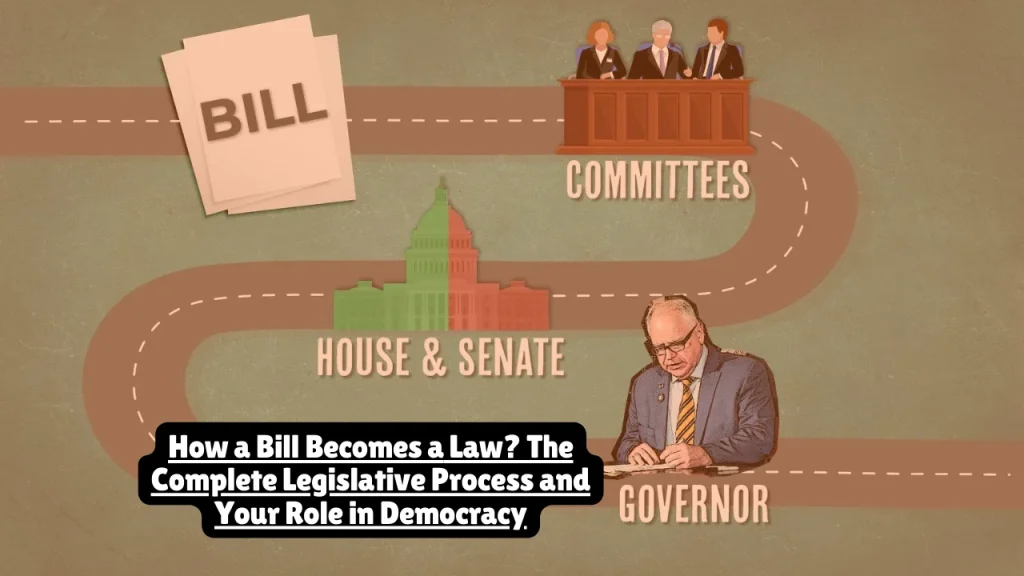
A bill becomes a law through a multi-step legislative process: introduction in either the House or Senate, committee review, floor debate and amendments, passage by both chambers with simple majority votes, and presidential action—signing, vetoing, or allowing the bill to become law without signature. Congress can override a presidential veto with a two-thirds majority in both chambers.
Understanding this process helps you track legislation that affects your rights, your business, and your community.
The Bill Introduction and Committee Process
How Bills Enter Congress
Any member of Congress can introduce a bill—proposed legislation—in their chamber. Bills introduced in the House receive an “H.R.” number. Senate bills get an “S.” number.
Once introduced, the bill is referred to the appropriate committee based on subject matter. Committees are groups of members who review bills on specific topics like agriculture, finance, or judiciary.
The committee holds hearings where experts and citizens testify. Committee members debate the bill, propose amendments—changes to the bill’s language—and vote on whether to send it to the full chamber for consideration.
Most bills die in committee. If a committee doesn’t act on a bill, it typically doesn’t advance.
Why Committees Matter
Committees provide the first real gatekeeping function in the legislative process. When you want to influence legislation, contacting committee members early can be more effective than waiting until floor consideration.
Committee hearings allow citizens to testify and provide input. Many major policy changes begin with committee markup sessions where bills are substantially rewritten before reaching the full chamber.
Understanding which government bodies make consumer protection laws helps you recognize where to direct your advocacy efforts.
Floor Debate, Voting, and Passage in Both Chambers
How Bills Move Through Congress
When a committee approves a bill, it goes to the full House or Senate for floor consideration. The floor is where all members debate and vote.
Members propose amendments during floor debate. Amendments may be adopted or rejected by majority vote. The bill’s sponsor may accept friendly amendments or oppose hostile ones.
For a bill to pass the House, it needs 218 votes out of 435 members—a simple majority. In the Senate, 51 votes out of 100 members constitutes a simple majority.
Both chambers must pass identical versions of the same bill before it goes to the President. If the House and Senate pass different versions, a conference committee reconciles the differences.
The reconciled version must pass both chambers again before presidential action.
The Conference Committee Process
When the House passes one version and the Senate passes another, members from both chambers meet in conference committee to negotiate a compromise.
Conference committees can significantly reshape legislation. The final version sometimes differs substantially from either chamber’s original bill.
Both the House and Senate must approve the conference committee’s reconciled version. If either chamber rejects it, the bill dies.
Presidential Action and Veto Override Procedures
The President’s Four Options
When a bill reaches the President, four outcomes are possible. The President can sign the bill, making it law immediately.
The President can veto the bill—reject it—and return it to Congress with objections. This is the most direct form of presidential opposition.
The President can take no action. If Congress is in session and the President doesn’t sign within 10 days, the bill becomes law without a signature.
The President can employ a pocket veto. If Congress adjourns and the President takes no action within 10 days, the bill dies. This prevents Congress from overriding the veto.
Related article: Is It Legal to Protest in a Church? First Amendment Rights vs. Property Rights and When You Need Permission
How Congress Overrides Vetoes
If the President vetoes a bill, Congress can still make it law through a veto override. Both chambers must vote again.
The override requires a two-thirds majority—290 votes in the House, 67 votes in the Senate. This is a much higher threshold than the simple majority needed for initial passage.
Veto overrides are rare because they require significant bipartisan support. When they succeed, the bill becomes law without presidential approval.
Understanding the constitutional framework behind these processes connects to the supreme law of the land—Article I of the Constitution establishes Congress’s legislative powers and procedures.
What People Get Wrong About the Legislative Process
Many believe a bill becomes law as soon as it passes one chamber. Wrong. Both the House and Senate must pass identical versions.
Others think the President’s veto automatically kills a bill. Congress can override vetoes with a two-thirds majority, though this rarely happens.
Some assume committees have no real power. In reality, committees are where most bills die and where substantial policy changes happen.
Many believe citizens can’t influence legislation. You can contact representatives, testify before committees, and participate in advocacy campaigns to shape policy outcomes.
How to Track and Influence Legislation
Finding Bills That Affect You
Visit Congress.gov to search for bills by number or topic. Review the bill’s text, current status, committee assignments, and voting records.
Track committee actions and floor votes. Note whether your representatives supported or opposed bills important to you.
Understanding voting rights helps you exercise influence through elections when representatives don’t reflect your policy preferences.
When to Contact Your Representatives
Contact your House representative and Senators about bills affecting your interests. Be specific about which bill and what action you want them to take.
Consider testifying before committees if you have relevant expertise. Many committees accept public testimony during hearings.
Participate in advocacy campaigns organized by groups aligned with your interests. Coordinated constituent outreach can influence legislative outcomes.
Vote for representatives who support your policy preferences. Your voting record sends the clearest message about what legislation you support.
Last Updated: January 20, 2026
Disclaimer: This article is for informational purposes only and explains the legislative process; consult an attorney for legal advice about how specific laws affect your rights or obligations.
Take Action: Track bills using Congress.gov. Contact your representatives about issues you care about. Understand how your representatives vote. Participate in the democratic process. Most importantly, stay informed about legislation that affects you.
Stay informed, stay protected. — AllAboutLawyer.com
Sources:
- U.S. Constitution Article
- Congress.gov Legislative Process Overview (congress.gov/legislative-process)
- House.gov Legislative Process (house.gov/the-house-explained/the-legislative-process)
- Senate.gov How Laws Are Made (senate.gov)
- USA.gov How Laws Are Made (usa.gov/how-laws-are-made)
About the Author

Sarah Klein, JD, is a licensed attorney and legal content strategist with over 12 years of experience across civil, criminal, family, and regulatory law. At All About Lawyer, she covers a wide range of legal topics — from high-profile lawsuits and courtroom stories to state traffic laws and everyday legal questions — all with a focus on accuracy, clarity, and public understanding.
Her writing blends real legal insight with plain-English explanations, helping readers stay informed and legally aware.
Read more about Sarah