
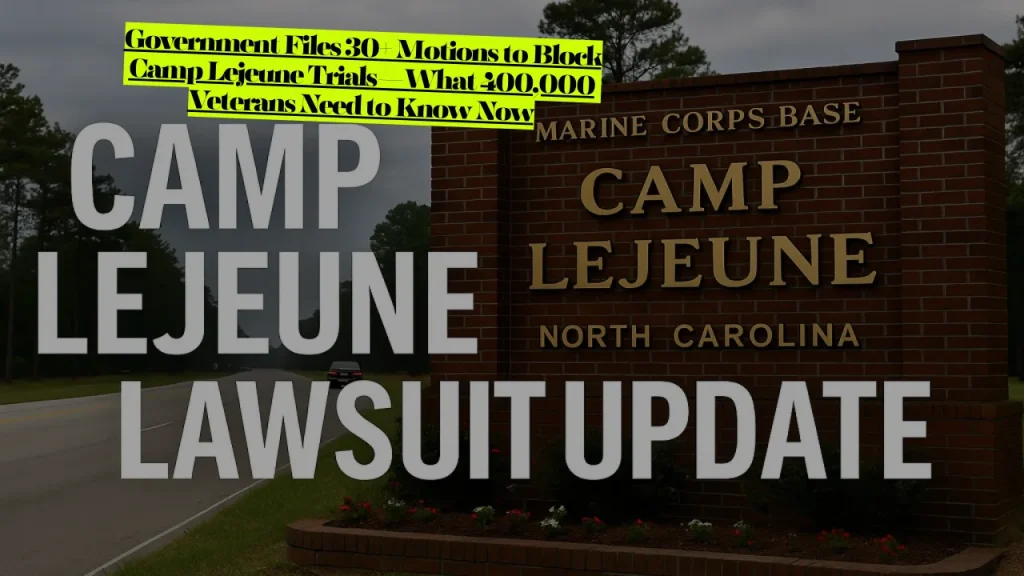
Government Files 30+ Motions to Block Camp Lejeune Trials—What 400,000 Veterans Need to Know Now
The government submitted more than 30 Daubert challenges targeting expert witnesses in the Camp Lejeune water contamination lawsuit as over 3,600 lawsuits and 400,000 administrative claims remain pending. Plaintiffs’ attorneys filed a motion on November 12, 2025, urging the court to set bellwether trials for early 2026, while both sides expressed cautious optimism about reaching a global settlement framework by year’s end.
The filing deadline passed in August 2024, but claimants denied or awaiting responses can still pursue federal lawsuits. Here’s what veterans and families need to know about compensation amounts, trial timelines, and settlement options as this historic litigation enters a critical phase.
What Is the Camp Lejeune Lawsuit?
The Camp Lejeune Justice Act allows people who lived, worked, or were exposed to toxic water for at least 30 days between 1953 and 1987 to sue the federal government. The law established a lower burden of proof, requiring plaintiffs to demonstrate contaminated water was at least as likely as not the cause of their illness. Over one million people may have been exposed at the North Carolina base.
Water samples from 1980-1985 primarily contained tetrachloroethylene, trichloroethylene, and their breakdown products, along with benzene. Contamination came from leaking underground storage tanks, waste disposal sites, industrial spills, and an off-base dry-cleaning firm.
Related Lawsuit: Michael Jordan Nascar Lawsuit, Michael Jordan Takes NASCAR to Court—NBA Legend’s Racing Team Fights Monopoly Claims as Trial Opens
Current Status: Trials Delayed as Government Challenges Expert Testimony
The government filed Daubert motions totaling 690 pages and more than 233,000 words—longer than Herman Melville’s Moby Dick. These motions seek to exclude every expert witness and dismiss all Track 1 bellwether cases.
Plaintiffs’ Leadership Group responded by requesting kidney cancer cases proceed to trial first, noting more than 23,000 claimants have been affected by kidney cancer. The motion emphasized that 72 years after first exposures and two years of intense litigation, it’s time to give America’s poisoned Marines their day in court.
Key Litigation Timeline
- October 2025: Expert discovery deadline extended through October 31, 2025
- Early 2026: First bellwether trials expected to begin
- Summer 2025: Bellwether mediations scheduled for the 25 selected cases
- 2026: Settlement Masters may submit draft settlement matrix framework
Settlement Masters began circulating approximately 2,400 claimant survey forms to assess injury categories and develop a settlement matrix. This pre-negotiation groundwork could lead to a draft framework submitted to the court in 2026, though the effort could be unsuccessful if the Department of Justice doesn’t agree.
Camp Lejeune Settlement Amounts: What Claimants Are Actually Getting
Elective Option Payouts
As of July 2024, $14.7 million in payouts had been made to claimants. Settlement offers under the Elective Option range from $100,000 to $550,000, depending on illness severity and exposure duration.
Tier 1 Conditions (Higher Payouts):
- Kidney cancer
- Liver cancer
- Non-Hodgkin’s lymphoma
- Leukemia
- Bladder cancer
Tier 2 Conditions:
- Multiple myeloma
- Parkinson’s disease
- Kidney disease/End-stage renal disease
- Systemic sclerosis/systemic scleroderma
Payouts within the early settlement program span from $100,000 to $450,000, using a 2-by-3 grid system based on length of stay at Camp Lejeune and disease tier. Claims involving death receive an additional $100,000.
Reality Check on Settlement Offers
Only about 63,000 claims fall within the Elective Option scope, and fewer than half are being meaningfully reviewed. Out of 1,800 pending cases, only 93 received offers under the early settlement program, and just 37 offers were accepted.
Legal experts argue Elective Option settlements fall well short of what cases would command in court. Original estimates suggested Parkinson’s disease cases could reach $1 million to $1.5 million, but Elective Option settlements haven’t reflected those numbers.
Projected Settlement Values
The Congressional Budget Office projected $22 billion to settle these cases. The federal government expects to pay over $21 billion to claimants and families over the next decade.
Expected settlement amounts vary significantly by case, with cancer victims and Parkinson’s disease claimants receiving the highest amounts. Some claimants may receive compensation offers approaching seven figures.
Who Qualifies for Camp Lejeune Compensation?
Eligibility Requirements
You can file if you lived, worked, or were exposed at Camp Lejeune for at least 30 days between August 1, 1953, and December 31, 1987. Those exposed in utero also qualify if their mother was present during pregnancy.
Presumptive Conditions (VA Benefits)
Veterans may receive disability compensation for eight presumptive conditions: adult leukemia, aplastic anemia and myelodysplastic syndromes, bladder cancer, kidney cancer, liver cancer, multiple myeloma, non-Hodgkin’s lymphoma, and Parkinson’s disease.
Additional Covered Conditions
VA healthcare without co-pays covers 15 conditions including bladder cancer, breast cancer, esophageal cancer, female infertility, hepatic steatosis, kidney cancer, leukemia, lung cancer, miscarriage, multiple myeloma, myelodysplastic syndromes, neurobehavioral effects, non-Hodgkin’s lymphoma, renal toxicity, and scleroderma.

Critical Deadlines and How to File
Filing Deadline Status
The deadline to file CLJA claims passed on August 9, 2024—no new claims are being accepted. However, if you filed before the deadline, you may still file a lawsuit if the Department of Navy didn’t reply within six months or denied your claim.
Claimants have 180 days from denial to file a lawsuit in federal court.
How to File a Lawsuit
Start by filing an administrative claim with the Department of Navy. If the Navy denies your claim or you wait longer than six months for a decision, you can file a lawsuit in the Eastern District of North Carolina.
Attorney fees for administrative settlements cannot exceed 20% of the award, and litigation settlements are capped at 25%.
Understanding the Elective Option vs. Litigation
Elective Option Advantages
- Payment guaranteed within 60 days of acceptance
- Lower burden of proof compared to lawsuits
- No offset by VA disability payments
Elective Option Disadvantages
- Settlement offers compensate only the most severe health condition—multiple illnesses aren’t fully compensated
- Qualifying injury must have been diagnosed before August 10, 2022
- Diagnosis must occur between 2 and 35 years after first exposure
- Accepting waives your right to file future lawsuits
Legal experts warn amounts could be far lower than filing in federal court.
Track 1 Bellwether Cases: What They Mean for Your Claim
Track 1 bellwether trials focus on five diseases: bladder cancer, kidney cancer, Parkinson’s disease, non-Hodgkin’s lymphoma, and leukemia. Twenty-five cases were selected for the first round of trials.
Bellwether trial outcomes heavily influence settlement values for all remaining claims. If plaintiffs win big verdicts, it will pressure the government to offer better settlements; if the government wins, they’ll fight harder.
Legal Framework: The Camp Lejeune Justice Act Explained
Enacted 40 years after government testing showed drinking water contamination, the CLJA removed previous barriers to lawsuits. The law established a lower standard of proof requiring plaintiffs to show contaminated water was at least as likely as not the cause of illness.
Victims had two years from when President Biden signed the act to sue the federal government—a window that closed in fall 2024.
Court Jurisdiction
Consolidated federal court proceedings occur in the Eastern District of North Carolina. Nearly 3,600 lawsuits have been filed, distributed fairly evenly among four federal judges.
What This Means for Veterans and Military Families
Impact on VA Benefits
Filing for relief under the CLJA won’t affect eligibility for VA disability or healthcare benefits. Court awards under this law don’t affect VA disability payment amounts or healthcare eligibility.
Government Accountability
The CLJA represents a major shift in military accountability, allowing veterans and families to hold the government responsible for decades of contamination exposure. Despite the overwhelming number of pending claims, not a single case has gone to trial.
Current Challenges
The burden of proof remains high because the government is choosing to make it that way through rigid documentation requirements. Medical records and proof of presence are scrutinized through a lens so narrow it appears designed to delay resolution.
Frequently Asked Questions About Camp Lejeune Claims
Can I still file a Camp Lejeune claim in 2025?
No new CLJA claims are being accepted after the August 9, 2024 deadline. However, if you filed before the deadline and were denied or received no response within six months, you can file a lawsuit.
How long will it take to receive compensation?
Cases are expected to take 1-2 years to settle on average. Elective Option payments are guaranteed within 60 days of acceptance.
What is the average Camp Lejeune settlement amount?
Elective Option offers range from $100,000 to $550,000. Average settlement payments are around $246,000, with bladder cancer victims receiving the greatest amounts.
Will accepting the Elective Option affect my VA benefits?
No—Elective Option offers will not be offset by disability awards or VA benefits.
What diseases are covered under the Camp Lejeune lawsuit?
Track 1 diseases include bladder cancer, kidney cancer, Parkinson’s disease, non-Hodgkin’s lymphoma, and leukemia. Additional conditions covered include multiple myeloma, liver cancer, aplastic anemia, myelodysplastic syndromes, breast cancer, esophageal cancer, female infertility, hepatic steatosis, lung cancer, miscarriage, neurobehavioral effects, renal toxicity, and scleroderma.
When will the first Camp Lejeune trials begin?
First Track 1 bellwether trials could begin in 2026. Expert discovery runs through October 2025, with pre-trial motions to follow.
Should I accept the Elective Option or wait for a trial verdict?
The Elective Option is the right move for some, but not the path to resolve this litigation. If you want to maximize your case value, you’re likely better off waiting unless you really need money now or are desperate for closure.
Next Steps for Affected Veterans and Families
If you filed a claim before August 2024:
- Monitor your claim status through the Department of Navy Claims Management Portal
- File a lawsuit within 180 days if your claim was denied
- Review any Elective Option offers carefully with legal counsel
- Gather medical records and proof of Camp Lejeune presence
Both sides remain cautiously optimistic about reaching a global settlement framework by the end of 2025. Settlement Masters are developing questionnaires for a settlement matrix, with bellwether mediations scheduled for summer 2025.
This article provides legal information, not legal advice. Consult a qualified attorney specializing in Camp Lejeune claims for guidance on your specific situation. Information current as of December 2025.
About the Author

Sarah Klein, JD, is a licensed attorney and legal content strategist with over 12 years of experience across civil, criminal, family, and regulatory law. At All About Lawyer, she covers a wide range of legal topics — from high-profile lawsuits and courtroom stories to state traffic laws and everyday legal questions — all with a focus on accuracy, clarity, and public understanding.
Her writing blends real legal insight with plain-English explanations, helping readers stay informed and legally aware.
Read more about Sarah