
Good Samaritan Law 2026, What It Protects, Exceptions, State Variations, and Your Rights
Good Samaritan laws protect people who provide emergency assistance from liability for ordinary negligence, meaning you can’t be sued if you act reasonably to help someone in an emergency. All 50 states and DC have these protections. However, they don’t cover gross negligence, willful misconduct, or if you expect compensation. Protection applies only in emergencies, when you act voluntarily, in good faith, and within your training level. You can still be sued, but the law provides a strong defense.
What Is Good Samaritan Law?
Good Samaritan laws are based on the principle that consensus agreement supports good public policy by limiting liability for individuals who voluntarily provide care and assistance during emergencies.
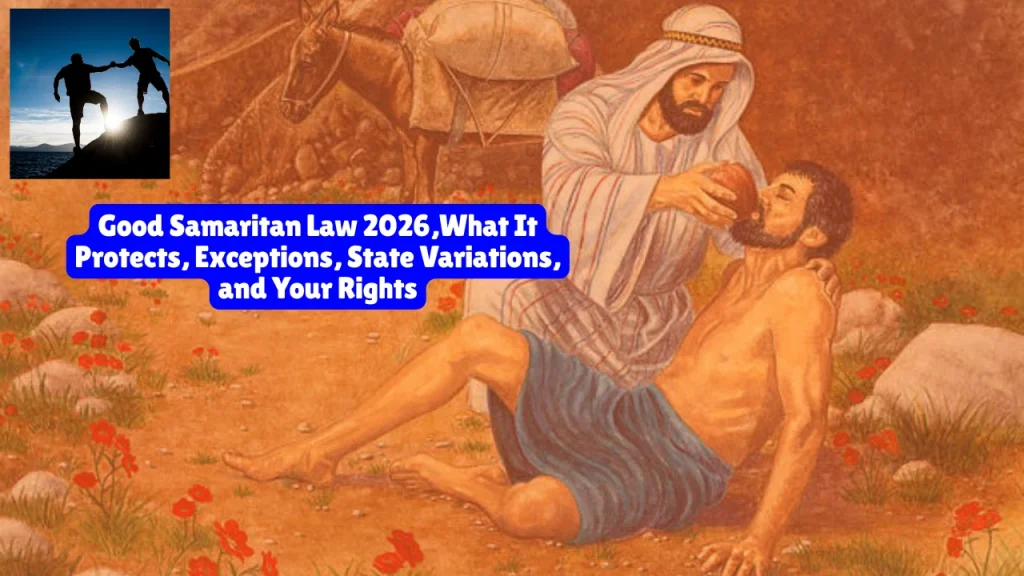
The term comes from the biblical parable of a Samaritan who helped an injured stranger. These laws encourage bystanders to help without fear of lawsuits.
Key Principle: Society benefits when potential rescuers—Good Samaritans—focus solely on helping individuals in need rather than worrying about potential liability for their assistance.
What Conduct Good Samaritan Laws Protect
Good Samaritan laws typically protect:
Emergency Medical Care
- CPR and chest compressions
- Using an AED (automated external defibrillator)
- Basic first aid
- Helping someone who is choking
- Controlling bleeding
- Treating shock
Rescue Assistance
- Pulling someone from a burning car
- Moving someone away from immediate danger
- Calling 911 for help
- Staying with an injured person until help arrives
Common Emergency Situations:
- Heart attacks
- Choking incidents
- Car accidents
- Drowning
- Drug overdoses
- Severe allergic reactions
- Falls causing injury
Related article: California Disturbing The Peace Law, What Penal Code 415 Really Means, Penalties, Defenses, and Your Rights
Elements Required for Protection
Most Good Samaritan laws require the following elements to be met: The situation must be an emergency. The carer must act voluntarily (for example, they must not be under some legal duty to help). The victim must consent to the assistance, if capable.
1. Emergency Situation A car accident, someone choking on food in a restaurant, or a person suffering a heart attack are good examples of the types of emergencies contemplated under Good Samaritan laws.
2. Voluntary Act The carer must not have a pre-existing duty to help the victim. For example, as the language of the California, Connecticut, and Indiana laws implies, it’s the job of first responders on duty—and medical personnel on duty and in their specific clinic or hospital—to help accident victims (so the assistance they give is not voluntary).
3. No Compensation Another common exclusion in state statutes is that the healthcare provider must not receive compensation for their assistance. If any remuneration is involved in rendering emergency care, the individual is no longer considered a Good Samaritan, and the legal protections do not apply.
4. Good Faith You must act with honest intentions, trying to help rather than harm.
5. Reasonable Care You must act as a reasonable person would in similar circumstances, within your level of training.
What Good Samaritan Laws DON’T Protect
Gross Negligence Good Samaritan laws provide liability protection against “ordinary negligence,” which refers to the failure to act as a reasonably prudent person under similar circumstances. However, these laws do not protect against “gross negligence” or willful misconduct. Gross negligence involves a conscious and voluntary disregard for the need to use reasonable care, leading to a foreseeable risk of serious injury or harm to people, property, or both.
If a rescuer acts with gross negligence, meaning their actions are reckless or worsen the situation significantly, their immunity under Good Samaritan laws does not apply. Negligence include actions like using excessive force, disregarding safety protocols, or performing procedures beyond one’s training.
Related article: Lisa Barlow Lawsuit Update, 3 of 4 Cases Dismissed, $410K Carlson Lawsuit Still Active in 2026
Examples of Gross Negligence:
- Performing surgery on someone in a parking lot when you’re not trained
- Moving someone with obvious spinal injuries without cause
- Using excessive force causing additional harm
- Acting recklessly or worsening the situation
- Ignoring clear safety protocols
Willful Misconduct Good Samaritan Laws do not protect individuals who intentionally cause harm or engage in malicious actions while providing aid. If the helper’s actions are purposefully harmful, legal action is taken against them.
Pre-Existing Duty to Act For Good Samaritan laws to apply to clinicians and other healthcare providers, specific conditions must be met, primarily that there is no preexisting duty to treat. For this reason, on-call physicians are generally not covered by these protections. Therefore, a physician with a preexisting relationship with the patient also cannot be considered a Good Samaritan.
Ordinary Negligence vs. Gross Negligence
Understanding this distinction is critical for understanding Good Samaritan protection.
Ordinary Negligence (PROTECTED)
- Making an honest mistake during emergency care
- Breaking ribs while performing CPR (common and acceptable)
- Not knowing advanced medical procedures
- Acting within your training but the outcome is poor
- Misjudging the severity of an injury
Gross Negligence (NOT PROTECTED)
- Complete disregard for safety
- Actions a reasonable person would never take
- Reckless behavior causing obvious harm
- Acting far beyond your skill level with reckless disregard
- Voluntary and conscious disregard for others’ safety
The difference relates to the understanding of negligence in personal injury law—ordinary negligence is a simple failure to exercise reasonable care, while gross negligence is extreme carelessness.
State-by-State Variations
While all 50 states have Good Samaritan laws, details vary:
California California: Provides immunity for emergency medical aid and AED use; assistance must be without expectation of compensation.
Florida Florida: Covers laypeople and healthcare providers, but only for actions within reasonable care. Gross negligence is not protected.
Florida’s Good Samaritan Act provides legal immunity to individuals who voluntarily provide emergency assistance to someone in need. The law is designed to protect people who act in good faith from being held liable if their aid does not succeed or if the victim suffers additional harm.
New York New York: Protects aid for both medical and non-medical emergencies. Certain professionals, like healthcare providers, have a limited duty to assist.
Texas Texas: Offers broad immunity to lay rescuers, specifically covering AED use in emergencies.
Vermont Vermont: Has a unique duty to rescue for all residents, requiring bystanders to assist or report emergencies if feasible.
Good Samaritan laws in Vermont, Minnesota and Rhode Island require bystanders to act in some limited capacity.
Alabama Alabama’s law only extends to trained rescuers and public education employees unless the emergency is cardiac arrest, at which point anyone can get involved.
Oklahoma In Oklahoma, Good Samaritan protection only covers bystander emergency assistance related to CPR or controlling bleeding.
AED Use Protection
All states and the District of Columbia’s Good Samaritan Laws exempt people from liability when using automated external defibrillators (AEDs) in an emergency.
The Cardiac Arrest Survival Act (42 U.S.C. §238q) protects anyone who uses an AED in good faith (except for gross negligence), with additional state protections.
Medical Professionals and Good Samaritan Protection
All states except Kentucky provide legal coverage for any licensed physician providing Good Samaritan emergency care in that state, regardless of the state(s) in which the physician has a medical license. Kentucky provides legal coverage only to…</cite> physicians licensed in Kentucky.
Key Limitation: Good Samaritan laws generally do not protect medical professionals from liability when acting within the scope of their usual duties.
When Medical Professionals ARE Protected:
- Off-duty doctor helps at a car accident
- Nurse provides CPR at a restaurant during dinner
- Paramedic assists at scene while not on shift
- Physician helps on airplane during flight
When Medical Professionals ARE NOT Protected:
- On-duty ER doctor treating patients
- Nurse working her hospital shift
- Paramedic responding to 911 call while on duty
- Doctor treating patients in their office
Overdose Good Samaritan Laws
<cite index=”15-1″>A recent area of interest in legislation is the opioid crisis, with drug overdose now the leading cause of accidental death in the United States, most commonly involving opioids. In response, 40 states and the District of Columbia have enacted Good Samaritan laws specific to this issue. These laws are designed to reduce drug overdose deaths by encouraging victims and witnesses to call 911, thereby offering a degree of immunity in return.</cite>
These laws protect people who call 911 during a drug overdose from:
- Possession charges
- Paraphernalia charges
- Underage drinking violations
Example: In 2010, Washington state passed a law to encourage more people to seek medical help after a suspected drug overdose. Following this, both emergency medical services and police prioritized patient care over drug confiscation and arrests.
Duty to Rescue States
Most states don’t require bystanders to help. However, three states impose limited duties:
Vermont Bystanders must provide assistance or call for help if they can do so without danger to themselves.
Minnesota A person at the scene of an emergency who knows that another person is exposed to or has suffered grave physical harm shall, to the extent that the person can do so without danger or peril to self or others, give reasonable assistance to the exposed person.
Rhode Island Similar limited duty to assist or report emergencies.
Louisiana IMPORTANT: Louisiana requires any witness to an overdose to intervene and assist the victim – failure to assist is punishable by fines and imprisonment.
Can You Still Be Sued?
Yes. Good Samaritan laws won’t keep you from being sued. Instead, they serve as a defense you can use if you are sued. The Good Samaritan defense doesn’t provide absolute immunity; rather, it applies as long as certain elements are met.
What Happens If You’re Sued:
- Complaint Filed Plaintiff sues claiming your assistance caused harm.
- Good Samaritan Defense Your attorney asserts Good Samaritan immunity as a defense.
- Burden on Plaintiff Plaintiff must prove you acted with gross negligence or didn’t meet the law’s requirements.
- Likely Outcome If you acted reasonably and met the elements, courts typically dismiss the case or rule in your favor.
Famous Good Samaritan Case: California Paralysis Lawsuit
A bystander in California who witnessed a car accident and pulled the victim from the vehicle out of concern that it would catch fire was later sued by the victim, who was left permanently paralyzed. The bystander won the lawsuit but the decision was later reversed by an appeals court that ruled she didn’t provide medical assistance.
This case (Van Horn v. Watson) illustrates that courts sometimes narrowly interpret Good Samaritan protections, requiring the assistance to be “medical” in nature.
What to Do If You Witness an Emergency
If you find yourself in a situation where someone needs help, consider the following steps: Call 911 to request professional medical assistance as soon as possible. Provide aid within your level of training and ability. Avoid making medical decisions if you are not trained to do so. Do not accept payment for your assistance, as compensation may affect legal protection.
Additional Guidelines:
- Introduce yourself and ask if you can help
- Get consent if the person is conscious
- Don’t move someone with suspected spinal injuries unless immediate danger exists
- Stay calm and reassure the victim
- Don’t attempt procedures beyond your training
- Wait for professionals if you’re unsure
- Document what happened if possible
Breaking Someone’s Ribs During CPR
Even if you’ve never taken a CPR class, you are legally protected if you try to help and unintentionally cause an injury (such as broken ribs, which are common). The law only limits protection if someone acts recklessly or deliberately causes harm.
Broken ribs are common during CPR and don’t constitute negligence. Proper CPR requires sufficient force, which can break ribs, especially in elderly victims.
Criminal vs. Civil Liability
A Good Samaritan law may not protect you from criminal liability. The California, Connecticut, and Indiana laws, for example, expressly provide a defense only for civil liability and are silent as to criminal liability.
Civil Liability (Lawsuits): Good Samaritan laws protect against most civil claims for ordinary negligence.
Criminal Liability: Good Samaritan laws generally don’t address criminal charges. However, criminal charges are extremely rare for emergency assistance unless gross negligence or intentional harm occurred.
2025 CPR Guidelines and Good Samaritan Protection
The 2025 CPR Guidelines introduce key updates in Systems of Care, Education, and Ethics, emphasizing the principles of beneficence, non-maleficence, respect for autonomy, and justice, with a focus on addressing health inequalities.
The 2025 Guidelines emphasize introducing CPR education to children aged 12 and above, recognizing that this age group can perform effective chest compressions with proper instruction.
These updates reinforce the importance of lay rescuer participation, which Good Samaritan laws encourage by providing legal protection.
What If the Victim Refuses Help?
If a conscious, competent adult refuses your help, you must respect their decision. Providing care against someone’s will could constitute battery.
Exception: If the person is unconscious, confused, or unable to make decisions, the law assumes “implied consent”—they would consent if they could.
Frequently Asked Questions
Can I be sued for helping someone in an emergency?
Yes, you can be sued, but Good Samaritan laws provide a strong defense if you acted reasonably, voluntarily, in good faith, without compensation, and within your training.
Do I have to help someone in an emergency?
In most states, no. Only Vermont, Minnesota, Rhode Island, and Louisiana impose limited duties to assist or report emergencies.
Does Good Samaritan law protect me if I’m not trained in CPR?
Yes. Good Samaritan laws protect both trained and untrained rescuers as long as you act in good faith and within reason.
What if I accidentally make the situation worse?
If you acted reasonably and didn’t show gross negligence, Good Samaritan laws protect you. Even medical professionals sometimes have poor outcomes—what matters is whether you acted appropriately given the circumstances.
Can I use an AED without training?
Yes. All states protect AED use. Modern AEDs provide voice instructions and are designed for untrained users.
Does Good Samaritan law protect me if I ask for money after helping?
No. Accepting compensation disqualifies you from Good Samaritan protection.
What if I’m a doctor but I’m off duty?
You’re protected as a Good Samaritan when off duty and not in a clinical setting. Your professional license doesn’t eliminate protection for voluntary emergency assistance outside work.
Should I move someone who’s injured?
Only if they’re in immediate danger (fire, traffic, drowning). Otherwise, wait for trained responders to avoid causing spinal injuries.
The bottom line: Good Samaritan laws encourage helping others by protecting well-intentioned rescuers from liability. If you see someone in distress, call 911 and provide assistance within your abilities. The law is on your side.
This article provides general information about Good Samaritan laws and should not be considered legal advice. Consult with an attorney in your state for guidance specific to your situation.
About the Author

Sarah Klein, JD, is a licensed attorney and legal content strategist with over 12 years of experience across civil, criminal, family, and regulatory law. At All About Lawyer, she covers a wide range of legal topics — from high-profile lawsuits and courtroom stories to state traffic laws and everyday legal questions — all with a focus on accuracy, clarity, and public understanding.
Her writing blends real legal insight with plain-English explanations, helping readers stay informed and legally aware.
Read more about Sarah